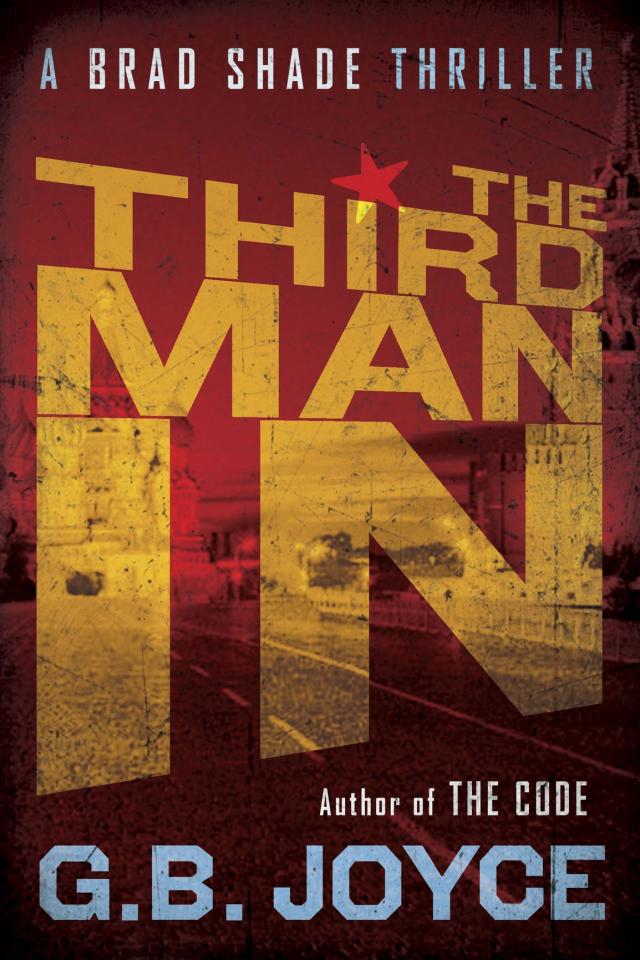
The third man in, p.1
The Third Man In, page 1


ALSO BY G.B. JOYCE
NONFICTION
The Only Ticket off the Island
Taking the Game by Storm
When the Lights Went Out
Future Greats and Heartbreaks
The Ovechkin Project (with Damien Cox)
The Devil and Bobby Hull
Breaking Away (with Patrick O’Sullivan)
FICTION
Every Spring a Parade Down Bay Street
THE BRAD SHADE THRILLERS
The Code
The Black Ace
The Third Man In
G.B. JOYCE
PENGUIN
an imprint of Penguin Canada, a division of Penguin Random House Canada Limited
Canada • USA • UK • Ireland • Australia • New Zealand • India • South Africa • China
First published 2016
Copyright © 2016 by Gare Joyce
All rights reserved. Without limiting the rights under copyright reserved above, no part of this publication may be reproduced, stored in or introduced into a retrieval system, or transmitted in any form or by any means (electronic, mechanical, photocopying, recording or otherwise), without the prior written permission of both the copyright owner and the above publisher of this book.
www.penguinrandomhouse.ca
Publisher’s note: This book is a work of fiction. Names, characters, places and incidents either are the product of the author’s imagination or are used fictitiously, and any resemblance to actual persons living or dead, events, or locales is entirely coincidental.
ebook ISBN 9780735233157
Cover design: Scott Richardson
Cover image: Spaces Images / Getty Images
v4.1
ep
Contents
Cover
Also by G.B. Joyce
Title Page
Copyright
Dedication
Epigraph
Where Are They Now?
Четверг: Thursday
Chapter 1
Chapter 2
Chapter 3
Пятница: Friday
Chapter 1
Chapter 2
Chapter 3
Chapter 4
Chapter 5
Chapter 6
Chapter 7
Chapter 8
Chapter 9
Chapter 10
Chapter 11
Chapter 12
Chapter 13
Chapter 14
Chapter 15
Chapter 16
Chapter 17
Chapter 18
Суббота: Saturday
Chapter 1
Chapter 2
Chapter 3
Chapter 4
Chapter 5
Chapter 6
Chapter 7
Chapter 8
Chapter 9
Chapter 10
Chapter 11
Chapter 12
Chapter 13
Воскресенье: Sunday
Chapter 1
Chapter 2
Chapter 3
Chapter 4
Chapter 5
Chapter 6
Chapter 7
Chapter 8
Chapter 9
Chapter 10
Chapter 11
Chapter 12
Понедельник: Monday
Chapter 1
Chapter 2
Chapter 3
Chapter 4
Chapter 5
Chapter 6
Chapter 7
Chapter 8
Chapter 9
Chapter 10
Chapter 11
Chapter 12
Chapter 13
Chapter 14
Chapter 15
Chapter 16
Chapter 17
Chapter 18
Chapter 19
Chapter 20
Chapter 21
Chapter 22
Chapter 23
Chapter 24
Chapter 25
Вторник: Tuesday
Chapter 1
Chapter 2
Chapter 3
Chapter 4
Жизнь Продолжается: Postscript
Second Act: A Brad Shade Short Story
For Ellen, Laura, and Susan
I saw that I’d get nowhere on the straight path, and that to go crookedly was straighter.
Gogol
Who are these so-called heroes and where do they come from? Are their origins in obscurity or in plain sight?
Dostoyevsky
Where are they now?
VLADIMIR DUBININ
Career numbers: 44 goals and 47 assists in 186 games with Los Angeles, St. Louis, and New Jersey from 1992 to 1997.
A product of Moscow Dynamo, Dubinin first skated into the spotlight when he scored the winning goal in the 1988 Olympic semi-final at age nineteen, the youngest player on the Soviet team. After a second gold medal in ’92, Dubinin signed with Los Angeles but was traded to St. Louis midway through his rookie season. A skilled centre, he was credited for an assist on Bret Dawson’s 500th career goal in January 1995, a goal Dawson later admitted that he never touched on its way past Los Angeles goaltender Chad Hunt. “I just waved at it and threw my stick up in the air,” Dawson said last year. “I was stuck on 499 for three weeks, so I’ll take it.” Dubinin returned to Russia and played for Spartak in the ’95–96 season before signing with New Jersey. Dubinin later played and coached in Switzerland, Germany, and Italy.
Today: Dubinin resides in Moscow with his wife, Olga, a former two-time Olympic medalist as a member of Soviet and Russian volleyball teams. He returned to Russia in 2002 to work in an executive position with Dynamo and coached his former team, winning the Kontinental Hockey League championship in 2005, his last season behind the bench. Since 2006 Dubinin has been the Moscow-based scout with Los Angeles.
Photo: Slava Dubinin with Moscow Spartak in 1996 (Reuters)
THE RECORD / JANUARY 12, 2011
Draft Prospectus
Maxim Dmitrov: One of the five most skilled players in the draft. Leading scorer of the gold-medal-winning Russian team as a seventeen-year-old at the world under-20 tournament. According to a European scout with an Eastern Conference team: “With plus-plus size and plus-plus puck skills and speed, it’s not unreasonable to project him as a potential all-star and franchise player. The question is when you can sign him and get him to your team. His contract situation is unclear. ‘Evolving’ is one way to put it.” The Hockey News prediction: Dmitrov’s signability issues drop him into the 15-to-25 range. New York is a possibility because of management’s record of drafting and signing Russian draftees.
THE HOCKEY NEWS / JUNE 1, 2011
With the fifth-last pick of the draft, No. 226 overall, the team selected left winger Sergei Belov, another Metallurg Magnitogorsk player. Scouting director Brad Shade said Belov hasn’t played for Russian teams in international tournaments and went undrafted in his first year of eligibility. “I saw him in the Russian league when I was out watching Dmitrov,” Shade said. “Really only saw the kid twice. Third game I went to he took a puck off his ankle on his second shift and was helped off the ice. By the seventh round, you’ve pretty well gone through the names on your list. No one felt more strongly about any of the names than I did about Belov, so I pulled rank. Seventh round, you’re buying lottery tickets.”
THE LOS ANGELES TIMES / JUNE 24, 2011
ЧЕТВЕРГ
THURSDAY
1
The only one in Sokolniki Arena who witnessed my kid Sergei drawing his last breath was a cameraman looking through his scratched viewfinder from the far side of the ice. Over the days to come hundreds of thousands would watch footage on YouTube, but Aivazovsky was the only one who saw it all go down in real time.
All eyes in the stands were trained on the home team’s end of the rink. It had been a bad season for Spartak Moscow, winners of only seven of the last nineteen games, and fans’ discontent had reached critical mass with five minutes to go when Metallurg Magnitogorsk had taken a 5–1 lead. Profanities, shoves, and gloves up in opponents’ faces punctuated every stoppage in play, but when Metallurg captain Kalinin slashed Spartak goaltender Vasilyev across the forearm, hostilities on the ice and anger in the seats escalated. The whistling, the white noise of humiliation in Russian rinks, reached 120 decibels. An empty bottle intended for Kalinin bounced off Vasilyev’s neck just below the back of his helmet, and the goalie dropped to the ice as if shot. In other words, just another day at the office.
I’d find out later that Aivazovsky had cut his teeth in television working May Day parades and state funerals in the early ’80s, and he knew his instructions for situations that went sideways like this: cut away. It might make great action on a broadcast anywhere else in the world but the state-run sports network, СПОРТ 1, didn’t want to show the Kontinental Hockey League in an unflattering light and piss off any of the overnight oligarchs who owned KHL franchises. Nothing Happened wasn’t censorship. Nothing Happened had always been and was again the best policy.
Aivazovsky was twenty rows up at centre ice. He had to have been pissed that the network had assigned him a Soviet-era relic of a camera. Other units were working with the new hardware. He swivelled sharply to his right and focused on the generation gap on Metallurg’s bench, framing his shot. At the right, Jiri Suk, age forty, one of the game’s greatest stars a decade before and still the owner of the game’s greatest mullet, though it’s grey-flecked no w. Suk was standing on the ice, leaning against the boards, talking to teammates half his age and smiling. At the left, Maxim Dmitrov, age nineteen, a bona fide prodigy whose name my boss, Hunts, had called at the draft a year ago. Dmitrov was sitting on the bench, washing his face with a hard squirt from the water bottle and looking entirely bored. And between them, also sitting on the pine, Sergei Belov, age twenty, a kid who had been a complete unknown when I called his name in the last round of that same draft. Belov stared ahead blankly, seeming not to notice anything going on around him.
The arena was dimly lit, washing the colour out of the picture. When the next awful two minutes and thirteen seconds were seen on the other side of the world, they were as grainy as surveillance video. Still, the sequence was replayed 124,398 times over the next twenty-four hours, a dozen times by me alone. You could make out Jiri Suk putting his hand on Belov’s shoulder and then calling over the trainer. You could make out Maxim Dmitrov leaning in front of Sergei Belov and looking into his teammate’s unseeing eyes. And you could make out Sergei Belov falling forward, never raising his hands to break his fall. Belov disappeared below the boards. Suk and Dmitrov waved and yelled for help but none came for an anxious interim, twenty-three seconds if YouTube’s count was to be trusted. At that point a trainer finally came into the picture. Like Belov, he disappeared below the boards, Suk and Dmitrov watching him. Suk trembled when he told me about the whole scene later: the trainer looking for Belov’s pulse, finding none, and then pounding on the kid’s chest, hopelessly hammering the Metallurg crest on his sweater.
At that point, Volchkov, the play-by-play man, turned his attention away from the ugly events by the Spartak goal and glanced at his monitor where an even more awful scene was playing out. Volchkov knew the protocol just like Aivazovsky did and he observed a discreet, job-preserving silence. When he realized what viewers were seeing across the country, he opted for understatement. “Есть инцидент,” Volchkov said. Roughly translated: “There has been an incident.”
Aivazovsky’s and Volchkov’s earpieces would have been vibrating with directions from the production truck outside the arena. Aivazovsky pointed his camera at the scoreboard and Volchkov signed off bloodlessly. “Окончательная оценка Москва Спартак один Магнитогорск пять.” That is, “Final score, Moscow Spartak 1, Magnitogorsk 5.”
The sense that something awful and maybe tragic had just happened sobered the lushes and silenced the whistling. Ten thousand eyes took in a scene that didn’t make it to the official broadcast, though a shaky handheld video found its way online. It took seventy nerve-wracking seconds for a Soviet-era stretcher to be rolled across the ice to the bench. The two guys pushing the relic weren’t emergency medical staffers. It turned out that they were janitors at the arena. They dropped Belov down on the gurney like they were offloading a bag of cement. Jiri Suk, his smile replaced by a look of panic, pulled the stretcher across the ice toward the exit. One of the janitors gave tractionless chase at the gurney’s stern while his colleague pressed a cellphone to his ear. I’d find out later that he was trying in vain to get a hold of the ambulance driver who, half in the bag again, had left the arena after the second intermission to beat traffic.
2
I found out that what happened after. What happened once they got the kid on the way to the hospital played out roughly like this:
A network executive was on the phone to the twenty-one-year-old webmaster managing СПОРТ 1’s site and his orders left no room for interpretation: Do not try to edit out the graphic scenes in the last minutes of the broadcast. Just don’t post a video at all. Simple text was fine: the final score and the goal summary. The reporter from the national news service followed suit, filing an account of the game that included the final score, the scorers of the goals, and not a mention of a player taken off the ice on a stretcher. This wasn’t censorship, not self-censorship, not denial, not avoidance. No one needed to strategize or cave in to sensitivity. No one would have been acting sympathetically or even consciously. For anyone in their trade this would have been pure reflex.
Without the streamed video of the game in full, there was no knowing if Aivazovsky got a shot of Vladimir Dubinin earlier in a pan of the crowd during a stoppage in play. My guess is that he would have. Dubinin’s angular, muscular, and conspicuously tanned face would have been easy to pick out. If the camera pulled back slightly, viewers with sharp eyes would have noticed his expensive overcoat, the one with a mink collar, something that he had picked up at a GUM store affiliated with a Parisian couturier, nothing you’d see in the blocks of apartments near the arena. His vanity suited a younger man but he had always confused vanity with pride when he was in front of a mirror. Others around him, the hooligans, wore team sweaters, team colours, and funny hats. They waved banners and banged drums, desperate to be seen and heard. The descendants of the peasants populating the bleakest of Gogol’s novels, they invested the remains of their passions and their financial pittances in Spartak. They might have stood around Dubinin, but Dubinin, silent and still with his hands in his pockets, would have stood out among them, like a noble among serfs, an idea he would have liked. The Spartak fans were looking for one thin victory, a momentary break from a lifetime of small defeats, while Dubinin possessed the easy, comfortable bearing of one who glides from triumph to triumph, seeing the next opportunity before the current ones have run their course.
If Aivazovsky had zoomed in on Vlad Dubinin that night, Volchkov would have identified him by name, a familiar one to hockey fans of a certain vintage. The play-by-play man would have given a quick rundown of Dubinin’s CV for those in their twenties and thirties: his two Olympic gold medals, his years with Soviet national teams and then Russia’s, and his long career with Moscow Dynamo, a captain on the ice for eight years and the team’s general manager for seven more. The broadcaster would have skipped over Dubinin’s brief stint in North America, where I played with him for half a season back when he signed with L.A. after the ’92 Olympics. The play-by-play man would definitely not have mentioned Dubinin’s work as an L.A. scout, one of the dubious staffers I inherited when I took charge of our amateur scouting department two years ago. KHL broadcasters aren’t much for talking about the league on the other continent for fear of legitimizing or glamorizing it.
Aivazovsky and Volchkov would have been more respectful of Dubinin than any of his former teammates in L.A. were back in the day. We wouldn’t have minded his Olympic medals, sure, but we still looked at him as a guy who couldn’t cut it in the only league that really mattered. Funny thing was, other Russians I played with over the years didn’t want anything to do with him either. “Too Russian,” one told me one time, and what that meant I had no idea. Coaches he played for and some guys he played beside might have said that Dubinin had all kinds of talent and they could never understand why he didn’t stick it out playing against the best and making cold, hard American cash. All the rest of us would have said then what we’d say now: why he didn’t doesn’t matter. He didn’t. Period. End of discussion.