

Heart of stone hearts of.., p.1
House of Spells and Secrets, page 1


Also available by Ivy Cassidy (writing as Melissa Bourbon)
The Lola Cruz Mysteries
Fa-La-La-La-Lola
Lola Baby
Drop Dead Lola
What Lola Wants
Bare-Naked Lola
Hasta La Vista, Lola
Living the Vida Lola
The Magical Dressmaking Mysteries
Hem Fatale
Bobbin for Answers
Bodice of Evidence
A Seamless Murder
A Killing Notion
A Custom-Fit Crime
Deadly Patterns
A Fitting End
Pleating for Mercy
The Book Magic Mysteries
Shadows on the Page
The Open Door Bookshop
Long Forgotten Stories
The Bibliomancer’s Daughter
Between the Lines
The Legends Series
The Final Victim
The Final Prey
The Spellbound Series
Storiebook Charm
The Foxy Ladies Mysteries
God Rest Ye Murdered Gentleman
Love, Lies, and Lousy Exes
Writing as Winnie Archer
The Bread Shop Mysteries
Bread Over Troubled Water
A Murder Yule Regret
Death Gone A-Rye
Dough or Die
Flour in the Attic
The Walking Bread
Crust No One
Kneaded to Death
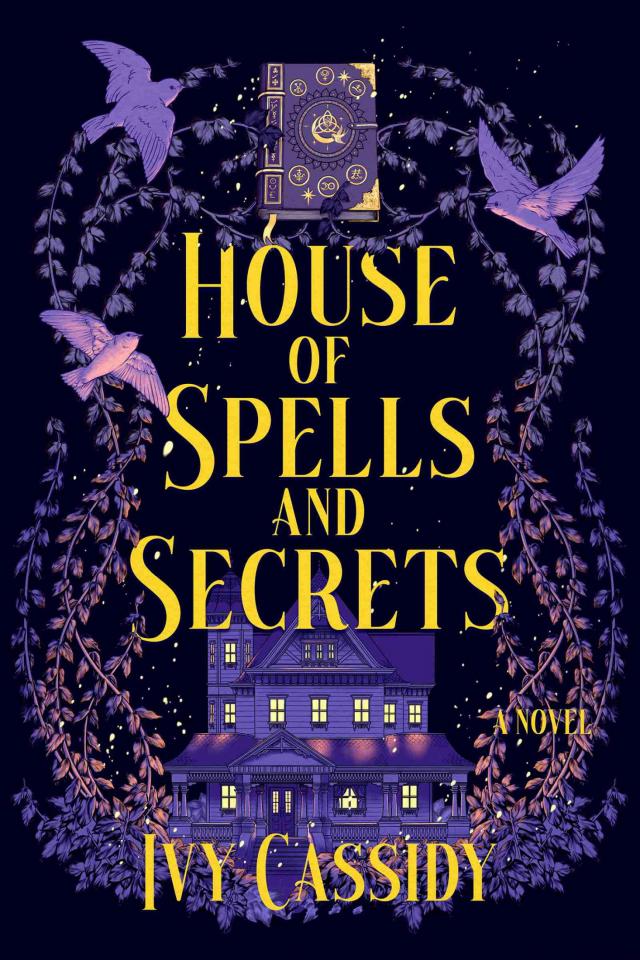
HOUSE OF SPELLS AND SECRETS
A Novel
IVY CASSIDY
For my dad,
who is always in my heart—
and now, forever inked on my arm.
I carry you with me in every word.
And for my mom,
my first and forever best friend.
Your love grounds me, always.
Prologue
Paddy, 1839
The swallows came to roost under the eaves of the house on the Chesapeake Bay the day Paddy Early mortared the last brick and hung the last shingle. They’d followed him all the way from Ireland. Some people thought they were his protectors, but he knew better. They were loyal not to him but to his mother, Biddy. She called herself a Silverborn—one who remembered. One who heard memories.
She was bewitched, and he’d betrayed her.
The swallows were going to be the bane of his new existence in America. He was three thousand miles from his home, but he knew that no matter how far he traveled, he would never escape his mother or her magic. He stared up at the house he’d built with its steep A-line roof. Stared at the mud nests the birds had already built, at the bird with the red feathers, and for a moment, he was transported back to the three-room cottage in Feakle, County Clare. The swallows’ nests there were identical. They conjured up the memory of the last time he’d seen his mother. Biddy had watched him as he’d walked down the lane.
“You can never escape who you are, Paddy, and you can’t escape me,” she said. “The magic, it will always find you.”
She’d spoken calmly, as if she’d expected his disloyalty. He’d shifted the parcel tucked under his arm, the object wrapped in one of her quilts. The quilt had been given to her in trade for some healing ointment or cure. That’s how things worked in Biddy’s life. It was how the goats and pigs came to graze in her yard, how the stack of knitted blankets in the bedrooms grew, and why the cupboards overflowed with whiskey. Their house had become a social hall where townsfolk came to drink and play cards. It had also been a target for the tenant landlords and Catholic priests who thought Biddy was a heretic.
Who thought he was one too. Guilt by association.
The bundle he held pulsed with energy. He thought it would fade the farther away he got from Biddy, but the opposite happened. It grew stronger until his arms quivered.
He ignored it as best he could because leaving Ireland meant an end to his suffering. No more taunting about Biddy being a changeling or about her talking to the fairies.
No more accusations of witchcraft.
No more because he had left, and he had taken the thing that was her lifeblood. During the entire crossing from Belfast to Baltimore, the wrapped parcel had felt heavy, like an anchor that would take him to the bottom of the sea if he let it. Onboard the Glenmore, he’d heard his mother’s voice calling to him from the sky, through the clouds and the billowing sails. His first thought was that she had transformed herself into a swallow and was following the ship. Over and over, his gaze shot upward, and over and over, he spotted Biddy’s swallows. He heard her say his name. He heard Siobhan ó Dálaigh too. And he saw one swallow turn and glide away from the ship, back the way it had come. Reporting to Biddy, no doubt. He closed his eyes against their warnings, telling him he shouldn’t leave. He ignored the omen that he would pay for his betrayal.
Oh, but he held no loyalty to Biddy, and he certainly held none to Siobhan. He had loved her as much as a twenty-year-old man can love. But he loved the idea of freedom more. Siobhan had run after him, begging him to stay, the dust of the road swirling around her feet. He’d stopped once. Turned to look at her. But it was Biddy, standing still as a stone on the road behind Siobhan, who drew his attention. She didn’t look angry or hurt at his thievery. He’d faltered for a moment when she’d shaken her head. Even from where he’d stood, he could see the expression on her face. Disappointment, plain and simple.
Biddy had ruined his life with her potions and spells, curses and cures. He’d thought taking the one thing she cared about most would be the end of her, but he still felt her presence like an aura, always pressing down on him.
Now he stood on the threshold of the house he’d built on the little island in the Chesapeake Bay, the Flemish bond making the brick structure sturdy and immovable. He raked his fingers through his hair, yanking loose the knots, strands of auburn coming free in his hand. Overnight, a vine he had not planted had grown alongside the house. A winter creeper. He’d have to keep an eye on it, cut it back or it would take over.
Overhead, the swallows warbled and chirped, but he ignored them. He was done with Biddy. She was an ocean away. Here in America, he would take his mother’s magic and make it his own.
He lifted his arm and waved them away. “Go ’ome,” he hollered. Without warning, his mind hurtled back to that last moment with Biddy when he’d turned his back on her. Her voice had come after him, spiraling from her mouth straight into his ear. He still wasn’t sure if she’d actually spoken or if he’d only heard the words in his head. “De swallows, dey are de keepers now.”
Chapter One
Rowan, 1971
The Connors girls had always been called witches.
Not the cauldron-stirring kind, but the kind people whispered about. The kind who made the air shift when they entered a room. Who left something behind after they’d gone.
“You have a gift,” their mother used to say, tucking Rowan’s hair behind her ear like it was a blessing. “A charm. Something older than you can imagine.”
People called it intuition. A knowing. But Rowan had always known better. There was magic in their blood. In all of them.
She’d seen it clearly in her sisters.
They were triplets, born within nine minutes of each other. Caraline was the oldest, born on the thirty-first of December in the waning minutes of 1950. Saoirse had come on the cusp of midnight, and Rowan had been delivered mere minutes later.
True to being the firstborn, Caraline’s magic was louder and warmer. It thrived in her cooking, when she folded it into dough and steeped it in broth. Rowan didn’t know how hibiscus rolls could soften an argument, or why rosemary bread helped someone remember things that had long ago started to fade, but somehow they did. Caraline called it comfort, but Rowan knew it was enchantment.
Saoirse could coax flowers to bloom out of season and lure herbs to grow even in the heaviest clay soil. Her teas did more than soothe. Rowan had seen them ease fevers, quiet grief, and silence nightmares. Saoirse didn’t call it magic, but Rowan had always felt it in the way a room calmed when she entered. She carried stillness like a cloak.
And then there was Rowan. She didn’t brew curative tinctures or bake healing breads. Her magic, such as it was, served no purpose. It didn’t look like theirs.
In fact, it didn’t look like anything.
Her eyes, green like clover and threaded with gold, drew stares she couldn’t explain. And her hair, with a single streak of impossible red, practically glowed in the moonlight. She tried to hide it, oh, how she tried. She used bleach to turn it Marilyn Monroe blonde, but it didn’t work. She dyed it every shade of brown, then black, thinking she could bury the flame. But it never lasted. The ruby streak always returned, a mark she couldn’t shake.
People always looked at her a second too long, as if they could sense something inexplicable about her. Sometimes she even felt it too. But most of the time she felt like the odd one out with her sisters.
Saoirse had a head of red hair and her eyes were dark like pine needles. Unlike Rowan, she didn’t long for friends. All she needed were her plants, herbs, and whatever flower she held at any given moment, plus the apothecary she always created wherever they lived. And, of course, the swallows, which she could make behave.
Caraline’s hair was the color of midnight, which set off the flecks of amber in her eyes. She was the opposite of both Rowan and Saoirse. Friendships with women she could do without, but the attention she got from men? That practically fed her soul. At every new place they went, Caraline had herself a new beau within days.
And Rowan had her red streak.
But it wasn’t just her hair. It wasn’t just her eyes. Worse were the unexpected tastes that bloomed on her tongue whenever she was around people. Her magic stirred, and it was as if she could taste their emotions and who they were, deep down inside. Bridget called it “clear tasting.” Bridget, not Mom, because she’d always insisted. “I’m too young to be called Mom.” She’d say it with a wink, like it was a joke they were all in on.
Rowan’s first taste came when she was six. Molly Jameson had swiped a brownie from Rowan’s lunchbox—one of Bridget’s best, rich with dark chocolate and a pinch of sea salt. She shoved it into her mouth with a smug, greedy grin.
That’s when Rowan’s magic flared. Hot, musty bitterness spread across her tongue, sour and sharp, like spoiled milk and old pennies. It wasn’t the brownie at all. She understood that the tastes she experienced were an expression of who Molly was inside: Mean. Petty. Rotten at the edges.
And that’s when Rowan knew that people might lie, but her magic never would.
Clear tasting didn’t have anything to do with food. It was tasting people. Their hidden selves. The truths they carried but never spoke aloud. Most of the time, it was like standing in a candy shop surrounded by sweetness, only to bite down and find something spoiled and rancid beneath the sugar.
Happy people tasted like bright citrus or warm honey. Angry people left a bitter film, like burnt coffee. But the worst were the cruel ones. While they wore smiles, their hearts were dark and they tasted of decay and ash.
There was no comfort in a gift like that. No peace. Only the constant hum of other people’s emotions, sour and sweet, sharp and searing, pressing against her senses until she couldn’t breathe.
Her only reprieve was with her family. With her sisters the onslaught of tastes didn’t come, and with Bridget it was always subtle.
Rowan learned to avoid crowded rooms, to steer clear of groups of people, especially those who were sick, and to keep her eyes on the ground. Her sisters wove their gifts into kindness, healing, and warmth. But Rowan’s magic was hard to deal with. It was relentless and impossible to escape.
Not even Bridget understood. She only whispered, “Keep your gifts contained.” But how did you contain something that lived in your blood, in your senses, in the fire-colored streak of hair that refused to disappear?
They made a covenant with Bridget to keep their magic a secret between them, renewing the pact every year on December thirty-first at midnight, the moment that straddled Caraline’s and Saoirse’s birthday and Rowan’s on January first. Their magic belonged only to them. Thank God she had her sisters. She didn’t think she’d survive without them.
But the truth was, her sisters had gifts that mattered, and Rowan had a burden. “It’s a curse,” she complained to her mother when she was young. “I hate it!”
“That’s the thing about magic,” her mother said. “It doesn’t always show itself when you want it to. Sometimes, it waits for the right moment. Someday you will understand it. You’ll learn what it means and how to use it.”
“I doubt it,” Rowan had muttered under her breath.
“Do you know what our greatest gifts are?” Bridget asked her after a particularly bad day when Rowan was thirteen years old. She had spent the day hiding from the kids who made fun of the crimson streak in her hair, trying to swallow the horrid tastes that assaulted her tastebuds.
She felt herself deflate at her mother’s question. “There’s another one?”
They’d sat side by side on the steps of the front porch. Bridget bumped her arm against Rowan’s, smiling at her. “There is. And we all carry them with us. It’s our names. I named you after my favorite tree. The rowan tree. It has white flowers in the spring, red berries in the fall, and the leaves turn yellow in autumn. It’s so delicate looking, but really it’s hardy and strong.” She smiled, bumping Rowan again. “It’s a tree of power, where magic will flower. That’s you.”
After her mother told her about the tree, Rowan liked her name a little bit more. Still, she envied Caraline with her normal name—despite the Irish spelling. “I knew the moment I laid eyes on her that your sister would be a free spirit, like me. Difficult to tie down. That’s what Caraline means, and it fits her.”
That was true. Caraline ran around barefoot in fields of flowers and snuck through windows into the deep of night. Even as a preteen, she had this haunting look about her, like a brooding princess who refused to be trapped in a tower.
“And Saoirse?” Rowan had asked. No one knew how to pronounce it, but her sister didn’t mind. She just said, “Seer-sha” to people who struggled to make the sounds work and carried on with whatever she’d been doing.
“Ah, Saoirse. Her name means liberty. That girl is, and always will be, true to herself. She sees the world differently. She has the freedom inside her to always be herself—nothing more, nothing less. She’s going to be powerful one day once she learns how to lean into it.”
Powerful? Saoirse? Rowan was skeptical about that. Saoirse only liked plants. She could grow anything she wanted. All she had to do was think about it, touch the soil, and a seed sprouted then and there. “What, like Jack and the Beanstalk? I want to climb to the clouds!”
Bridget laughed, but Rowan detected a hint of melancholy which Bridget always seemed to carry with her. “We can’t always go where we want to,” she said cryptically.
Rowan moved on, picking at a jagged cuticle. “What they do is cool. My magic is just …” She wanted to say it was lame. A burden. And it had no purpose.
“I feel it in you, a leanbh,” she said, calling Rowan by her favorite Irish endearment. “Your magic is stronger than either of your sisters.”
“No, it’s not! All I have is this—” she tugged at her red streak. “And the terrible tastes.” Rowan felt tears prick her eyelids “How is any of that stronger than healing people, even Caraline who doesn’t hardly try?”
“You have to trust me,” Bridget said. “You will grow into your gifts and your name. You, Rowan, are important. You will always protect them because it’s who you are.”
Rowan had eyed her mother. “Protect them from what?” she’d asked, but Bridget just looked past her as if she were lost in a memory, and Rowan let it go.
The sisters knew they were three parts of a whole. They had an immutable bond—because of their magic or because they were triplets, Rowan didn’t know. They were her lifeblood. An invisible thread wove them together, body and soul. She could feel Saoirse’s vexation when a potion fizzled out. She felt the heat of the stove’s flame against her own skin as Caraline leaned over a boiling pot. And her sisters suffered right alongside Rowan when her frustration bubbled over and the air around her turned stifling. When something was off with one, they all felt it.
And Bridget had been right. As they’d grown older, Rowan slipped into the role of protector and leader. Saoirse was always too distracted with her flowers and potions to be in charge of anything, and Caraline was always flitting off doing who knows what.
As adults, they had their own dreams, but they were still interconnected. Caraline wanted to run a café with a bake shop. Saoirse wanted to make lotions and curatives and put them for sale in a corner of Caraline’s shop, and Rowan would be the one behind the scenes, doing everything else. As long as she wasn’t around people, she’d be just fine. Which was work because her magic wasn’t centered on anything specific like her sisters’ was.
But they had to settle down somewhere first, and even now, at twenty-seven, their mother had been adamant that it wasn’t the right time or place. “We’ll know when it’s right,” she told them. “Be patient.”
But now their mother was gone. Bridget Connors had died, and everything felt wrong. She had been the sun to their orbiting planets, and now the sisters were adrift, spinning away with nothing to ground them. Saoirse’s way of dealing with the sudden separation was to grow a plant that bloomed with creamy white flowers, had stems like bamboo, and whose leaves looked like the head of a pointy-ended shovel. She used it to brew a special tea and made them sit together in the little house they shared in Arkansas, sipping it.
Twice Caraline got up to leave, and twice Rowan convinced her to stay.


