

Outlaw vengeance, p.1
Outlaw Vengeance, page 1


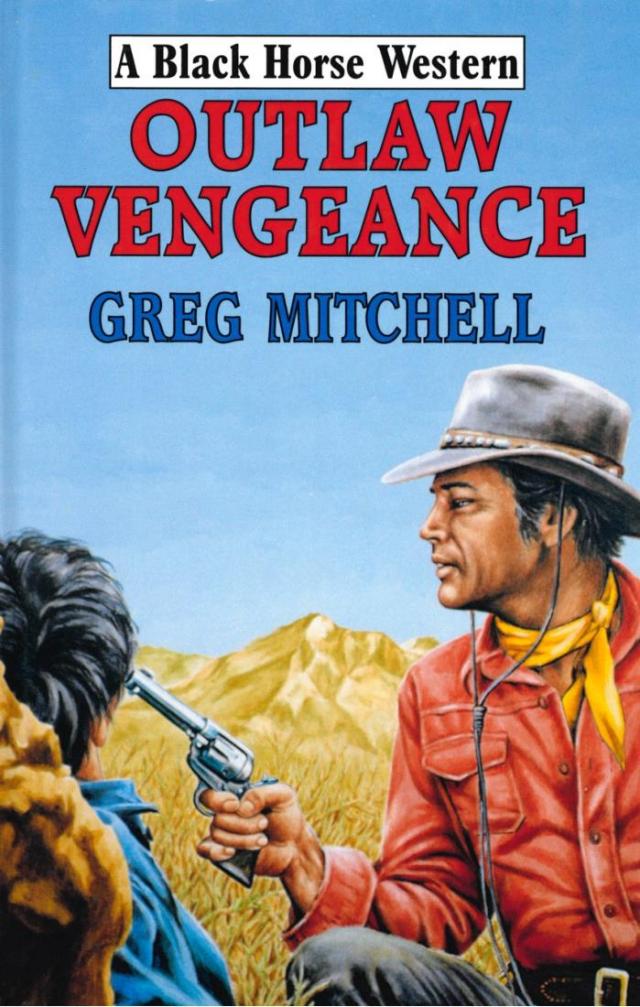
Outlaw Vengeance
Jeff Malone had no interest in the outlaw Jonas Grigg until their paths accidentally crossed. Then, partly out of self-preservation and partly because of an atrocity performed by the outlaws, he led an army patrol against them. The gang is smashed but Grigg narrowly escapes and those who antagonized him are marked for death.
Tracing Malone to Rocky Creek, Grigg gathers a new gang with the dual purpose of killing his old enemy and robbing the town bank. When an acquaintance of Malone is murdered and mysterious gunmen appear the outlook seems ominous indeed.
Malone must find Grigg’s hideout and destroy him if he’s to ever remove the threat of the outlaw and his vengeance.
Outlaw Vengeance
Greg Mitchell
ROBERT HALE
© Greg Mitchell 2006
First published in Great Britain 2006
ISBN: 978-0-7198-2372-5
The Crowood Press
The Stable Block
Crowood Lane
Ramsbury
Marlborough
Wiltshire SN8 2HR
www.bhwesterns.com
This e-book first published in 2017
Robert Hale is an imprint of The Crowood Press
The right of Greg Mitchell to be identified as author of this work has been asserted by him
in accordance with the Copyright, Designs and Patents Act 1988.
Contents
Chapter 1
Chapter 2
Chapter 3
Chapter 4
Chapter 5
Chapter 6
Chapter 7
Chapter 8
Chapter 9
Chapter 10
Chapter 11
Chapter 12
Chapter 13
Chapter 14
Chapter 15
Chapter 16
Chapter 17
Chapter 18
Chapter 19
Chapter 20
CHAPTER ONE
Joe Maxwell squinted down the twin barrels of his shotgun and centred the bead foresight squarely on the chest of the rider who had halted the coach. Though dust from the sudden stop still swirled around, he could see at a glance that this man was no ordinary cowhand.
The rider was young, tall but slightly built. His crumpled grey hat was pulled low over his eyes to shade against the low afternoon sun and the face between hat and red bandanna had been clean-shaven but now sported a week’s dark stubble. His clothes were those of a frontiersman, a faded blue shirt and dusty light-brown trousers tucked into long boots, but the stranger had a dangerous look about him. Maxwell could see an ivory-handled revolver on the rider’s right hip and its holster hung from a belt filled with cartridges. The brass receiver of his Winchester carbine caught the lowering sun’s rays as it swayed in the leather loop attached to the saddle horn. The saddle was not the usual westerner’s type. It was a lighter Hope saddle as favoured by some military officers. The man’s mount was a fine bay gelding with a white blaze and was guaranteed to attract the attention of any admirer of good horseflesh. Usually only lawmen and military officers who could afford them, or outlaws who could steal them, rode such animals.
Maxwell was overly cautious at the best of times and under these circumstances was in no mood to take chances. The outlaw, Jonas Grigg, was rumoured to be in that part of the country. Beside him, he saw the driver, Bert Olsen transfer his reins to his left hand and move his right hand to his gun butt. He was wary of the strange rider, too.
‘Be careful with that cannon,’ the rider warned.
‘I’ll decide how careful I’ll be. Who are you? Why have you stopped us?’ Maxwell demanded suspiciously.
‘I’m Jeff Malone, scouting for the Fifth Cavalry. Major Carter sent me to stop you. A big party of Cheyenne have jumped the reservation. It’s not safe to go on.’
‘We didn’t hear nothin’ about that when we left Pronghorn Flats last night,’ Olsen said, ‘and nobody at the last change station knew about it. We ain’t seen the cavalry in these parts either. Last we heard, the Cheyenne were all livin’ peaceful on the reservation.’
‘You heard wrong,’ Malone said bluntly. ‘Some of them never went on to the reservation and a lot come and go as they please. I’ve been up there with the army trying to corral them. This is the biggest breakout yet.’
‘How do I know you ain’t a road agent? You could be Jonas Grigg for all I know.’ The guard was not convinced and had not lowered his shotgun.
‘You ain’t wearin’ buckskins. I figured that all Indian scouts wore buckskins.’ The driver also sounded doubtful.
‘They only do that in dime novels. Buckskins get too hot.’
‘He don’t look old enough to be Grigg,’ Olsen whispered.
‘He could still be one of his gang,’ Maxwell said stubbornly.
Malone was tired from hard riding and was growing impatient. He had seen unshod pony tracks earlier in the day and half suspected that a war party could be in the vicinity. A coach in such an area was a tempting target to scalp hunters.
‘I don’t have all day. You are risking your lives and the lives of your passengers every second you argue. If you have a lick of sense you’ll turn this coach around and head back to the last change station. Get yourself killed if you like, but your passengers should have some choice.’
‘Passengers don’t make company rules,’ Olsen announced. ‘As driver, I’m in charge here.’
‘Not any more,’ said a cold voice behind him.
The driver looked down to see one of his passengers, a gambler, who called himself Mark Wilson, leaning out the coach window and holding a small revolver pointed straight at him.
Wilson normally took a casual approach to life, but the driver’s arguments in the face of obvious danger had angered him. He decided to settle the issue by direct action.
Olsen sat stunned. He had not expected trouble from someone who appeared as easy-going as Wilson. The big, gruff rancher, McDonald, seemed more likely to dissent, or even the two female members of the three Cranes. Women could be difficult passengers at times, but gamblers were used to taking the rough with the smooth.
Wilson did not waste words. ‘There are five passengers here. We’ve heard what the scout said and we all agree that we should turn back. I’m quite prepared to blow you off that box if you don’t turn this coach around.’
‘I’ll do it, but you’re in trouble. The company’s gonna hear of this.’
The gambler gave a grim smile, his eyes cold above the gun’s sights. ‘If you don’t turn this coach around, they sure as hell won’t hear it from you.’
Another passenger, the male member of the Crane party called, ‘We should turn back, driver. You can’t take the risk of going on.’
‘Looks like you’re overruled, driver,’ Malone said. ‘I’ll ride ahead so you can watch me, if you’re that dang suspicious, but your time will be better spent watching for trouble.’
Mumbling under his breath at the lack of respect for his position, but secretly relieved that a difficult decision had been taken out of his hands, Olsen released the brake, shook the reins and swung his team about. If they were robbed or delayed unnecessarily he could always claim that he had been forced at gunpoint to divert the coach.
As Malone cantered his horse around the turning coach, he saw two pretty female faces, one framed by dark hair and the other with fair hair looking anxiously from the coach window. They were a welcome sight after the weatherbeaten cavalrymen who had been his constant companions for the past three weeks. Keep your mind on your work, he told himself.
Inside the coach, Nancy Crane brushed her fair curls away from her face and laughingly told her sister-in-law, ‘There’s a husband for you, Julie.’ Nancy was recently married to Tom and thought that Julie had been single too long.
‘I suppose I could do worse,’ the dark-haired girl said, as though she was really considering the prospect. She knew the reaction she would get from her extremely protective brother.
Tom Crane did not see the joke. As a railroad surveyor he had seen a few government scouts on the frontier and had seen none that he considered worthy of his younger sister. ‘I think you can forget that one, Julie. Some of those scouts are wild men, drunks and gunfighters and only half-civilized. I would not let you marry a man like that.’
Wilson, the gambler, imagined that he had a way with the ladies and joined in the teasing. ‘What about me?’
‘Certainly not you, Mr Wilson,’ Julie laughed. ‘I just saw you stick up a coach.’
‘I guess that only leaves me,’ the other male passenger chuckled. Jason McDonald was a powerfully built, middle-aged man with a neatly trimmed beard and the clothes of an affluent rancher. He had a big Smith & Wesson .44, butt-forward on his left hip and looked as though he knew how to use it. Beneath the affable manner however, McDonald was seething. He had not wanted to turn back and Wilson’s action had surprised him as much as it had surprised the coach driver. Still, he would make the best of a bad situation. There was no point in getting scalped. He joked with his fellow passengers and pretended to be hurt when Julie laughingly turned down his proposal.
Tom Crane was a worried man. His brown eyebrows nearly met as he wrinkled his brow in a frown. Until Malone’s arrival he had been enjoying the trip but now he was really worried. During his work on the Union Pacific railroad he had seen the results of Cheyenne raids. He found himself suddenly wanting his Remington hunting rifle that was with the baggage in the boot. The thought of his wife and sister falling into Cheyenne hands completely eclipsed his concerns about his own fate.
Faced with a longer stage and with his team already tired, Olsen held the six horses to a steady trot. Malone, riding about fifty yards ahead, kept the bay horse to the same pace. It was not a relaxing ride for anyone. The coach road ran through a landscape of rolling, sage-covered hills with occasional thickets of scrub oak and cedar. Here and there rocky outcrops projected from the red soil adding to the number of places where ambushers could lurk.The plume of dust thrown up by the horses and coach wheels would attract the attention of observers miles away and those in the right places could easily set a trap for the travellers.
The sun was sinking, throwing long shadows across the ground when Malone glanced to his left and saw a glint of metal on a distant hill. He watched but the reflection did not come again. Whatever had caught the sun’s rays had moved.
He checked his horse and pulled off the road till the coach came abreast. He pointed to the hill.
‘There’s someone up there. I just saw the sun glinting on metal. It could be some stray Cheyenne. How far are we from the change station?’
‘About two miles,’ Maxwell shouted back.
‘That hill’s about a mile away so we have a bit of a start. It might be an idea if we pick up the pace a bit. The sooner we get a few walls around us, the safer I’ll feel,’ Malone called.
‘I’m the driver here,’ Olsen growled. ‘I say what the pace is to be.’ He held the team to the same pace until he felt that he had made his point and then urged them to greater speed.
The scout was worried. The light was failing quickly and soon it would be too dark to see any pursuers or warriors lurking ahead of them in ambush. While Indians did not like fighting in the dark, he knew that they would risk it if the chances of being killed were minimal. The prospect of scalps and loot often outweighed the fear of being killed at night and wandering forever in darkness.
The team was tiring visibly when the coach topped the hill from which the Two Wells station could be seen. The buildings and corrals showed as an indistinct blur half a mile away in the gloom.
‘Somethin’s wrong,’ Olsen told Maxwell. ‘No lights are showin’.’
The guard called to Malone, ‘Hold up a bit. Might be trouble ahead.’
When the scout rode over to the coach, Olsen leaned down and told him, ‘The change station is only about half a mile ahead. They should have the lamps lit by now. Somethin’s wrong.’
Malone spoke softly, ‘Wait here. I’ll have a look around. Keep as quiet as possible. Sound carries a long way out here. If you hear shooting turn around and try to find a place to fort up. If all is right, I’ll strike a match or show a light of some kind. Be a bit patient because I’ll be creeping in there and it could take me a while.’
‘What if they get you before you can shoot?’ the driver asked.
‘I’ll have a cocked gun in my hand and the odds are against them getting me so quick and quiet that I can’t pull a trigger. But if they do, you’ll need to figure out something else.’
Tom Crane looked out of the coach window. ‘It seems to me that you are taking on a very dangerous job here, Mr Malone. Is there any way round this situation?’
‘Not really,’ the scout replied. ‘A coach and six horses are hard to hide but easy to stop, one leader down and the whole shebang crashes. It’s best if you keep out of danger until we know the lie of the land.’
‘But it’s not fair that one person should take all the risks,’ Crane argued. ‘What if I go with you?’
‘Thanks for the offer but if things go wrong at the station, every man will be needed here. The army pays me two dollars a day for doing this sort of thing and I’ve had a bit of practice at it.’
Quietly the scout moved his mount off the trail and walked it through the brush where there was less chance of being seen. He rode watchfully with a drawn six-shooter in his hand, his eyes swivelling from one pool of shadow to another. Periodically he would pause and listen, his senses straining to detect the first sign of danger.
After ten nervous minutes he was at the edge of the brush so he dismounted and hitched his horse behind a couple of low trees. He could see a barn nearby, its side windows two squares of blackness. If anyone was in the building, he would have little chance of seeing them. He could only hope that he had not been observed. Moving silently, using the shelter of scattered, low bushes, Malone crept to where he could see that the building’s double doors were gaping open.
A large horse corral was between the barn and the adobe-walled station building. The corral was empty and, as he moved into the shadow of the barn wall, the scout could see that its gate was wide open. Taking a chance he slipped through the barn door. To his intense relief, he found himself alone. From a window he studied the station building. It was dark and silent and the front door was closed. If anyone was watching from inside, they would have an easy shot at him as he left the barn and ran swiftly to the station door. Half expecting a shot in his direction, he sprinted for the building. Pressed against a side wall, he listened but heard no sound from inside. The latch string on the door was out so he cocked his gun and with his left hand lifted the latch and threw open the door.
Relief flooded through him as no gun blazed and no war cry broke the silence. Moving more confidently, Malone checked the few rooms in the building and when he was sure that he was alone, he struck a match and lit the lamp beside the station door. Then he went to retrieve his horse. He had unsaddled the animal and was feeding it some stage company oats when the coach rumbled up to the corral.
‘Where’s Somers an’ the other two?’ Olsen demanded, as he halted his team. He glared pointedly at the bay horse eating company fodder.
‘I don’t know. The place seems deserted,’ Malone replied. He ignored the driver’s disapproval. The horse had earned the feed it was eating and while he was on army business he was allowed to commandeer fodder for his mount.
‘Do you reckon it could be Indians?’ Maxwell asked. He still held the scattergun ready for trouble. Change stations were usually places of frantic activity and it worried him to see it so silent.
Malone shook his head. ‘The place doesn’t look wrecked. I think something scared them and they took off.’
CHAPTER TWO
‘Step down, folks,’ Olsen called. ‘Go inside and make yourselves at home. If that no-good Somers left any grub we might be able to get ourselves a meal.’
Talking among themselves, the passengers alighted, stretched to get the stiffness from their limbs and made their way uncertainly to the gloomy, low-roofed building.
While the passengers went inside the stage station, Malone helped Olsen with the horses.
‘Somers’s buckboard is gone,’ the driver told him, as they unharnessed the team. ‘Looks like all three of ’em took off on it. Why do you reckon they did that?’
Malone led a coach horse to the water trough and watched it start drinking before replying. ‘I’m guessing that a Cheyenne war party must have run off the spare horses in the corral and your people decided to get while the going was good. Probably reckoned their chances were better if they joined forces with the men at the next station. Let’s hope the Cheyenne didn’t catch them on the trail somewhere.’
It took a while to unharness the team, hang the harness where it would not become tangled and water the horses. After that they placed each one in a stall with a manger of feed.
Maxwell joined them just as they were about to close the barn doors. He had come to collect the strong box from the coach. ‘There’s a lot of money in this. Can’t afford to leave it lyin’ about.’ He grunted a little as he lifted the small but heavy box and added, ‘Them Crane gals are fixing us a meal from the supplies that Somers left. They said to come for a feed as soon as you are finished here.’
It was then that Malone remembered that he had not eaten since early morning and breakfasts in cavalry camps were hardly lavish. He was ravenous by the time the last horses had been fed and stabled. His mind was still on food as he walked with the driver and guard from the barn.


