

Range rustlers, p.2
Range Rustlers, page 2
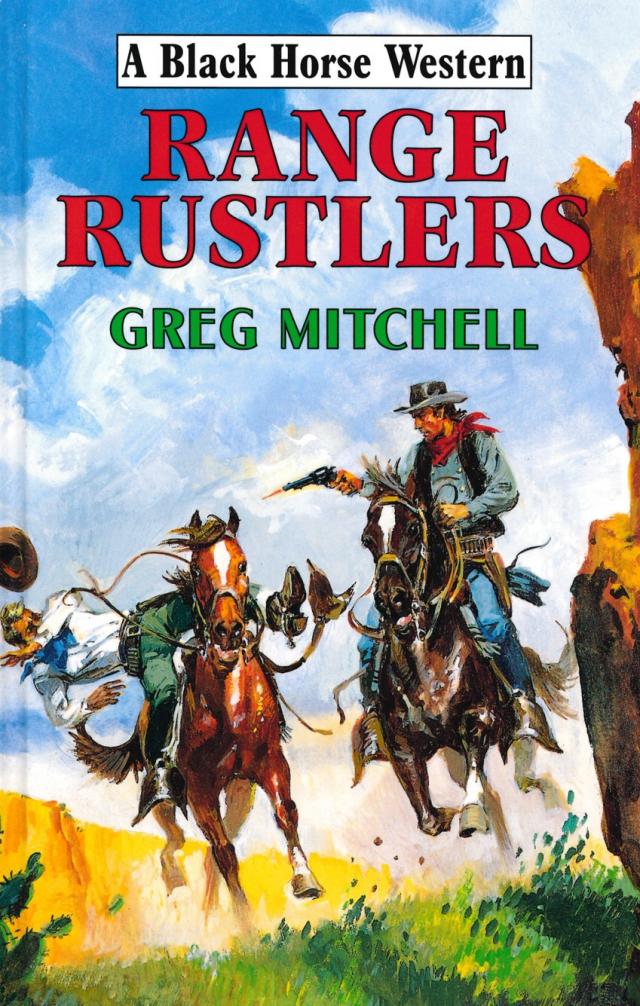


‘Then why are you skulking around here?’ she demanded suspiciously.
With difficulty Connell kept his anger in check. ‘I’m not skulking anywhere. I could make my base at one of the ranches, but then my impartiality would be questioned by one side or the other. I’m not taking sides in any disputes over grass. I am here to investigate claims of rustling and to stop any further killing if I can. Over the next few days I’ll be calling at most of the ranches and I’ll be out on the open range too. You can tell your friends that I’ll be around.’
‘I intend to,’ the girl snapped. Then she wheeled her pony about and cantered back the way she had come.
An hour later Connell was guiding his chestnut horse around a cow track on a steep hill. His bay pack horse followed obediently without needing to be led. Down the slope from the track he saw a weathered carcass on a section of flat ground beside a small creek. Here’s as good a place as any to start, he told himself, and turned the chestnut down the slope.
The dead steer looked strangely shrunken and obviously had been lying there for some weeks, but Connell had seen such sights before. The skin had partially collapsed and he knew why: there was no carcass underneath. Someone had killed the steer, butchered it on the hide but left the head and lower legs attached to the skin. A few strategically placed sticks under the hide held it up enough to give the appearance of a body underneath, as though the animal had died of natural causes and rotted away. The ruse might have worked if scavenging animals had not knocked away some of the props leaving the supposed carcass looking strangely flat. The hide was half rotted, but the deputy could discern that it bore the Double T brand. A bullet hole in the skull showed where the animal had been shot. He had seen such work before. These slaughterings were never part of large-scale rustling operations and could be either the work of small settlers down on their luck, or big ranchers too mean to kill their own stock for beef. Even people from towns had been known to come out, slaughter a steer and carry the meat away in a wagon. Although in this case a wagon could not have negotiated the rough country. The meat would have been packed out.
Some small-scale rustling was inevitable but, to Connell’s mind, the days of large numbers of stock being run off were over. Branded cattle were hard to sell illegally and altering brands involved holding large numbers of stock in areas where they might be discovered. With a walking speed of about two miles per hour, it would take a long time to shift stolen stock out of a particular area. Though brands could be changed, ranch cattle were also ear-marked and altering these marks was difficult.
The deputy remounted his horse and continued his patrol. If rustling was occurring on a large-scale, he was sure that he would find signs.
He knew that the large ranchers never had an exact count of their stock and simply multiplied their annual brandings by three. If the calf crop was noticeably down they might suspect a rustling problem, but it was difficult to be sure. Connell knew that he had many more enquiries to make before he would have the full picture.
CHAPTER THREE
Crossley-Hunt had seen variations of the same situation many times before. The cowhands were trying him out. He had acquired a wide-brimmed hat and replaced his tie with a bandanna but his eastern riding breeches and long shiny boots still marked him as a dude.
Ed Adams had first arrived with a sleepy, fat pinto horse whose scarred knees showed that he was not very good on his legs. It also demonstrated the foreman’s contempt for the visitor’s riding ability. The company man was singularly unimpressed and promptly told him to select something better and, if he could not, he was to surrender his own mount. After all, the company owned it. A short while later the foreman reappeared with a smart-looking bay gelding and a few grinning cowhands riding behind.
Crossley-Hunt knew that Adams would not risk being fired by giving him an unrideable horse but he was sure that the animal they brought him would test out his ability. It would be the sort of horse that a competent cowhand was expected to ride. As though unsuspecting, he checked the length of his stirrups, the tightness of the cinch, and casually stepped aboard. The bay walked a couple of paces, then with no warning, dropped its head and launched itself skywards. It hit the ground and came back under him, a hard buck to ride at any time, but the Englishman was still in the saddle. The animal only knew one trick and, when its best effort failed, it gave a couple more crow hops before lifting its head and walking off.
‘If you fellows think this horse could buck,’ he told the obviously disappointed spectators, ‘you should try riding some of the Australian Waler remounts we had in India, and we had only Nolan military saddles. Game time is over now but there is one more thing: my name is Crossley-Hunt and anyone who calls me Crossways or Crosscut or some other variation will soon be looking for another job when he picks himself out of the dirt.’ He could see that the message was not lost on Adams and continued, ‘Now I want to have a look around the range. I only need Mr Adams and possibly one other man, so the rest of you might as well go back to what you are supposed to be doing.’
They rode for a couple of hours, first around the ranch where a few stud animals and horses were kept. Adams volunteered no information and replied only when questioned directly. The company man noted that fences, corrals and sheds were in good order and that the animals were in good condition. Finally the trio rode out on the open range where most of their stock lived between roundups and sales.
Stock of many different breeds and brands grazed together but Crossley-Hunt could not help noticing that a large number wore the Double T on the left hip and had a T-shaped piece clipped from the right ear. He remarked to Adams,’ The Double T seems to be running a considerable number of stock. How would they know that they are losing cattle to rustlers?’
‘They know – we all know,’ the foreman replied vaguely. ‘Rustling is one hell of a problem.’
It was the cowhand riding with them who first drew attention to the fresh horse tracks. ‘Someone’s around,’ he said quietly. ‘Maybe he’s up to no good.’
‘He could also be someone checking on stock, the same as we are,’ Crossley-Hunt suggested. ‘Let’s not jump to conclusions.’
Adams reined in his horse and pointed. The rider in the distance might not have been noticed against the dark green pines if it had not been for the grey horse. ‘Someone over there,’ the foreman said. ‘Do we go after him? He has a long start on us.’
Crossley-Hunt looked in a slightly different direction and saw two saddled horses at a low point on the valley floor. ‘Let’s see what’s happening with those horses first.’
Connell watched the riders approach. Two were obviously cattlemen, but the leading rider looked different. His gleaming, black boots advertised that he had not been in too many dusty corrals. When the stranger called, ‘Hello there,’ he knew that he was not looking at a rustler.
Connell walked over to the trio. ‘Howdy,’ he greeted. ‘I’m Tom Connell. It’s a good day for a ride, but you men look like you’re on business. What ranch are you from?’
After the others introduced themselves, Adams said that Connell’s name sounded familiar Then he remembered. ‘You’re the new special deputy hired to keep an eye on rustlers. Have you seen any yet?’
‘Can’t say I have but there’s a sign of them just over here. It is small-scale stuff and it’s not recent. This steer has been killed for meat. Unfortunately it doesn’t tell us much about who butchered this animal and the way things are there would be no shortage of suspects. The prevailing view on the open range is that a man chokes if he eats his own beef. Big ranchers and small ranchers have all been guilty of this. All we can assume is that the butcher was not from the Double T because it would be too far to pack home the beef and there would be no need to conceal what they had done.’
Adams said angrily, ‘It wasn’t anyone from the Diamond R. We don’t touch other ranches’ cows. We kill our own beef.’
‘Glad to hear it,’ Connell observed.
Crossley-Hunt suggested that the deputy should return to the ranch with them and discuss matters with Oliver Jensen, the manager. As this was something he had intended to do anyway, it suited Connell’s plans to accept the invitation.
‘We saw a rider on a grey horse not far from here,’ Crossley-Hunt told him. ‘He disappeared over a hill before we could get a good look at him.’
The deputy’s only comment was, ‘It’s open range. That rider probably had as much right to be here as anyone else. Uncle Sam owns this country, not those who are running cattle on it.’ He saw no point in involving Mary Coulter unnecessarily.
While riding back to the ranch, he questioned his companions about the rustling problem. As a visitor, Crossley-Smith did not know much so Adams did most of the talking. The foreman’s answers seemed to be coming from a carefully prepared script with many general claims but few specific details. Satisfied that he was getting nowhere, Connell allowed the talk to swing around to cattle.
The Diamond R had recently imported eight young Black Angus bulls from Scotland in an attempt to improve the quality of their mixed-breed herd. Adams made no secret of his dislike for the new strain. He disliked muley cattle on the grounds that they had no defence against predators and the new bulls were not the long, low animals he had been expecting. In his opinion they were rather ordinary.
Crossley-Smith mentioned that he had seen a few in Kansas as he travelled west. The breed was comparatively new in the United States but was gaining popularity. One advantage was that when crossed with other breeds, they produced all-black calves that looked to be good beef types.
‘That may be,’ Connell observed, ‘but I knew a Scot who came over with one of the first shipments in ’seventy-three. He said that these Angus cattle, if crossed with dairy breeds—’
Any further comment ceased when the foreman pointed to the distant ranch house. ‘There’s a few horses tied outside. Looks like we have visitors. It ain’t usual to have so many people calling at once. I reckon something’s wrong.’
‘We will soon find out,’ said Crossley-Hunt.
CHAPTER FOUR
The visitors turned out to be Joe Raymond, owner of the Double T and a couple of his cowhands. The rancher was short but broad-shouldered with a neatly trimmed grey beard and wore wire-framed spectacles. His age was hard to guess but he moved like a comparatively young man. When introduced to Connell, he muttered, ‘You’re just the one I need. My foreman, Denver Cutler was murdered this morning. I’m getting some men together to go after his killer.’
‘Do you know who killed him?’ Connell asked.
The rancher looked at him as though he was a backward child. ‘It was rustlers, sonny, the same ones behind all the trouble here. He just walked out of the bunkhouse door this morning and someone put a rifle bullet through his heart – killed him stone dead.’
‘Any idea why he was shot?’ Connell enquired.
Raymond looked vaguely uncomfortable and glanced at Jensen before replying, ‘No – no idea at all.’
The answer did not ring true and the deputy could see that some of the others seemed uneasy about the reply. Jensen looked about uncomfortably. Adams looked as though he was about to say something but thought better of it.
‘This wouldn’t have anything to do with the Murphy lynching?’ Connell persisted.
‘Of course not.’ The denial came a little too quickly.
‘Just where were you intending to start looking for the killer?’
‘Where he came from, one of those little two-by-four outfits along Alder Creek. Now I suggest that you stop asking questions and do what we’re paying you to do.’
‘I’ll do that,’ Connell said quietly, ‘just as soon as you people give me enough information so that I know where to start looking. Has Sheriff McLeod been advised?’
‘I sent a man to tell him,’ Raymond growled. ‘Now let’s get moving.’
Jensen told his foreman. ‘Take a couple of the boys and go with them.’
‘Go where?’ the deputy demanded.
‘Where else? To Alder Creek to clear out that nest of murdering rustlers once and for all.’
‘I’ll go with you,’ Crossley-Hunt announced. ‘Just wait while I get my revolver from my room.’
Connell disapproved of a vengeful posse riding around the countryside, but figured that enquiries had to start somewhere and Alder Creek would have to be looked at anyway. Hoping to be a steadying influence, he decided to ride with the group and arranged to leave his pack horse and pack at the ranch. He was unloading the animal when, to his annoyance, the posse rode away without him. But he was not the only one left behind.
Crossley-Hunt appeared on the veranda wearing a military-style gunbelt. He looked in dismay at the rapidly diminishing dust cloud in the distance. Connell intercepted him as he was running to where he had left his horse. ‘Take your time,’ he told him. ‘They’ll be easy to track.’
‘They might at least have waited, ’specially Adams and the Diamond R men. They’re not working for the Double T.’
Connell checked the cinches on his saddle and mounted. ‘It seems that for some reason they don’t want you and me around and that in itself is a bit of a worry. It’s not just impatience; I suspect they are planning something illegal so I’m following them anyway. Would you care to join me?’
‘Why not? It’s a good day for a ride.’
Oliver Jensen watched the pair ride away with a sense of relief The Englishman’s presence was a worry. The longer he spent away from the ranch, the safer the manager felt. How convenient it would be if Crossley-Hunt was to be shot by the rustlers or suffer some other fatal accident.
Mary Coulter could hardly wait to tell her parents that a sheriff’s deputy was in the area.
Ben Coulter with an aching back and a mouthful of horseshoe nails was in no position to comment as he started nailing the final shoe on a fractious black mare. He listened with growing unease as Mary told him of the new deputy.
Coulter continued driving and clenching down the nails. ‘Go and tell your mother and find out where your brother is. I reckon trouble’s on the way. I’ll be along soon as I finish here. Some of these special deputies are only hired killers brought in by the big ranchers. I don’t want you or Bob out on the range with one of them murdering coyotes about.’
CHAPTER FIVE
Bob Coulter steered his grulla pony around the places where the cattle were lying up in the shade. Though only seventeen, he had spent most of his life among cattle and knew better than to disturb them when they were resting out of the noonday heat and chewing their cuds. He had been checking on his father’s cattle and keeping an eye out for any young stock that might have been missed in the spring roundup or had been born since then. It was important that they still followed Coulter cows because if they were weaned, the big ranchers were likely to claim them as mavericks at the fall roundup. Though the family cattle were mixed with those of other ranches and scattered over miles of range, he saw no evidence that any C2 Bar calves had been missed in the spring.
His pony gave the first sign of danger and threw up its head as it heard the beat of approaching hoofs. The boy felt uneasy as he remembered the lynch mob that some claimed was stalking the range. Though his conscience was clear, Bob knew that he could be a target because of his father’s small-rancher status. He grew increasingly nervous and tried to tell himself that it was only some cowhands in a hurry, but something in his mind was whispering danger. The sounds grew louder and then, as suddenly as a war party of raiding Sioux, a group of riders burst over the low hill to his left. Also like Indian raiders, the riders whooped in triumph when they sighted him and increased their pace. The boy had seen enough. He wheeled his pony about and rode hard for home. The horsemen yelled and followed, the thrill of the chase overcoming natural caution on the rough ground. One of the pursuers even fired an ineffective shot which immediately dispelled Bob’s doubts as to any peaceful intentions.
The boy had less than a hundred yards start and rode hard to increase his gain. The closer his enemies came, the greater were his chances of being hit by a bullet. He was more than a mile from the back boundary of their ranch and would have to nurse his pony carefully if he hoped to reach it. The grulla had been a good horse but now was past its best. Although lightly weighted, the rough ground and the pace would soon begin to take their toll.
Raymond and Adams had lived long enough to know that riding hard through such country was a good way to get hurt so they slowed their pace and allowed the younger, more reckless cowhands to keep up the pursuit. They could keep the others in sight with less risk to themselves.
Connell and Crossley-Hunt were also in the vicinity. They had taken a fairly leisurely pace until they heard that first shot. Spurring their horses up a nearby ridge, they looked about. A tiny dust cloud showed the location of the quarry and the hunters not far behind. The latter were stretched out in a long line depending upon the speed of their horses and the nerve of their riders.
Connell pointed ahead. ‘We can take a couple of short cuts by staying on the ridge line.’
Crossley-Hunt slightly shortened his reins, ‘Lead on.’
Bob’s pony was tiring. It was covered in foaming sweat and its head was lowering as it neared the end of its endurance. The boy had tried every trick he knew to spare his mount but the pursuers were gradually closing the gap. A glance over his shoulder showed that they would soon be in revolver range.
Then the pony fell. There was no stumbling or warning of any kind. It just crashed to the earth and threw its rider out ahead of it. The boy hit the ground, rolled and came up on his feet. Defiantly he drew his gun. He had no intention of finishing up like John Murphy. The gun was an old Navy Colt loaded with paper cartridges and he would only have five shots. For safety’s sake he had the hammer resting on an empty chamber.


