

Professor k the final q.., p.1
Professor K- The Final Quest, page 1
part #4 of Jack Rogan Mystery Series


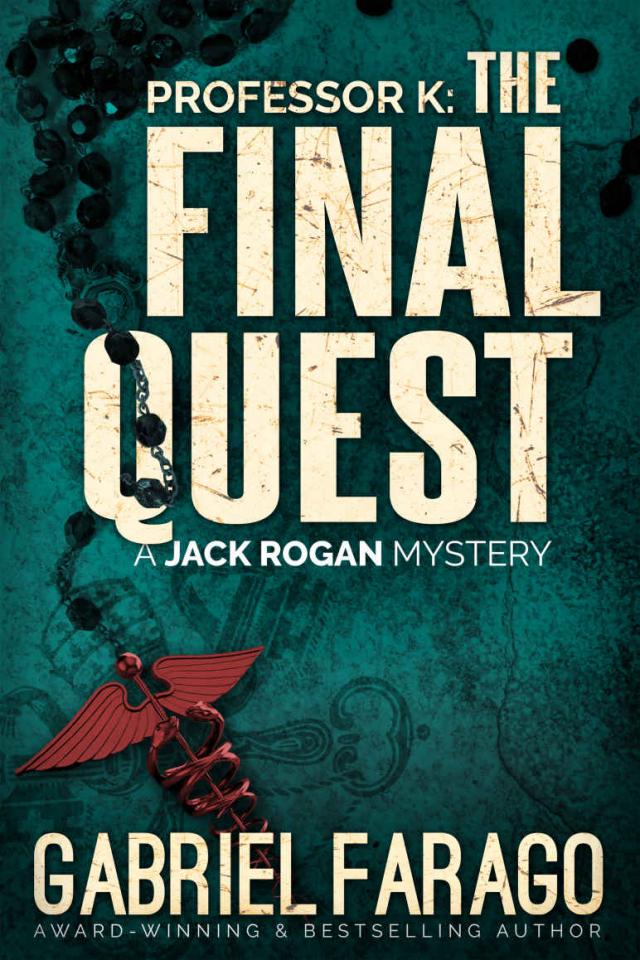
PROFESSOR K: THE FINAL QUEST
An action-packed historical medical mystery
Jack Rogan Mysteries Book 4
Gabriel Farago
Amazon Kindle Edition
This book is brought to you by Bear & King Publishing.
Publishing & Marketing Consultant: Lama Jabr
Website: https://xanapublishingandmarketing.com
Sydney, Australia
First published 2018 © Gabriel Farago
The right of Gabriel Farago to be identified as the author of this work has been asserted by him in accordance with the Copyright Amendment (Moral Rights) Act 2000.
All rights reserved. Except as permitted under the Australian Copyright Act 1968 (for example, fair dealing for the purposes of study, research, criticism or review) no part of this publication may be reproduced, stored in a retrieval system, or transmitted in any form or by any means, electronic, mechanical, photocopying, recording or otherwise, without the written permission of the publisher.
This is a work of fiction. Names, characters, businesses, places, events and incidents are either the products of the author’s imagination or used in a fictitious manner. Any resemblance to actual persons, living or dead, or actual events is purely coincidental.
Signup for the author’s New Releases mailing list and get a free copy of ‘The Forgotten Painting’* Novella and find out where it all began ... Click Here to Download
* I’m delighted to tell you that The Forgotten Painting has just received two major literary awards in the US. It was awarded the Gold Medal by Readers’ Favorite in the Short Stories and Novellas category and was named the ‘Outstanding Novella’ of 2018 by the IAN Book of the Year Awards.
A Note from the Author
After the release of The Hidden Genes of Professor K – book three in the Jack Rogan Mysteries series – in 2016, I was somewhat overwhelmed by the reception of the book, especially in the US, Europe and Australia. The book, a medical thriller, resonated with my readers so strongly, especially in medical research circles, that it was suggested I consider writing a sequel.
Encouraged by several prominent scientists who had assisted me with the science before, and after speaking with many of my readers, I was persuaded to go ahead with the project. However, this turned out to be a much bigger challenge than I thought at the time.
Because all the books in the Jack Rogan Mysteries series are ‘standalone’ and not sequels as such, it soon became apparent that something was needed to link The Hidden Genes of Professor K to a sequel. I was working on a short novella at the time – The Forgotten Painting – which was intended as a free giveaway to my readers as a small token of my appreciation for their encouragement and support.
As it turned out, the novella became the perfect vehicle to connect The Hidden Genes of Professor K to the sequel – Professor K: The Final Quest.
For those of you who are not already familiar with the novella, or my previous books, I have included a synopsis of The Forgotten Painting, which I hope you will find entertaining and an interesting introduction not only to this book, but my work generally. Others may find it a helpful ‘refresher’, preparing the way for Jack Rogan’s next adventure.
However, please note that this book – like all my others – does ‘stand alone’ in the Jack Rogan series and can therefore be read as such.
If you would like to read the novella in full, you can download it now for free by visiting my website at www.gabrielfarago.com.au and follow the prompts.
Gabriel Farago
Leura, Blue Mountains, Australia
The Forgotten Painting: The Story So Far ...
Warsaw Ghetto: 15 May 1943
The audacious uprising of 19 April 1943 had been brutally crushed by the SS. Soldiers searching the ghetto for survivors discovered a family – the Krakowskis – hiding under the floorboards in the ruins of one of the buildings.
An SS major was about to execute the father – Berenger Krakowski – when he noticed a striking painting hanging above a sideboard in the room. When he questioned Krakowski about it, he discovered that the painting had been given to Krakowski by a famous artist in 1920. Instead of shooting the family, the major sent them to the railway station for deportation to a concentration camp. As soon as he was alone, the major dismantled the picture frame and stole the painting.
McCormack & Sons of London, auctioneers: December 2014
The much-anticipated auction of a precious painting – a rare, recently rediscovered Monet – was about to begin. The auctioneer told potential bidders he had a surprise in store for them that would throw some light on the unique provenance of the painting. He then introduced the owner of the painting – Benjamin Krakowski – who gave an account of its extraordinary history.
Krakowski told his spellbound audience that the painting had a name – Little Sparrow in the Garden – and that it had been presented to his father, Berenger Krakowski, by Monet himself in 1920. Krakowski continued to surprise his audience by telling them that the man in the picture playing the violin in the garden was in fact his father, Berenger, and then described the tragic events that followed: the Warsaw Ghetto uprising of 1943; the arrest and deportation of his family to Auschwitz; the murder of his parents and his sister; and how he himself had miraculously survived after his brother had been killed during an unsuccessful escape attempt. Choking with emotion, Krakowski concluded by stating that he had seen the painting for the last time as he and his family were taken away by the SS and herded with so many others to the railway station; destination, Auschwitz.
As he left the podium, Krakowski announced that the entire proceeds of the auction sale would be donated to the Rosen Foundation – a well-known charity doing outstanding medical work in the Third World – in memory of his murdered family.
Delighted with this unexpected, emotional account of the painting’s turbulent history, the auctioneer introduced his next surprise guest – celebrated author Jack Rogan – who could answer the question on everyone’s mind: Where had the painting been since it was last seen by Krakowski as a boy in the Warsaw Ghetto in 1942.
Rogan knew how to tell a good story. He held up what looked like a small notebook, which turned out to be the diary of a German missionary – Brother Francis – that promised to answer all the questions.
Rogan’s story began in outback Queensland in 1985, the year of one of the worst droughts in living memory. Rogan, then seventeen, was living on his parents’ cattle station and had watched the cattle die as the relentless outback sun sucked the life out of the parched earth and turned the meagre pastures into dust bowls.
To earn some much-needed money during the devastating drought, young Jack had spent a few months working on a mission near the family’s property, where he befriended Brother Francis. An elderly, enigmatic character, Brother Francis died soon after and left a tidy sum and a cryptic note he had written just before he died, to Jack. This unexpected inheritance saved the family from ruin at the time and sent Jack on his way to pursue a dream. Sadly, however, the family cattle station was lost during another heartbreaking drought later on.
Rogan held up the note at the auction and read it aloud:
Dear Jack,
By the time you read this, I will be in the Good Lord’s hands. I realise we knew each other for only a short time, but the length of days has nothing to do with friendship. There are many things about me and my past you don’t know, and when you do find out, you will be shocked and no doubt disappointed. Words cannot express the regret I have felt over the years for the things I have done.
As a dying man and your friend, I ask you to help me right a great wrong. I know this is a big ask, but there is no time left to explain it all. The best I can do is point you in the right direction and hope you will one day grant me this last wish. Just before I left Europe after the war, I buried something in a cemetery. If you follow the instructions on the back of this note, you will find all the answers, and a lot more ...
You are the son I never had.
Your loving friend,
Francis
Many years later, the journey took Rogan to a cemetery in Berchtesgaden in Bavaria on Christmas Eve, 2008, where he discovered Brother Francis’s diary and an ornate key hidden in one of the graves. Slowly, line by line, Rogan began to piece together a tragic story about unspeakable atrocities and a fascinating, complex man overcome by remorse.
He discovered that during the war, Brother Francis had been a high-ranking Nazi officer in charge of putting down the 1943 Warsaw Ghetto revolt. He learned about the crimes committed by that officer and finally discovered the great wrong Brother Francis had asked him to set right: it was all about having sent the Krakowski family to a concentration camp to face certain death, and then stealing the only thing of value left in the ruins of their miserable home: a painting.
As the war drew to an end, the officer sank deeper and deeper into despair and consumed by guilt, he became obsessed with one particular subject: returning the painting to where it belonged; its rightful owner. Of course, this made no sense in light of what had happened, but by then he was no longer rational or coherent.
In June 1945 the war was over. The officer was on the run and was hiding in the Imperial Crypt beneath the Capuchin Church in Vienna, the final resting place of the German and Austrian emperors. With him, he carried the painting that was giving him so much grief. By now the Russians had complete control of the city and the officer realised he was no longer
Imperial Crypt, Vienna: 2012
Translating and piecing together Brother Francis’s diary entries had been a laborious, time-consuming task. Several years passed before Rogan – by now a celebrated international author – found time to revisit the subject. During a trip to Vienna, he decided to explore the Imperial Crypt under the modest Capuchin Church in the city centre.
Open to the public, the crypt was one of the little gems of Vienna. What made the Imperial Crypt so unique was the fact that with one exception, all one hundred and forty-five individuals buried there belonged to one family, the Habsburgs, and included twelve emperors and seventeen empresses. As a depository of European history, it was unparalleled.
Rogan had the relevant pages of the Francis diary referring to the crypt with him as he walked along the rows of magnificent sarcophagi, each a masterpiece of artistry and craftsmanship. Unfortunately, the pages had been badly damaged, and the remaining clues were insufficient to identify the sarcophagus mentioned in the diary. All Rogan had left to go by was the coffin key. Regrettably, that too turned out to be a dead-end, and that was where matters rested until he contacted Benjamin Krakowski in London and told him about the Francis diary and the crypt.
Rogan, a master storyteller, had the entire auction room spellbound. Instead of telling his audience what happened next, he asked the auctioneer to invite Krakowski back to the podium to reveal the final chapter in the painting’s extraordinary journey.
Delighted, the auctioneer obliged and Krakowski then gave a brief, emotional account of how the painting was finally discovered hidden inside Empress Marie-Louise’s sarcophagus in the Imperial Crypt. However, his story was vague and sketchy, and lacked detail. Important questions remained unanswered.
The auction
Realising that a high point had been reached and basking in the excitement all around him, the auctioneer reached for his gavel and began the auction. Bidding was fast and furious, and soon it became apparent that a new Monet record was within reach. Little Sparrow in the Garden was finally sold for a staggering thirty-five million pounds to an anonymous buyer, bidding over the phone.
After the auction, Celia Crawford – a journalist working for the New York Times – approached Rogan. Because Krakowski had left many questions unanswered, she sensed there had to be more to the story and decided to investigate. She cornered Rogan on his way out and began to ask questions about the Imperial Crypt and the painting’s discovery. Instead of giving her a quick answer or fobbing her off, Rogan invited her to dinner at his hotel.
When Rogan met Celia Crawford later that evening at the Waldorf, an exciting partnership was formed leading to some extraordinary revelations about the painting and its turbulent history.
It turned out that Crawford knew a lot about Rogan. She had written several articles about his books and adventures, and was about to file another one about the lost Monet and the auction, but she wanted more information. Rogan enjoyed the attention of the attractive, intelligent journalist and felt instantly relaxed and at ease.
Over dinner, he told her about a violin recital in the crypt, a coffin key and a remarkable boy with psychic powers, and how destiny and fate had collided in the Imperial Crypt and led to the discovery of the Monet hidden in a sarcophagus by a desperate Nazi on the run at the end of the war.
Hanging on Rogan’s every word, Crawford took copious notes. However, the evening ended abruptly, as she had to rush back to her hotel and call her editor in New York to file her article. She thanked Rogan profusely and was about to leave when Rogan dropped a bombshell: he asked her if she would like to find out who the mystery buyer was …
‘You know?’ asked Crawford, her eyes wide with astonishment.
‘Aha.’
‘Are you going to tell me?’
‘I’m meeting the proud new owner for lunch tomorrow,’ said Jack casually, sidestepping the question. ‘You can come with me if you like.’
Rogan hadn’t told Celia everything. He didn’t tell her about the other intriguing item he had found under the painting in Empress Marie-Louise’s sarcophagus. The reason he hadn’t mentioned it was not because he didn’t trust her, but something quite different. He was still trying to work out what it all meant. But something told him it was important, as certain cryptic references in Brother Francis’s diary were beginning to make sense. All Jack needed was a little more time to investigate and follow the breadcrumbs of destiny.
The next day, Rogan took Celia to the famous Time Machine Studios, a converted bond store on the banks of the Thames, to meet a legendary rock star – Isis.
Inspired by Krakowski’s generous donation of the proceeds of the auction sale to the Rosen Foundation, Isis, an avid art collector, had become the mystery buyer of the painting. Apart from inviting Jack to view the painting in her penthouse, Isis had also invited Krakowski and Dr Rosen because she had an important announcement to make.
Isis told her guests that the tragic loss of her family and her recent recovery from a near-fatal illness had changed the way she saw herself, her success and the world around her, and that she had decided to use her staggering wealth and influence to make a difference. Isis announced that she was about to set up a Time Machine Foundation to support certain cutting-edge medical research, and that Little Sparrow in the Garden would become its emblem.
‘My friends, a toast,’ said Isis. She walked over to the painting and held up her champagne flute. ‘May the little sparrow in the garden turn into a Time Machine eagle for the future. I give you, Little Sparrow in the Garden!’
‘Little Sparrow in the Garden,’ echoed the others, visibly moved, and raised their glasses.
Looking at the closely-knit group of friends about to sit down to a celebratory lunch, Celia felt like an intruder. She mentioned this to Rogan, who assured her it wasn’t so and that very soon she too would be part of this special family.
‘What on earth do you mean?’ asked Celia.
‘Isis wants to go public with this right now and ... I suggested you.’
‘Me? Why?’
‘Because you are the right person for the job.’
‘And this is okay with Isis?’
‘She trusts my judgement,’ said Rogan, smiling.
The old man in the Swiss mansion
Emil Fuchs, a wealthy, reclusive art collector in his nineties with a shady past, lived in a grand Swiss chalet with spectacular views over the Alps. Fuchs had made his fortune during the war in ingenious ways. As a young executive in his father’s bank, he had acted as the contact point between the bank and the Nazis to facilitate the flow of much-needed money to keep the wheels of the Nazi war machine turning.
Temperamental, arrogant and demanding, he had only one passion left in life: his fabulous art collection, mainly paintings, which he kept in his home. A man of iron discipline and routine but confined to a wheelchair, reading the papers in the morning – especially the New York Times, his favourite – was one of his little pleasures and the highlight of his day.
Enjoying the warmth of the morning sun near the panoramic window, Fuchs let his eyes wander over the headlines until they came to rest on something extraordinary: an article by Celia Crawford.
Mystery buyer pays 35 million pounds for lost Monet.
During an epic auction that lasted several hours, a mystery buyer bidding over the phone paid thirty-five million pounds for Little Sparrow in the Garden, an unknown painting by Claude Monet that has recently been rediscovered.
The celebrity auction, which was well attended, made headlines around the world. This was due to the painting’s colourful history, reaching back to Nazi Germany and the war …





