

The case of the counterf.., p.1
The Case of the Counterfeit Eye, page 1


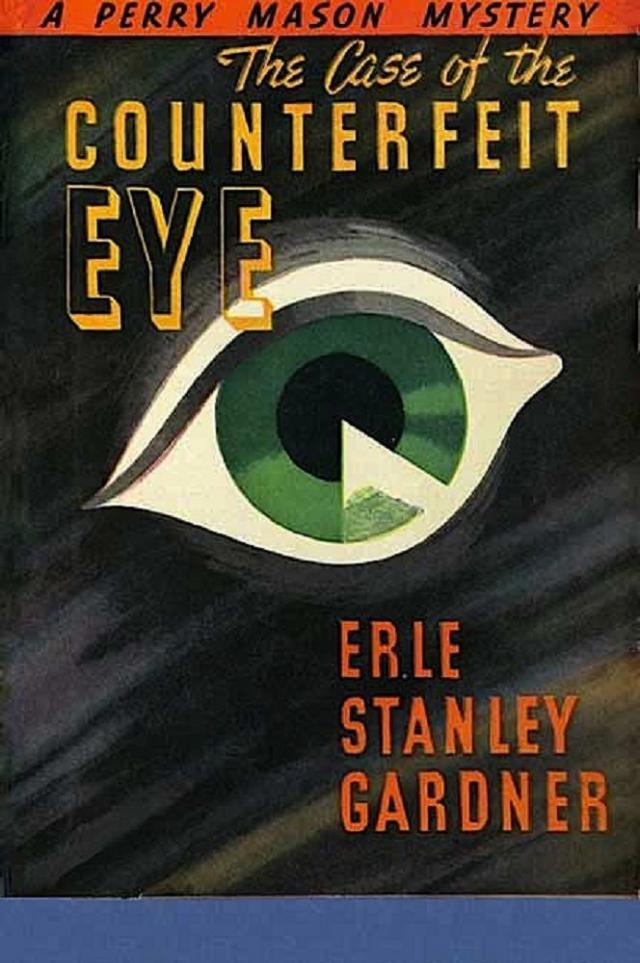
The Case of the
Counterfeit
Eye
Erle Stanley Gardner
Copyright © 1935 by Erle Stanley Gardner. Renewed 1962 by Erle Stanley Gardner.
Electronic Book: Copyright © 2013 by The Erle Stanley Gardner Trust
Published by Della Street Press. All rights reserved. No part of this book may be used or reproduced in any manner whatsoever without the written permission of the copyright holder.
CONTENTS
CAST OF CHARACTERS
Chapter 1
Chapter 2
Chapter 3
Chapter 4
Chapter 5
Chapter 6
Chapter 7
Chapter 8
Chapter 9
Chapter 10
Chapter 11
Chapter 12
Chapter 13
Chapter 14
Chapter 15
Chapter 16
Chapter 17
Chapter 18
About the Author
CAST OF CHARACTERS
PERRY MASON, a lawyer who had to play detective, window washer and a desperate game of blind-man’s buff
DELLA STREET, his confidential secretary
PETER BRUNOLD, who dropped his eye under embarrassing circumstances and wouldn’t take a counterfeit
PAUL DRAKE, a droll-faced private detective, who got results by going without sleep
BERTHA MCLANE, a working girl with a cross to bear
HARRY MCLANE., her brother; a young embezzler with a double-cross to bear
HARTLEY BASSET, a money lender who wanted an eye for an eye and got a bloodshot glass one
ARTHUR COLEMAR, his owl-eyed bookkeeper
SYLVIA BASSET, Basset’s browbeaten wife, who planted a gun and reaped a cell
JAMES OVERTON, Basset’s chauffeur-spy
DICK BASSET, Sylvia’s hot-tempered son and protector, and Basset’s adopted heir
HAZEL FENWICK, who was beaten by a murderer, parked Perry Mason’s car before a fire plug and vanished
SERGEANT HOLCOMB, Perry Mason’s blunderingly ubiquitous opponent; a penny-shrewd, pound-foolish cop
HAMILTON BURGER, the D.A., honest but stubborn
THELMA BEVINS, a hungry young lady with a unique job, who more than earned her wages
JUDGE WINTERS, who was made to look ridiculous, but took it with a grin
Chapter 1
PERRY MASON TURNED HIS BACK TO THE MORNING SUNLIGHT which streaked in through the windows of his private office and regarded the pile of unanswered mail with a frown.
“I hate this office routine,” he said.
Della Street, his secretary, glanced up at him with eyes that contained a glint of amusement in their cool, steady depths. Her smile was tolerant.
“I presume,” she said, “having just emerged from one murder case, you’d like another.”
“Not necessarily a murder case,” he told her, “but a good fight in front of a jury. I like dramatic murder trials, where the prosecution explodes an unexpected bomb under me, and, while I’m whirling through the air, I try to figure how I’m going to light on my feet when I come down. . . . What about this chap with the glass eye?”
“Mr. Peter Brunold,” she said. “He’s waiting for you in the outer office. I told him you’d probably delegate his case to an assistant. He said he’d either see you or no one.”
“What does he look like?”
“He’s about forty, with lots of black, curly hair. He has an air of distinction about him and he looks as though he’d suffered. He’s the type of man you’d pick for a poet. There’s something peculiar in his expression, a soulful, sensitive something. You’ll like him, but he’s the type that would make business for you, if you ask me—a romantic dreamer who would commit an emotional murder if he felt circumstances required him to do it.”
“You can readily detect the glass eye?” Mason inquired.
“I can’t detect it at all,” she said, shaking her head. “I always thought I could tell an artificial eye as far as I could see one, but I’d never know there was anything wrong with Mr. Brunold’s eye.”
“Just what was it he told you about his eye?”
“He said he had a complete set of eyes—one for morning–one for evening—one slightly bloodshot—one . . .”
Perry Mason smacked his fist against his palm. His eyes glinted.
“Take away that bunch of mail, Della,” he commanded, “and send in the man with the glass eye. I’ve fought will contests, tried suits for slander, libel, alienation of affections, and personal injuries, but I’m darned if I’ve ever had a case involving a glass eye, and this is going to be where I begin. Send him in.”
Della Street smiled, vanished silently through the door which led to the reception room where clients who were to see Perry Mason personally were asked to wait. A moment later the door opened.
“Mr. Peter Brunold,” she said, standing very slim and erect in the doorway.
Brunold marched past her, strode across the office to Perry Mason, thrust out his hand.
“Thanks for seeing me personally,” he said.
The lawyer shook hands, stared curiously at Brunold’s eyes.
“Know which one it is?” Brunold asked.
As Mason shook his head, Brunold smiled, sat down and leaned forward.
“I know you’re busy. I’m going to get down to brass tacks. I’ve given your secretary my name, address, occupation, and all the rest of it, so I won’t bother with that now.
“I’m going to begin at the beginning and give you the whole business. I won’t take much of your time. Do you know anything about glass eyes?”
Perry Mason shook his head.
“All right, I’ll tell you something. Making a glass eye is an art. There aren’t over thirteen or fourteen people in the United States who can make them. A good glass eye can’t be distinguished from a natural eye, if the socket isn’t damaged.”
Mason, watching him closely, said, “You’re moving both eyes.”
“Of course I’m moving both eyes. My eye socket wasn’t injured. I’ve got about ninety per cent of natural motion.
“Now then,” he went on, “a man’s eyes vary. His pupils are smaller during the day than at night. Sometimes his good eye gets bloodshot. Lots of things may account for that, a long drive in an automobile, losing sleep or getting drunk. With me it’s usually getting drunk. I’m sensitive about my eye. I’m telling you about it because you’re my lawyer. I’ve got to tell my lawyer the truth, otherwise I’d see you in hell before I told you anything about having a bum eye. None of my closest friends know it.
“I’ve got a set of half a dozen eyes—duplicates for some, and some for wear under different conditions. I had one eye that was made bloodshot. It was a swell job. I used it when I’d been out on a binge the night before.”
The lawyer slowly nodded. “Go on,” he said.
“Someone stole it and left a counterfeit in its place.”
“How do you know?”
Brunold snorted. “How would I know?” he exclaimed. “The same way I’d know anything. How would you know if someone stole your dog, or your horse, and left a cur or an old plug in its place?”
He took a case from his pocket, turned back the flaps and disclosed four artificial eyes in leather pockets.
“Carry that with you all the time?” Mason inquired curiously.
“No. Sometimes I slip an extra eye in my vest pocket. I’ve got a vest pocket lined with chamois skin, so the eye won’t scratch. I always keep this leather case in my grip if I’m traveling, or on my dresser if I’m not.”
He extracted a glass eye and handed it to the lawyer.
Mason held it in his palm, stared at it thoughtfully.
“Rather a neat job,” he said.
“Nothing of the sort,” Brunold contradicted. “It’s a rotten job. The pupil’s a little out of shape. The thing they call the iris is irregular; the colors aren’t blended, and the veins are too red. A good vein for a bloodshot eye has a yellowish tint to it . . . Now, take a look at this eye and you can see what a good eye is like. Of course, that isn’t a bloodshot eye like that first one I gave you, but it’s an eye made by an expert. You can see the difference. It’s got better color. The blending is better. The pupil is regular.”
Mason, inspecting the two eyes, nodded thoughtfully.
“This isn’t your eye?” he asked, tapping the bloodshot eye with his forefinger.
“No.”
“Where did you find it?”
“In that leather case of mine.”
“You mean to say,” the lawyer asked, “that the person who stole your bloodshot eye took it from this case and put the counterfeit eye in the pocket from which the original had been taken?”
“That’s right.”
“What possible object would anyone have in doing that?”
“That’s what I want to know. That’s what I’m here to find out.”
The lawyer raised a quizzical eyebrow.
“Here to find out?” he asked.
Brunold narrowed his lids until they were mere slits. He lowered his voice and said, “Suppose someone stole that eye in order to get me in bad?”
“Just what do you mean?”
“An eye is an individual thing. Very few people have exactly the same colored eyes. Artificial eyes, when they’re well made, are as distinctive in style of workmanship as an artist’s painting.
“Go on,” the lawyer said, “tell me the rest of it.”
“Suppose,” Brunold said, “someone who wanted to get me in bad stole one of my eyes and left me a counterfeit? Suppose a crime was committed—a burglary, or, perhaps, a murder, and my eye was left at the scene of the crime? I’d have one hell of a time explaining to the police that I wasn’t there.”
“You think the police could identify your eye?” the lawyer inquired.
“Sure; they could if they went about it in the right way. An eye expert could tell who the man was that made the eye. He’d recognize the type of workmanship. The police could get in touch with that man and show him the eye. That fellow makes eyes for me right along. He’d take one look at it and say, ‘Pete Brunold, 3902 Washington Street.’ ”
The lawyer’s eyes were intent in their steady scrutiny.
“Do you think,” he asked slowly, “that your eye is going to be left at the scene of a murder?”
Brunold hesitated a minute, then nodded slowly.
“And you want me to fix that?” the lawyer asked. Brunold nodded again.
“A murder,” asked Perry Mason, “of which you are innocent, or of which you are guilty?”
“Innocent.”
“How do I know that?”
“You’ve got to take my word for it.”
“And what do you want me to do?”
“Show me some scheme by which I can beat the rap. You’re a criminal lawyer. You know the way the police work. You know the way juries think. You know the way detectives work up a case.”
Mason swung slowly back and forth in his big swivel chair.
“Has this murder been committed?” he asked. “Or is it going to be committed?”
“I don’t know.”
“Is it,” Mason asked, “worth fifteen hundred dollars to you to work a trick that will put you in the clear?”
Brunold said slowly, “That depends on how good the trick is.”
“I think it’s good,” Mason told him.
“It’s got to be better than good. It’s got to be perfect.”
“I think it’s perfect.”
Brunold shook his head and said, “There isn’t any perfect scheme. I’ve gone over it time and time again in my mind. I stayed awake half the night trying to figure out some solution. There isn’t any. That eye can be identified, if the police go about it the way I said. Understand, it isn’t only a question of proving I’m innocent after the eye is identified. It’s a question of not wanting to have the police identify the eye.”
Mason pursed his lips, nodded slowly. “I think I understand,” he said.
Brunold took fifteen one-hundred-dollar bills from his wallet and spread them on Perry Mason’s desk.
“There’s fifteen hundred bucks,” he said. “Now, what’s the stunt?”
Mason handed Brunold the bloodshot eye, dropped the other in his pocket, picked up the bills and folded them together.
“If,” he said slowly, “the police should find your eye first, they’ll look it up and identify it in the way that you mention. If they find some other eye first, they’ll try to identify that. If they find another eye second, they’ll try to identify that. If they find your eye third, they’ll take it for granted that it’s just like the first two.”
Brunold blinked his eyes rapidly. “Give that to me again,” he said.
Mason said slowly, “You’ll find out what I mean if you think it over long enough. The trouble with your eye is that it’s too good a job. It’s a work of art. You know that, because you know something about glass eyes. The police won’t know that, not unless something happens to direct it to their attention.”
Sudden animation ht Brunold’s face.
“You mean,” he asked, “that you’re … ?”
His voice trailed away into silence.
Mason nodded.
“That,” he said, “is exactly what I mean. That’s why I fixed the price at fifteen hundred dollars. I’ll have some expense in connection with the matter.”
Brunold said, “Perhaps I could save some . . .”
“You,” Perry Mason told him, “aren’t going to know a single damn thing about it.”
Brunold shot forth his hand, clasped the lawyer’s hand and pumped it up and down.
“Brother,” he announced, “you’re clever! You’re clever as the very devil. That’s an idea that had never occurred to me, and I’ve been stewing over this thing all night.”
“My secretary has your address?” Mason inquired.
“Yes, 3902 Washington Street. I’ve got a little jobbing house there—in automotive parts—piston rings, gaskets and that sort of stuff.”
“Own it yourself or working for someone?”
“I own it myself. I’m fed up working for other people. I was a salesman for years. I traveled on rattling trains, ruined my stomach eating poor food, and made a lot of money for the smart boys that stayed at home and owned the business.”
He winked his glass eye significantly.
“I got that,” he said, “in a train wreck back in 1911. You can see the scar on the side of my head—knocked me out cold. I was in the hospital for two weeks, and it was a month after that before I knew who I was—loss of memory. It lost me my eye and ruined my life.”
Mason nodded sympathetically and said, “All right, Brunold; if anything happens, you get in touch with me. If I’m not in the office, you call Della Street, my secretary, and talk with her. She’s in my confidence and knows all about the business of the people who call on me.”
“Will she keep her mouth shut?” Brunold asked.
Mason laughed. “Torture,” he said, “wouldn’t get a word out of her.”
“How about money?”
“No chance.”
“How about flattery? How about someone making love to her? She’s a woman, you know, and a mighty attractive one at that.”
Mason’s shake of his head was accompanied by a frown. “You worry about the things that concern you,” he said. “I’ll worry about the things that concern me.”
Brunold started toward the door through which he had entered.
“You can,” Mason said, “get out this other way. This door leads directly to the corridor. . . .”
He broke off as the telephone bell on his private line rang insistently. He scooped the receiver to his ear, and heard Della Street’s voice on the other end of the line.
“There’s a Miss Bertha McLane here, Chief. She has a younger brother with her—a Harry McLane. They seem to be pretty much excited. She won’t tell me the nature of her business. She’s been crying, and the brother is surly. They look promising. Will you see them?”
“Okay,” he told her; “I’ll see them in a minute,” and dropped the receiver back into position.
Brunold, halfway through the door, said, “I left my hat in this other office. I’ll have to go out that way.”
He turned toward the outer office, stiffened suddenly and said, “Hello, Harry; what the devil are you doing here?”
Mason crossed the office in four swift strides, caught Brunold by the shoulder of his coat, jerked him back. “You wait here,” he said. “This is a law office, not a club room. I don’t want my other clients to see you, and I don’t want you to see my other clients.”
He pushed his head through the door and said, “Della, bring this man his hat.”
When Della Street brought in Brunold’s hat, Mason signaled her to close the door.
“Who was it?” he asked Brunold.
“Just young McLane,” Brunold said, trying to be casual.
“Know him?”
“Just slightly.”
“Know he was coming here?”
“No.”
“Know his business here?”
“No.”
“Then what made you turn pale?”
“Did I turn pale?”
“Yes.”
“I don’t know why I did it. Young McLane is nothing to me.”
Mason put his hand on Brunold’s shoulder. “Well,” he said, “you can go out this way, and . . . Good heavens, man, you’re shaking like a leaf!”
“Just nervousness,” Brunold said, breaking away and lunging through the door to the outer corridor. “That McLane boy means nothing to me, but the sight of him brings up certain ideas that . . .”


