

The case of the postpone.., p.1
The Case of the Postponed Murder, page 1


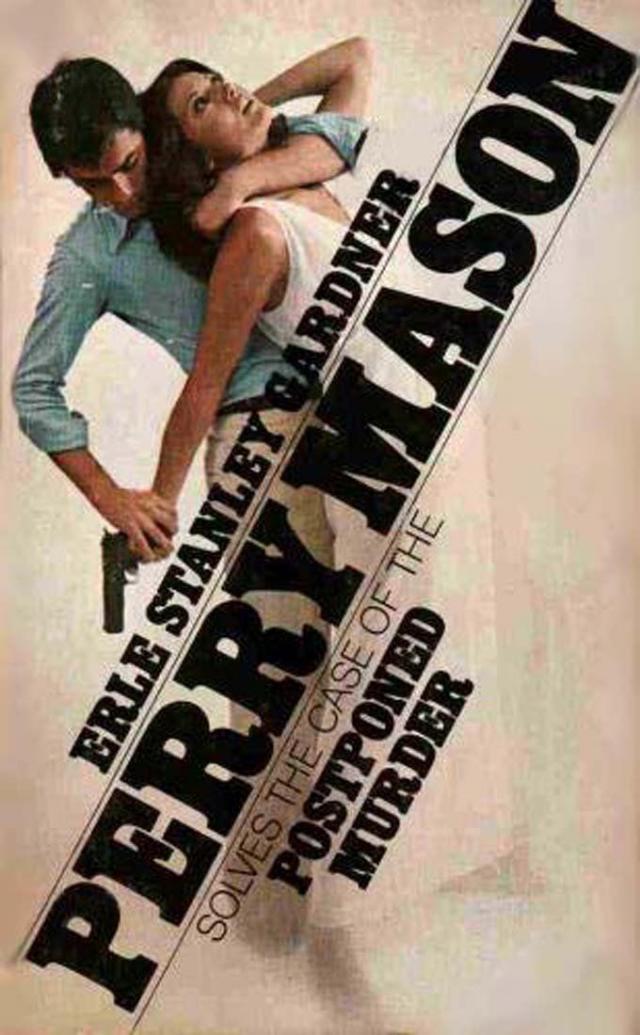
The Case of the
Postponed Murder
by
Erle Stanley Gardner
Copyright © 1961 by Erle Stanley Gardner. Renewed 1989 by Jean Bethel Gardner and Grace Naso
Electronic Book: Copyright © 2012 by The Erle Stanley Gardner Literary Trust
All rights reserved.
Contents
Copyright
Chapter 1
Chapter 2
Chapter 3
Chapter 4
Chapter 5
Chapter 6
Chapter 7
Chapter 8
Chapter 9
Chapter 10
Chapter 11
Chapter 12
Chapter 13
About the Author
Chapter 1
Perry Mason pushed himself slightly back from the desk and turned so that he was facing the young woman who had seated herself in the client’s big overstuffed leather chair. Della Street, his secretary, handed him the confidential information card on which had been typed:
NAME Sylvia Farr
AGE Twenty-six
ADDRESS North Mesa, Calif., 694 Chestnut St. Temporarily located at Palmcrest Rooms. Telephone number Hillview 6-9390.
NATURE OF BUSINESS About sister.
COMMENTS When she opened her purse for compact, noticed a wad of folded bills and several pawn tickets. – DS
Mason turned the card face down on the desk and said, “You wanted to see me about your sister, Miss Farr?”
“Yes.”
“Smoke?” Mason asked, raising the cover of his office humidor.
“Thanks. I have my own brand.” She took a new package from her purse, tore open a corner, extracted a cigarette, and leaned forward for his match.
“All right,” Mason said, settling back in his chair. “What about your sister?”
“She’s disappeared.”
“Ever do it before?”
“No.”
“What’s her name?”
“Mae.”
“Married?”
“No.”
“What about the disappearance?”
Sylvia Farr gave a quick, nervous laugh and said, “It’s hard for me when you shoot questions at me. Could I tell you in my own way?”
“Certainly.”
“Well, we live in North Mesa, and–”
“Just where is North Mesa?” Mason interrupted. “I don’t recall the place.”
“You wouldn’t,” she said. “It’s in the northern part of the state, off the main highways. It’s awfully rural. There hasn’t been any building activity for years. We did manage a new post office, but that doesn’t mean anything in particular.”
“So much for North Mesa,” Mason said with a smile. “Now how about Mae?”
“Mae,” she said, “left North Mesa over a year ago. It was the opposite of the conventional, short-story situation. She was the household drudge. I was the – Well, I was considered prettier, not,” she added quickly, with a deprecating smile, “that that means much in North Mesa.
“But you know the conventional setup. I should have been the one to get impatient at the small town stuffiness and head for the big city, try to crash the movies, wind up making a living waiting on tables in a cheap restaurant, then marry a prince charming – or go broke and return home, disillusioned, bitter, and cynical, to find that my homely sister had married the local undertaker, had three children, and was known all over the countryside for her wonderful disposition and fine apple pies.”
Mason’s eyes twinkled. “Mae,” he asked, “didn’t run true to form?”
“I’ll say she didn’t. She got fed up with North Mesa and decided she was going to see the world.”
“Where is she now?”
The laughter faded from Sylvia Farr’s eyes. “I don’t know,” she said.
“Where was she when you heard from her last?”
“Here.”
“Was she working?”
“She’d had several jobs,” Sylvia Farr said guardedly. “I think she tried to make up for some of the things she had lost in North Mesa. She formed a few friendships and enjoyed them immensely. She became quite a playgirl.”
“Older than you or younger?” Mason asked.
“A year and a half older. Don’t misunderstand me, Mr Mason. She knew what she was doing … But what I mean is that her attitude changed. In North Mesa, there was no animation about her. She seldom laughed. She felt she was just marking time there while life was slipping through her fingers, and her actions showed it. After she came to the city, she apparently had an entirely different outlook. Her letters really sparkled. They were quite clever, and … Well, I didn’t dare show all of them to Moms. I remember that Mae said that in the city a girl had to play with fire and that the art of keeping fingers from getting burnt was not to try to control the fire but to control the fingers.”
“When did you hear from her last?”
“A little over two months ago.”
“What was she doing then?”
“She was working as secretary to a man in the stationery business, but she didn’t give me the address of the firm. She was staying at the Pixley Court Apartments, and she seemed to be having a wonderful time.”
“You have a letter?” Mason asked.
“No. I destroyed all of her letters – that is, nearly all of them. She used to write me things in confidence. Occasionally, she’d write a letter for Moms to read, but they were mostly little notes.”
“Did she ever come back to North Mesa after she left?” Mason asked.
“Yes, she was back about six months ago, and I was never so flabbergasted in my life. I’ve never seen such a complete change in any human being. Her complexion was never good, and her hair was inclined to be coarse and dry. Her features aren’t what you’d call beautiful, but, my heavens, to see what she’d done to herself! Her clothes were smart. Her complexion was a lot better. Her eyes danced. She’d been taking care of her hair and her hands, and she was full of wisecracks and all the latest slang. She made us North Mesa girls feel hopelessly out of things.
“You know, Mr Mason, I’m not the moody type. I take things as they come and live life as I find it, but I never felt as blue as when Mae had left and we settled back into the old rut. Things weren’t so bad while she was there. Just being around her made all of the girls feel sort of urban and sophisticated, but after Mae left, the steam was all out of the boiler, and we couldn’t carry on …”
“I think I understand,” Mason said. “I think we’ve covered the preliminaries fairly well, Miss Farr.”
“Well,” Sylvia Farr went on hastily, “a month or so ago I wrote Sis, and she didn’t answer. Then I sent her another letter about two weeks ago, and the letter was returned with a note from the apartment house saying that she’d moved and had left no forwarding address.”
“She sounds as though she’d developed an ability to take care of herself,” Mason said. “I would hardly think there was any cause for worry.”
“In her last letter,” Sylvia Farr explained, “she mentioned a Mr Wentworth who had a yacht. I understand he’s a gambler, and rather wealthy. She’d been out on the yacht with him and wound up the letter by saying something like this: ‘Good Heavens, Sis, if you come to the city, lay off of people like Penn Wentworth. What I’ve told you about playing with fire doesn’t fit him. He goes through life taking what he wants, not asking for it. You can’t control either the fingers or the fire with men like that.’”
Mason said, somewhat impatiently, “Your sister isn’t the first girl in the world to find that you can’t make hard and fast rules about playing with fire, as she called it. You don’t need a lawyer, Miss Farr. You need a private detective if you need anyone. If you’ll take my advice, you’ll return to North Mesa and forget all about it. Your sister is able to take care of herself, and the reason she has failed to communicate with you is undoubtedly because she doesn’t want you to know where she is. The police can tell you that this frequently happens. If you want a good detective, the Drake Detective Agency in this same building has several very skilful operatives, and you can absolutely trust the discretion and honesty of Mr Paul Drake, the head of the agency. He does my work.”
And Mason swung about in his chair as an indication that the interview was terminated.
Sylvia Farr crossed over to the desk and stood looking down at him. “Please, Mr Mason,” she said, with desperation in her voice, “I know it sounds silly. I just couldn’t tell it the way it was. I can’t make you see Sis the way I know her. I tell you I know this is something different. I think – think – that she’s dead, been murdered.”
“What makes you think that?” Mason asked.
“Oh, just several things, knowing her and – because of things she said in that last letter.”
“You didn’t keep that letter?”
“No.”
Mason said, “If you’re absolutely convinced in your own mind that there’s something seriously wrong, go to the police. They’ll investigate. You may not be pleased with what you find out.”
“But I want you to investigate this, Mr Mason. I want you to …”
“All I could do,” Mason said, “would be to hire a detective agency. You could do that just as well yourself and save yourself money. I presume money means something to you, doesn’t it, Miss Farr?”
“Yes, it does,” she said. “But Sis means more to me than money, an
d I just know there’s something wrong.”
Mason said, “Go see Paul Drake. In all probability, one of his operatives can locate your sister within twenty-four hours. If it turns out your sister is in any difficulty and she needs legal help, I’ll still be available.”
Della Street said, “This way, Miss Farr. I’ll take you to Mr Drake’s office.”
Chapter 2
Paul Drake, long and loose jointed, entered Mason’s private office with the familiarity born of years of intimate association, and said, “Hi, Perry. Hi, Della. How’s tricks?”
He crossed over to the client’s chair, swung around so he was seated crosswise in the seat, and let his legs hang over one of the arms. “Thanks for the case, Perry,” he said.
“What case?”
“The girl you sent me yesterday.”
“Oh, you mean Miss Farr?”
“Uh huh.”
“Any money in it?” Mason asked.
“Oh, so so. Enough to cover a preliminary investigation and report. I figured it shouldn’t take over three or four hours to locate the girl.”
“Find her?” Mason asked.
“No, but I found out a lot about her.”
Mason grinned and reached for the cigarette humidor. “Smoke, Paul?” he asked.
“No, thanks,” Drake said. “I’m chewing gum today.”
Mason turned to Della Street. “He has something on his mind, Della. When things are coasting along, he smokes cigarettes and sits in the chair like a civilized human being. When you see him tie himself up in knots like a snake with a stomach ache, you know he has something on his mind. And chewing gum is another infallible sign.”
Drake tore the cellophane end off a package of gum and fed three sticks into his mouth, one after another, rolled the wrappers into a tight ball, and tossed them into Mason’s wastebasket. “Perry,” he said, “I want to ask you a question.”
Mason flashed Della Street an obvious wink. “Here it comes, Della,” he said.
Drake said, “No kidding, Perry, you did call the turn on me.”
“I know I did,” Mason said. “What is it, Paul?”
“Why the devil did you interest yourself in that girl’s case?”
“I didn’t.”
“You didn’t take it,” Drake said, “but from what she told me, you must have given her quite a bit of time.”
“Did she think so?” Mason asked.
“No,” Drake said. “She was sore. She thought you’d thrown her out on her ear. I explained to her that you were one of the highest-priced trial lawyers in the city and that darn few people ever got as far as your private office. That smoothed her down some.”
Mason said, “I darn near took her case at that, Paul.”
“That’s the way I figured it. Why?”
“Mason grinned and said, “You found the sister was in a fair-sized mess of trouble, didn’t you, Paul?”
The detective nodded, watching Mason warily.
“A fugitive from justice?” Mason asked.
“Nope,” Drake said. “Forgery.”
“I thought so,” Mason said.
Della Street looked at the lawyer curiously. Drake said, “Come on, Perry. Give me a break. How did you figure it?”
The lawyer’s eyes narrowed somewhat as they looked past the detective. “Darn it, Paul,” he said. “I wish I didn’t take such a keen interest in people and in mysteries. If there’d been just a little more mystery about that case, I’d have taken it and found myself donating five thousand dollars’ worth of work for a fifty dollar fee.”
“What was the mystery?” Drake asked.
“Did you locate Mae Farr?” Mason countered.
“No, we can’t find her.”
Mason made a gesture with his hand as though tossing something onto the big desk in front of him. “There,” he said, “is your answer.”
“What do you mean, Perry?”
Mason said, “Look at the setup. This girl comes to see us about her sister. Her sister has disappeared. She thinks her sister is in some sort of trouble, doesn’t know anything at all about what it might be, but is filled with vague forebodings.
“Notice the way she’s dressed – shoes that are the best on the market, a skirt and jacket smart in design but not new, a coat that apparently is new, of the cheapest sort of material cut along flashy lines with a fur collar and trim which looks as though it came direct from an alley cat.”
“Well,” Drake asked as Mason hesitated, “what’s the answer?”
Mason waved back the question with a quick gesture. “Her nails,” he said, “were manicured carefully. Her hair was slicked back. Her face had very little makeup on it. There was virtually no lipstick on her mouth, and then to clinch matters, her purse was full of money – and pawn tickets.”
Drake, nervously chewing away at his gum, looked across at Della Street, then back to Mason, and said, “I don’t get you, Perry. You’re leading up to something, but hanged if I know what.”
Mason said, “It’s a column of figures that doesn’t add up, that’s all. What does a country girl do when she goes to the city? Puts on her best clothes, tries to look her best. The country girls – the good looking ones – are the ones who try to look sophisticated. They’re the ones who go heavy on makeup when they’re calling on a lawyer. They’re particularly careful to have their hair done as soon as they get to the city.”
“She was worried,” Drake said. “She didn’t have time to go to a hairdresser.”
“She had had time to get her nails manicured,” Mason said, “and she’d been to a hairdresser. Her hair was pulled back to make her look as plain and unsophisticated as possible. A country girl would have economized on shoes, and put what she saved into getting a better coat, unless she was the type who liked that kind of a coat. In that event, she wouldn’t have ever had the shoes Miss Farr was wearing. The coat didn’t go with the clothes. The coat didn’t go with the shoes. The hair didn’t go with the nails. The face didn’t go with the story.”
Drake chewed away at the gum with nervous rapidity, then suddenly straightened in the chair. “Cripes, Perry, you don’t mean that she … that she was …”
“Sure, she was,” Mason said. “She was a fugitive from justice. She wanted a lawyer to pull some chestnuts out of the fire. She didn’t dare use her right name, so she posed as sister Sylvia.”
“I,” Drake announced slowly and impressively, “will be damned. I believe you’re right, Perry.”
“Of course I’m right,” Mason said, as though disposing of a matter which was entirely elementary. “That’s why I almost took her case. I wondered what kind of character she possessed, what sort of a scrape she was in, what mental quirk had given her the resourcefulness and ingenuity to think up that approach. Most girls would either have sought refuge in tears or hysterics or would have been hard boiled enough to brazen the whole thing out. She wasn’t particularly hard boiled. She looked as though she knew her way around. She was frightened, but she wasn’t giving way to tears. She was self reliant and, all in all, pretty resourceful. She’d hocked all her valuables, bought herself a flashy coat, had her hair done so that it made her look as plain as possible, but entirely overlooked her shoes and the fact that her nails were freshly manicured.”
Drake resumed his gum chewing. He slowly nodded. “Well,” he said, “she’s in a jam.”
“How much of a jam?” Mason asked.
“A forged cheque for eight hundred and fifty smackers for one thing,” Drake said.
“Who cashed the cheque, Paul?”
“Stylefirst Department Store.”
“Some cash and some credit?” Mason asked.
“Credit on a nine hundred and fifty dollar balance,” Drake said. “The department store received the cheque in the mail, put it through without paying very much attention to it, had it returned marked as a forgery, and got peeved about it. In the meantime, Mae Farr had evidently got wind of what had happened and skipped out.”
Mason pushed his chair away from the desk, got to his feet, and started walking the floor, his eyes staring in frowning concentration at the carpet as he walked. “Paul,” he flung over his shoulder, “I’m going to ask you a question. I hope the answer to the question is ‘no.’ I’m afraid it’s going to be ‘yes.’ Was that forged cheque signed by a man named Wentworth?”
“That’s right,” Drake said. “Penn Wentworth, and it was a lousy forgery.”


