

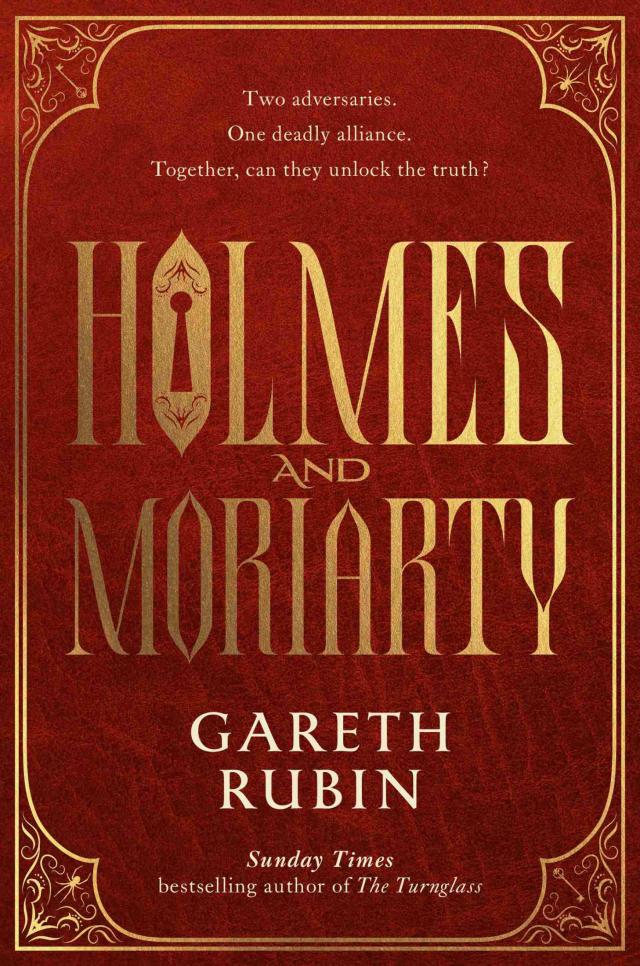
Holmes and moriarty, p.1
Holmes and Moriarty, page 1


Thank you for downloading this Simon & Schuster ebook.
Join our mailing list to get updates on new releases, deals, recommended reads, and more from Simon & Schuster.
CLICK HERE TO SIGN UP
Already a subscriber? Provide your email again so we can register this ebook and send you more of what you like to read. You will continue to receive exclusive offers in your inbox.
For Jacob
Chapter 1
I have sometimes, in these poor reminiscences of my days spent with Sherlock Holmes, attempted to describe the sensations I felt when we were called in by the authorities to decipher an incident that had baffled their finest brains. Such descriptions have always irritated my companion, it must be said, because he insists that the interest in such cases should be in their pure mechanics, not unlike a manual on the correct design of a locomotive engine, rather than the human emotions that were bound up in them. I should, therefore, keep such colour out of the narrative, he says. And yet, no matter the admiration I have always felt for Holmes – the greatest consulting detective that the world has ever known – I have always resisted him on that score.
And so I will relate what I felt in the light of a setting sun two days before the Christmas of 1889.
It was fear. Fear like I had never known.
For the murder of Britain’s Minister for War, at a time when all of Europe was on the brink of armed conflict, could have been the spark to set the whole continent alight. War, then, would have engulfed the greater part of the entire world. And I have seen war. I have seen the open gates of Hell.
What stood between us and those gates? It was a sight I would never have dreamed possible: the sight of the ever-righteous Sherlock Holmes and that malevolent denizen of the criminal netherworld, Professor James Moriarty, working together as if they were old friends, rather than two men sworn to each other’s destruction. Working together to save all of Europe from catastrophe.
Yes, on a Swiss mountain, as a terrible blizzard raged outside, their minds wrought as one, moulding around one another, creating a hybrid of good and evil: a weapon that would strike our first blow against a danger the likes of which the world had never seen before – and, I pray to God, never will again. As night fell, Moriarty looked to me and held out his hand. I nodded and passed him a fistful of bullets, each one made to send a man to his grave, when—
But I am getting ahead of myself. Holmes always tuts when I do so. ‘Everything in order, Watson. Without order, what is there but disorder?’ And I must admit he has a point. So I shall return to the chronology in which events unfolded.
* * *
I have had occasion in my previous reports, most notably that queer affair of the Greek Interpreter, to describe the Diogenes Club, the lair of London’s least clubbable men. A gentleman who despises the very thought of society may retreat to its muffled environs and content himself with reading periodicals or heftier tomes in an atmosphere devoid of the slightest sound. Indeed, anyone who so much as acknowledges another human being’s presence within the club’s public rooms runs the risk of permanent expulsion. In life-or-death situations, the Stranger’s Room is reserved for interaction, although any member observed entering or leaving it will still receive a black mark against his name in the club ledger.
In short, it was the perfect place for Holmes’s brother, Mycroft (who was, indeed, one of its founder members). Sherlock credits his sibling with a mind often surpassing his own when it comes to criminal detection – a fact that our Secret Service has frequently relied upon, Holmes assures me – but negated in its efficacy by the sheer indolence of its owner.
That inertness was a habit, but at the time that I describe, it had become medical. Mycroft was staying in one of the club’s bedrooms, and I had been called upon to see what cure I could advise.
The room was functional and no more than that – the inmates of the club like their furnishings in the Spartan style. If it serves a purpose, then let it be. If it is there to look fine, then chuck it out. So there were a couple of solid chairs, a writing desk and not a single painting, print or bunch of flowers to be seen. We stood at the foot of the bed in which Mycroft lay simultaneously reading a treatise on Asian arachnids in his right hand and a thick volume of Dante’s complete Divine Comedy in Italian in his left. The club’s white-coated steward, who had shown us to the room, muttered a few hoarse words as he hung around for some seconds without reason, glaring at us all, and then sullenly took his leave – at which point, Mycroft’s mouth cracked into a thin smile.
‘You observe, of course, Sherlock, how Manning has suffered a setback of late?’ he croaked. While Sherlock is tall, pale, slim and angular, his black hair swept back, with sharp green eyes and the air of an Indian ascetic who could burst into vivid life at a moment’s notice, Mycroft is short and plump, with a darker complexion and strange goatee that make him look a little like a Russian anarchist.
He was wearing silk pyjamas and an Egyptian fez hat, whereas we, who had come in from the thick winter smog – it was such a green-tinted pea-souper that the hansom cabs and street-sweepers were knocking into one another and pickpockets were making enough money to retire – were in heavy, wet gear. Indeed, we were crammed in close enough to feel the steam rising from each other’s clothes. And even among my rugby team-mates at the Blackheath club, I was accounted a large fellow, so I had had to truly squeeze myself into the small bed chamber. I wanted to remove my sopping outer garments but simply didn’t have the space to do so.
To make matters worse, I had, for the previous week, been attempting a disastrous experiment with side-whiskers, hoping that they would add gravitas to my face – it turned out that they only added gravity – and they too were quite sodden. I resolved to shave them off as soon as we returned to our comfortable rooms in Baker Street. Besides, they had been rather greyer than the fair hair on my head, and I disliked the reminder that I was not as young as I had once been. Even the waistband on my trousers was beginning to feel just a little more snug than it used to.
‘I see the obvious,’ Holmes replied to his brother. ‘That he lost ten bob on a horse at the Kempton Races this morning, his nag having nearly won, and that he is now in dire monetary straits.’
‘What?’ I uttered. ‘How can you tell?’
‘Oh, Watson. Surely you noticed his downcast and petulant demeanour when showing us in and how he lingered after his duty was complete – despite it doubtless being a dismissible offence in this institution to solicit a gratuity from members or their guests.’
‘It is,’ confirmed Mycroft.
‘But the rest…’
Holmes sighed. ‘The grass on his boots – we are mid-December, and green grass is hard to come by except on meticulously maintained grounds. The fact that he had not had time to clean his footwear before coming to his place of employment demonstrates that he came directly from the location where they picked up the vegetation. The torn-up pieces of paper unceremoniously stuffed in his trouser pocket, upon one of which the top of a numeral ‘10’ could just be seen, are surely the receipt he was handed by the tout – and I doubt Manning is able to stake ten guineas on any race, so it must be shillings. Similarly, it had to be Kempton for the simple reason that there were no other horse races today; and it is clear that his favoured runner was close to winning because his voice is very strained and hoarse, the man having shouted encouragement until his voice cracked under the strain. He would not have troubled himself to do so if the nag had been at the rear of the pack from the beginning.’
‘Good Lord,’ I exclaimed.
‘Well done, Sherlock,’ Mycroft said with a smile. ‘Just one detail rather off.’
‘And what would that be?’ my friend replied with a mild curiosity.
‘It was not a horse.’
‘No?’
‘Oh, Sherlock. Did you not notice? The smell of dog on him. It was as clear as day. The dog track, brother. Manning was at Walthamstow without a doubt.’
My friend shrugged as if unconcerned, although I knew him better than that. ‘What is wrong with you?’
‘Oh, no more than a head cold, I expect.’ Mycroft seemed to relish the chance to remain in isolated bed rest. ‘Is there something you can offer by way of medication to ease the pain, Doctor?’
‘I can have something dispatched to you. Drink a glass of it twice a day after meals. It should help.’
‘Thank you. And Sherlock, I did want to ask a boon.’
‘And what would that be?’
‘I intend to stay here for a while. But in my house are certain documents that I do not wish to leave open to every burglar from here to Constantinople. Take them to my office in Whitehall. And guard them with your life. They are of the utmost sensitivity at this time.’
‘Would some, perhaps, be written in German? Some in Russian, maybe.’
‘And French, a few in Italian. A smattering of Turkish. Yes, you guess correctly, brother.’
‘It was not too difficult a hazard, given the preoccupation of your colleagues in Westminster.’
I finally began to understand. Over the past few months, stories had begun appearing in the newspapers of ructions throughout Europe. A succession of younger politicians and princelings had been rousing nationalist emotions in their native states. The combined effects had left the Great Powers of Europe on high alert – and increasingly, at each other’s throats.
‘Quite, Sherlock. Quite. The papers are within my combination safe. Jarrow, my private secretary at my Whitehall office,
‘I will ensure their delivery. Is there anything more?’
‘No, no.’ He returned to reading his two books, as if our very presence had ended with the interview.
‘And what is the safe combination?’ I asked, surprised by the fact that he had failed to supply the information.
He looked at me with utter bemusement. ‘Whyever do you ask?’
‘Well, we can hardly open the safe without it,’ I suggested.
‘Can you not?’ He turned to Holmes with the same confusion. ‘Sherlock, is that the case?’
‘Of course not,’ my friend retorted.
Mycroft eyed me as if I had claimed that the moon was a giant fish. ‘Extraordinary thing to say,’ he muttered to himself.
‘Come, Watson,’ Holmes began. ‘We shall—’
But he never managed to finish the sentence because there was a muffled rap on the door.
Mycroft moaned at the noise. ‘Oh no, not visitors,’ he complained. ‘I am a sick man.’
Not wishing to hear more of his plaintive groans, I answered the knock myself and was quite surprised to see a well-dressed young gentleman – an old Harrovian, I noted by his tie (for it is not only Holmes to whom the gifts of noticing are given) – with neatly cut fair hair and a pleasant, boyish face. His height and good figure suggested plenty of wholesome exercise – I would have put him on the wing, myself. His mouth opened in preparation of speech, at which sign Holmes grabbed him by the shoulder and wrenched him into the room.
‘Young man,’ said Holmes, ‘it is more than your life is worth to breathe a word outside the bed chambers or Stranger’s Room of this club. You would immediately find yourself violently ejected onto the street.’
He looked a little shaken at his treatment but brushed it off. I had the impression that something severe was afoot. ‘Mr Sherlock Holmes?’
‘Of course.’
‘I have sought you out, sir.’
‘Naturally. Or you would not be here. I presume the admirable Mrs Hudson took pity upon you and informed you of our location?’
‘She did, sir.’
‘Sherlock, I am trying to read,’ Mycroft muttered, without lifting his gaze from the pages. ‘These octopods are intriguing little beasts and require my full attention at the moment.’
Holmes gestured to the young man, who, I suspected, wished to be considered our newest client. ‘Make it brief.’
The gentleman looked flustered. ‘Mr Holmes, my name is George Reynolds and I am the victim of fraud. But a fraud so strange I cannot even be sure it is fraud at all.’
A slight narrowing of Holmes’s lips was the only sign that such a declaration had piqued some interest in my friend. ‘How so?’
Young Reynolds ran his hand through his thick hair. ‘I am, sir, by profession an actor. I do not claim to be the greatest light of my generation, but I have some ability. I am currently engaged in a production.’
‘You play the titular role in Richard III, I see, and have performed a matinee performance today.’
The youth stared at him. ‘However could you know that?’
‘The faint line of grease-paint on your forehead forms a neat ring, indicating a hat or crown worn throughout the play. But more telling is your posture. As an actor, you will have trained yourself to stand as tall and proud as you can, and yet you present yourself slightly stooped at this moment, indicating that you have been bent over for a long time and your back has not yet recovered. What else but a stiff lower lumbar can one expect after three hours curled over with a hunched back?’
At that, the young man blinked and pulled himself straighter. ‘Yes, yes, I see.’
Mycroft sighed audibly.
‘And what is the fraud to which you refer?’
‘It is this, Mr Holmes: everyone else in the production, from the sword-carriers to the queen is a rank amateur. They have no idea what they are about, rarely remember their lines, have dreadful diction and really cannot possibly be considered actors at all.’
Holmes’s mouth pursed a little in dissatisfaction at the goods he had been sold. ‘Then I pity the audience, but such professional disappointments are hardly within my sphere of interest. Good day.’ And at that he propelled the young man towards the door.
‘But the audiences are in raptures,’ the young chap insisted, pulling his arm free.
‘More fool them.’
‘But that is the strangest thing of all. It is the same audience each time. About fifteen of them who seem to come on some sort of rota, with about ten each night. There is never anyone else. And every time they come, they disguise themselves to try to look like other people.’
At that, Holmes’s hand stayed. ‘The audience members wear disguises?’
Young George Reynolds stood taller now, and I noted that his clothes suited an actor well: a little daring in their cut and colour, but ultimately a bit down-at-heel, too. ‘We have had a dozen performances. Each time, they have sat in different pairs, or sometimes on their own, wearing anything from furs to washer-woman’s clothes to military dress. The men occasionally don beards or pull caps down low in the hope that they will not be recognized. Well, when you are on stage and the limelights are in your eyes, it is not easy to make faces out, but sometimes when I am off-stage I like to stand at the back of the hall to see if the audience are enjoying the show. And I started to notice that it is the same people and no others.’
‘A loyal audience that does not wish to be detected. That is certainly more unusual,’ Holmes said thoughtfully.
‘But that is not all of it.’
‘Then pray continue.’
‘You may know that the play features a climactic rapier duel between Richard himself and Richmond.’
‘I am aware.’
Mycroft threw his volume of Dante and the work on arachnids to the floor, sighing.
‘This afternoon, there was a dreadful accident. The blunt tip of my stage foil snapped as I thrust at Mr Gills, who plays Richmond, and I actually stabbed him in the stomach. It wasn’t a serious wound, but he was bleeding and quite shocked. But then, as he lay there, he began to panic. Not because of the blood, but because he thought I might quit the production. He was completely beside himself at the idea and made me swear on my life that I wouldn’t. He even attempted to stand, so I would think it was only a flesh wound. He collapsed in my arms, though he revived soon enough. Mr Holmes, what can it all mean?’
‘An incognito audience and a cast of strangely desperate amateurs.’ He clapped his hands and lifted them to the ceiling. ‘Mr Reynolds, there may be something to your case. Come, let us retire to Baker Street and discuss it further.’
I heard Mycroft mutter ‘Thank God’ as we left.
Chapter 2
If there’s one thing I like, it’s an ill-matched fight. I hate it when it’s fair and all one-way-this, then one-way-that, all punches and parries. No, give me a big bloke pummelling a little’un into the middle of next week and I’m happy as a lark.
I tell you this because this whole rum business started running at the annual Vauxhall Fair – a wide-brimmed bash better known to many as the Villains’ Walk-Out, on account of the general atmosphere of cut-purse vice and black-minded roguery. Once a year at Christmastide, you see, the powers-that-be would unchain the gates of the old Vauxhall Gardens, where the lords and ladies once took tea, to allow three days of what you might call ‘earthier’ entertainment for the likes of me. Out were the dainty little cups of Indian chai and in were the boxing fights and freak shows that those with the Devil in us liked to attend. That’s where I saw Merrick, the Elephant Man, and Bess the Geek, who ate nothing but chicken gizzards. I saw Waller, the Shropshire Giant, beat four men to a pulp in the ring at the same time – while their wives, every one, swooned for him and scrapped for the pleasure of wiping him down after. Bonny times, they were. Bonny times.
I told my friend and mentor – you know the one: the tall, thin gent with the sharpest mind for the analysis of criminal plans that the world has ever seen – about how I only really enjoy a fight when it’s unfair, and he said he quite understood my position.
‘The reason for it,’ he told me, ‘is that you are an animal, Moran.’


