

Gone tomorrow, p.1
Gone Tomorrow, page 1


ALSO BY GARY INDIANA
FICTION
Scar Tissue and Other Stories
White Trash Boulevard
Horse Crazy
Rent Boy
Resentment: A Comedy
Three Month Fever: The Andrew Cunanan Story
Depraved Indifference
Do Everything in the Dark
The Shanghai Gesture
Last Seen Entering the Biltmore: Plays, Short Fiction, Poems 1975–2010
Tiny Fish that Only Want to Kiss
To Whom It May Concern (with Louise Bourgeois)
NONFICTION
Let It Bleed: Essays 1985–1995
The Schwarzenegger Syndrome: Politics and Celebrity in the Age of Contempt
Utopia’s Debris: Selected Essays
Andy Warhol and the Can that Sold the World
A Significant Loss of Human Life
I Can Give You Anything But Love
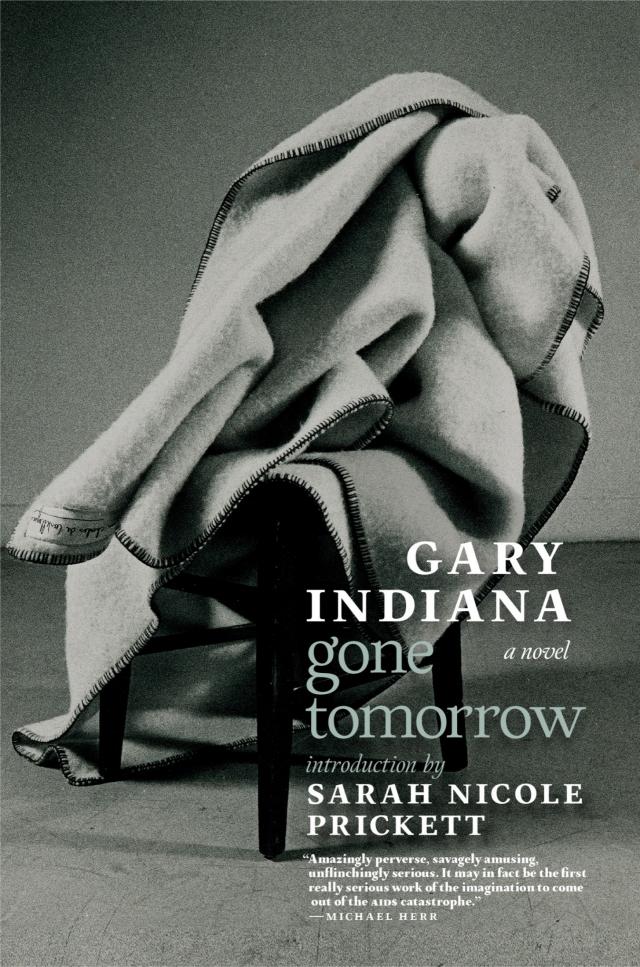
gone tomorrow
a novel
GARY INDIANA
introduction by
Sarah Nicole Prickett
SEVENS STORIES PRESS
New York • Oakland • London
Copyright © 1993 by Gary Indiana
Introduction © 2018 by Sarah Nicole Prickett
All rights reserved.
No part of this book may be reproduced, stored in a retrieval system, or transmitted in any form, by any means, including mechanical, electronic, photocopying, recording or otherwise, without prior written permission of the publisher.
Library of Congress Cataloging-in-Publication Data
Names: Indiana, Gary, author.
Title: Gone tomorrow / Gary Indiana.
Description: Seven Stories Press first edition. | New York : Seven Stories Press, 2018.
Identifiers: LCCN 2018017495| ISBN 9781609808631 (pbk.) | ISBN 9781609808648 (ebook)
Subjects: LCSH: Motion picture actors and actresses--Fiction. | Bogotá (Colombia)--Social conditions--Fiction. | GSAFD: Adventure stories.
Classification: LCC PS3559.N335 G66 2018 | DDC 813/.54--dc23
LC record available at https://lccn.loc.gov/2018017495
College professors and high school and middle school teachers may order free examination copies of Seven Stories Press titles. To order, visit www.sevenstories.com or send a fax on school letterhead to (212) 226-1411.
Manufactured in the United States of America
9 8 7 6 5 4 3 2 1
INTRODUCTION
Lost and Wanted:
Gary Indiana’s
Gone Tomorrow
by Sarah Nicole Prickett
The copy of Gone Tomorrow I wanted was a hardcover listed on Amazon as a “1993 Gay Signed First Edition,” printed in England by Pantheon, but it cost forty dollars plus shipping. The one I ordered was an American paperback, which had a more apt name on the spine—“High Risk Books”—and an equally suitable price of three dollars and ninety-nine cents. Three days later it came as advertised, in very good condition. No signs appeared of a former owner. Pages were unbent, words were neither underlined nor highlighted, and nothing was written in the margins until the end of the second-last chapter, minutes from close.
Here the dying subject, an art-house director—Paul Grosvenor— who has been diagnosed with HIV, gets groceries with the unnamed narrator, a quondam young actor, on the last day they will be together. Like most of the novel, the scene is told from memory during the course of an unplanned long afternoon the narrator spends with another man, Robert, a mutual friend last seen at the funeral. He recalls going with Paul
into the corner grocery, a mom-and-pop store. Paul took a shopping basket and began tearing through the place. He threw in a bottle of orange juice, then a bottle of grapefruit juice, a six-pack of Heineken, a jug of cranberry juice. Cheese. Cheddar cheese, brie cheese, blue cheese, provolone. Sweet Italian sausage. Hot Italian sausage. More cheese. A head of lettuce. A dozen eggs.
What is the rush? A staving off. Enough is in the cart for Babette’s dinner and Leopold Bloom’s breakfast. Only, Paul is not hungry. He’s desperate, filling time with the wan hope of more time.
At the bottom of the page a reader has jotted, in black gel ink newer than the paper, a neat seven words. Graphologists examining the writing would say that the annotator was a thwarted idealist, with a tendency toward sarcasm and anomie, in love with ambivalence; that he was regressive, fixated on ideas, modest and economical and at the same spontaneous, with a sharpened wit. Scholars would just look at the words:
And daytime is / The loss of this
The couplet is from a poem on something momentary:
This like a dream
Keeps other time,
And daytime is
The loss of this;
For time is inches
And the heart’s changes,
Where ghost has haunted
Lost and wanted.
The poem is by W. H. Auden. I would not have thought to compare Indiana with him, or to compare their works, not least because he—the poet—was fashionable in his time: no young person was brighter for a while. Auden in my mind remained wan and soigné and always reminiscing, definitively a “hopeless romantic.” Indiana by contrast was brilliant and inimical with style in excess of taste, as a sentence from a random page in Gone Tomorrow illustrates: “Somewhere between the moon and the villa a cloud shaped like a long, poisonous turd hovers in the balmy air, blue as a fatal contusion.”
But Auden in truth was more like a funny gay pessimist. Biographies skimmed reveal a wry sense of danger, a glimmering mordancy, the occasional attraction to murderers, wicked jokes. Anachronistically “open” about his sex life, he yet refused to “accept” himself as he was, was too neurotic and at the same time too Christian for that; he took care to seem more self-centered, indifferent, and aloof than he was intimately known to be, using effete aesthetics to obscure his severe and constitutive morality. Auden, when he wasn’t mooning, appeared as his own negative image. He was variable, too. He lived to reject as stupid or wrong his old verses, but forgot to deny what he’d famously said early on, that all his poems concerned love.
In Gone Tomorrow the motives and ends are both ulterior, the plotting kairotic. Paul, a cipher for Dieter Schidor (to whom the book is dedicated), begins making a film so experimental that the script is unfinished at shooting time in Bogotá, Colombia. Under the posthumous influence of a Low German auteur à la Fassbinder, he travels and works with a sybaritic entourage led by a translator whose name—Valentina Vogel—rings predictively of Veronika Voss. His ambition is fateful. Starring in the film is Irma, a rusty sexpot who effumes the “silvery illusion of perverse insatiability.” Opposite her is Michael, an unknown whose “southern beauty” is “so extreme that it . . . rip[s off] the veneer of civilization,” which is to say he looks like the girl in Joseph Conrad’s Victory. (That Indiana and Joan Didion have the same favorite Conrad novel makes sense. He likes to trace, as she does but less overtly, less permanently, the journey Heyst takes away from the world and from the self that exists because of others, and to linger on the eve of sure disaster.)
The narrator, whose part seems minor, watches the leads rehearse a sex scene. “Between them is developing the possibility of murder,” says Paul. “Between their characters,” the narrator tries to clarify, but the working definition of love is already clear. Locals say a serial killer is loose in Bogotá. Dinner is interrupted by the most erotic cockroach since the one in Clarice Lispector’s maid’s room. A situationist orgy among friends concludes the first act, and the second, where love is made on acid at Dachau and men die at home, makes as sharp a veer on paper as that between the Weimar Republic and Nazi Germany.
Indiana once, in an essay on Brecht and Weill’s opera, Rise and Fall of the City of Mahagonny, found it “possible to view the entire Weimar period . . . as one of reprieve—a long one, relatively speaking, that produced an immense outpouring of superior creative work,” which he likens to the time of cheap rent in a post–Robert Moses, pre–Donald Trump Manhattan, i.e., the mid-’60s to the early ’80s. Sarah Schulman, in her decade-old polemic The Gentrification of The Mind, remembers the critic Michael Bronski saying, at a conference on “AIDS literature” in 1998, that if it weren’t for fear of the homo it would be “American literature.” With Schulman, it’s possible to imagine a world where Indiana is as American as John Knowles (and only slightly more homosexual). Indiana, who is from New Hampshire the way Conrad is from Poland, may not want to be that American: He belongs to literature, purely. But, like Schulman, he dreads progressive memory loss, the encroachment of normalcy that passes for understanding. By the end of Gone Tomorrow the narrator, valiantly combatting the effects of alcohol, is thinking,
It was a real effort not to become histrionic, sentimental. [Robert and I] were two men who did not know each other very well, both in early middle age, making pleasant masks for each other in the starlit dreamtime of the Chelsea roof, while all around us the world we had known all our lives moved inexorably toward a gray homogenized blankness.
Indiana’s dry-eyed mourning evinces zero gratitude for being left alive. Paul, stricken with the plague before it has a name, let alone a cure, tries to kill himself with the soft, slow grandeur of a virgin on her wedding night, only to wake in the hospital with brain damage and parents in denial. There is nothing more absurd or redundant, tragic or farcical than the sick concatenation of “failed suicide attempt.” (When Auden’s Icarus falls into the sea, a distant spectator thinks it is “not an importa
It was around the time this novel came out that Eve Kosofsky Sedgwick, introducing her essay collection Tendencies, uneasily observed a culture’s rising fascination with gayness. “In the short-shelf-life American marketplace of images,” said Sedgwick, “maybe the queer moment, if it’s here today, will for that very reason be gone tomorrow.” Th she identifi the point of literature, for those who are queer and those who—more unfortunate—are human: “to make, stubbornly, a counterclaim against that obsolescence.”
gone tomorrow
For Dieter Schidor (1948–1987)
and for Bette Gordon, Wolf Wondratschek,
Vera Lehndorff, and Holger Trulzsch,
with gratitude
La vie c’est pas une
question de coeur.
L. F. Céline, Mort à crédit
PART ONE
mala hierba
no muere
1
At the Chelsea, 1991
I once had cancer on my face and when it was excised a fine web of scars embedded itself in my right cheek like the soft crust of a soufflé. Over the years the skin smoothed itself, but if light caught it at the wrong angle the flesh appeared bloated, trapped between intersecting keloid fissures. I would never again get parts that depended on my good looks; I changed careers and started writing for the magazines. I sued for malpractice the doctor who sewed me up and won a bundle in court. As I walked into the Chelsea, I fingered the dented filigree beside my mouth as if to rub a bit more of it away.
It surprised me to instantly recognize Robert Sheib, who sat on a sofa under an abstract painting. We had met only two or three times—in Munich, with Paul Grosvenor—when, as best friends of the same friend, we had assumed a superficial familiarity. Robert was an object of near reverence for people I had known, at various times, in various places: because he was esteemed as a poet, because as a public figure he’d come down on the worthy side of certain political questions, signed petitions and open letters and lent himself to committees for the general welfare, in former West Germany, former Munich, because he seemed to need very little from other people, and finally because he made an agreeable drunk. Now that Paul Grosvenor was dead (mysteriously dead, from my point of view), Robert was the only source of facts and rumors I thought it important to find out.
His plaid shirt, puffy cotton pants, and beige ankle boots evoked the costume of an early aviator—an effect, I realized, of the painting above his head, which suggested a small airplane whirring through muddy skies. The art in the Chelsea lobby has never looked entirely real or valuable to me, in spite of its cool pedigree.
“Well, so.” Robert grinned expectantly, a pale face coming into focus. I contrasted his relaxed English, unaccented enough to pass for American, with my memory of Paul’s overprecise diction. “It’s been years and years.”
Robert rose to his feet and offered a freckled hand.
“Four years, I think.”
“Where does the time go.”
“After forty it just races past.”
“The good times race,” Robert sighed. “Suffering crawls.”
“We should wish people a short life, I guess.”
“A wish often granted, alas,” said Robert, making my remark sound fatuous.
You have to climb up to the valley, I thought, and many lose their breath. My inner vision conjured a giant eye in the crater of a volcano, shuddering bloblike in time to a deafening heartbeat. Robert reminded me of Munich and Munich reminded me of a country house near Salzburg where, seven years earlier, I’d left a copy of The Other Side of the Mountain by Michel Bernanos, the one who died at forty. And those seven years were gone in the flutter of an eyelid.
That morning I had come across a postcard of a pensione I’d once stayed in in Positano. In my mind I saw steep cement steps wending down to a rocky beach, hairy torsos broiling in the sun, and echoing walkways threaded between damp stucco walls. The memory came attached to another dead friend: we had climbed one afternoon to a cemetery full of sweet clover and rosemary and dessicated weeds perched on a mountainside above Amalfi Drive. When this you see, remember me.
Standing, Robert looked like photographs of Rimbaud, handsome and bleary and spoiled, with short curls (in Robert’s case, red ones) and a subtle air of self-possession. He was the type of unaggressive male I had to remind myself wasn’t gay—“sensitive,” European, muy simpatico.
A blast of freon greeted us in El Quijote. There was something metallic about the restaurant’s vaguely controlled chaos.
When we had a booth and a pitcher of margaritas, Robert repeated what he’d told me on the phone: that he was sharing a suite upstairs with a television director named Dina, and writing bits for her ZDF documentary on hotels. They had a few more days of shooting at the Chelsea, then they’d go to the Marmont in L.A. Robert normally wrote books. In Munich, he and Paul had drifted together in the loose mix of cinema and literary types who inhabited the Deutsche Eiche and Harry’s New York Bar in the seventies and early eighties.
“I can’t sleep lately,” I said. “So a lot of times I try to drift off with the television on.”
“Uh-huh.”
“At four-thirty in the morning I hear this familiar voice. I open my eyes and look at the screen. And there’s Paul, all blond on blond, in Nazi drag—”
“The Guns of Koburg?”
“No, the American one, Cross of Glory, where he’s kind of an Ernst Junger type with a butterfly collection and hides a Jewish family in his wine cellar. I got up and took a pill.”
“Rudolph always ragged him about how natural he looked in an SS uniform.”
“Yeah. Well. Paul had the look, Rudolph had the behavior.”
The image of Rudolph Bauer rippled across the tangled circuits of memory. The Fat Man. Or, as Paul and I often joked, the largest German director of his day. Paul Grosvenor had produced one of Rudolph’s films—the last one, as it turned out, a big homo wet dream called Tarantella. Paul also directed a documentary film about Rudolph, for which Robert Sheib wrote a memorably unflattering narration. Most of the Germans I knew had been somehow mixed up with Rudolph, if not totally controlled by him. Paul, for instance, had had great plans of producing all Rudolph’s future movies, but then the great director overdosed on Mandrax in his Munich flat, dying with his head wedged into the toilet bowl. Since Rudolph had been a tyrannical, crazily vicious person (not consistently, that was the odd thing about Rudolph, he could also be the nicest person in the world, and there was never any logical reason for his viciousness, unless it was an irrational fear of abandonment) his passing wasn’t an unmitigated tragedy for his stunned circle. “A cross,” Paul once eulogized, “between the goose that laid the golden eggs and Dracula.”
I had met Paul in Paris after Rudolph’s death. Paul was still dining out on Tarantella then, and acted very grand, rather as if Rudolph were only temporarily dead and would soon launch a new project. Shortly after we became friends, Paul suffered a series of reversals, including lawsuits from Rudolph’s family, and at some juncture he filed for bankruptcy. Paul found his producing ambitions completely blocked. He kept busy with acting. He also directed several low-budget movies. These were all short subjects except one, The Laughter in the Next Room, which he’d hired me to appear in and shot in South America.
I remembered Cartagena as I scanned my forearms, unable to decide if particular tiny moles had been there for a long time. I remembered the bowl of the outer city, hills pockmarked with fortresses. In my memory the city had become a recumbent, scar-pestered body whose breath was the soughing of the tide.
“Do these little dots look normal to you?”
Robert examined my arm with pretended gravity.
“Yes,” he said. “Everybody gets those.”
I withdrew my arm. “I can’t help it,” I said. “When people drop all around you like flies. Not that you see so many dead flies. I’m always looking for tokens of the plague. I tell myself I should pitch a tent in the cemetery, since everyone will end up there eventually.” I said this as a charm against calamity.


