One shot harry, p.23
One-Shot Harry, page 23


“Him or me,” Ingram muttered. A rationalization he’d made more than once in the last two days.
After getting the pics he wanted of those onstage, Ingram meandered about, spotting Pettigrew sitting with his church folks, Strummer Edwards by himself and Arthur Yarbrough with the woman Ingram had met at Kinslow’s sendoff.
“How it going, Harry?” Yarbrough said as he stepped closer. Even with the voice of Governor Brown booming over the loudspeakers, his blind friend recognized the other man’s muffled footfalls on the grass. “That foot must be feeling better.”
“Like new.”
“I heard that. Oh, pardon me,” he said, turning slightly to his companion. “This is Millicent Mayfair. Millie was at—”
“Yes, I remember her.” Ingram stuck out his hand. “Pleased to formally meet you.”
“Same,” she said. Her voice had a husky, smoky quality. Arthur was grinning like a goof at Ingram. The three turned their attention back to the stage as several musicians began a musical interlude. Up there was Johnny Otis on vibes, Buddy Collette on clarinet, Clora Bryant on trumpet and Dexter Gordon on the sax. Reverend King had looked up from his notes to dig what they were laying down, Ingram observed.
When the musicians finished, Ingram made his way over to Otis, who was talking to Dexter Gordon. Ingram nodded at the tall saxophonist.
“Nice set, gents.”
“Thanks, man.” Otis dabbed at his sweaty brow with a handkerchief. He introduced Ingram to Gordon.
“Real quick, Johnny, you know a chick who goes by Hanisha?”
“Hell of a name,” Gordon rumbled.
Otis grinned broadly. “Yeah, played a few sets with her around town. But I heard she got out of the business to do her soothsayer hustle.” He chuckled.
“Do you know if Ben knew her?”
Otis looked away, then back at his friend. “Yeah . . .” he drawled, “seems to me Ben was in at least one of those gigs back when he was in town then.”
“Did they, you know, go around together?”
Otis hunched a shoulder. “Don’t know, why?”
“Just trying to fill in the blanks. Thanks.” Ingram turned to go.
“I remember I heard she was doing readings or whatever you call ’em for a few heeled white women on the west side. Maybe Ben helped make that happen. But I don’t know.”
“I hear you. Thanks again.”
Onstage comedian Dick Gregory was riffing at the microphone as Ingram again moved around, taking snaps of audience members laughing. After him a handful of other speakers came and went at the microphones until finally King came up to speak. First, though, he received a standing ovation that lasted over a minute. Ingram and Josh Nakano stood together clapping a few yards away from the stage.
“I want to thank Governor Brown, Reverend Dockery and all the other fine people up here today who have brought me back to this fine city,” King began. His next words were drowned out by more enthusiastic applause. When the clapping died down, he continued. “And you all out here today who believe that justice and equality are not simply lofty words but a clarion call to each and every one of us to do our part to bring about a nation that upholds its ideals set forth so long ago.”
The crowd exploded again.
“I gotta tell my mom about this,” Ingram said to his friend.
“Me too.” Nakano grinned.
Soon Ingram said good-bye to Nakano to work his way among those seated to capture the beaming faces of the more than thirty-five thousand in attendance. “Birmingham or Los Angeles, the cry is the same, we want to be free,” King proclaimed to thunderous applause. He looked out over the crowd. “Now is the time to transform the creative energy in this country to form a song of brotherhood to lift the country from the quicksand of racial injustice.”
His words garnered another standing ovation.
When King finally sat down, his shoulders slumped and his head dropped, like a boxer who’d just gone the distance. But when his head came up, he was smiling, and waved to the people. When the stadium again got quiet, singer Aretha Franklin came to the microphone to end the event. As her powerful voice filled the air, Ingram was kissing Anita Claire in a shadowed recess under the stands of Wrigley Field.
“Guess I better get back.”
“Okay,” he said, their faces close.
“Either of those two hoodlums been around?”
“Not lately.”
She pulled back farther, taking her hands from around his neck. “Those kinds of guys don’t fade into the woodwork, you know.”
“I hear you, baby. I’ll figure it out.”
“We’ll figure it out.” With a peck she was gone.
Ingram hadn’t told her about the bushwhacking in Altadena, or Morty. She didn’t know about his car being firebombed and him going into hiding. The last few days she’d been so busy getting things ready for King’s visit, they’d only talked by phone. In this way he also hadn’t had to let slip about his showdown with Wicks. The knife man, he could argue, was self-defense. His pulling the trigger on Wicks . . . a preemptive strike? That was only an excuse in wartime. Yet there had been no mention of either man’s demise in print or over the airways. As to why, Ingram wasn’t sure, but he was certain Hoyt was behind it. He supposed if pressed, the millionaire would send a killer after him to tidy up loose ends, so no sense calling attention to the two goons and Hoyt’s own involvement. This meant, though, Ingram would have to strike first to make sure nothing happened to Anita. Was he seriously contemplating killing a rich white man? If by some miracle he remained alive after being arrested, he’d be sent to death row, waiting his turn to suck in the gas chamber’s fumes.
But today the idea of death at the hands of the law didn’t faze him. Today he had a job to finish.
Ingram and Eddie Burrows, the writer covering the rally for The Nation, had arranged a time to meet outside of gate 7. Ingram walked out to the blacktopped parking lot to keep the appointment.
“Hell of a speech by King,” Burrows said. People streamed past them exiting the stadium, then milled in the parking area, talking about the rally. Burrows was in short sleeves and from the streak of wetness on his back, he’d sweated profusely this day.
“August in D.C. will be even bigger, grander,” Ingram said. He lit a cigar.
“Indeed. Are you going?”
“At first I had no interest, but now, yeah.” Ingram nodded. “Even if it’s on nobody’s ticket, yeah, I might just go.” If he wasn’t sitting in jail, he didn’t add. “How about you?”
“I want to, but looks like I’ll be in Indo-China then. Vietnam, they’re calling it now.”
“Didn’t Kennedy send some troops there?”
“Yeah, these tough bastards that eat nails for breakfast. They’re called the Green Berets. The word now is he’s stepped up our involvement on the sly to help out the French and keep the dominoes from falling.”
“They sold us that bill of goods in Korea,” Ingram said pointedly. Absently, he aimed and took a shot of Bradley talking to Governor Brown nearby.
“I’m tracking down something called Operation Ranch Hand.”
“What’s that?”
Burrows’s eyebrows went up. “Not exactly sure. But apparently it involves a chemical spray to screw up the North Vietnamese’s crops. A way to starve them out I guess.” He paused, then asked, “You think there’ll ever be a Black president of this country, Harry?”
“The Arctic gonna run out of icebergs?”
“No, really. Like King said. We can only aspire to be whatever we want to be when the roadblocks to make that happen are eliminated. Isn’t that the goal?”
Ingram tapped ash off the end of his cigar. “Not sure why any colored man would want to be the president. The aims of the Confederacy are alive and well in plenty of white folks’ hearts, Eddie. Black man as president, well,” he hunched a shoulder, “that fella would be living in a glass house. Every step he took, every sneeze he made would be a reason to find fault with him.”
“But think of how that could mean we’ve turned a corner when it comes to race and race relations.”
“Huh,” Ingram said, “right around that corner will be another white wall. Taller and harder to get over than the last one.”
“I hope you’re wrong.”
“Me too.”
In his shirtsleeves, Dr. Martin Luther King Jr. sat in a club chair in a corner of the large living room. In a few hours he’d be driven from this home in Sugar Hill to the airport to take an overnight charted flight to Chicago for the rally he was speaking at the next day, Sunday—at that city’s more famous Wrigley Field. He’d had a catnap between the rally at the stadium and the fundraiser with the Hollywood crowd that included Marlon Brando and Burt Lancaster. Ingram had skipped the event in favor of this one at the O’Dells’ home. The O’Dells, Nan and Hal, were an older white couple who’d lived here since the 1940s. Unlike several of their white neighbors, they hadn’t moved away when the neighborhood started changing. Claire had also informed Ingram the husband and wife were contributors to Bradley’s campaign.
Inside the home all sorts of people talked and snacked. It was a small gathering and the house itself was only two blocks away from the previous time Ingram had been in the neighborhood, the last time he’d seen Ben Kinslow alive. He was the only journalist here and had already gotten several candid shots he felt certain he could sell to one of the white slicks.
“I’ll be glad to get some sleep tonight,” Shoals Pettigrew said to Ingram as they stood off to one side of the home.
Stifling a yawn his friend answered, “You and me both.”
Despite a very long day, King was in good humor and chatted with several people who stood near him. Ingram drifted over to where Anita Claire and Judy Berkson were hovering near the spread laid out on the dining room table. Berkson nibbled at a cracker dabbed with a green blob. Given their trim figures, Ingram figured he put away more calories at breakfast than they did between the two of them all day.
“How you all holding up?” he asked them.
Claire briefly slipped an arm around his waist. “You losing weight, baby?”
“It comes from trying to keep up with you.”
“You two are too cute,” Berkson quipped. “Anita says you talked with Charlie Sutton.” She’d finished her cracker and was eyeing another one with a small, boiled shrimp on it.
“Interesting cat. I’m going to legitimately write up an article on him. But as to the diary, it doesn’t seem like he swiped it.”
“And we only have two others, one of them away until next week.” Berkson worried her bottom lip.
“We’ll figure it out,” Claire said. “Don really wants to write this book, huh?”
Her friend said, “He’s already started to work on it. But the diary contains specific dates and such that will help him keep it all organized. He’d like to have the facts to write the fiction.”
Ingram and Claire nodded.
Later, when it was just the two of them in the kitchen, she said to him, “I’ll work with Judy and her folks to get his book in shape. My mom’s got a pretty good memory and she can help fill in the gaps.”
“You’re not worried about the diary?”
“If it’s gone, it’s gone.”
“You was kinda hot to find it before.”
She laid a look on him he couldn’t decipher.
The swing door opened and in stepped a white woman, athletic build, early forties, tawny skin and decked out stylishly in black capri pants, a buttoned-up shirt and matador shoes.
“I’ll get you a beer and something to eat, Martin,” the woman was saying. She smiled at Ingram and Claire and reached a hand to the refrigerator. That’s when Ingram noted the sparkling bracelet on her wrist. The bracelet he’d seen in the photo among the ones Kinslow had stowed away.
“What is it?” Claire asked, catching Ingram glaring at the woman.
“Nothing, tired is all,” he said, trying to sound casual, a hand on her shoulder.
Past her, the woman had removed a can of beer from the refrigerator and placed it on the tiled counter. She rummaged in a drawer for an opener, then used it on the can. She’d also retrieved a highball glass from the cupboard and poured an amount into it. From the way she moved about the kitchen it was obvious she’d been a guest of the O’Dells before. She smiled again at the two as she exited.
“Harry,” Claire began.
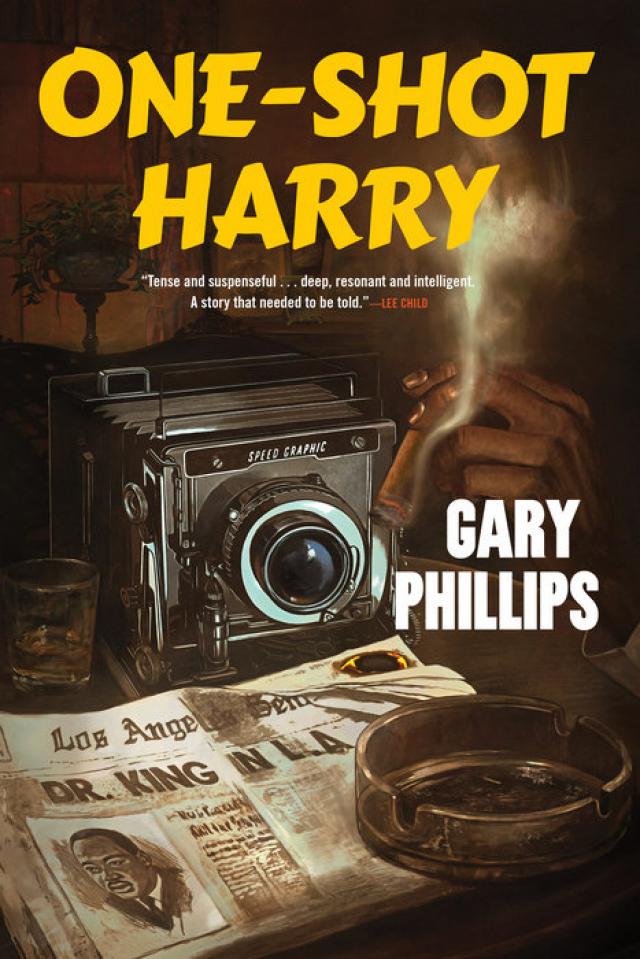
A finger to his lips, he turned from her and opened the swing door a crack. In this way he could see into the dining room, where the food was laid out under overhead lights. He had set aside his Speed Graphic but had also brought along his compact Canon. He watched as the woman piled several dainty triangles of sandwiches on a small plate. Ingram held the camera level to his sternum. Just before the woman picked up the plate, she dropped a round white pill into the beer glass and swirled the contents to help dissolve the pill. She then left his field of vision to deliver her goods.
Standing in the kitchen, Ingram frowned at Claire, who looked at him questioningly. “I think that lady is trying to poison the reverend.”
“What?”
“Come on.” He tugged her by the wrist to the living room.
The highball glass and sandwiches were on an end table next to the club chair King had been sitting in. Ingram stared fixedly at the glass. The level of the head of foam seemed to be where he’d last seen it less than a minute ago. At the moment King was standing, a hand in his pocket as he talked to Reverend Brookings. The woman with the particular bracelet was talking to a man and woman across the room.
“Shit,” Ingram mumbled. He whispered to Claire, “I’m going to distract Reverend King and you swipe his beer. In fact, spill it if you can so you have to replace it.” He started off.
“Okay,” she said softly to his back.
Ingram walked over and said to the clergymen, “Mind if I get a shot of you two?”
Brookings looked annoyed but King said, “Make it fast, will you? I’m about dead on my feet.”
“Sure, of course.” As Ingram lined up his shot, Claire was in position. But then King held up his hand.
“Hold on, I’m parched.” He pivoted and picked up the highball glass with a flourish, as if auditioning for a TV commercial to sell its contents.
Like when he was in combat, time slowed for Ingram, his heart racing and throat constricted by fear and anticipation.
King winked at him, saying, “Now you wait till I put this down. Got to keep certain parts of my real self separate from my public image.”
The words came to Ingram as if through a heavy scrim. He watched as King had the glass to his mouth. As he tipped it forward to drink, Ingram had two flashbulbs in hand plucked from his pocket. He threw them with force onto the hardwood floor. They exploded in audible pops, causing wide eyes all around.
“Sorry, nerves,” he stammered.
As if reacting to the mini-explosions, Claire bumped into the reverend. “Goodness,” she declared. Her action caused the contents of the glass to slosh over, wetting King slightly.
“Oh no,” someone said.
“It’s fine,” the prophet of nonviolence said, wiping at his shirt with his hand. “I’m still thirsty though.”
“Coming right up,” the woman with the bracelet said.
“I got it,” a man said, already heading through the swing door.
Someone else had fetched a wet towel and was rubbing King’s shirt.
“I’ve got another one in my luggage,” King assured his helper. “But the good Lord bless you for this beer.” The man had returned from the kitchen and King eagerly took the offered libation, this time straight from the can. He had a sizable sip and sighed satisfactorily. “That’s better.”
The woman with the bracelet had her arms folded, her mouth a thin line as she clenched her jaw. She stared hard at Claire.
With time to spare, King nonetheless said his good-byes about forty minutes later and was out the door, on his way to the airport. The woman had left before then. Ingram had glanced around the curtained window, and had noted the car she was driving. It was a sporty Jaguar XKE convertible.
Afterward at his place, Ingram and Claire unwound and debriefed.
“Maybe it wasn’t poison,” she wondered.
“What, a sleeping pill? He wasn’t driving himself.”
“Doesn’t seem to me the Providers would want him dead,” she said.
Ingram put his feet in his socks on the coffee table. “Four months before what’s going to be the biggest gathering ever for jobs and justice for the negro? Could you imagine how defeated everyone would feel if he were to die?”
Claire observed, “Seems to me that would drive more people to Malcolm X’s militant point of view. Cause riots and whatnot. King is for reform, not revolution. Him being cut down could make people way less inclined to wait for answers from Washington and more inclined to seek it in the streets.”
Shaking his head he said, “We’d need a whole grip of white folks on our side to pull off that kind of action, baby. Unless of course there’s a whole bunch of your running buddies’ secret cells around. And I mean there’d have to be several high-placed ones in the armed forces and all.” He imagined tanks rolling down Broadway, firing into buildings in the ghetto indiscriminately.
“The Bolsheviks built on a series of intense struggles over years, including maneuvering their allies into the governmental structure to pull off their coup.”