

The bastard legion frien.., p.28
Tiny Threads, page 28
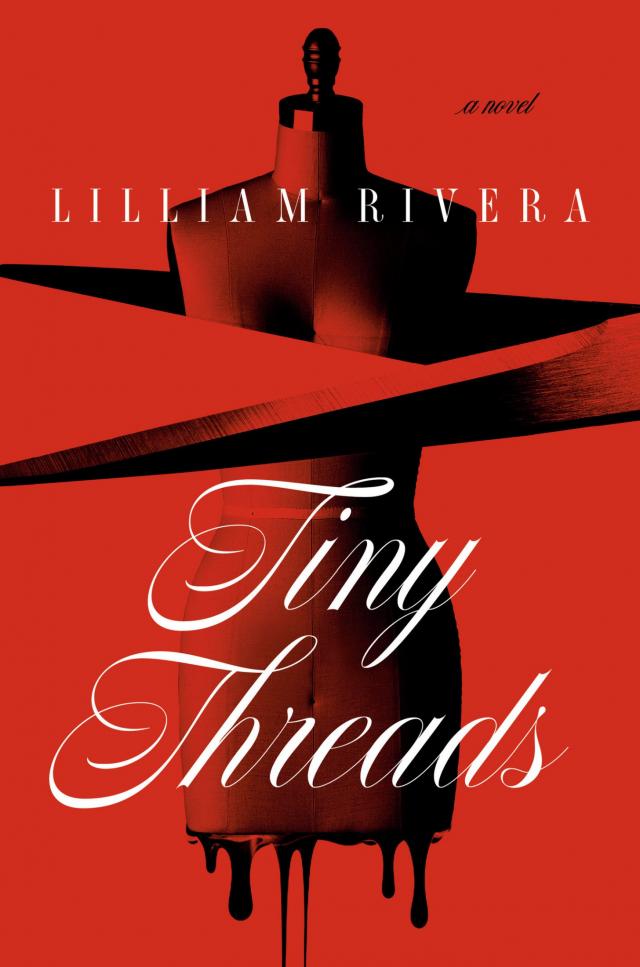


By Lilliam Rivera
The Education of Margot Sanchez
Dealing in Dreams
Never Look Back
We Light Up the Sky
Tiny Threads
Tiny Threads is a work of fiction.
Names, places, and incidents either are products of the author’s imagination or are used fictitiously. Any resemblance to actual events, locales, or persons, living or dead, is entirely coincidental.
Copyright © 2024 by Lilliam Rivera
All rights reserved.
Published in the United States by Del Rey, an imprint of Random House, a division of Penguin Random House LLC, New York.
Del Rey and the Circle colophon are registered trademarks of Penguin Random House LLC.
Hardback ISBN 9780593600474
Ebook ISBN 9780593600481
randomhousebooks.com
Book design by Edwin A. Vazquez, adapted for ebook
Cover design: Rachel Ake
Cover photos:Jeffrey Coolidge/Getty Images (dress form), MirageC/Getty Images (scissors), Ted Cavanaugh/Gallery Stock (drips)
ep_prh_7.0a_148318219_c0_r0
Contents
Dedication
Prologue
Chapter 1
Chapter 2
Chapter 3
Chapter 4
Chapter 5
Chapter 6
Chapter 7
Chapter 8
Chapter 9
Chapter 10
Chapter 11
Chapter 12
Chapter 13
Chapter 14
Chapter 15
Chapter 16
Chapter 17
Chapter 18
Chapter 19
Chapter 20
Chapter 21
Chapter 22
Chapter 23
Chapter 24
Chapter 25
Chapter 26
Chapter 27
Chapter 28
Chapter 29
Chapter 30
Chapter 31
Chapter 32
Chapter 33
Chapter 34
Chapter 35
Chapter 36
Chapter 37
Chapter 38
Chapter 39
Chapter 40
Acknowledgments
About the Author
_148318219_
To the countless workers toiling unseen
Prologue
The huskiness of his voice reminds her of the men back home, of tobacco and sweat. This is what draws her to him, the earthiness of his scent interlaced with the sweetness of the sprigs of lavender he carries in his pocket like a secret. The flower is for her alone, a gift he gives her whenever he enters the shop. When she lies down to sleep on the hard cot, she inhales deeply the perfume of smoke and lavender that nestles in the waves of her hair. The fragrance replaces the strawberries that once stained her fingers.
The dress she wears that night is too big for her slender frame. She always admired the intricate design of the vibrant red gown and the richness of the silk chiffon fabric complete with a tiny leather flower gracing the back of the neck. Wearing the corset underneath, she feels restrained yet powerful, the rounded neckline framing her bosom. The dress she borrowed from the shop without the patrona knowing of her deed. It’s just for one night, and she’ll return it to where it belongs.
She holds the white opera gloves in one hand, still unsure if she should wear them or be less formal. The gloves were left behind by one of the customers. She’s never been allowed to greet the patrons, has always been tucked away in the back, sewing by hand or cutting the fabric, doing what the patrona asks of her. Not tonight.
Tonight, she’ll be seen with him.
“Encantadora,” he says when they meet in their agreed-upon corner away from the shop. The patrona warned all the girls to keep away from the important townsfolk, but what does that God-fearing old woman know of these things? She’s nothing like the patrona.
“La zorrita, zorrita, señores, se fue a la loma…”
He leads her toward the bright lights and the sound of a woman singing. She’s never once entered the saloon at this hour. The only time she’s seen the inside of the place was late one morning when the saloon owner’s wife wanted her dress mended. That day, silent workers swept away the aftermath of a rambunctious night, but the pungent smell of vomit still lingered. She never once looked at the owner’s wife while she worked on the dress, but now her chin is raised as everyone greets the man with lively handshakes and hints of fear. The women also nod at her as a greeting and she does the same. They’re judging her, but tonight, she’s one of them.
She’s handed a drink and the man approves when she empties the glass without hesitation. So many people are pressed against each other, drinking and singing loudly alongside a woman strumming the guitar, her cheeks and lips stained red.
“Here.” He fills her glass again. Imbibing spirits has always been forbidden to her, but so is everything about this moment—the borrowed, ill-fitting dress, her too-tight shoes that don’t match, and the gloves that seem so ridiculously out of place now. So prim and proper. So pure. She gulps down the concoction, allowing it to warm her body, loosening her limbs. Soon the crowd moves outside, toward the back of the saloon.
“This way, sir,” a boy says. “We have your seats ready, front and center!”
They flow along with the crowd and she giggles at the sight of the madness, how the townspeople are letting go of their Sunday morning demeanor, the one she witnesses when she attends mass. The churchgoers crowd around the outdoor boxing ring, situating themselves on wooden benches.
“Ladies and gentlemen! In this corner you have the undefeated fighter of all of California!”
The crowd is restless, itching for something vile to happen. The fight commences and all around her everyone shouts while the room begins to spin. She covers her face at every punch and he teases her for it.
He leans in and whispers in her ear. “You don’t like it. Too brutal for you. Let me take you somewhere quieter.” The man has such gentle eyes.
There’s a slight chill in the air and she draws nearer to his warmth. He caresses her fingers as he leads her away from the crowd to a barn.
“You’re not like the others in the shop, are you?” he asks and she searches for the right word to say. The language is still so strange. The words sometimes just lay on her tongue like a lump.
“Diferente,” she says at first, then corrects herself. “Different.”
She holds her breath when he draws nearer.
His caresses take a different tone and at first she welcomes the sudden change. His large hand firmly holds the back of her neck, the same way she would hold a cat. But his touch becomes rougher, hurtful. She doesn’t recognize this side of him, but it’s too late. When she tries to back away, the slap across her face stings. She drops the gloves on the muddy floor.
“La zorrita, zorrita, señores, se fue a…”
Outside the singing continues, intermingled with the screams of the people wanting more blood. All the while, he does such monstrous things to her. Her body no longer exists. It becomes a foreign object, a tool, a meal. Teeth marks on her skin. Chunks of hair floating. Thrusting and laughter. Others soon join, and the night will be endless, filled with such relentless pain.
Later, cloven hooves will climb over her bare legs and atop her chest. There will be so many.
She never screams, not once, only grunts.
When I find it, I’ll pull that garment
from its hanger like I’m choosing a body
to carry me into this world, through
the birth-cries and the love-cries too,
and I’ll wear it like bones, like skin…
—“What Do Women Want,” Kim Addonizio
Chapter 1
December 4
Samara’s first day
The lobby is all dark furniture with hard edges and luminous glass walls, except for the piece of art located above the reception desk. Samara recalls reading how the legendary fashion designer Antonio Mota, her new boss, acquired this artwork by the late Cuban artist Ana Mendieta for an exorbitant amount of money. The piece, titled Color Photo of Earth, depicts the artist covered in green grass and white flowers. In the article, Antonio said the image spoke to him. “Even in death, Ana’s message lives on.” The banal-enough statement became the pull quote for the article. Some say Mendieta was pushed out the window by her jealous lover, artist Carl Andre. It’s interesting how the striking photo became a print on a pencil skirt Antonio sent down the runway last season. If Ana were still alive, would she have approved?—a question the reporter failed to ask.
“Hi, I’m here to see—”
The receptionist stands.
“Good morning, you must be Samara. Welcome! We’re so happy to have you be a part of our family. My name is Lake Montoya.”
Lake is tall and thin with long black hair framing her profile. She wears all black, from the designer’s fall collection: a long, clinging silk skirt and a form-fitting blazer with severe, pointy shoulders.
Samara spent the last couple of months committing to memory the various collections and the themes associated with each. Antonio started off in New York in the late seventies with violent, complicated designs that rarely translated into sales. Only a select few bold personalities were able to wear them. He eventually conquered Paris with his less intense creations, but as the years went by, his collections became more and more diluted. They became safe. Easy. After the line for Target came out, his edge was gone. He wants—no, needs—to return to his roots.
The receptionist gestures toward Samara’s luggage. A tattoo of an anatomical heart peeks out from her right wrist. “I can take that from you and store it, if you like. How was your flight?”
The place is library-quiet. Only slight murmurings can be heard above the soft, ambient music. There’s a whiff of the woodsy and grounding smell of palo santo. The eponymous fragrance is new for the company as they expand into other verticals. Samara’s mind can’t stop working overtime naming each of the new products. She may have secured the job, but her testing period has begun.
“It was fine,” Samara says. “No crying babies, thank God.”
Her voice changes to her “white girl voice.” When she’s with family and friends, her jaw relaxes and her speech drops to a lower octave. It’s deeper, guttural. Her white voice is higher, more controlled.
“Antonio should be arriving soon.”
“Great. Is there a restroom I can use?”
Samara follows Lake, admiring her towering flatforms. Lake takes a quick left and presses her hand against a silk-screen wallpaper based off of one of Antonio’s textile patterns to reveal a hidden door. Samara enters the spacious bathroom with toiletries displayed hotel-style.
Inside, she adjusts her sheer Helmut Lang top and tucks it into her Chanel sailor pants. Her style has always been very Italian mobster princess/hip-hop queen, rocking Nike high-tops and her signature large nameplate hoop earrings. Vintage aviator sunglasses sit atop her straightened brown hair. Samara dresses high and low—mostly low…always low—but she’s learned to mask the cheap by sprinkling in designer brands here and there. It’s how she’s been rolling even while living rent-free with her nosy Cuban family in Jersey. Working as a journalist meant being knee-deep in delayed checks courtesy of unreliable freelance gigs.
Moving away from journalism to work behind the scenes with a designer is what excited Samara most about her new position. She has such deep respect for anyone who can manipulate fabric to convey desire or violence. And it all began with a simple sketch and ended with the wearer of the fashion piece becoming a translator of the designer’s vision. As Executive Director, Global Brand Voice, Samara can help articulate that visual conversation, try to capture what the designer wants to convey to the masses, and with her input, help shape his message.
Some in the industry thought her too inexperienced for the title. But at twenty-five, Samara was the only fool still living at home instead of with friends crammed into a small apartment in the city no one could afford. So no matter what people said, this was her moment to carve her own space.
Moving to California in December meant she could give Jersey winters—and certain recent fucked-up events that almost destroyed her—the middle finger.
“Stop Sleeping on Vernon” was the title of the New York Times Style feature Samara wrote six months ago, covering how designer brands were setting up shop in the once industrial city of Vernon, California. Located southeast from downtown, just ten minutes away, Vernon is the new L.A., and now it is her new home.
“Where is she?” A commanding voice resonates across the office.
Samara steps out of the bathroom and places one hand in her pocket. Her headache from the tiny liquor bottles she consumed on her flight is mostly gone. She’s as alert as can be with a hangover. She walks back to the reception desk.
“You’re finally here,” Antonio loudly says, breaking the silence with his deep voice.
Antonio’s turning sixty-five this year, although people say he’s secretly way older, especially since he’s always so coy about revealing his age in interviews. He’s lucky to be both beautiful and ageless in that Latino way, with surgeries also keeping his face baby smooth. There’s no judgment from Samara about that.
They hug and do a kiss on each cheek. He holds a small stack of notes, phone messages, and a green juice.
“I’m so happy to see you,” he says, then addresses the receptionist. “Conference room.”
Lake nods. “It’s all set up.” She presses a button and makes an announcement on the intercom for everyone to meet in fifteen minutes.
Antonio leads Samara to his large expanse of an office. This is not where he sketches. He prefers to work alongside the junior assistant designers he hires in the open floor plan. This office is purely ego, to showcase more art pieces, but it’s not the art he’s acquired that draws the eye when entering. Instead, it’s the art he created: the dress form that showcases his first major design. The Ramona.
Samara walks up to the dress and admires it, finally seeing it in person after reading so much about it. The garment itself combines intricate lacework and leather in vampire red with a plunging neckline revealing an exposed breast. The skirt has a steel-wired hoop, creating a structured bustle with balloon sleeves. Motifs from nature, of flowers and dragonflies, travel up and down the dress. The lacework juxtaposed against the leather became Antonio’s signature style. The gown is named after Antonio’s great ancestor, the matriarch who forged a new life in California at the turn of the century after leaving Europe.
“Antonio, no one can ever come close to replicating your designs,” Samara says while caressing the leather flowers.
“They always try,” he answers with a chuckle.
Samara fell in love with how Antonio found ways to fold violence with beauty. At his first show in Paris, Antonio asked two model friends to end the show with one covered in bloodred paint and wearing a thin silk chemise and the other wearing The Ramona. When the model wearing The Ramona pretended to strike at the blood-drenched woman, as Antonio had instructed her to do backstage just minutes before she stepped on the runway, the crowd went wild. He named the show La Venganza. Critics loved the boldness of it, how he featured white models subservient to the indigenous-looking ones, for once flipping the script. Although he was raised in New York, ten years ago Antonio traced his roots to California. It’s why he landed in Vernon. His actual percentage may scream Mexican, but he never fails to bring up how connected he is to his Basque side—the Ramona side.
“Are you settled in your new apartment?” Antonio asks, pouring a cup of tea for her. Samara joins him on the couch.
“Not yet. I will after I leave today.”
“You didn’t have to come here right away. You could have stopped first at your place. I’m not that evil.”
Samara grins. This is definitely a trick. Antonio had insisted she take the earliest flight in and come directly to the office from the airport. For this year’s Fall/Winter collection, Antonio will be simultaneously streaming two live runway shows on the same day: one in Vernon, immediately followed by the other in New York’s Bryant Park. The date is set for February 10, just two months away, and her hiring as Global Brand Voice is evidence of its importance. The newly formed title oversees creative content across all channels. It’s on her to make sure the designer’s edge is consistently conveyed in every single consumer-facing sentence—be it digital or retail. Samara even pulled some strings to get press on her new position. They posed together for WWD: the upstart writer and the legendary designer.


