

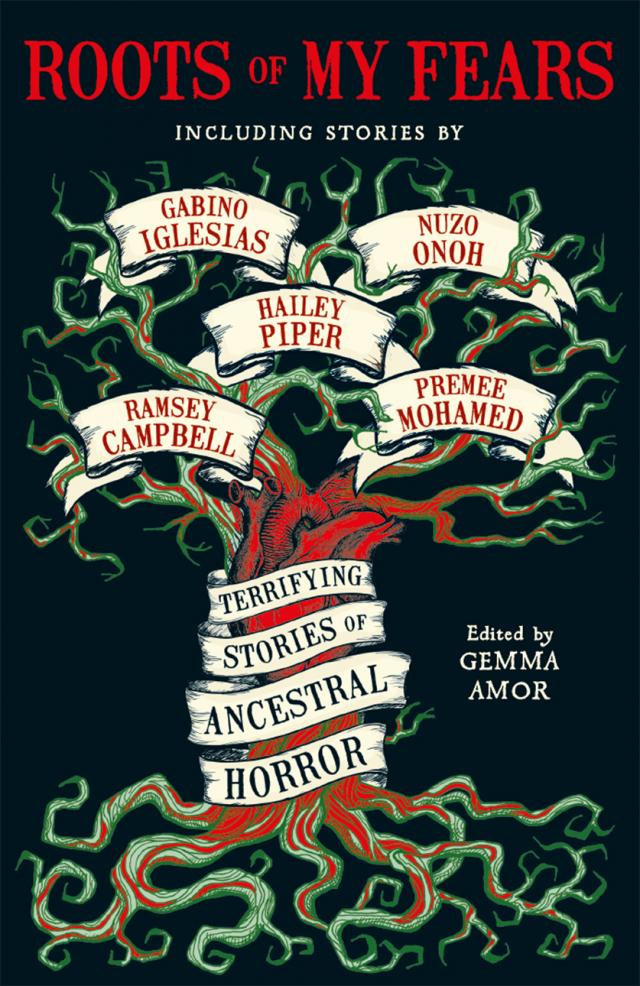
Roots of my fears, p.1
Roots of My Fears, page 1


CONTENTS
Cover
Title Page
Leave us a Review
Copyright
FOREWORD Gemma Amor
LAMB HAD A LITTLE MARY Elena Sichrovsky
THE HOUSE THAT GABRIEL BUILT Nuzo Onoh
THE FACES AT PINE DUNES Ramsey Campbell
IN SILENCE, IN DYING, IN DARK Caleb Weinhardt
ONE OF THOSE GIRLS Premee Mohamed
JURACÁN Gabino Iglesias
THE SAINT IN THE MOUNTAIN Nadia El-Fassi
CREPUSCULAR Hailey Piper
LAAL ANDHI Usman T. Malik
THE WOODS Erika T. Wurth
UNSEWN Ai Jiang
TO FORGET AND BE FORGOTTEN Adam Nevill
THE VETERAN V. Castro
CHALK BONES Sarah Deacon
Acknowledgements
About the authors
About the editor
ROOTS
OF
MY FEARS
Edited by
GEMMA AMOR
Also available from Titan Books
FANTASY
Rogues
Wonderland: An Anthology
Hex Life: Wicked New Tales of Witchery
Cursed: An Anthology
Vampires Never Get Old: Tales With Fresh Bite
A Universe of Wishes: A We Need Diverse Books Anthology
At Midnight: 15 Beloved Fairy Tales Reimagined
Twice Cursed: An Anthology
The Other Side of Never: Dark Tales from the World of Peter & Wendy
Mermaids Never Drown: Tales to Dive For
The Secret Romantic’s Book of Magic
CRIME
Dark Detectives: An Anthology of Supernatural Mysteries
Exit Wounds
Invisible Blood
Daggers Drawn
Black is the Night
Ink and Daggers
Death Comes at Christmas: Tales of Seasonal Malice
SCIENCE FICTION
Dead Man’s Hand: An Anthology of the Weird West
Wastelands: Stories of the Apocalypse
Wastelands 2: More Stories of the Apocalypse
Infinite Stars
Infinite Stars: Dark Frontiers
Out of the Ruins
Multiverses: An Anthology of Alternate Realities
Reports from the Deep End: Stories Inspired by J. G. Ballard
Revolution in the Heart
HORROR
Dark Cities
New Fears: New Horror Stories by Masters of the Genre
New Fears 2: Brand New Horror Stories by Masters of the Macabre
Phantoms: Haunting Tales from the Masters of the Genre
When Things Get Dark
Dark Stars
Isolation: The Horror Anthology
Christmas and Other Horrors
Bound in Blood
THRILLER
In These Hallowed Halls: A Dark Academia Anthology
These Dreaming Spires: A Dark Academia Anthology
LEAVE US A REVIEW
We hope you enjoy this book – if you did we would really appreciate it if you can write a short review. Your ratings really make a difference for the authors, helping the books you love reach more people.
You can rate this book, or leave a short review here:
Amazon.com,
Amazon.co.uk,
Goodreads,
Barnes & Noble,
Waterstones,
or your preferred retailer.
Roots of My Fears
Print edition ISBN: 9781803369365
E-book edition ISBN: 9781803369372
Published by Titan Books
A division of Titan Publishing Group Ltd
144 Southwark Street, London SE1 0UP
www.titanbooks.com
First edition: September 2025
10 9 8 7 6 5 4 3 2 1
This is a work of fiction. All of the characters, organizations, and events portrayed in this novel are either products of the author’s imagination or are used fictitiously. Any resemblance to actual persons, living or dead (except for satirical purposes), is entirely coincidental.
FOREWORD © Gemma Amor 2025
LAMB HAD A LITTLE MARY © Elena Sichrovsky 2025
THE HOUSE THAT GABRIEL BUILT © Nuzo Onoh 2025
THE FACES AT PINE DUNES © Ramsey Campbell 1980. Originally published in New Tales of the Cthulhu Mythos, 1980. Reprinted by permission of the author.
IN SILENCE, IN DYING, IN DARK © Caleb Weinhardt 2025
ONE OF THOSE GIRLS © Premee Mohammed 2025
JURACÁN © Gabino Iglesias 2025
THE SAINT IN THE MOUNTAIN © Nadia El-Fassi 2025
CREPUSCULAR © Hailey Piper 2021. Originally published in Far From Home: An Anthology of Adventure Horror, 2021. Reprinted by permission of the author
LAAL ANDHI © Usman T. Malik 2014. Originally published in Truth or Dare, 2014. Reprinted by permission of the author.
UNSEWN © Ai Jiang 2025
TO FORGET AND BE FORGOTTEN © Adam Nevill 2009. Originally published in Exotic Gothic 3: Strange Visitations, 2009. Reprinted by permission of the author.
THE WOODS © Erika T. Wurth 2025
THE VETERAN © V. Castro 2025
CHALK BONES © Sarah Deacon 2025
The authors assert the moral right to be identified as the author of this work.
No part of this publication may be reproduced, stored in a retrieval system, or transmitted, in any form or by any means without the prior written permission of the publisher, nor be otherwise circulated in any form of binding or cover other than that in which it is published and without a similar condition being imposed on the subsequent purchaser.
A CIP catalogue record for this title is available from the British Library.
EU RP (for authorities only)
eucomply OÜ, Pärnu mnt. 139b-14, 11317 Tallinn, Estonia
hello@eucompliancepartner.com, +3375690241
Designed and typeset in Adobe Caslon Pro by Richard Mason.
FOREWORD
Root” is a powerful word, and an even more powerful natural phenomenon. Charles and Francis Darwin theorised that roots, in a botanical sense, act like a brain, dictating how plants grow, move and behave and how their cells communicate with each other. Their theory was seen as revolutionary biology and is wonderfully applicable as a human allegory. My own roots determined the current version of me; how I act, think, move and grow, like some strange, organic, time-travelling magic based on consequence, for roots also ignore the traditional constraints of time. They stretch into the past and weave through the present and the future.
When I think of roots now, I mostly think of reasons to stay.
Those reasons anchor me to this earth with hopeful tendrils and fibres spreading out through the soil of lived experiences. Or maybe the roots are the memories of those experiences, each one stubbornly tied to this life. Without them, we are unmoored, drifting, lost. My roots kept me here when I no longer wished to slog through the daily struggles. When my brain told me I wanted to die, my roots nourished me and helped me to grow stronger, fitter, more present. I have these little tubers of obligation, and purpose, and love, and duty, affection, and history, causes that snake through and around everything I do and all who live in my world.
They aren’t all healthy, these connective ties. Some of them have withered and rotted in the ground, but I remain attached, even though I do not live where I was planted. Like so many of us who hated where they grew up, I got out of that dying market town at eighteen and never looked back. The sky feels larger and heavier there, the land too flat. The town decays and shops in the centre around the once busy marketplace are empty, metal sheets fixed across the windows to prevent break-ins. I sometimes wonder what my life would look like if I had stayed. Would I be writing or editing books?
The connective family root has not fully shrivelled. Every now and then, there is this little tug on my soul, and I find myself ‘home’. It is always as depressing and exhausting as I imagined it would be, even though some good memories remain.
These are also my roots: a pair of headstones in a cemetery, carved with my grandparents’ names, who raised me. My mother, who refuses to move from our hometown. The bus back takes me past my old school before it drops me near my childhood house. Primary roots, without which, I would not exist. I both love and loathe them.
Which got me thinking about ancestry, about a sense of place, about what it feels like to be rooted in a culture, a tradition, a family, chosen or inherited; prejudice, love. Or, what it feels like to be uprooted, transitory, confused. Horror is the perfect playground for such explorations: it is a genre highly bound in identity, in existential explorations, in matters of belonging, or of being alone. The stories in this anthology, Roots of My Fears, portray some of those ideas in masterful fashion, from writers you’ve heard of and a few you perhaps have not. The roots pushing insistently through these pages tell of family dynamics, meaningful places, journeys of identity, death, birth, loss, pain, gain, shame. Customs and lore, traditions and superstitions. Bones, blood, scales, fur and teeth. Hauntings of an intimate and highly personal nature. Monstrous things made of grief, of hate, of regret, of hunger. I am extraordinarily proud of what we’ve created here, and the breadth of stories we’ve been able to tell. I hope you enjoy this assortment of magical, and at times, devastatingly beautiful, horror fiction as much as I enjoyed putting it together. I hope that during a time where many of us are searching for meaning in a life that seems fraught and fri ghtening and overwhelming, a reminder of where we’ve come from, for better or for worse, can provide some comfort as we try to grow towards the light, no matter how scant. The roots will keep us firm and steady. The roots will provide.
GEMMA AMOR
March, 2025
LAMB HAD A LITTLE MARY
ELENA SICHROVSKY
Lamb had a little Mary, with cheeks as white as snow.
And everywhere that Lamb went, Mary was sure to go.
Lamb never roamed far into the forest, but wherever she walked on her long legs Mary had to run to keep up. Lamb told Mary that one day her body would sprout legs just as long and spindly. Someday, she would be taller than the berry bushes; someday, she would look just like Lamb, with those big, shadow-rimmed eyes and sour breath.
The only place Mary was not allowed to follow was the cellar. Some nights Lamb would go down there and open a spigot of rage and let it rush into her mouth, like a flaming red colony of ants. Mary would sit on the edge of her bed and wait and wait until Lamb came back up the stairs, wobbling on those long, bendy legs.
Mary always knew when Lamb had been to the cellar because she felt fire from Lamb’s tummy when she laid her head there to rest. She felt warm droplets hit her dress when Lamb pissed herself while tucking Mary in bed. She felt heat from Lamb’s snores when she fell asleep beside her, heavy arms splayed across Mary’s thin bones.
The one thing that still felt cold was the light from the window. Lamb always forgot to put the paper-cut stars on the glass pane, so the night became one giant black eye that never cried or even blinked. Even when Mary closed her eyes, she could feel the chill creeping through her eyelids.
* * *
The next morning Lamb opened her mouth and last night’s dinner came pouring out for breakfast.
Mary was still hungry, so she went out into the forest and plucked black pearls off the throat of a chokeberry bush. Chokeberries had magic because of their ruby-midnight color. She whispered a secret to each berry before pushing it between her teeth. She told the first one that sometimes, in her dreams, Lamb acted more like Wolf, except Wolf wasn’t real; it only lived inside storybook spines. She told the last berry that she wished for another Mary. They could be little together; they could push Lamb’s sleeping body off the bed and watch the paper stars shine forever.
The last chokeberry must have had the most powerful magic, because it listened to her. By winter Lamb’s legs grew much fatter and Mary heard knocking from inside when she put an ear to her swollen tummy. Lamb slept longer, read fewer stories at bedtime, and sometimes didn’t return from the cellar until morning.
One day the tummy-knocking stopped and the crying started.
Then Mary met Tiny.
* * *
Tiny was wrinklier and pinker than Mary. Tiny cried at the sun when it set and cried when it rose. Tiny even cried at the moon. Sometimes, when Mary told Tiny about the chokeberry that had granted her wish, Tiny stopped crying.
Lamb looked strange now. Parts of her chest looked longer, like bells with pink ends that Tiny would grab and suck at. Mary was hungry too, but Lamb said only Tiny could drink from the bells of white cream and sweet smell. Mary wanted to go out and find more chokeberries, but now the ground wore ice dresses and glass shoes and Mary was afraid to slip into their dizzying dance, so she sat by the window and licked wet mist off the shivering glass instead.
Then Lamb’s pink bells stopped ringing.
Tiny cried and cried until her little mouth grew cherry red, but there was nothing left to drink. Lamb went back to the cellar and Mary waited and watched Tiny thrashing in her cradle. After some time, when Lamb did not return, Mary put a spot of spit on her finger and laid it between Tiny’s lips. There were no teeth, just soft elastic gums sucking at her fingertip.
One night, Lamb came back from the cellar and her legs were dancing so hard and fast that when she spun, she flung Mary across the room. Mary hit her head and rolled out the open door, landing in the ballroom of dark ice dresses. Snowflakes spun her into a dream that was silver at the edges and howling in the center.
Mary didn’t get up for some time. She just laid there, drinking up the cold beauty like poison. Her fingers and toes disappeared and then returned, again and again like the wooden seat of a swing.
When Mary finally crawled back into the house, shivering and shaking, there was no one in the bedroom.
* * *
Mary ran around inside and outside, calling for Tiny. She wondered if the magic had run out and the chokeberries had taken Tiny back. She determined then and there that she would dig through the snow and find more chokeberries; she would tell them every secret she had, about the family of dead snails under the flowerpots and the headless monsters under her pillowcase. Anything they wanted to know, she would give them, if only they would let her have Tiny again.
Then Mary smelled a whiff of piss from below. She wasn’t supposed to enter the cellar, but Tiny didn’t know that. Mary had to warn her. She climbed down the staircase, one hand covering her eyes, two fingers spread far apart enough to see through the crack.
When she arrived at the cellar door it was open. Lamb was holding Tiny and pressing her little lips to the rage spigot. Mary ran over and snatched Tiny away. The fire that Lamb drank was bitter and angry, and Tiny should only have sweet things in her mouth, things laughing and white and soft-smelling.
But Lamb was angry that Mary had come to the cellar. She rose, loud and red, moving fast and dark, and she scratched Mary.
So it turned out that Lamb was part Wolf after all.
* * *
Mary took Tiny to the bed and laid down to sleep beside her. The scratch on Mary’s arm burned against the blankets, so she told the scratch a story. The paper-cut stars on the dresser got up and sat around her in a glowing circle to listen, too. Mary talked about the powerful family of chokeberries that wandered the forest beyond the house, and how the magic that had given her Tiny would surely keep them safe.
But then the paper stars heard footsteps coming, got scared and ran away.
Mary saw Lamb-Wolf looming on crooked legs—a tall, faceless shadow—until she moved forward and collapsed to sleep at their side, her unhappy mouth wide and wet with drool.
The sheets were damp when they woke up. Lamb-Wolf said that Mary had wet the bed. Mary saw the dark stain on the front of Lamb-Wolf’s clothes, but didn’t say anything. She washed the sheets like she was told and boiled them in the sun until they bubbled to the surface like drowned clouds.
Mary’s arm still hurt where Lamb-Wolf had scratched her, so she showed her wound to the icicles hanging from the rooftop. The icicles poured little rivers onto the patch of skin, now rippling in hues of purple and green. Mary explained that the scratch had transformed into a spiral of dream-dust, just like the Northern Lights, and the icicles melted into applause, one at a time.
* * *
Lamb-Wolf was different now. Her eyes were even darker than before. Mary followed her to the bed and then down to the cellar and back to the bed, but Lamb-Wolf didn’t talk to her anymore. Mary was too afraid to get scratched again, so she just watched Lamb-Wolf hold Tiny up to the spigot, watched Tiny cry all night, watched Tiny reaching in vain for Lamb-Wolf’s chest bells.
Days and nights passed. The icy ballgowns of the forest went away, and the earth took out green skirts and thin brown scarves. Mary taught Tiny how to count Lamb-Wolf’s crusty yellow toes and crawl up the long bridges of Lamb-Wolf’s legs. She told Tiny that soon the chokeberries would bloom again and they would know how to help. They might even fix Lamb-Wolf so that she would just be Lamb again.
* * *
The chokeberries didn’t come back in time.
They didn’t stop Lamb-Wolf from dropping Tiny under a soapy tongue of bathwater. Lamb-Wolf was closing her eyes on the edge of the tub, and Tiny’s mouth opened under the water, with no sound coming out. Mary got the sleeves of her dress wet when she reached in to rescue Tiny.
Then Lamb-Wolf woke up and pulled at Mary’s wrist, but Mary pushed her away. She didn’t want her to sleep in their bed tonight. She wanted to dream with Tiny and the paper-cut stars. So she pushed Lamb-Wolf’s head into the warm bubbles of the bath, making her hair all wet and shiny. And Mary kept pushing and pushing and pushing—


