

The douglas dc 3, p.1
The Douglas DC-3, page 1


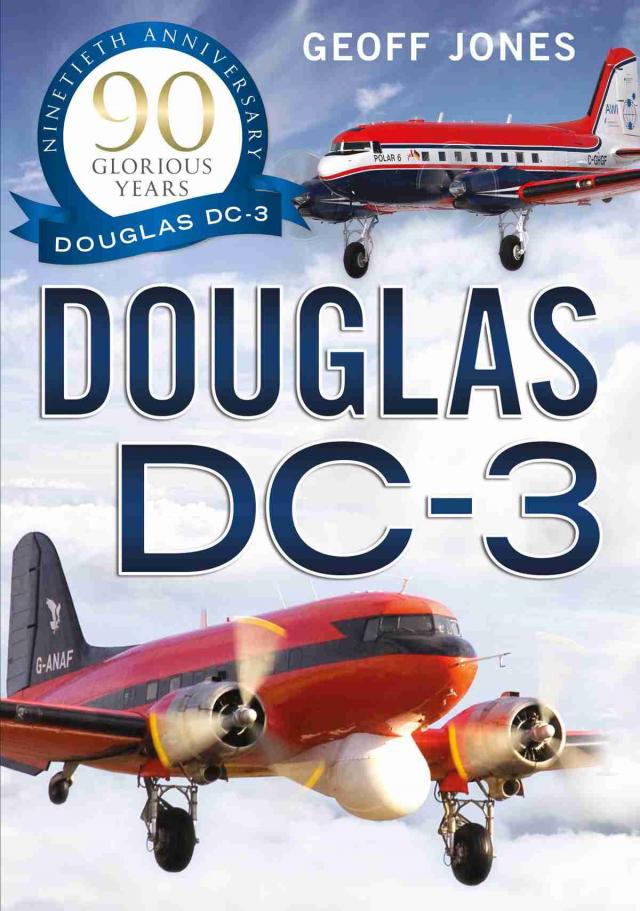
First published in hardback in the United Kingdom and the United States of America 2015
This paperback edition published 2025
Published by Fonthill
An imprint of
Pen & Sword Books Ltd
Yorkshire - Philadelphia
www.fonthill.media
Copyright © Geoff Jones 2015, 2025
ISBN 978-1-80420-060-5
The right of Geoff Jones to be identified as the author of this work has been asserted by him in accordance with the Copyright, Designs and Patents Act 1988. A CIP catalogue record for this book is available from the British Library.
All rights reserved. No part of this book may be reproduced or transmitted in any form or by any means, electronic or mechanical including photocopying, recording or by any information storage and retrieval system, without permission from the Publisher in writing.
The Publisher’s authorised representative in the EU for product safety is Authorised Rep Compliance Ltd., Ground Floor, 71 Lower Baggot Street, Dublin D02 P593, Ireland.
For a complete list of Pen & Sword titles please contact
PEN & SWORD BOOKS LIMITED
47 Church Street, Barnsley, South Yorkshire, S70 2AS, England
E-mail: enquiries@pen-and-sword.co.uk
Website: www.pen-and-sword.co.uk
or
PEN AND SWORD BOOKS
1950 Lawrence Rd, Havertown, PA 19083, USA
E-mail: uspen-and-sword@casematepublishers.com
Website: www.penandswordbooks.com
For Julie, Angela, and Siân—my girls
Acknowledgements
I would like to thank Jay Slater for commissioning me to undertake this daunting task, and for keeping faith with me along the bumpy road to completing it. A huge thank you is also due to Propliner magazine, its editor, and its contributors—information and articles it contains were invaluable in filling vital gaps in my knowledge. Also, I want to thank (in alphabetical order) those who have so freely and willingly supplied illustrative and other material: ATDB (Aero Transport Data Bank); Gӧzde Akyüz, Collections Management Specialist at Rahmi M. Koc Müzesi Istanbul; Alfred Wegener Istitut; Norman Atkinson; Aviodrome (Will Porrio); Italo Battioli; Alain Battisti; Morné Booij-Liewes; Tony Carless; Claudio Carretta; Vladimiro Cettolo; Phil Clarke; Gavin Conroy (NZ); Geoff and Jessica Cooper (NZ); Ron Cuskelly, Vice President of the Queensland Air Museum; Keith J. Dagwell; Dakota Association of South Africa; Dakota Norway (Martin Nilsen and Truls Kaland); Justin de Reuck; Paul Filmer; J. M. Gradidge and the biblical trilogy she published with Air Britain, The DC-1, DC-2, DC-3—The First Seventy Years; Clinton Groves Collection; Ken Honey; Mike Hooks; Paul Howard; Alan Howell; Reinhard Keimel; John King (Aviation News New Zealand); Murray E. Kirkus; A. K. Levent (Istanbul Hava Müzesi, History Branch); Terry Love; Kelvin Lumb; Michael Magnusson; Tony Merton-Jones and his excellent Propliner magazine; Adam McCallum (BSAS International); Carmen McKinney (LCMCD); Heiko Müeller (Klassiker); Rob Neil (NZ); NWA History Centre; Andy Ozanne; Dave Partington; George Pennick Collection; Esteban Raczynski; Bryan Pill; Graham Robson; Santiago Rivas; Andreas Rohde; Dan Ryan (and Kelly Nagle), at the Museum of Flying, Santa Monica; Dick Snook (MFI); Chuck Stewart; John Underwood; Simon Westwood (Classic Air Force/Air Atlantique); Nigel Williams; Franco Zanaboni.
Contents
Acknowledgements
Note from the Publisher on the 2025 Edition
Introduction
1 Before the Beginning: DC-1 and DC-2
2 DC-3: The American Dream-Maker
3 UK and European Airlines Embrace the DC-3
4 Nazi and Fascist DC-2s, DC-3s, and the DC-2½
5 Brazilian Adventures and Latin America
6 DC-3 Conversions
7 Missionary Flights International DC-3s
8 Bugs Beware
9 Antipodean and African Dakotas
10 Survivors
11 Best of the Rest
Appendix 1: DC-3 Variants
Appendix 2: Basic Specifications and Performance
Appendix 3: Dak Stats
Note from the Publisher on the 2025 Edition
Geoff Jones, who died in 2017, was a pilot, writer and photographer. He grew up in the 1960s hearing the sounds of Cambrian Airways DC-3s thundering out of his local airport at Cardiff/Rhoose. Geoff wrote about and photographed many aspects of the world’s civil aviation scene during a career spanning fifty years, and built a reputation as a respected author/photographer with fourteen civil aviation book titles to his name and thousands of magazine articles. Flying a DC-3 in the Caribbean was a career highlight.
This paperback edition of Douglas DC-3 has been published ten years after the publication of Geoff’s original book—hence the updated subtitle ‘90 Glorious Years’. For DC-3 enthusiasts, Geoff’s writing is still as relevant today in 2025 as it was in 2015, and its relevance will continue for as long as the DC-3 is remembered and loved—and long may that be. As Geoff says in his introduction: ‘Some airframes have been re-built and re-engineered, fitted with turbine engines, and will fly on well beyond the DC-3s 100th anniversary.’ We are pleased to present this long-awaited paperback edition in Geoff’s memory.
Introduction
The Douglas Aircraft Company’s DC-3 is as synonymous with civil commercial air operations as the Spitfire and Hurricane (and, more recently, the C-130 Hercules and F-16 Falcon) are to military air operations. Although ‘iconic’ is a much over-used word, the Douglas DC-3 truly is an iconic airliner. The DC-3 has many names, sometimes affectionate and sometimes less so—for example, Gooney Bird, Charlie Forty Seven, Skytrain, Skytrooper, Mainliner, the Doug, Dumbo, and, of course, the RAF name ‘Dakota’ or simply ‘Dak’. If Soviet and Japanese production is included, over 16,000 were built—a number almost greater than any other transport aircraft in the history of aviation. It easily ranks up there with other air-transport icons, such as the de Havilland Comet, the Boeing 747 Jumbo Jet, and Concorde.
A considerable number of airliners were designed and built after an airline CEO requested them from a manufacturer. When Howard Hughes was head of Trans World Airlines, he told Lockheed, ‘You build it, we’ll buy it’—referring to the Lockheed Constellation. Edward Hillman, of the 1930s Hillman Airways airline, is alleged to have earlier said the same thing to Geoffrey de Havilland in the United Kingdom. He was looking for a replacement for the DH Fox Moth, to begin a London-Paris scheduled air service; the DH84 Dragon was the result. President of American Airlines Cyrus Rowlett Smith, supported by his Vice-President of Engineering, William Littlewood, was already happy with the smaller DC-2. However, he wanted a larger, ‘wide-body’ version, with a 50 per cent greater payload and range—so he said to Donald Douglas, ‘…we’ll contemplate an order for up to twenty wide-body developments of the DC-2 if you will build them.’ Before this, however, Transcontinental & Western Air’s Vice-President Jack Frye had written to the Douglas Air Company, requesting a new specification of airliner. At this stage the desired aircraft was a tri-motor—they wanted ten of them, in order to compete with United Air Lines and their Boeing 247. The aircraft that emerged was the first Douglas twin, the DC-1, which quickly developed into the DC-2.
The DC-3 design was developed from the DC-2, and was first dubbed the ‘Douglas Sleeper Transport’ or DST—because half of Smith’s order was for fourteen-passenger DSTs that would fly through the night, as part of the airline’s services from the US East Coast to the West Coast. Despite Douglas’s apparent reluctance to proceed with this development, Littlewood was seconded to the Douglas Aircraft Company’s Santa Monica factory to assist the Douglas design team. Here, he helped Dr Bailey Oswald, Arthur E. Raymond, and Ed Burton to ensure that the basic American Airlines specifications were applied to the DC-2 when creating the DST. These were:
By the end of the twentieth century, this plane had flown more hours than any other. It is North Central Airlines N21728 (c/n 2144)—it accumulated more than 50,000 hours with Eastern, and was then sold to North Central. In June 1975, when it finally retired to the Henry Ford Museum at Dearborn, Michigan, it had accumulated 84,875 airframe flying hours. (Geoff Jones Collection)
Douglas DC-2-120 NC 14278 (c/n 1311) in American Airlines colours, photographed on 19 August 1935. Note the paint-scheme on the wing aileron surfaces, which make the wing appear streamlined and swept. This aircraft went on to the RAF, as HK867, in 1940. It crashed in Sierra Leone in September 1941. (Klassiker de Luftfahrt Archive)
The start of it all—Douglas DC-1 X223Y, during one of its early flights in July 1933, over the San Fernando Valley near Los Angeles. It had flown from Clover Field, Santa Monica. (Mike Hooks Collection)
1. To be much improved technically and in passenger comfort over the biplane Curtiss Condor, with which the airline had launched the sleeper service.
2. To have a greater payload than the Douglas DC-2, in order to significantly improve seat/mile costs.
3. To have a fuselage cross-section wide enough to accommodate berths on each side of a central aisle.
4. To have increased range, in order to achieve US trans-continental service in four sectors and to fly non-stop between Newark (New Jersey) and Chicago.
Engines are the lifeblood of any powered aircraft. The DC-2 had two Curtiss Wright R-1820-F radial engines, rated at 750 hp. A larger, heavier airframe, with greater range and speed, would require more powerful engines—Wright Cyclone R-1820-G nine-cylinder radials, rated at 1,000 hp each, were being developed, but American Airlines were told they wouldnâ€
Design of the prototype DST began in late 1934, with a surprisingly-long gestation period—Douglas had hoped that the new aircraft would have 85 per cent commonality with the DC-2. The company was not that keen to add another design to their already burgeoning production line, as they were extremely busy with fulfilling orders for DC-2s. On 10 May 1935 Arthur Raymond presented his Douglas Aircraft Report No. 1004, which detailed the performance, weights, and proposed specifications for a DST which would comply with the requirements of American Airlines. Douglas embarked on a construction of an engineering mock-up. It was rapidly becoming apparent that the DST would be an almost wholly new design: a greater wingspan, a larger vertical tail with a dorsal fin (to provide stability at lower speeds), and a much-stronger undercarriage would be necessary, in addition to the wider fuselage.
An incredible line-up of American Airlines Douglas Sleeper Transports, marked ‘Flagship Skysleeper’ on their upper fuselages during a publicity shoot. American was a launch customer for the type—which soon became simply the ‘Douglas DC-3’—and ended up operating 114 of the aircraft. (Geoff Jones Collection)
Curtiss Wright T-32 Condor flew American Airways ‘sleeper’ services prior to their introduction of the DC-2. (John Underwood Collection)
Cyrus Rowlett ‘CR’ Smith, who was with American Airlines from the 1930s through to the 1960s—and was their President from 1934 until 1968. He is largely credited with pressing Douglas to build the DC-3, backing this with an initial launch order for twenty DSTs and DC-3s. (Geoff Jones Collection)
Donald Douglas’ reluctance to embark on the building of this ‘Super DC-2’ was tempered by his decision to proceed with this as a self-financed prototype—in advance of the signature of a formal contract—but also with instructions to the shop floor for the strictest economy. In fact, American Airlines were unable to sign a formal contract with Douglas until November 1935, when they obtained a $4.5 million loan; only then did Douglas formally agree to proceed with the development of the DST prototype.
The prototype DST was finished with considerable speed, and was registered as X14988 (s/n 1496); it flew for the first time at Clover Field, Santa Monica, California, on 17 December 1935, with company test-pilots Carl Clover and Elling Veblen in the cockpit. That was the start of the great DC-3 adventure, which would become encapsulated in the Second World War production of the Douglas C-47 (and a few predecessor C-41s). General Dwight D. Eisenhower would dub this version ‘one of the four pieces of equipment most vital to the Allies’ success in Africa and Europe in WWII’. Production of the DC-3Ds would continue until 1946 (when the last two were delivered to NAB, in Brazil), while the production of the DC-3C would continue until 1947 (when the last three were delivered to Sabena, in Belgium).
In 1945, Dakotas of No. 46 Group were responsible for flying men home from internment in prisoner-of-war camps. WAAF women were on-hand to greet the former prisoners and look after them. No. 46 Group flew 1,620 repatriation sorties, carrying 46,921 former prisoners— only exceeded by Bomber Command, who carried 74,195 former prisoners in their much-larger Avro Lancasters. (Geoff Jones Collection)
PRODUCTION FIGURES (DC-3 + Military)
(With acknowledgement to J. M. Gradidge)
Santa Monica civil DC-3
579
Santa Monica military
382
Long Beach military
4,285
Oklahoma City military
5,381
Oklahoma City civil DC-3D
28
US Total:
10,655
Japanese L2D
487
Russian Li-2
4,937
World Total:
16,079
Eighty years later, just 200 or less of the original 16,000 DC-3s and their derivatives are believed to be still flying. A significant additional number are potentially airworthy, are preserved in museums, or lie derelict in remote corners of the globe. Some airframes have been re-built and re-engineered, fitted with turbine engines, and will fly on well beyond the DC-3s 100th anniversary. The economy of operation demanded by C. R. Smith has not been lost on many commercial operators—or the military—and, although the number of piston-engine DC-3s flying in 2015 is small, and the price of the avgas fuel has increased dramatically, the low seat/mile cost enables survivors to fly with reasonable economy.
Allegheny Airlines N150A (c/n 6178). Based at Pittsburgh, the company was formed from All American Airlines in 1953, and flew DC-3s until the early 1960s. Martin 202s, British Napier-engine Convair CV-540s (soon replaced by CV-440s), and Fairchild F27Js replaced them. (Geoff Jones Collection)
All American Airways DC-3 N91221 (c/n 13860) flew its first scheduled passenger service on 7 March 1949, from Washington National Airport. The airline’s name was changed to Allegheny Airlines in 1953. (Geoff Jones Collection)
Shamrock Airlines—a small US charter airline, based at Bethany, Oklahoma—operated this DC-3, N18196 (c/n 6326), in the 1960s. (Geoff Jones Collection)
North Central Airlines acquired an all-cargo DC-3 (C-47DL), or Cargoliner, in April 1965. N86553 (c/n 4715) has ‘Herman’—the airline’s blue-goose logo—on the tail, carrying cargo slung from its beak. ‘Herman’ remained as the company logo after the take-over by Republic in 1979, until a re-branding in 1984. (Terry Love)
The days of the popular 1950s-60s catchphrase ‘the only replacement for a DC-3 is another DC-3’ are unfortunately over, with the pool of replacement airframes having almost entirely dried up. Another major issue is the lack of avgas to fuel the aircraft, with supplies becoming less common in many of the world’s more-remote regions— where the DC-3 had previously thrived. The PT-6A re-engined turbine DC-3s benefit from the widespread availability of Jet A-1 fuel, even in the isolated areas of Africa and South America. This, as much as anything else, will ensure the survival and continued flying of this air-transport icon.
This book briefly attempts to chart the DC-3’s history, with many previously unpublished illustrations. It focusses mainly on the airliner’s commercial usage, and also describes many of today’s survivors; however, the author is the first to admit that, due to the DC-3’s widespread use and its enduring survivability, those described and detailed are just a scratch at the surface. The reader should also note that the use of the designation DC-3 is used somewhat loosely—many of the described examples started life as the military C-47 (USAAF) or the R4D version (US Navy).
Several enthusiast groups have bought, restored, and continue to fly ‘traditional’ piston-engine DC-3s. The Basler turbine conversions and BSAS International conversions carried out in South Africa provide many with their only chance of seeing or flying a DC-3 in 2015. For this reason some of these operators and their aircraft are profiled here, in print, for the first time. Some might question the need for yet another book on the DC-3; I consider its continuing and evolving saga a sufficient reason to celebrate the most iconic of transport aircraft on the occasion of its 80th birthday.
The longevity of DC-3 operations was illustrated at Cardiff’s Rhoose airport in February 1972, when this trio of Air Anglia aircraft (G-AGJV, G-AMPZ, and G-ANTD) flew Norwich City FC fans to Wales for the football match between Cardiff City and Norwich City. (Kelvin Lumb)
Above left and right: Wartime production of the military DC-3 derivative (the C-47) was centred at Santa Monica (CA), Long Beach (CA), and Oklahoma City (OK)—the three plants built a total of 10,048 aircraft. This is part of the Douglas Long Beach facility; in the foreground is 43-15228, which became PR-NDH after the war. It was active until at least 1969. (Mike Hooks Collection)
In October 1944 a batch of ten C-47s was dispatched to Russia. They are seen here prior to delivery, wearing Russian markings; 43-48752 (c/n 14568/26013) features prominently in the line-up. (Mike Hooks Collection)


