

Look away, p.1
Look Away, page 1


30-11-2023
Converted from a great scan
LOOK AWAY
GEORGE ALEC EFFINGER
LOOK AWAY
GEORGE ALEC EFFEMGER
Introduction by
Gregory Benford
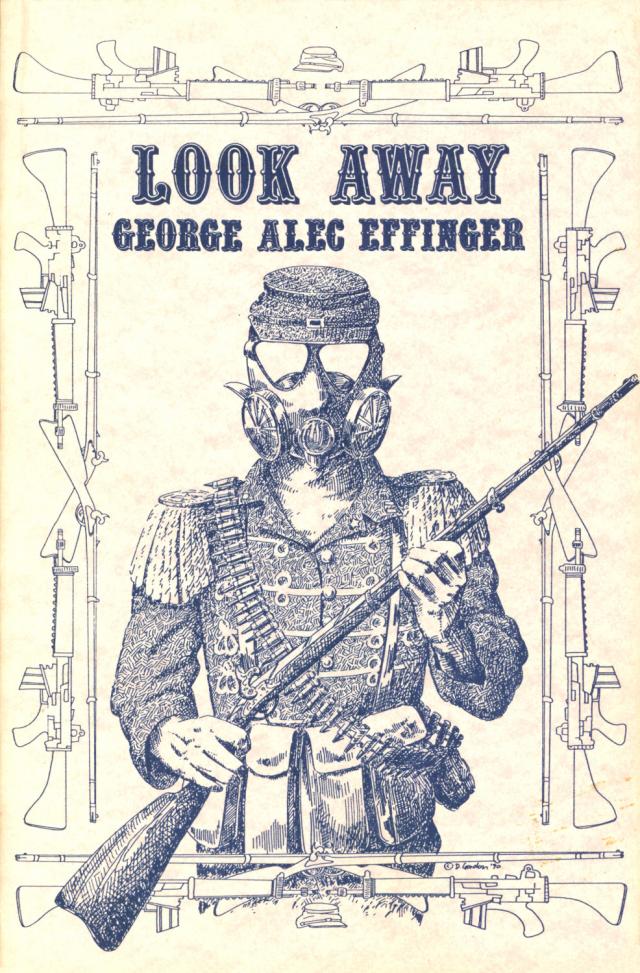
Illustration by
Donna Gordon
AXOLOTL PRESS
Pulphouse Publishing Box 1227
Eugene,
OR 97440
LOOK AWAY is book #12 in the Axolotl Press series.
Copyright © 1990 by Pulphouse Publishing, Box 1227,
Eugene, OR 97440. All rights reserved.
LOOK AWAY copyright © 1990 by George Alec Effinger
“Introduction” copyright © 1990 by Gregory Benford.
Cover illustration copyright © 1990 by Donna Gordon.
To Connie Willis, for writing LINCOLN’S DREAMS, the finest SF book responding to the American Civil War I’ve ever read.
And to GregBenford, who in inviting me to contribute to his anthology, WHAT MIGHT HAVE BEEN (co-edited with Martin II. Greenberg), gave me not only the inspiration for a forthcoming alternate-Civil War novel of my own, but the idea for the following unrelated novella as well.
INTRODUCTION
GREGORY BENFORD
INTRODUCTION
The South has played a strong role in American fantasy, but little in science fiction. Southern settings seem, in the mind’s eye, to have an almost automatic fantastic glaze.
We readily call up images of brooding purple ruins, green corpses, melancholy figures shrouding a dread secret that reeks of musty shadows. Edgar Allan Poe, the first great Southern writer, started it all — along with the detective story and the short story itself.
This dominance of fantasy is a bit curious, considering that one of the distinctive inventions of twentieth century American literature has been modern science fiction, a jury-rigged genre put together in the same era when the South was undergoing its own great cultural renaissance. Between 1930 and 1967, the era marking sf s rise, the South had twenty-one Pulitzer Prize winners, eight of the twenty-four National Book Award winners in poetry and fiction, and of course William Faulkner won the Nobel Prize.
But sf got nothing from the Southern Renaissance. It was and is dominated by Nawth’n Cult’ral Imperialism.
It’s easy to see a deep reason for this, stemming from that four-year “moment” when the South was a distinct nation, the Confederate States of America. The war itself did not change southern culture very much — people were too busy fighting and dying — but, in a profound irony, the South thereafter was more powerfully influenced by the Lost Cause mythology than by Confederate realities. The region’s response to battle, defeat, and shaky Reconstruction spawned a myth-history which ennobled a great catastrophe.
Somehow, in the minds of millions, the Southern cause was not only undefiled by defeat, but the colossal bloodbath actually sanctified the values and ideals of the Old South. And all this was done by the people themselves, not by Nawth’n meddling or falsified history. Scratch a Southerner and you’ll find a history buff, a military history buff. We gaze backward, almost reflexively. Look away, Dixie land.
I’m a product of that culture. I feel it a dozen times a day, but I can’t explain it. It’s in the blood.
How odd, then, that I became a part-time writer of science fiction, a genre devoted to technology and tomorrow. The Southerner’s identity rests firmly on events now shrouded by more than a century of misty recollection and outright fabrication.
Science fiction is about the future, mostly. Frequently it has been molded by a Heinleinian fascination with the winners, the doers. Much of the best Southern literature is fixated on the long recessional from that ringing defeat.
The frontier looms large in sf as a place to be confronted, pushed against, defeated, expanded. The South was definitely not a frontier. Instead, from early on, it was a wilderness already enclosed by the still-expanding nation. As a boy growing up in rural southern Alabama, it was a great piney reserve holding unfathomed mysteries and a sense of a stretching past. I later wrote a whole novel (AGAINST INFINITY) about this connection between the Southern sense of the wilderness vs. the Nawth’n image of frontier, writing straight out of my subconscious, and without realizing until months later what the true concerns of the book were.
To its loss, sf has learned little from Southern concerns and literature, a deep facet of American culture. We Americans are embedded in a rich and fruitful past, none more deeply than Southerners, but the genre keeps its beady gaze firmly fixed on the plastic futures we authors so glibly devise. Yet much of history is dominated by inertia, not by the swift kinetics of technology.
Bismarck, the great German foreign minister of the 19th century, remarked that his study of history had taught him that God helped three groups: women and children in distress, injured small animals, and the United States of America. There’s a lot of truth in that aphorism. We took on foreign antagonists in the best possible circumstances and prevailed, often with little damage — two wars each against the British, against the remnants of the Spanish empire, then against the Germans and allies. Now we seem to have destroyed the Soviet Empire by containing it and waiting. (And considering the revelations of mass murder routinely carried out by regimes in Eastern Europe, can we plausibly doubt any longer that much-decried description, the Evil Empire?)
Our greatest casualties, though, came from our war against ourselves. That war also left the deepest wounds; despite all the talk of the New South, the region has not fully recovered.
Yet even in that catastrophe we were rather lucky. After all, the South came quite close to winning; only timidity made the Confederates not immediately follow up on the northern disaster at the first battle of Manassas (Bull Run). The South outfought the North for years; indeed, it is still something of an embarrassment to historians to explain why a nation outnumbering the South by better than 2 to 1 and possessing far greater resources took four years to win.
But we were lucky in a more profound way, too, as Bismarck noted. We were able to take on the European powers one at a time in our wars, and to fight our own War of Southern Seccession without significant meddling from Europe’s vying factions.
This was enormously helpful. It framed the issues clearly, without intruding nationalisms of varying stripes. (Of course, the great constitutional issue of whether a state may leave the Union was not settled, and will, I predict, come back to bite us again. The Soviet Union will face that problem within months, I suspect.) It was a fair fight and we got to slug it out alone.
Lebanon is merely the most awful recent example of what can happen when outside interests stir the red pot of hatred and anger. With a few rather minor changes, our Civil War (as it is known in the Nawth) might well have settled nothing and devastated much more.
Realizing this takes some imagination, and that is where a variant of science fiction I particularly enjoy comes into play. I’ve already edited three collections of alternative history — HITLER VICTORIOUS, and WHAT MIGHT HAVE BEEN Vols. 1 and 2 — exploring the delicacy of history. George Alec Effinger contributed a remarkable story about the Civil War to WHAT MIGHT HAVE BEEN Vol. 1, “Everything But Honor.” Now he has written this remarkable novella, with insight and background which uniquely qualifies him.
Though a dread Nawth’ner, he has lived in New Orleans, that most wonderful and mysterious of cities, for almost twenty years. His sense of the South is now probably better than mine. I was in Fairhope, Alabama, my birthplace, only last week, and I find that I can now only dimly fathom the intricacies of Southern manners and indirection. (I love the tones and sliding graces of the language still, south of what we call the Mason-Diction Line.)
He has adroitly done a task which only sf in its alternative history form can do, at last making use of the vast body of Southern experience in a science fictional context. The energy and insight of this experiment illustrate yet again how genre strengths and invention are in fact the most significant facet of our national literature in this century.
More than that, he has made a solemn and forbidding thesis enjoyable to follow, harrowing though it might be. And that is why he is one of our very best.
Gregory Benford
27 December 1989
LOOK AWAY
GEORGE ALEC EFFINGER
“I see you have a band of music with you,” [Lincoln] said, and when a voice called up, “We have two or three!” he proposed closing the interview by having the musicians play “a particular tune which I will name….
“I have always thought ‘Dixie’ one of the best tunes I ever heard. Our adversaries over the way attempted to appropriate it, but I insisted yesterday that we fairly captured it.”
Abraham Lincoln
April 10, 1865
The car-bomb, indiscriminate in its terror and impact, aiming at civilians, had by 1984-1985 come to epitomize Lebanon’s war. Ten years earlier it was the sniper on the rooftops of Beirut buildings who had been the symbol of the war. Since then, the willingness to kill has reached new heights and the technological means have improved.
Eli Reed and Fouad Ajami
Beirut, City of Regrets
LOOK AWAY
GEORGE ALEC EFFINGER
1.
The Queen of England shuffled the deck of cards and then passed it to her prime minister, who cut the deck and handed it back to the queen. The queen began to deal.
“It is my position,” said the prime minister, “that we have a moral responsibility to help emerging and undeveloped nations whenever it is within our ability to do so.”
“You’ve made your position on this redundantly clear,” said the queen, “and on more occasions than we care to number. You threaten to bore us.” She dealt them both a tenth card, then placed the remainder of the deck between them and turned up the top card. It was the four of spades.
“We have here a people anxious to determine their own political destiny. We have a nation tormented by hostile invasions. We have once-proud cities reduced to rubble and burnt-out ruins. And we have the chance to join in a great humanitarian service to all mankind.”
“We don’t see how,” said the queen, looking over her hand thoughtfully, waiting for the prime minister either to pick up the four of spades or take another card from the deck.
The prime minister picked up the four and discarded the jack of hearts. “Imagine a city divided by a Green Line, with warring factions raiding murderously back and forth across it, killing innocent women and children in their mad struggle to control blocks of devastation and debris. Could we continue to think of ourselves as civilized, if we had the power to bring peace but did not?” “That is our problem put precisely,” said the queen. “You must persuade us that we indeed have the power to bring peace.” She took the top card from the deck. It was the nine of diamonds. The queen frowned and decided to break up a pair of eights, putting the nine between the eight of diamonds and the jack. It was bad strategy to hope for the ten of diamonds to appear and she knew it, but her predecessors had not built the British Empire by playing safe. She dropped the king of clubs.
“Perhaps Great Britain alone could not bring an end to this sad situation. That is why I feel obliged to tell you that I’ve been engaged in deliberations with several other world leaders. They have already agreed in principle to the deployment of an International Peacekeeping Force. In fact, a small-scale, probationary version of such an IPF is already in place, lacking only our participation.”
The queen hesitated, frowning. “This probationary army has already been sent to the region, before anyone — including you — worked up the courage to discuss the involvement of Great Britain in the project? Without our leadership, innocent Europeans may die!”
The prime minister had known the queen would respond just this way. It was best to proceed until the accumulation of arguments had quite worn away the queen’s contrariness. “We felt that such a multinational armed force might succeed in bringing a timely end to the hostilities. The next step is to invite both the unstable government in power and the various factional leaders to the bargaining table. The President of the United States has said that he will be glad to meet personally with any legitimate representative of the rebels, if that is what is needed to stabilize the situation.” The prime minister drew a card and discarded the queen of spades.
“The president!” murmured the queen disdainfully. She drew the top card, which was the ten of diamonds. She felt a small thrill of excitement. She looked up at the prime minister. “We’re surprised that you’ve let him seize the initiative in this undertaking. Are you not always reminding us that Great Britain must not let herself be a junior partner of the United States in world affairs?” She discarded the five of hearts.
“Yes, that’s true,” said the prime minister fiercely. “It is time for Great Britain to assert herself again upon the world stage. This is a perfect opportunity to increase our prestige and influence. And after peace has been restored to that suffering part of the world, there is no doubt that Great Britain will have won a friend. More importantly, perhaps we will have won a client.” The prime minister drew a card and threw down the king of hearts.
The queen gave a brief smile. “Ah, now we understand completely. For a moment, we were afraid that you’d failed to include your customary hidden agenda, perhaps through overwork or some other excuse. Now we are most reassured. Those beleaguered people, the families who have lost their husbands and fathers, their sons and brothers, they will remember that it was Great Britain who helped them in their hour of need.”
“It will be an international effort, of course, but I will see to it that we come out of this affair second to none.”
The queen drew the ace of clubs and put it in her hand. She frowned as she looked over her cards for a good discard. “Of course, there must be stories in the world press of tattered children innocently playing at their games in the midst of the horrors of war, and kindly British soldiers passing out sweets among the shattered remains of elegant homes and blocks of flats. After all, what good is someone else’s tragedy, if we don’t make the most of it ourselves?” She laid down the four of diamonds.
“By all that’s holy!” cried the prime minister, taking the card. “You saw me pick up the four of spades! Can’t you even remember —”
“You forget yourself, Lord Palmerston,” warned the queen in a stern voice. “We are not amused. Not in the least.”
“Forgive me, Your Majesty.” The blunt-speaking prime minister lowered his eyes, humbled. He slowly laid down the four of spades, four of diamonds, and four of clubs. Then he set down the king, ace, and deuce of hearts, and the seven, eight, and nine of spades. “Gin,” he said.
Victoria pointed a stiff finger at his run in hearts. “We didn’t agree that we could go around the corner,” she said stiffly.
“Your Majesty,” said Lord Palmerston. He was almost pleading.
The queen sourly totaled the cards she’d been left holding. “We are definitely not amused,” she said.
There are two things that war — any war — produces in great abundance, in even greater abundance than the corpses it generates. First, for some grotesque reason, war attracts spectators, the kind of non-combatant folk who pack folding chairs and card tables and picnic lunches and go to sit up on hillsides overlooking the devastation and carnage they know will occur sometime later that day. Second, war is an unexcelled source of rubble.
The young man in the mud-stained and threadbare regimental uniform rested on one of these piles of rubble, trying with all his might to derive some pleasure from his morning ration of bitter-bark tea and stone-hard flat bread. Beside him on the hill of broken brick sat a boy, a boy who had attached himself to the young man all through the recent maneuverings of the young man’s rebel unit. “Will there be a battle again today?” asked the boy, kicking at small, red fragments and sending them sliding down the hill.
“This July heat is like to kill me first,” said the young man, “but the dry red dust we throw up when we march is no comfort either. All you’re interested in, though, is watching the fighting. There was some pretty good shooting yesterday. What did you think?”
“I think that today you’ll die,” said the boy. “Or tomorrow.”
“If I die today,” said the young man in the uniform, “who’ll share his food with you?”
The boy only shrugged. “Let’s look around,” he said. “I can see two or three men in your squad alone who would take pity on me. In your platoon, I’d have more than I could possibly bear to eat. That’s your great failing as warriors: your pity.”
The young man laughed. “You’ll have no pity for me, if I should die today,” he said.
“Dying is what you do,” said the boy. “It’s your job. It’s what you get paid for. My father made furniture, beautiful small tables and chairs. You’ve just chosen the wrong line of work. Besides, no one asked you to come here and turn my city into rubble.”
“Here, take this from a ghost.” The young man handed the boy the last of the tea and the hard bread. “It’s my city, too,” he said. “If I die today, I’ll go wherever your father went. If I don’t die today, we’ll forget all about this conversation.”


