

Adam steele 31, p.1
Adam Steele 31, page 1
part #31 of Adam Steele Series


The Home of Great
Western Fiction!
Accord, Wyoming.
To Steele it looked like some sort of ghost town. Nothing moving, no people, no horses, not even a cur dog. Nothing except the hot dry wind blowing down the one street, raising a little dust. His horse’s hooves echoed lough as he rode warily through.
Then, suddenly, Steele found people. A crowd gathered on the far side of town, watching. Under a tree a young fear-sweated cowhand waited, his wrists bound. From the tree dangled a rope.
Steele was just in time for the hanging, just in time to get involved in a range war that would stain too much bad blood across the good land.
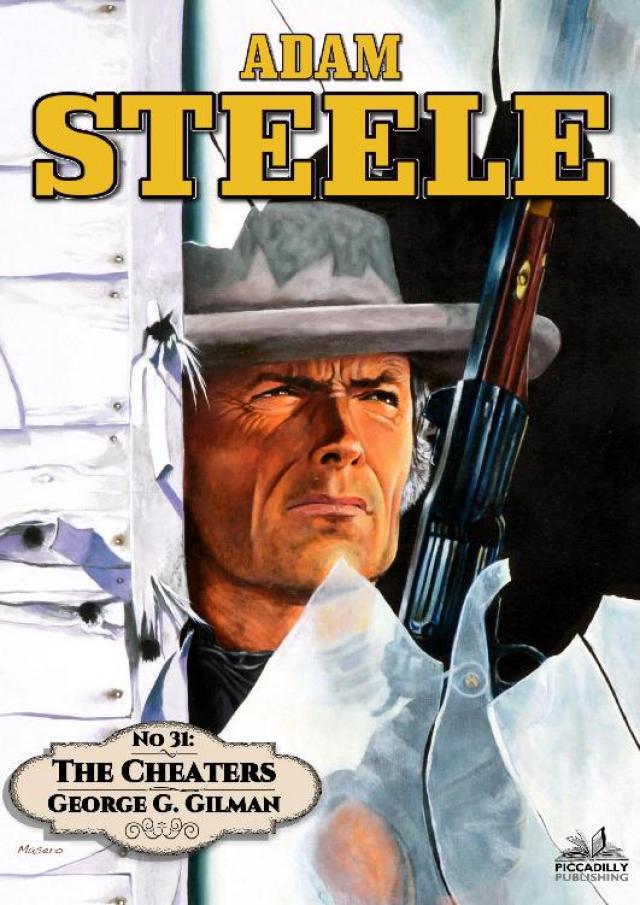
ADAM STEELE 31: THE CHEATERS
By George G. Gilman
Copyright © 1982 by George G. Gilman
This electronic edition published November 2022
Names, characters and incidents in this book are fictional, and any resemblance to actual events, locales, organizations, or persons living or dead is purely coincidental.
You may not copy, store, distribute, transmit, reproduce or otherwise make available this publication (or any part of it) in any form, or by means (electronic, digital, optical, photocopying, recording or otherwise), without the prior written permission of the publisher. Any person who does any unauthorized act in relation to this publication may be liable to criminal prosecution and civil claims for damages.
This is a Piccadilly Publishing Book
Text © Piccadilly Publishing
Series Editor: Mike Stotter
Visit www.piccadillypublishing.org to read more about our books
For:
John and Joan
Who give us a place to bed down
when we come east
Illustration © Tony Masero
Table of Contents
Chapter One
Chapter Two
Chapter Three
Chapter Four
Chapter Five
Chapter Six
Chapter Seven
Chapter Eight
Chapter Nine
Chapter Ten
Chapter Eleven
Chapter Twelve
Chapter Thirteen
Chapter Fourteen
About the Author
Chapter One
FOR MORE THAN two minutes after he had ridden by the neatly painted wooden marker that named the community as Accord, Wyoming, the impassive faced man astride the chestnut mare could have easily assumed the place to be a ghost town.
More recently abandoned by its former inhabitants than Silver Pass, Colorado: the buildings were in a much better state of repair here, obviously well-tended until very recently. And there had been no invasion of lawless hard men to hasten the process of destruction and decay which the elements ...
Adam Steele spat to the side and the rutted surface of the curving street immediately soaked up the moist saliva. The impression of a deserted town was dispelled when a man at the side of the street toward which the newcomer had spat said morosely:
‘If you’re thirsty from the trail, stranger, you’re gonna have to wait to wet your whistle. Mort Dodson who runs the saloon here is at the hanging.’
Steele shifted his gaze without haste. The old man was sitting in a rocking chair he was not rocking, just inside the threshold of a barber shop, still a few feet ahead of the slow moving horse. The rider touched the brim of his hat and responded in a voice that revealed his Virginian upbringing:
‘You’ve seen enough men die that way, feller?’
‘Seen too many men die most every way there is, stranger. And at my age it’s gettin’ a mite too close to home.’ He spat, triggering a bout of coughing that made his chest sound hollow. When it was over, he called after the stranger: ‘Anyways, I don’t agree that outside trouble oughta be brought to town.’
Adam Steele resisted an impulse to turn in the saddle and peer back at the man in the doorway. Forced himself to rationalize that the old-timer was not remarking on his presence in town—instead was expressing his opinion about the hanging. And in the same way was now able to reject the line of thought that had caused him to start comparing Accord on the high plains of north eastern Wyoming with the town in the Colorado Rockies where he had last been brushed by the shadows of other people’s dying. Where he could be said to have brought trouble from outside, and where a hanging had been set to take place when he and a man called Edge rode in.
Consigning the recollections of that time-months ago now—to the dark recesses at the back of his mind where a thousand and one other memories of violent death were stored, he sensed that his slow progress along the street was being monitored by other local citizens. More secretive in their survey of him and less garrulous than the old-timer in the doorway of the barber shop.
He sensed not only that he was being watched from within the business premises which flanked this section of the street: he also felt the distrust that was directed toward him through sun glinting windows or out of the shadows in back of half open doorways.
Then he rode around the sharpest section of the curve of the town’s main street and saw a group of people who watched him openly. Unsmiling and not even sparing a nod of tacit greeting as they eyed him, the clop of the mare’s hooves having announced his approach.
There were perhaps thirty of them. Mostly men, with just a half dozen women scattered among them. No children. Gathered into a loose knit group on the south side of a small square formed by the intersection of the main street with another one: out front of a fine looking church that was one of the few stone built structures in Accord.
Another such building was the sheriff’s office and gaolhouse on the east side of the square. And it was to this that many people in the group looked after they had ended their unwelcoming survey of the stranger. While others, equally grim-faced, gave their attention to a leafless oak tree that grew at the very center of the intersection: more precisely gazed at the length of rope which was suspended from a stout bough of the tree, with its noosed end some ten feet above the ground.
Just off the north side of the square, on the cross street, there was a row of commercial premises with a roofed sidewalk out front. One of the signs on the row read: Molly O’Brian’s Grocery Store. And it was toward the grocery that Adam Steele angled his horse. Could easily have got out of touch with reality again as he heard the clop of the mare’s hooves sound disproportionately loud in the surrounding silence. Then, when he reined the horse to a halt, swung out of the saddle and hitched the reins to a sidewalk roof support post, even such small sounds as he made seemed to be an unwarranted intrusion into the tense stillness. And next it was as if the Virginian’s footfalls across the sidewalk boarding thudded like thunder in the ears of the waiting crowd.
But he refused to indulge in such fantasies and did not glance back at the enmity-harboring watchers on the other side of the square before he entered the store. Caused a bell to tinkle cheerfully when he opened the door. Then had the door snatched from his grasp and slammed closed by a stray draught.
The woman who stood at the far end of the counter which ran down one side of the store gasped at the sound of the bell and shuddered when the door slammed.
‘Sorry, ma’am,’ the Virginian said and briefly raised his hat. ‘I didn’t mean for that to happen.’
She looked hard at him for long moments. As if she thought she knew him from somewhere but could not place him. Or as if she were confused by his presence at a time and place he had no right to be.
The man she saw was on the brink of forty years of age. Shortish—he stood no more than an inch over five and a half feet tall—and was built on lean lines. A good looking man with well chiseled features cloaked with evenly tanned skin cut with more than a fair share of lines for somebody of his years. The lines inscribed by the ageing process and by the harsher experiences of a lot of the past years.
With his hat briefly removed, the woman behind the—counter could see that all his hair was prematurely grey—not just that which grew as extended sideburns on his otherwise clean shaven face.
His eyes were jet black and there was a coldness in them as they raked his surroundings. But then he smiled as he spoke, his gentle mouthline briefly shifted from repose to display very white, perfectly even teeth. And the expression served to make him look several years younger—and not capable of cruelty.
‘Need to buy some supplies, ma’am,’ he went on, and ended the smile as he replaced his hat.
The grey Stetson was the same color as the city suit he wore under an open, knee-length sheepskin coat. The suit jacket was buttoned, but did not entirely conceal his yellow vest, in the vee of which could be seen a white shirt with a black bootlace necktie neatly knotted at the collar. His boots, with no spurs and worn under the cuffs of his suit pants, were also black and city style.
His clothing was recently new and showed only superficial signs of having being worn by a man riding a fairly long, open trail. Not so the scuffed and torn black buckskin gloves which fitted snug enough to follow every contour of his hands. Nor the silken scarf that hung loosely around his neck and had also seen many better days.
‘Then you come to the right place, young man,’ the sixty-year-old woman with insipid yellow hair and crooked teeth responded dully as she advanced with shuffling gait to a midway point along the cluttered counter. ‘Though maybe you could’ve chosen a better time to visit Accord.’
She had not showed a smile of greeting. Now she grimaced as she raised her voice slightly, as if in a token attempt to drown out the buzz of talk that had abruptly started on the square outside.
‘I made a list this morning.’
Steele took a strip of paper that had once been a jar label from a pocket of his topcoat and set it down on a carton of beans cans in front of where the old woman stood.
‘Fine, young man. And if you have a clear hand, I’ll be able to read what you want.’ She picked up the list and squinted at it. Nodded. ‘Yeah, I’ll be able to fill this for you while you watch the hangin’.’ She seemed compelled to glance out through the display window, but quickly returned her attention to the pencil written list. Then shuffled off to do the chore she was obviously pleased to have.
The burst of low voiced talk had been abruptly curtailed by then and just the slow clop of hooves could be heard. Until a man began to speak, intoning words in the manner of a prayer, which carried into the grocery as just a monotonous drone.
‘Something special about this hanging, ma’am?’ Steele asked, surveying the scene beyond the window.
The hooves of another horse hit the hard packed street surface. Coming from the north west at a gallop that was reduced to a canter and then a walk.
The Virginian continued to watch after the attention of the crowd had been switched from the slowing horse and rider coming along the cross street back to the scene at the hanging tree.
‘Depends what you mean by special, young man. Last hangin’ we had in Accord was more than five year ago, I guess. Maybe more than six. When Sheriff John Lore and a posse brought back one of the two men that robbed Job Stoker’s bank and killed the Bates girl while they was doin’ it. That was the last hangin’ and the only hangin’. Until today. Today John Lore is hangin’ Gil Colman for murder of Mary Edlin that was one of Morton Dodson’s whores down at the Waterin’ Hole Saloon. And since the Colman boy is local—kinda—and that Edlin woman wasn’t liked by nobody but men drinkin’ and lustin’, I guess you could say the hangin’s special.’
Her voice was as dull toned as before. So that the gasp came as a surprise to Steele, who interrupted his watch through the display window to look briefly at the woman. And caught her in the act of peering bitterly at the man who rode across the front of her store.
‘George Dayton,’ the woman rasped and, as if she was ashamed to be seen watching the scene outside, began again on the task of filling Steele’s order as she added: ‘The Colmans and the Daytons don’t get on. You wanna know any more, you ask somebody else. I got work to do.’
Steele moved away from the counter to go to stand in back of the display window from where he could clearly see the scene on the square. Saw it from much the same viewpoint as George Dayton who had reined his grey gelding to a halt just past the grocery, where the cross street met the square, and where an elderly woman stood beside a buckboard that was parked outside the hat store.
All three watched with totally different responses as a black gelding with two men in the saddle was brought to a stop under the tree at the center of the square.
Gil Colman, wrists tied at his back, was supported in the saddle by the arms of Sheriff John Lore who reached around to either side of the doomed man to hold the reins.
Colman was hatless, so that the sheriff was easily able to drop the noose of the hanging rope over his head and slide the running knot snug to the side of his neck.
Lore swung down from the gelding, but kept one hand on the reins and another on Colman’s belt buckle to ensure that the horse did not move nor the man toppled from the saddle ahead of time.
It was very quiet on the sunlit square. Gil Colman, who looked to be no older than twenty, swallowed hard and the sound of his gulp carried to the ears of all who watched. Even to Steele, inside the grocery redolent with the aromas of food, where Molly O’Brian forced herself to be busier than was necessary to fill the order for the stranger to town.
The crowd out front of the church on the south side of the square shuffled closer to the hanging tree. A woman in the crowd sniffed to hold back tears. Somebody coughed and this triggered a spate of sound as others felt the need to clear their throats. A few men spat.
George Dayton, fifty years old, heavily built and ugly, struck a match on a thumbnail and lit the half smoked cheroot that angled from his mouth. He looked around, as if to ensure that everyone saw the grin of relish firmly fixed to his thick-lipped, hook-nosed, small-eyed face. The smile broadened when he saw the old lady beside the buckboard outside the hat store. A short, thin, ramrod straight woman of more than sixty who had been silently weeping ever since Steele first saw her—the tears running down over her heavily lined cheeks to drip unheeded off her jaw to splash to the dark fabric of her dress.
For perhaps a second the woman held the stare of the man’s smiling eyes. Then, with a lack of expression that was more dismissive than a sneer would have been, she returned her attention to the tree, the man astride the black gelding and the two who now stood beside the horse - a grey-haired preacher with hands clasped together at his chest having left the main body of the watchers to stand beside the sheriff.
John Lore gazed morosely into infinity while the preacher peered up at the face of the doomed young man and began to intone a prayer for the salvation of his soul.
Adam Steele watched and listened impassively. Colman also appeared to be totally unmoved by what was happening to him. Pale faced, with tightly compressed lips and half closed eyes, he stared directly ahead along the curving street by which Steele had entered Accord. Then he seemed to become aware of the grinning man smoking the cheroot. And he turned his head with infinite slowness to look at Dayton, an expression of limitless loathing spreading across his youthful features.
A short, gleeful laugh erupted from the object of his hatred, which drew a body wrenching sob from the diminutive old lady who had cried silently until now.
These two sounds caused the preacher to curtail his prayer and snap his head around. John Lore and the group of watchers out front of the church were similarly distracted. Until Gil Colman shrieked:
‘You friggin’ bastard, Dayton! Ain’t it enough you sonofabitchin’ skunks framed me up? You gotta come see me dance at the end of a rope … Oh, sweet Jesus, no! Momma!’
The black gelding had seemed calm enough in the taut atmosphere of the execution’s prologue. But the abrupt loudness of Gil Colman’s voice, perhaps augmented by the vitriolic bitterness of his tone, made the animal skittish. He went back and to the side, but the young man trapped astride him was too concerned with his hatred for Dayton to be aware of the danger.
John Lore seemed to have the gelding under control, but the horse suddenly abandoned the backward and sideways motion and lunged into a forward bolt.
The sheriff realized he could not control the animal, and elected to make the execution official. He released his hold on the reins, took a single step forward to shoulder charge the preacher clear, and crashed a hand down on the gelding’s rump, powering it into an instant gallop.
The young man in the check shirt, dark pants and spurless boots was jerked out of the saddle. Had his neck broken by the first tautening of the rope as it accepted the strain of his weight an instant after he screamed for his mother.
His body spasmed to the dictates of his nervous system, then became limp, swinging in a pattern of decreasing circles, his head tipped forward and his angled down boots some three feet off the ground.
The dust raised by the bolting horse settled, and the sound of galloping hooves faded from earshot as he rounded the curve of the street.
Sheriff John Lore made to help the preacher to his feet, but was tacitly rebuffed by the cleric who rose by his own efforts on to his knees. There to pray in a quiet voice for the deceased.
The sheriff removed his hat and bowed his head and, one by one, the men in the crowd did likewise.
George Dayton smoked the cheroot and abandoned the grin in favor of a look of pleasurable satisfaction.
‘All over, uh?’ Molly O’Brian said, checking a heap of supplies on the counter top against the Virginian’s list.
‘One Colman’s dead, ma’am,’ he reported evenly, turning away from the window. ‘But it could be a long way from over. The way that Dayton feller—’


