

Adam steele 32, p.1
Adam Steele 32, page 1
part #32 of Adam Steele Series


The Home of Great
Western Fiction!
Northern California.
Giant redwoods clinging to the slopes of the Coastal Range as it drops down to the blue Pacific Ocean.
Man stretched out on the wide deserted beach right by the water’s edge. Surf may be up but he’s paying no mind. Not working on his tan either on account of his being fully dressed. Just lying there quite still on account of he’s dead.
Bullet hole drilled clean between the shoulder blades. Near him a horse, a black gelding, edgy, close to being spooked, while another man, black hair, maybe some Apache blood in him, searches through the saddle bags. Hurried.
Not the sort of picture a tourist brochure would use. But a scene to freeze the blood of a man called Steele. Especially when he looks into the dead man’s face and discovers his own double.
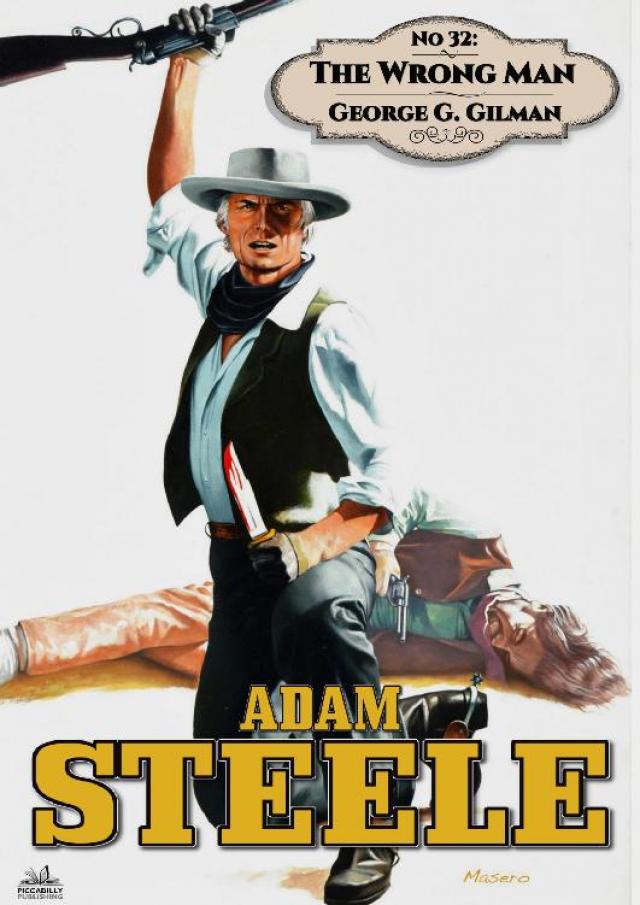
ADAM STEELE 32: THE WRONG MAN
By George G. Gilman
Copyright © 1982 by George G. Gilman
This electronic edition published January 2023
Names, characters and incidents in this book are fictional, and any resemblance to actual events, locales, organizations, or persons living or dead is purely coincidental.
You may not copy, store, distribute, transmit, reproduce or otherwise make available this publication (or any part of it) in any form, or by means (electronic, digital, optical, photocopying, recording or otherwise), without the prior written permission of the publisher. Any person who does any unauthorized act in relation to this publication may be liable to criminal prosecution and civil claims for damages.
This is a Piccadilly Publishing Book
Text © Piccadilly Publishing
Series Editor: Mike Stotter
Visit www.piccadillypublishing.org to read more about our books
Mick and Hazel, another couple of dog nuts.
Illustration © Tony Masero
Table of Contents
Chapter One
Chapter Two
Chapter Three
Chapter Four
Chapter Five
Chapter Six
Chapter Seven
Chapter Eight
Chapter Nine
Chapter Ten
Chapter Eleven
Chapter Twelve
Chapter Thirteen
Chapter Fourteen
About the Author
Chapter One
THE MAN RODE the black gelding out of the coastal strip of giant redwoods and paused briefly before he heeled his mount forward again. To move at the same easy pace across the soft sand of the broad beach toward the gently breaking surf at the edge of the ocean. He kept the horse headed slightly north of due west, so that he was able to gaze at the calm infinity of the Pacific directly in front of him without need to crack his eyes against the full glare of reflected light of the mid-afternoon sun.
The lone rider who crossed this driftwood featured stretch of deserted northern California beach was about forty. Perhaps a half inch over five and a half feet tall and built on lean lines—but there was an unmistakable stamp of strength on the way the man was put together. His face was unremarkable, the features regular in an arrangement that gave him a kind of nondescript handsomeness. His eyes were jet black, there was a suggestion of gentleness about his mouthline, and his hair—cut short but allowed to grow somewhat wild in sideburns—was mostly grey. And there were many deep furrows cut into the element burnished flesh of his face.
At first, second or even third glance, this is the impression a casual observer would receive of the man who rode across the thirty yard wide, slightly down sloped beach. Just this, plus the obvious fact that he was unshaven for many days.
He was dressed for western rough riding in a black Stetson, heavy duty boots without spurs and a sheepskin coat that concealed most of what else he wore—except for a grey kerchief at his throat. All his clothing was old and travel stained. And the gelding also had the look of an animal which had seen better days many weary miles away from this ocean shore.
And the horse snorted and quivered in equine relief when he was reined to a halt and his rider swung down from the saddle. This just short of where the blue ocean broke white along a strip of sodden, hard-packed sand.
There was more than mere weariness in the way the man dismounted. And he arched his back, flexed his shoulder muscles and sighed his pleasure as he lowered himself gently down on to his haunches. Then became aware that the warmth of the sheepskin coat—so welcome in the deep shade of the giant redwoods—was not necessary out here in the bright glare of the hot sunshine. And while with the forefinger and thumb of his left hand he tried to work some of the tiredness out of his red-rimmed dark eyes, with his right he began to unfasten the coat buttons.
He yawned, his mouth gaping open to its widest extent.
And this was how it remained during the full second he was able to experience the sensation of the bullet drilling into his flesh.
Then he clamped his mouth closed, his teeth crashing together so hard that it pained him. Hurt so much that he was no longer conscious of the bullet in his back.
He grimaced and heard the crack of the rifle shot that had blasted the bullet at him. Saw the ocean get suddenly bluer, felt the heat become abruptly far more intense and heard the once peaceful thud of the breaking surf expand to an ear-splitting crash.
The bullet in his heart had stopped the organ’s vital pumping function by then. And there was no time to indulge in melancholic regret that his life was to end this way. For as his brain was starved of fresh blood, the world of this man on the very brink of violent death was—for the final part of his last second of life—even more surreal.
Its color was entirely white. Its sound was reduced to a rushing noise of variable pitch. Its taste was salt. Its feel was wet. It had no smell.
And he died without realizing why all this was so—that the impact of the bullet had pitched him forward from his squat, to sprawl him face down in the breaking waves.
Where he was gently pushed and pulled by the action of the ocean at its edge.
Overhead, gulls screeched.
The gelding backed off a few paces and tossed his head.
The back shooter came out of the giant redwoods at the same point the rider had emerged. And advanced slowly along the tracks in the sand left by the horse.
He was dressed more suitably for the unshaded heat of the California afternoon—wore just a white cotton shirt without sleeves, buckskin pants that were pale green in color and moccasins. No hat, but then he did have a head of thick, long growing black hair: long enough to almost brush over his shoulders with its ends and thus framed his entire face.
The face of a half Indian, half white. In his late forties or early fifties. The face long and lean, like the near six feet tall frame of the half breed. With angular features—the eyes sunken, the nose pointed, the cheeks hollow and the jaw jutted. The shape and set of the features entirely Indian. While the color of his skin and the dark bristles that sprouted on the lower portion of his face revealed that he was not pure bred.
He carried a Winchester rifle in two hands angled across the front of his shallowly rising and falling chest, the muzzle aimed at the cloudless sky to his left.
For three-fourths of the way from the fringe of the trees to where the corpse was gently moved by the ocean’s tideline, the half breed advanced like an automaton. Then, some twenty or so feet from the dead man, he halted his measured strides. And wrenched his unblinking stare away from the half floating, spreadeagled form in the surf. To glance down at the rifle.
His face expressed a silent snarl. And he pumped the lever action of the rifle. To eject the expended shell of the fired bullet and jack a fresh one into the breech.
Then he aimed the Winchester at the bobbing form in the white water and completed his cautious approach. Halted again with his moccasined feet just inches away from the tideline: and the snarling set of his features changed to a grin of satisfaction when he saw the neat hole—cleaned of blood by seawater—in the coat of the face down man. Precisely far enough left of center for the bullet to penetrate the man’s heart.
The gulls continued to screech in shrill and raucous counterpoint to the regular dull thud of the breaking surf.
For the first time since he showed himself at the fringe of the timber, the half breed looked elsewhere but at his victim and the rifle.
Gazed north to where a rocky point jutted into the ocean some three miles away. Then shaded his eyes and squinted to survey the coastline southwards where, about five miles distant, a wooded rise with a black cliff base ended the beach in this direction. Just variegated pieces of misshapen driftwood featured the broad swathe of fine yellow sand.
To the west, no ship was close enough in shore to be seen.
And in the east, back of the slight slope of the beach, there was just the great forest of massive giant redwoods. Teeming with life, but all of it as invisible to the half breed as that which inhabited the ocean.
The half breed’s rifle was unaimed while he surveyed the beach in both directions, and the ocean. While he raked his no longer smiling eyes over the timber, though, the muzzle of the Winchester tracked along the same vista. Then, still tense—and casting a constant stream of suspicious glances toward the cover of the nearest section of forest—the killer turned his attention to the horse of the dead man. Held the rifle in just his left hand now, as his right became busy with the fastening of one of the saddlebags.
The bag’s fastening came free and the half breed delved a hand under the flap. Explored the interior blindly for a few moments, then made to look into the bag.
But sensed danger.
Snatched his hand from out of the bag. To fist it around the barrel of the Winchester. Next powered into a whirl and a half crouch.
A series of sudden moves that created fresh fear in the brain of the gelding. Caused the animal to turn away from the half breed and lunge along the hard packed strip of beach: hooves tossing up clods of sodden sand.
The half breed was like a granite statue for a stretched second. Then wrenched his head to the side to stare down at the buoyantly moving corpse. Jerked it back up and around again: to gaze at the man who had ridden his chestnut mare out of the giant redwoods.
Depthless terror was abruptly carved into every plane and hollow of the half breed’s face. This as his eyelids were stretched open to their widest extent. And his mouth gaped to vent a scream of horror—that took perhaps two full seconds to find voice. For this length of time was as if petrified again.
Then he swung half around, away from the stranger who had reined in his mare when the Winchester was aimed at him. Began to run, which was easy for the first few strides. But then the hard packed sand was behind him and the fine, dry grains gave way under his pumping feet so that he had to drag free each trailing leg before he could throw it forward to become the leading one.
He stared fixedly ahead again now—but more fearfully than when he came so much slower down the beach. He no longer screamed. Instead trailed behind him in the saline air an eerie, almost animalistic wailing sound. Which set the seagulls to screeching again. And threatened to drive the horse of the dead man into a fully-fledged bolt.
But then this sound, too, was curtailed. For the half breed needed to suck air into his lungs. After which he could only pant—the terror that triggered his dash for the timber far more draining than the exertion of ploughing through the clinging sand.
Then he was on firm ground, racing through the trees: beads of sweat spraying away from his face in his slipstream. He had angled across the beach, heading north east, in an effort to constantly widen the gap between himself and the stranger who was approaching from the south east: and also to gain the cover of the timber in the shortest possible time.
He knew when he was in cover—had to veer to left and right to get around the trunks of the towering trees. But his terror was undiminished and he ran faster still—as fast as the firm ground and his reserve of energy would allow. Never once looked back to see if he was being pursued. Eventually pitched into a forward sprawl of physical exhaustion. And lay face down on the carpet of rotting redwood detritus. Panting and weeping and trembling. The mouth in his fear contorted face working to form words which had no sounds. In English and the Apache language, as he prayed to God and to the Great Spirits. Begging forgiveness for the wrong he had committed in killing the man, and imploring that he be immune from the evil that had been unleashed by the murder.
By which time, the man who had aroused such a degree of dread in the half breed was at the very edge of the ocean: having ridden slowly, a hand on the stock of his booted rifle, after the running man went from sight. Rode with his cautious attention divided between what was obviously a dead body floating at the tideline, and the fringe of the timber.
Then, after sitting his halted horse for perhaps fifteen seconds—while the black gelding tentatively approached the chestnut mare—he decided that the frightened half breed was not about to make a rapid recovery from hysteria and return. And he dismounted, dropped down on to his haunches and reached for a booted foot of the corpse. Caught hold of it at the first attempt when a breaking wave floated the body closer. Then quickly straightened and stepped backwards. Managed to keep his boots out of the water as he dragged the whole length of the dead man clear of the ocean. Then stooped and, with one hand on the shoulder and the other on the hip, flipped the corpse over on to its back.
Grimaced as he muttered: ‘Can see why that feller reckoned he’d seen a ghost.’
A man named Ethan Winston, now sprawled out on his back on the wet sand, might well have been the identical twin brother of the one who gazed down at him. A man named Adam Steele.
Chapter Two
STEELE PERHAPS WEIGHED a few pounds more than the dead man. And he had shaved this morning. Also, among his prematurely grey hairs were a few that still gave a clue to the auburn that he once had been.
Apart from these minor differences, all else about the two men appeared to be identical. As identical as the knee length sheepskin coats which they wore.
Not so the rest of their clothing. For Steele’s Stetson was grey and although his unspurred boots were black, they were more stylishly made than those of Winston. And beneath the topcoat which he now removed, he wore a grey, city style suit, a yellow vest and a white shirt with a black bootlace tie knotted at the throat. A grey scarf of silken fabric hung loosely around his neck—this, like the snug fitting buckskin black gloves on is hands, much older than the rest of his outfit.
Not normally the kind of man to show his feelings, Adam Steele displayed obvious surprise for many stretched seconds as he continued to stare down at the face of the dead man while he took off the coat. And still felt uncomfortably warm—not entirely from being out in the direct glare of the sun.
Then a man shouted.
‘Hey, mister!’
Horses snorted and hooves beat on the sand.
‘That there a breed you plugged?’ a second man demanded to know.
Steele tore his gaze away from the unnerving sight at his feet when the first shouted word reached him. Then had swung around and taken a step toward his mare before he saw the two riders. Had the sheepskin coat flung across his saddle and a fist around the frame of the booted rifle when the question was yelled.
The skittish horse of the dead man sidled away from the sudden activity. But did not bolt.
Adam Steele, the mare between himself and the riders, rested a gloved thumb on the hammer and curled a forefinger to the trigger of the Colt Hartford, but did not slide the rifle out of the boot.
The riders came down the line of tracks left by Ethan Winston’s gelding and the half breed. The gallop quickly giving way to a weary walk as the soft sand dragged at the hooves of the horses. And the eager excitement of the men in the saddles was drained by the sight of Steele with a hand on the rifle.
‘Shit, we don't mean you no harm, mister!’ the one on the piebald gelding assured. He was about fifty, tall and with a muscular build that was starting to run to fat. Blue eyed and black bearded.
‘Jesus, Vic!’ the other man—riding a grey gelding—rasped as he hauled his mount to a halt. ‘It’s Ethan all dressed up like he was gonna go on the town with a woman and—’
‘No it ain’t, Ryan!’ Vic gasped, and halted his horse ten feet closer to the edge of the ocean. Stared at the corpse and then pointed a finger at it as he completed: ‘There’s Ethan, all drowned!’
Ryan was a few years older than Vic. A head shorter and a great deal lighter in weight. He had an emaciated, gnarled face with black eyes that shone like polished coal—and widened as they flicked from the face of Steele to that of the dead man and back again.
Both Vic and Ryan were dressed in baggy pants and check shirts, with kerchiefs knotted at the rear. They wore battered and stained Stetsons and scuffed work boots. Each had a gunbelt slung around his waist, with a Colt Peacemaker in a loose hanging holster on the right. Vic had a single shot Springfield rifle jutting from a boot on his saddle.
Men and mounts were weary and ill cared for at the end of a long trip. In many respects were a match for Ethan Winston and his horse. But in the matter of facial features and physical build, nowhere near as alike as the dead man and Adam Steele.


