

Adam steele 46, p.1
Adam Steele #46, page 1
part #46 of Adam Steele Series


Contents
Cover
About the Author
Also by George G. Gilman
Dedication
Copyright
Title page
Chapter One
Chapter Two
Chapter Three
Chapter Four
Chapter Five
Chapter Six
Chapter Seven
Chapter Eight
Chapter Nine
Chapter Ten
Chapter Eleven
Chapter Twelve
Chapter Thirteen
Chapter Fourteen
Chapter Fifteen
Chapter Sixteen
About the Author
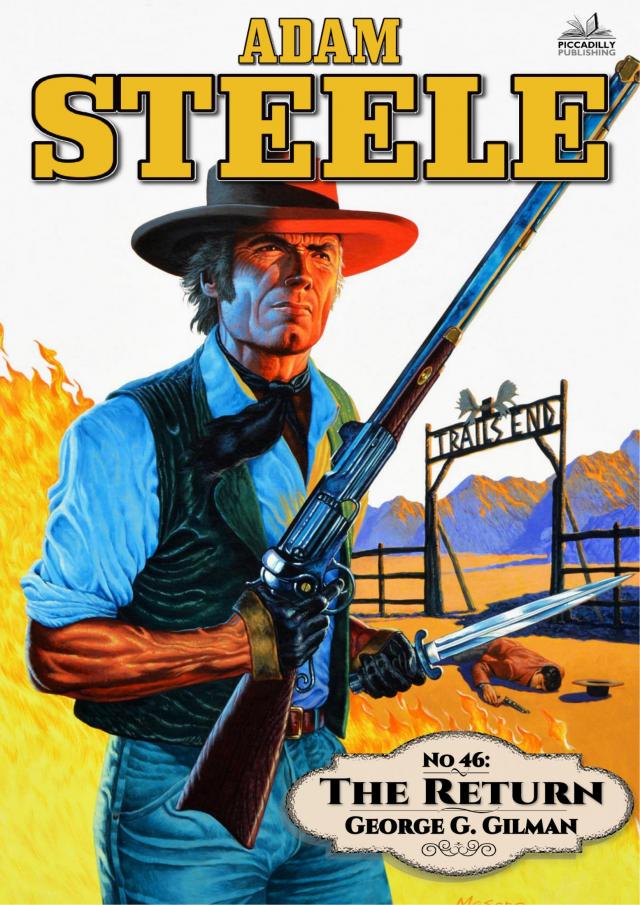
Illustration by Tony Masero
George G. Gilman was born Terry William Harknett in 1936, in what was then a small village east of London. Upon leaving school he abandoned all earlier ambitions and decided to become a professional writer, with strong leanings towards the mystery novel. He wrote short stories and books during evenings, lunch hours, at weekends, and on the time of various employers while he worked for an international news agency, a film company, a weekly book-trade magazine and the Royal Air Force. He turned to writing full-time in 1970, writing mostly Westerns which have been translated into a dozen languages and have sold in excess of 16 million copies.
Read more on the Author
Also by George G. Gilman
ADAM STEELE
Steele’s War: The Stranger
The Big Prize
The Killer Mountains
The Cheaters
The Wrong Man
Valley of the Shadow
The Runaway
Stranger in a Strange Town
The Hellraisers
Canyon of Death
High Stakes
Rough Justice
The Sunset Ride
The Killing Strain
The Big Gunfight
The Hunted
Code of the West
The Outcasts
The Return
… and still to come:
Trouble in Paradise
Going Back
The Long Shadow
EDGE
Backshot
Uneasy Riders
Doom Town
Dying Is Forever
The Desperadoes
Terror Town
The Breed Woman
The Rifle
Edge Meets Steele: Double Action
for
Chris Barrett
an enthusiastic collector
Chapter One
THE MAN WAS leaning face forward against the corral fence across the yard from the house. Gazing over the corral in which his horse was enclosed, toward the pastureland, the hills beyond and the western slope of the Providence River Valley.
Steele knew when he first glimpsed him that the man was not young. Also, he gained an impression he was infirm. But this might be wrong, since the assumption was based on how the elderly man stood: feet slightly apart, arms straight out in front of him, fists gripped to the top rail of the fence. Like he needed to brace himself in such an attitude to keep from falling down.
It could be the man was bone weary, enraged or otherwise emotionally distracted. For the way a man stood when he considered himself to be alone was not necessarily any kind of reliable clue to what he was, Steele allowed as he dismissed the surmise, and resisted the temptation to come to other ill-informed conclusions about the unexpected visitor. The man who had arrived at Trail’s End while the Virginian was in Providence, made himself at home to the extent of unsaddling his horse, turning the animal loose in the corral.
As Steele rode along the track between the two crop fields, freshly plowed at this fall time of the Californian year, he expected the man leaning on the fence to turn toward him, having heard the slow clop of the gelding’s hooves across a distance of five hundred feet or so.
But he did not do this: did not move a muscle as he continued to gaze out over the Trail’s End spread. So, Steele assumed with good reason, he was hard of hearing. Then, closer, he was prepared to revise this assumption. Decided the man could be caught up in a private world of deep emotion that impaired his ability to sense the proximity of another who showed keen interest in him.
This stirred a sudden turmoil of high emotion within Steele; which showed as fires of anger in his coal-black eyes, while his element-burnished face between the long gray sideburns became strangely distorted. This as he endeavored to mask his feelings—at least to the extent of hiding the fact that his anger was sparked by a brand of fear he hated to acknowledge: dread of the unknown.
Nobody but Steele himself was entitled to be so enrapt at Trail’s End.
He thought his expression was impassive when he reined in his horse, asked: ‘Something I can do for you, feller?’
To his own ears his Virginia-accented voice sounded just a little strained.
Advancing years to a total close to eighty had not affected the stranger’s hearing to any great extent. He had been locked in deep thought. And Steele’s voice in the silence after the horse halted on the center of the yard, twenty-five feet behind and to the left of the old man, startled him out of it.
He snapped his head around, maybe would have stumbled had he not retained the two-handed grip on the fence rail for a few moments. He shook his head once, then allowed a sigh to trickle out of his throat. Regained control of himself with what seemed like a carefully rehearsed series of movements that brought his feet together, released his fists from the fence, turned him fully to face the mounted man.
Then he completed rearranging his expression. From the detached frown that had been on his face while he made his survey of the three and a half thousand acres of the spread, through shocked surprise, then self-anger that he had allowed himself to be so withdrawn, to a smile that seemed to be of pure pleasure.
‘Gee,’ he murmured. ‘You sure startled me, young man. But from what I’ve heard about you, I guess it ain’t no surprise you did that. Hear tell surprises are what you’re always givin’ folks. If you’re Adam Steele, that is?’
‘That’s who I am,’ the Virginian confirmed as he swung out of the saddle, self-consciously aware the stranger was studying his every move with avid interest, like a ravenously hungry man eyeing somebody putting the finishing touches to an overdue meal.
What the old-timer saw was a man little more than a fraction over five and a half feet tall. Lean framed, with a quality in the way he carried himself that suggested he was stronger than most men of his build. He was closer to fifty than forty, so the ‘young man’ term of address was misplaced even though it came from somebody in the region of eighty.
When he was younger, Steele had been able to create an impression of shedding years with a boyish grin that used to come easily to his nondescriptly handsome features. But since he had attained the age that did not make the grayness of his once red hair premature, he looked just what he was in terms of the number of his years.
In other respects it was sometimes easy for strangers to receive a wrong impression of him. But today he looked what he was trying to be: his heavy-duty footwear, pants, shirt, vest and unfancy Stetson those of a working rancher. Just the fact that in the scabbard slung to the front right of his saddle there was a far from ordinary rifle might, to a careful observer, strike a wrong note about this first impression.
‘I’m real glad to make your acquaintance, Mr. Steele,’ the stranger said. He moved forward, and it was obvious that he suffered some muscular pain for the first few steps. But he lost the stiffness from his gait and the grimace off his face, was grinning broadly when he came close enough to extend his right hand. ‘Name’s Sanderson. Ephraim Sanderson. Guess you’ve heard somethin’ of me?’
Steele suppressed a stronger than ever inclination to impotent anger. Then fleeting depression. Next a passing sense of philosophical acceptance of something he had always at the back of his mind considered to be inevitable. Lastly a momentary, almost irresistible impulse to coldly smash a fist into the smile-wreathed face of the one-time owner of the Trail’s End spread.
‘Guess it’s your turn to be surprised now, uh?’ Sanderson asked. And for part of a second as he read in Steele’s face the powerful emotions the revelation had erupted; the grin was under threat of sliding off the old-timer’s face. But he worked hard to hold it as he went on: ‘Want you to know right off, I ain’t here to make claims. Nor do nothin’ to give you more than that moment of concern I just caused you to have.’
He continued to stand with his hand extended, and Steele gained some of the recovery time he needed by slowly removing the buckskin glove off his right hand. Then he shook the hand of Ephraim Sanderson, who was a head taller than himself but weighed a lot less: had enough loose, wrinkled skin to show that he once was powerfully built. Maybe he had been handsome then, for there was a strong suggestion of classic good looks in the basic bone structure of his face with its pale blue eyes.
These eyes were now watery, his lips were slack and he wore badly fitted dentures too large for his mouth. He had cut himself shaving this morning, and two crusted patches of dried blood still adhered among the bristles on a cheek and his jaw this mid-afternoon. He was dressed in a faded and rumpled gray suit that was either a hand-me-down or had been tailored when he had sufficient bulk to fill it. No hair showed beneath the brim of his battered black Stetson.
He did not have a strong grip, but he tried hard to convey the genuineness of his warmth toward Steele with the han dshake: held on a long time and brought up his other hand to strengthen the clasp for a final second. Then he let both hands fall to his sides, pursed his lips to expel another sigh. Looked left and right, at the house and the rolling acres spread to the northwest, motioned with a hand to indicate the barn that bounded the yard on the side opposite the crop fields, said:
‘I’m impressed, Mr. Steele. I heard tales. But I never expected the place to be in such fine shape as this.’
‘How long have you been here, Mr. Sanderson?’ the Virginian asked. And for the first time since he got back to the place he looked at something other than his visitor, a brand of suspicion in his attitude as he swept his gaze over their surroundings.
‘Hour, give or take a few minutes,’ Sanderson said, suddenly anxious as he took a fast look around. Then he nodded that he understood why Steele was concerned, hurried to explain: ‘Took the liberty of puttin’ my horse in the corral, the saddle and stuff in the barn. I didn’t touch nothin’ else. Never even peeked into the house through a window.’
Steele nodded his satisfaction, showed an easy grin that accurately reflected what he now felt about the unexpected visitor. It even held a degree of sheepishness on account of his first reaction toward Sanderson. Now he thrust out his hand again, offered:
‘Forget how I got us off on the wrong foot, Mr. Sanderson. I guess I’m a little over-sensitive to finding strangers on my … on the place unless I’m expecting them.’
Sanderson grinned broadly again. Accepted the hand, the friendliness of its greeting supplementing that seen in the face and heard in the voice of the Virginian.
‘Lookin’ around, it’s easy to understand why that should be so, young man. You’ve made this Trail’s End spread a place to be proud of. And if anyone tried to take it away from you, you’d be a damn fool not to kick against it real hard. But like I already told you, you ain’t got no need to be concerned on account of me bein’ here.’
As the second handshake ended, the old-timer spread a melancholy expression across his wrinkled face, gestured to encompass their surroundings. Went on: ‘This property wasn’t nothin’ but bad luck to me and the missus when we tried to raise a herd of Hereford cattle here. And the last thing I’d want to do, especially at my age, is to try and take back what I figure never was really mine in the first place.’
Steele took hold of the gelding’s bridle and said, ‘If you tried, Mr. Sanderson, that’s what it could turn out to be.’
‘You lost me, young man.’
‘The last thing you’d do. And it wouldn’t be old age that finished you.’
Chapter Two
STEELE NEUTRALIZED THE threat with a brief, bright grin which Ephraim Sanderson obviously did not entirely trust. Because the old-timer directed a double take at the Virginian, then still felt the need to growl:
‘If I was lyin’ about not bringin’ trouble here, I’d know there’d be good reason for me to be scared, Mr. Steele. Havin’ heard so much as I have about you.’
The Virginian nodded, smiled again. ‘Now we know where we stand, I reckon we can back off from each other without having to look over our shoulders? You want to go into the house, heat up the coffee pot that’s on the stove? While I take care of the horse?’
Sanderson looked long, hard and apprehensively at the single-story house with white smoke wisping lazily up from the fieldstone chimney at one end. Then, when he started toward the door between the two curtained windows and Steele headed for the barn, the Virginian realized the reason for the old-timer’s uneasiness.
If distant views of the spread he once worked had conjured up memories which dragged him depressingly deep into the past, he was sure to be perturbed by the prospect of the kind of painful nostalgia that could be generated when he entered the house.
Steele did not hustle to unsaddle the gelding and settle the animal in a stall of the barn’s stable section. Neither did he prolong the chores so that Ephraim Sanderson would have extra time in which to come to terms in private with his feelings on seeing the house he and his wife had lived in and abandoned so many years before.
It was not until he was about to leave the barn that Steele noticed the saddle and accouterments Sanderson had set down at the foot of the wall just inside the doorway: like the old-timer had purposefully held back from encroaching any further into another man’s domain. The gear looked as shabby and worn as Sanderson’s clothing. He did not carry a scabbarded rifle, just as he did not pack a handgun—unless it was concealed within the looseness of his over-large suit.
Outside in the pleasantly warm fall sunlight of the yard, Steele glanced up at the chimney, saw thicker smoke was rising now. So whatever his reflections upon the long distant past when he had lived here, Sanderson had not remained idle.
As he approached the house, Steele scanned his surroundings, attempted to see the well-tended crop fields and grazing land, the repaired buildings and corral, the neatened stands of timber and the new runs of property fence through the eyes of Sanderson: all of this, he was sure, in better shape than it had been while the Sandersons lived here.
And as he thought along this line he realized the threat he had made to the old man—half serious at the time—was totally empty. Despite everything the man who had since settled it had done to improve it, the spread still belonged to Ephraim Sanderson.
Steele even paused at the half open door, came close to clenching a gloved fist and knocking before he entered. But he held back from doing this, gave a low grunt of self-disgust, pushed the door fully open. Stepped into the house that even more than the land would bear little resemblance to how Sanderson had last seen it.
The Virginian had not known it then: recalled it as a derelict shack before he applied as much painstaking care to renovating the house as to getting the spread into shape.
Longer than it was wide, the house still had a large room divided into a kitchen and a parlor. But the parlor area was no longer subdivided into a bedroom, also. For recently Steele had added on a small room for sleeping.
The place was fixed up with good quality functional furniture. Its whitewashed walls were hung with paintings. There were rugs on the floor. Books in cases. And a pair of ceramic kerosene lamps hung from the painted ceiling. There was nothing fussy nor fancy in the way, perhaps, that a woman would have influenced the style of decoration and furnishing. It was neat, tidy, comfortable and homely in both senses of the term.
Sanderson announced from where he stood beside the stove in the kitchen area of the room: ‘At first I was real surprised again. Not for long though. Way you fixed things up outside, it followed you’d take trouble with the house the same way. You got fine taste, Mr. Steele, to my way of thinkin’. And I’ve a feelin’ Mary would’ve approved of everythin’ you done in here. If that matters, which I don’t guess it does to a man like you?’
‘Mary was your wife?’ Steele hung his hat on a peg behind the closed door, leaned the Colt Hartford rifle against the wall nearby.
‘You got it. A fine woman she was. Been gone seven years come this Christmastime. She liked to read, same as it appears you do. But she didn’t have near so many books. And she had a hankerin’ for nice things like pictures. Probably she’d have had china ornaments and such like scattered around, the way women like. But the kinda luck we had here, wasn’t no chance of us havin’ much of anythin’ like that. Nothin’ that wasn’t strictly necessary, you know?’
‘It doesn’t matter to me right now, Mr. Sanderson,’ Steele told him, having to make a conscious effort to keep a cold hardness out of his tone. Then added: ‘But if I ever get to thinkin’ about it, I’ll be easier in my mind: knowing your wife would have liked what I’ve done in this house where you lived with her. That coffee looks ready to drink now.’
Sanderson had started to study the room in much the same way that he had surveyed the spread outside: seemed unaware of—or was unaffected by—Steele’s less than amiable attitude. Now he looked suddenly at the blackened pot on the stove as the lid rattled and it spurted steam from the spout.
He had already taken two mugs from a shelf and set them on the pine table. Now he poured coffee into both as Steele pulled out one of the four chairs, sat down. Removed both his gloves before he lifted the nearest mug to take a first sip of the coffee. When Sanderson was seated opposite him, had encircled the hot mug with both bare hands and apparently felt no discomfort, the Virginian asked:


