The eye of darkness, p.28
The Eye of Darkness, page 28
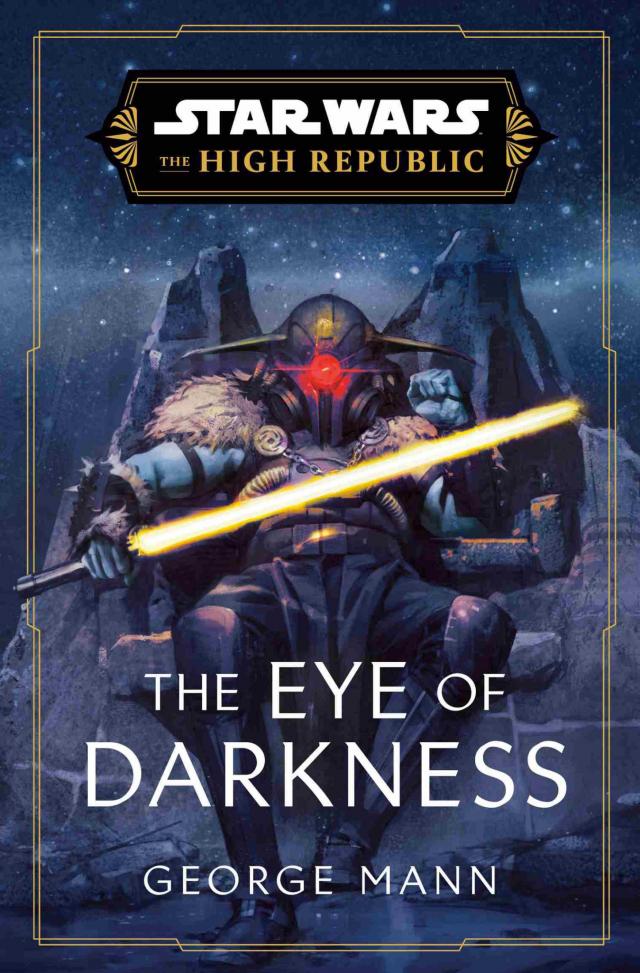


“But ‘all of this’ is just standing still. We’re no closer to stopping them than we were months ago. We need to find a new way to fight back.” She hated the fact she couldn’t see a way through this. That she didn’t know how to lead her people. That she felt so lost.
“Overreached, the Nihil have,” said Yoda. “This situation will be unsustainable. The bigger their domain becomes, the less control they have. There will be uprisings. A move made in haste, this expansion is.” He closed his eyes, as if peering into the future. “They have made a show of strength, but it will become a weakness.”
“Even if that’s true, we can’t wait for them to tear themselves apart,” said Lina. “Too many lives will be lost. Too much damage will be done.”
Yoda nodded. He opened his eyes, but they were heavy-lidded, as if he were still somewhere else, lost in his own thoughts. “Agree, I do. We must keep the pressure on. The Council has already sanctioned more Jedi to assist in the capture of a Path drive. One priority, this must be.”
Lina nodded. She didn’t know what else to say.
“There are trying times ahead,” said Yoda. “Our attention is divided. People need our help, more than ever before. Our resources are spread thin. The Stormwall must be breached. Learn how to combat the Nameless, we must.”
Lina wanted to scream in frustration. “As appalling as those monsters are, as worrying as their effect is upon the Jedi, surely, they’re just a weapon harnessed by a mad dictator. How can they be the answer to all of this?”
“Intertwined with the history of the Nihil, the Nameless are. Unlock the truth of them and the answers will become clear,” said Yoda.
“You’re sure of this?” asked Lina. She couldn’t begin to understand it, but she had to put her faith in the Jedi Council. Now was not a time for shutting down any options.
Yoda nodded. “We grow closer to understanding. With the help of Azlin, and through the dedication of Jedi such as Reath Silas and Emerick Caphtor, soon we will know the truth.”
“Then what can I do to help? As you say, our resources are already spread thin, but whatever you need, I shall put at your disposal.”
“Wise, this is,” said Yoda. “Help, we will need. The Jedi cannot deal with the Nameless alone.”
“I’ll speak to the RDC commanders,” said Lina. “We’ll coordinate with the Council and allocate appropriate personnel to help with this.”
Yoda got down from his seat. “Speak to the Council, I shall.”
Lina nodded, exhausted.
“Together, we will face this, Lina Soh,” said Yoda. “Together, we will find a way.”
HETZAL, INSIDE THE OCCLUSION ZONE
“Avar. This is Rhil. The plan is go. Same location tonight, sunset.” A pause. “Avar. This is Rhil. The plan is go. Same location tonight, sunset.” And then: “Avar, this is—”
Viess reached over and punched the off switch on the recording device. She stared at the odious little Talpini standing before her in her private chambers. He was wearing a self-satisfied grin so broad she thought it might develop its own gravity horizon and swallow him whole. “All right, Petrik. You’ve done well.”
Petrik slipped the recording device back into his filthy coveralls. “I got suspicious, see. Meglar kept making excuses to be alone with the reporter woman. At first, I thought—”
“Yes, yes. I can imagine what you thought,” said Viess, with a shudder. No wonder the fool had been spying on them. He’d obviously been hoping to catch sight of more than just a secret transmission.
But what a transmission.
Avar.
It had to be Avar Kriss, the legendary Jedi. The marshal of Starlight Beacon. The so-called Hero of Hetzal, who’d saved this very planet from destruction after the first Great Disaster.
Was she here, on Hetzal, now? Had she been operating inside the Occlusion Zone all this time, unnoticed? It certainly sounded like it.
Viess had heard stories about a female Jedi—most recently after picking up an escape pod containing two Nihil guards, who’d been ejected from a transport ship carrying a grain shipment. They were dead now, of course—that sort of failure couldn’t be tolerated—but they’d spoken of a blond, female human with a lightsaber.
A woman with the power to move things with her mind, who hadn’t killed them even though she’d had ample opportunity.
A Jedi through and through.
Of course, there wasn’t much information to go on. There were probably dozens of Jedi who’d modeled themselves after Avar Kriss. But hearing this now…it would make sense.
Avar Kriss, almost within reach.
From the recording, it seemed the Jedi was planning something with Rhil Dairo and the traitorous Halisite, Quith Meglar. Perhaps some sort of prison break. Perhaps more.
For months, Viess had been telling Ro that keeping the reporter alive was a risk. That, despite the delicious irony of using one of the Republic’s former mouthpieces to broadcast propaganda against it, Dairo would try to turn the tables on them at the very first opportunity.
Clearly, Ro had understood that. In fact, he’d probably counted on it, seeing it as a way to lure more Jedi, who might try to save their erstwhile friend, or at the very least try to put an end to her broadcasts.
The plan had worked, too. Although Viess had no intention of telling Marchion Ro. At least, not until she could serve Avar Kriss to him on a silver platter.
She’d failed to bring in Porter Engle. So far.
This, though—this would be the crowning glory. This would see her elevated above the other ministers. It would finally silence that fool Ghirra Starros, who was so intent on peace that she’d practically become an enemy sympathizer. And Boolan, too. That horrendous Ithorian with his grotesque experiments. There’d be no need for him and his own Jedi-hunters. Not when Viess had brought Avar Kriss to the table.
“Shall I kill them?” asked Petrik, with a little too much enthusiasm. “Or do you want to do it yourself?”
“Not yet,” said Viess.
Petrik looked confused. “But they’re traitors. We should stick ’em and split ’em before they have the chance to cause any real trouble. It’s what the Eye would do.”
“And how would they lead us to the Jedi if they were dead?” said Viess, her patience quickly running out. “We don’t know where their secret ‘location’ is, do we?”
Petrik shook his head. “The Jedi? You mean there’s a Jedi mixed up in all of this?” He actually looked scared at the thought of it. How the imbecile was still alive was anyone’s guess.
“Look, just…keep an eye on them both. Let them have all the space they need. If they make any more broadcasts, you know what to do.”
“I do?”
“Record them and bring them to me, like this one,” said Viess, through gritted teeth.
“Ah, yeah. Of course.”
“And Petrik—if you tell anyone else about this, they won’t be the only ones who end up ‘stuck and split.’ Do you understand?”
“I think so,” said Petrik.
“Then get back to whatever filthy little hole you crawled out of. And be ready. When they leave to make that rendezvous, you’re coming with me.”
Petrik nodded and hurried out.
Viess watched him go.
Fodder for the Jedi’s blade, that one.
Assuming I don’t kill him first…
HINTIS IV
The light of the red sun made Bell think of blood.
It washed over him as he stood at the viewport in the tactical station, bathing his face, steeping him in its soft crimson glow. Today, the city ruins looked like a graveyard, a mausoleum raised to account for the dead.
And there were so many dead.
The mood at the RDC base on Hintis IV was somber. People had lost friends and loved ones in the attack on the Stormwall and were wallowing in grief. Others were reeling in shock at the loss of their homeworlds, engulfed by the expanding Occlusion Zone. Families, homes, all of them now out of reach. It was inconceivable, and the ripples would be felt for generations.
Bell had tried to reach Coruscant, to speak to someone—anyone—about what had happened, but the comm channels were all overloaded, and the Jedi were scrambling to field the thousands of new problems they all faced.
The best thing he and Burry could do—they’d agreed—was to redouble their efforts to capture a Path drive. Not only that, but they had a new border to help patrol.
The Hintis IV base was now dangerously close to the new border itself, which had swelled right into the neighboring star system before it finally stopped. The raids could be coming for them next. People were understandably nervous.
Bell, on the other hand, was feeling deeply frustrated. He’d spent some time meditating, trying to come to terms with the anger and desperation that had caused him to try to turn the Tractate around, to strand himself and the others inside the Occlusion Zone as it expanded.
It was an action born out of that same frustration, that need to be fighting back, doing something worthwhile, making a difference.
But he’d let it go too far, and he’d apologized to Burry, Captain Pel, and the crew.
The thing was, they understood. They shared his frustration, his desperation. They wanted nothing more than to stop the Nihil. But Burry had been right. One more ship inside the zone wasn’t enough. And they were needed. The last thing the Jedi Order needed was to lose more people behind the Stormwall without a plan.
And so he’d turned his attention back to the plan.
Where they’d hit another wall.
“So there’s still no pattern you can decipher from the raids?” said Bell, turning away from the viewport.
Harlak, the Gran technician, shook his head. “Nothing. It almost seems as if they’re being randomized. As if, whenever a ship with a Path engine wishes to traverse the Stormwall, the system allocates a random permitted route through which to travel.” He shrugged. “It’s a clever setup. Primitive, but if you have control of the home ship and a load of Path drives containing maps of otherwise uncharted hyperspace routes, it’s close to infallible.”
Burry gave a low growl of displeasure.
Harlak held up his hands in mock surrender. “I’m not saying I like it,” he said, “but I can appreciate it for what it is.”
“So what you’re telling us is, there’s no pattern to be found in the way the Cacophony carries out its raids?” said Bell.
“That’s what it looks like,” said Harlak.
Burry shook his head, setting his braids jangling. He pointed out that couldn’t be the case. The raids were anything but random. They were too well executed, too carefully planned. Some were orbital bombardments, others ground-level assaults. They couldn’t do that without knowing what they were getting into—it was too much of a risk, even for the Nihil. One misstep, attacking a stronghold or armed garrison, and they’d be obliterated or risk letting a Path drive fall into enemy hands. On top of that, he was certain that Shryke was using the raids as a sort of bait, an attempt to lure in more Jedi to capture and take back behind the Stormwall.
“You’re right,” said Bell. “It fits with what happened to Master Veter. And what they tried to do when they attacked us with those drill ships. The Cacophony could have finished us off. Blown us to pieces while were stranded. But instead, they were closing in.”
“Interesting,” said Harlak.
“It means not all the raids can be random,” said Bell. “Most, perhaps, where it makes little difference to the outcome. But Melis Shryke could be working to a plan. Using particular Paths to bring her closer to Jedi patrols.”
Burry nodded. He crossed to the tactical station and brought up the holographic map of the Stormwall. Bell tried not to think about how much bigger it looked. Burry turned a series of dials, rolling back the timeline to before the recent expansion. The holographic Stormwall shrank again.
“What are you doing?” asked Bell. He and Harlak crossed to join Burry, peering at the wavering blue map.
“Arrwwwrara warrgh,” said Burry, explaining that he had an idea.
“Oh, that’s good!” said Bell. “Why haven’t we thought of looking at it that way around before?”
Harlak looked at Bell, fathomless. “What did he say?”
Bell smiled. “He said instead of looking at the point of emergence, why don’t we try correlating the sites of the actual raids.”
Harlak considered that for a moment. “It could work. We’ve tried it before, but more generally, and found no obvious patterns. But if you’re right about the Cacophony specifically…” He looked genuinely excited now, fidgeting with his hands as if already having to hold himself back from the terminal. “If we isolate the raids we know for certain were carried out by the Cacophony, we might well be able to triangulate to see if there’s a pattern that emerges.”
“Genius,” said Bell.
Burry thumped him lightly in the arm.
“I meant you! I meant you!”
Bell rubbed his arm pointedly. When he looked around again, Harlak was already busily plugging in data.
CORUSCANT
Elzar had avoided pretty much everyone upon his return to the Jedi Temple on Coruscant. He knew he’d have to face them sooner or later—there would be an inquiry, during which he and Keven Tarr would each outline their understanding of what had happened during the attack on the Stormwall.
He had no concerns or qualms about that. He would be honest and straightforward about his decisions and their implications, and he knew Tarr would, too.
The truth was, though, that both the Jedi Council and the RDC had far more important things to concern themselves with first. The expansion of the Stormwall was a blow none of them could have anticipated, and it would dominate their lives for the foreseeable future. Decisions were being made. New lines were being drawn. Jedi were being reassigned to assist RDC operations in new sectors. Others were being sent out to reinforce efforts to capture a working Path drive.
The Temple was a hive of activity.
Elzar would help with it all, in whatever way he could. He would play his part to the very best of his ability.
That would come later, though. For now, he had retired to his chambers.
To hide.
It wasn’t that he was unable to face their scorn. It was more that he wasn’t sure he could bear their kindness. It was why he’d isolated himself from Tarr on the journey home—because Tarr was almost as empathetic as Burryaga, despite his veneer of studious distraction. Tarr would have sought to comfort him, and Elzar didn’t think he could stand that. He’d made the wrong decisions, pushed and pushed until he got his way, and then gambled with the lives of others. He had to face what he’d done and learn to live with the consequences, the weight of the responsibility.
He didn’t need kindness. He needed honesty and truth. He needed someone to hold a mirror up to him and remind him why he cared so much, why he did what he did; why he was a Jedi in the first place.
He needed Stellan.
Or Avar.
Sitting on the floor, his knees pulled up to his chest, he wondered if he would ever see her again. The thought that he might not was unbearable.
Avar was a friend. A fellow Jedi Master. They’d agreed long ago that’s all they would ever be. And it was enough. Truly, it was.
What he needed from her now was a shoulder to lean on. Guidance. Understanding.
He needed to know someone cared.
That someone could still see the real Elzar, behind all the mess, behind the façade he’d been trying so desperately to maintain. He needed her help to find himself again.
Elzar wanted to say all of this to her. She was the only one left who he could talk to like that. Still the only one he’d told about Chancey Yarrow. He needed to tell her how he was feeling.
He knew that was selfish of him.
Yet, regardless, he needed to get it out. To just…talk.
He glanced at a nearby drawer.
Perhaps there was a way.
He leaned over, pulled the drawer open, and withdrew a small, black comm unit. It was ancient, a relic, really, designed for an old communications relay system that made use of a string of satellite buoys seeded during the great expansion nearly two hundred years earlier. The tools of the old Pathfinders and their comm teams, left to languish unused since the mapping of the hyperspace lanes that made them obsolete.
It would translate his words into a kind of simple code, a sequence formed from pips, whistles, and beeps, that would be cast out into the depths of the Outer Rim.
He’d once hoped it might be a way of getting a message into the Occlusion Zone, a tech so old that the jamming equipment employed by the Nihil to block comms wouldn’t even recognize it.
In the months after Starlight’s fall, he’d sent several messages out, using a variety of techniques and old equipment, working to the same principle—that the Nihil wouldn’t be actively blocking any old or outdated modes of communication. He’d spent weeks in the Jedi Archives researching obsolete technology, as well as more arcane, ancient techniques of Force projection. He’d assembled devices and transmitted his messages, but had received no reply.
Only once had he tried to reach Avar directly. But the experience—made using a device he’d built to try to channel the Force—had proved painful and ineffective.
In the end, he’d given up the whole enterprise as futile, but only after he’d exhausted every avenue he could find. It seemed no one was listening, and if they were, they probably wouldn’t know how to decipher the strange codes he’d had to use to make the equipment work. They probably wouldn’t even think to scan the right channels. The tech was so obscure now that the entire enterprise was most likely a complete waste of time.