

Emberfall, p.1
Emberfall, page 1


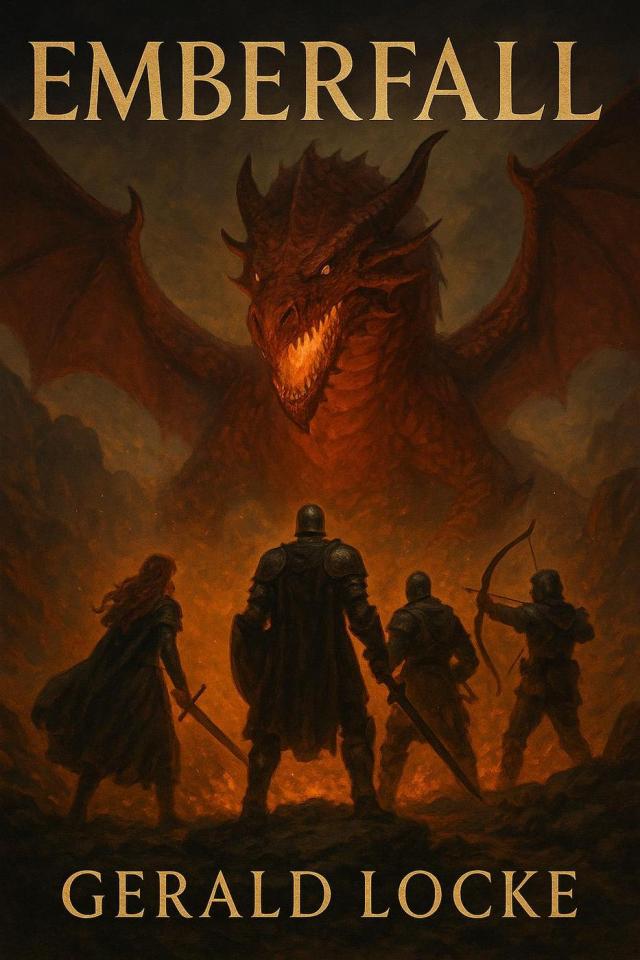
Emberfall
by
Gerald Locke
“A tale of flame, memory, and the quiet that follows”
Emberfall
Copyright © 2025 by Gerald Locke
All rights reserved. No part of this book may be reproduced, stored in a retrieval system, or transmitted in any form or by any means—electronic, mechanical, photocopying, recording, or otherwise—without prior written permission from the author.
This is a work of fiction. Names, characters, places, and incidents either are products of the author’s imagination or are used fictitiously. Any resemblance to actual persons, living or dead, events, or locales is entirely coincidental.
Printed by Locke Publishing
Cover and interior design: Gerald Locke
Discover more books by Gerald Locke:
GeraldLocke.com
Follow for updates and new releases:
TikTok: @geraldlockeauthor
Facebook: Gerald Locke – Author
Table of Contents
Introduction – The World Before Quiet
Prologue — When the World Burned First
Chapter 1 – The Kingdom Beneath Ember Skies
Chapter 2 – Call of the Adventurers
Chapter 3 – Ash and Horizon
Chapter 4 – Marrow Pass
Chapter 5 – The Ash-Born Kingdom
Chapter 6 – Veins of Fire
Chapter 7 – The Shattered Crown
Chapter 8 – The Mirror and the Mask
Chapter 9 – Ashes of Trust
Chapter 10 – Embers in Exile
Chapter 11 – The Fire That Sleeps
Chapter 12 – The Heart Beneath the Ash
Chapter 13 – The Dream That Remembers
Chapter 14 – The Memory Throne
Chapter 15 – The Guardians of Emberfall
Chapter 16 – The Voice of Flame
Chapter 17 – The First Remembered
Epilogue – Emberfall
“The world does not end in silence;
it ends in understanding what silence means.”
—Gerald Locke
Introduction – The World Before Quiet
Before the silence, there was fire.
It burned without mercy or shape, devouring the names of rivers and mountains alike. The old kingdoms fell not by sword, nor plague, nor time — but by memory itself, because the fire remembered what mortals had forgotten. It remembered how to hunger. When it came, it did not roar; it sang. Whole cities vanished between one verse and the next, and the light that followed was beautiful enough to make the survivors weep.
From that ruin, the world learned stillness. The sky dimmed to the color of cooled iron, the seas retreated into themselves, and the wind carried ash so fine it whispered through stone. What remained of humankind gathered in hollow places, afraid to speak lest the fire hear them again. For nearly a generation, no new words were made — only echoes of the old ones, brittle as bone.
It was then that the fortress called Emberfall began to rise.
No one built it in the way walls are usually built. Its foundations were already there — slabs of black glass and obsidian fused from the earth’s surface when the fire had passed. The survivors found those shining ruins and discovered that the stone was warm. It pulsed faintly beneath their hands like a heart too tired to beat. They built atop that warmth, not knowing whether it was life or curse.
What they made became both sanctuary and scar. The fortress glowed faintly at night, light bleeding from its seams as if something within still dreamed of flame. People gathered there to survive the cold. They told themselves the warmth was mercy, not memory.
They were wrong.
At the edge of this new world lived those who remembered what had been lost — the dragons and the remnants of the beasts once called divine. Most had perished in the burning, their bones buried beneath seas of glass. But one remained.
Rhaedyn, eldest of the Emberflight, slept deep beneath the mountain roots. His scales had dulled from crimson to rust, his breath slowed until even the stone forgot his heat. Yet when the fortress of Emberfall began to hum again, when mortals dared rebuild upon the heart that had destroyed them, the dragon’s eyes opened.
The sound that woke him was not the voice of gods. It was human.
In the third generation after the Burning, the world began to change again. Grass pushed through the cracks of old roads. Rivers that had turned to dust found new beds. And in Emberfall, a woman was born who carried light beneath her skin.
Lyra was the daughter of healers — quiet, thoughtful, more listener than speaker. Her hair caught the sunrise like metal, and her hands were always warm. The elders said she was blessed by what they called the Heart Beneath, the living ember that pulsed below the fortress. She could coax dying plants to rise, soothe fever with a whisper, and once, in a moment of fear, she burned a wound closed without touching it.
The priests feared her. The people adored her. And Lyra herself — she feared only the silence that followed when she slept, because in her dreams, the world spoke back. It told her of a name older than flame: Remembrance.
Far from the fortress, across the jagged plains where glass still cut the wind, a soldier wandered.
Kael had survived the last of the border wars — wars that had never really ended but simply forgotten their purpose. He was a man made of scars and discipline, carrying loyalty like a burden. He came to Emberfall not as conqueror but as penitent, hoping to find something to believe in beyond command and loss. What he found instead was duty reborn — and a woman whose voice could wake gods.
The first time Kael heard Lyra speak the forbidden language — the old tongue of light — he thought the sky itself had broken. The walls trembled, the rivers glowed, and the air tasted like iron and honey. When the silence returned, he knew the world had changed again.
Scholars recorded the tremors. The fortress chronicler, Seris, wrote that the pulse beneath Emberfall had quickened for the first time in centuries. The readings from her ancient instruments — brass, crystal, and bloodsteel — showed impossible harmonics. She claimed the heart was alive, conscious, and listening. But when she presented her findings to the Council, they laughed.
“Stone cannot dream,” the high priest said.
Seris did not argue. She simply pressed her palm to the floor, felt it tremble beneath her, and whispered, “Then it’s waking.”
The weeks that followed were filled with small impossibilities. Birds began nesting in the tower spires though none had flown since the Burning. The river’s edge sprouted pale flowers that glowed after dusk. The air near the fortress shimmered faintly, as though the world was remembering color.
But every gift carried weight. Crops grew in a single night only to wilt the next morning. Children were born with eyes of gold and skin that shed light when they cried. And through it all, Lyra dreamed. She dreamed of a voice rising from below, patient and curious, calling her name.
Come speak to me, it said. The silence is lonely.
When Rhaedyn rose from the mountain depths, the ground split open for miles. The dragon’s wings blotted out the dawn, scales shedding sparks as he crossed the valley. The people fled. Only Lyra stood her ground.
He landed outside the fortress, the heat of his breath melting the outer stones. His eyes, vast as the gates themselves, fixed upon her.
“The heart remembers,” he said. His voice shook every wall. “And it has chosen its tongue.”
That was the moment Kael drew his sword, Seris dropped her books, and history began again.
Emberfall became the axis of everything that followed — the meeting point between mortal will and divine memory. From its towers, rivers of light began to flow outward, threading through dead lands, carrying both life and corruption. The people called it the Renewal. The wise called it the Repetition.
No one agreed on what Lyra had done. Some said she blessed the heart and brought the world back to balance. Others said she cursed it by giving voice to its hunger. What is known is this: for the first time since the fire, the world began to change itself.
And deep beneath, in chambers where no human hand had carved, the stone began to breathe.
If you walk the plains today, you will still see the shimmer of light where the fortress once stood. The grass there grows taller and greener, and the rivers sing softly even when there is no wind. The scholars say the hum beneath the soil is nothing but pressure, the echo of the planet settling. But those who remember the songs of the old fire, those who have seen the stars flicker in unison above the ruins, know better.
They say Emberfall was not a place at all, but a promise — that creation itself could learn mercy.
They say a woman taught the world how to sleep without dying.
And when the night is still, when even the wind holds its breath, you can almost hear her voice — soft, human, and infinite — whispering from beneath the stone:
“Rest now. The world remembers enough.”
Prologue — When the World Burned First
Before there were kings or kingdoms, before the word “sword” was ever spoken, the world was a raw, molten dream.
Stone and flame were lovers then, and sky had not yet learned to separate itself from smoke. Mountains breathed like living things. Oceans glowed from the heat of the earth’s newborn heart. And within that blazing womb, the first dragons awoke.
They did not hatch, nor were they born — they ignited.
The gods called them the First Flame, sen
But power, even in innocence, cannot help but hunger.
When the dragons looked upon the void beyond their domain, they desired to fill it. They roared across the skies, and their roars became thunder; they bled upon the soil, and forests grew from their blood. Yet creation was imperfect. In the hollows of their flame, something new took root — something that questioned.
From the ashes of the dragons’ shedding scales, the First Humans rose. Fragile. Finite. Burning with curiosity instead of fire. The dragons watched them as one might watch sparks drifting too close to kindling. The gods had not intended these smaller flames, but they burned nonetheless — and in their smallness, they were beautiful.
For a time, dragons and humans shared the world in uneasy harmony. Humans built temples of obsidian to honor their colossal benefactors, leaving offerings of song and blood. The dragons taught them the language of the wind, the meaning of the stars, and the forging of fire.
But where dragons saw stewardship, humans saw possession.
They envied the sky.
The first betrayal was not loud. It was a whisper — a human sorcerer speaking to a dragon, asking what it felt like to breathe worlds into being. The dragon, proud and curious, shared the secret.
The sorcerer captured it.
From that single stolen flame, humanity made its first weapon of fire.
Thus began the First War of Flame — the war that split heaven and earth.
The skies bled for centuries. Whole mountain ranges turned to glass. Seas boiled away to reveal the skeletons of ancient leviathans. Dragons fell, one by one, brought down not by strength, but by cunning — poisoned by their own reflected fire.
Yet humanity, too, paid a terrible price. The gods, horrified by their creation’s defiance, turned away. The air itself became bitter. For every dragon slain, a thousand cities turned to ash. Still, mankind pressed on, their resolve hardened by grief and guilt, until only one dragon remained — the greatest, most radiant of them all.
Aetherion, the Eternal Flame.
Its wings spanned horizons. Its voice shook time itself. Aetherion was not mere fire — it was the source of fire. It burned in colors no mortal eye could name. It looked upon the armies that marched against it — men armored in dragonbone, their faces blackened with soot — and it pitied them.
“You seek to master the flame,” Aetherion spoke, “but you are flame. You will devour yourselves in your striving.”
Yet humanity would not kneel. They raised a weapon forged from the souls of the fallen — the Runeblade of the Seventh Light — and with it, they cut through creation itself. The wound they made became a prison. Aetherion’s roar scorched the world one last time before silence fell.
The dragons were gone.
The gods were gone.
And the flame — the flame was buried.
Out of that silence, humanity built new cities.
They forged kingdoms upon the bones of wyrms, raised towers where dragons had once nested, and called it peace. But deep beneath their triumph, the earth still pulsed with the rhythm of something ancient — a heartbeat of fire beneath stone.
Generations passed. Memory faded into myth. The dragons became bedtime stories, their bones relics, their names forbidden prayers. Yet the flame does not die; it only sleeps.
And sometimes, when the wind shifts at dusk, the sky remembers.
The people of Valecross have learned to live beneath that memory.
They light their torches every night, believing the flame belongs to them.
But the flame remembers its true masters.
And the world, tired of silence, is beginning to breathe again.
Chapter 1 – The Kingdom Beneath Ember Skies
The first light of morning spills across the Ashen Peaks like molten glass. Each ridge catches fire beneath the rising sun, painting the sky in ribbons of copper and blood-gold. From those burning horizons, the city of Valecross awakens.
Smoke curls gently from the forges of the Outer Ward, mingling with the perfume of bread and tallow and horses. Hammerfalls ring in rhythm—steel on steel, the city’s heartbeat. Bells toll from the Temple of the Eternal Flame, slow and resonant, as if calling the sun itself to duty. The sound ripples through every arch and alleyway, bouncing from marble towers to slate-tiled roofs until it reaches even the slums beyond the eastern gate.
A thousand small lives stir at once. Fishermen haul nets across the silver canals. Apprentices sweep the dust of yesterday from shopfronts painted with saints and dragons. Children chase one another through steam rising from sewer grates, their laughter sharp against the murmur of the crowd. Above them, banners of crimson and white snap in the early wind—the sigil of Valecross, a phoenix rising from a ring of swords.
Atop the western battlements stands Kael Ardent, captain of the Crimson Guard, watching his kingdom come alive.
His armor is half-buckled, his hair still damp from the barracks’ cold basin. Sleep clings to him like soot. Below, the world moves with the effortless rhythm of those who have not yet learned what it means to lose. Kael leans on the parapet, gauntleted hands blackened from last night’s patrol. The air smells of iron and rain. For a moment, he allows himself to breathe.
Perhaps today will be ordinary, he thinks. Perhaps there will be no alarms.
He has thought that every morning for seven years, and the gods have yet to listen.
A whisper stirs among the guards—barely sound, more vibration than voice. The pigeons nesting in the arrow slits burst outward in a flurry of wings. Then the whisper becomes a tremor. Cups rattle on tables below. Horses rear in the streets. Kael’s fingers tighten on the stone just as the sky roars.
It is not thunder. It is alive.
From beyond the eastern mountains, a shadow uncoils—vast, sinuous, aflame along its edges. Light bends around it. The morning sun pales. A trail of ember and ash streaks behind its wings as it cuts through the clouds. The air itself seems to bow.
The Ember Drake.
For a heartbeat, the entire city forgets to move. The creature’s cry rolls across the plains like the sound of the earth splitting. Windows shatter. Dogs wail. Kael’s knees lock as heat ripples over the walls, scalding the exposed metal of his armor. He cannot think, cannot breathe; only see—the impossible, the legendary, the nightmare from his father’s tales—alive again.
“Sound the alarm!” His voice breaks the spell. The bells of Valecross explode into motion.
Inside the citadel, priests abandon their chants and run barefoot across marble floors. In the market, merchants grab their children and scatter. From the docks, sailors gape at the crimson arc searing across the sky. Every tower, every street corner erupts in the same cry: “Dragon!”
Kael sprints along the wall, shouting orders. “Archers to the east! Load the scorpions! No panic—eyes on me!”
But already the city burns with chaos. Smoke spirals upward where a falling ember strikes a roof. The great forges, still glowing from dawn’s work, become pyres as the first gust of draconic wind feeds their flames.
The Ember Drake does not descend; it glides, vast and silent now, surveying. Its wings blot out the sun as it circles once over Valecross, a god inspecting the ants below. Its scales shimmer between black and molten orange, as though the creature is forged anew each second. When it exhales, the air warps—heat waves bending towers like reeds.
Kael’s lieutenant, a young woman named Mira, stumbles to his side.
“Captain—by the gods—what is it doing?”
“Remembering,” Kael mutters. “It’s remembering what this place took from its kind.”
The drake tilts its head, and Kael swears its eyes meet his. In that gaze he feels not hatred, but recognition—an old intelligence measuring him, weighing his courage as one might weigh a coin before the forge. Then the creature gives a slow, almost mournful hiss, folds its wings, and vanishes into the clouds with the thunder of a collapsing world.
Only its wake remains—a rain of ash and sparks drifting down upon the stunned city.


