

The phantom hollow, p.1
The Phantom Hollow, page 1
part #1 of Trevor Lowe Series


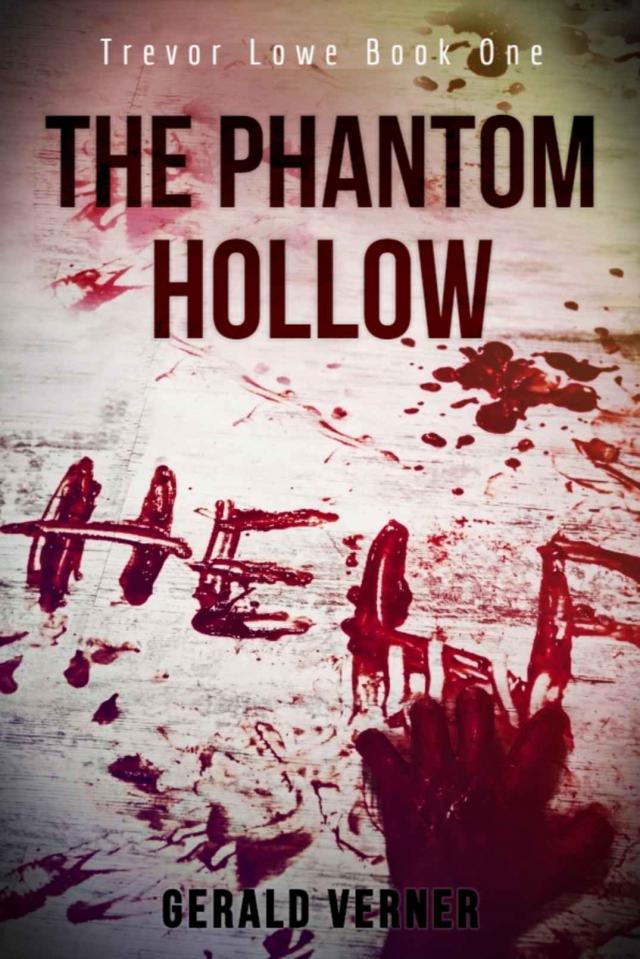
THE PHANTOM HOLLOW
Gerald Verner
© Gerald Verner 1933
© Chris Verner 2016
Gerald Verner has asserted his rights under the Copyright, Design and Patents Act, 1988, to be identified as the author of this work.
First published in 1933 by Wright & Brown Ltd.
This edition published in 2019 by Endeavour Media Ltd.
TO MRS. EDGAR WALLACE
Table of Contents
Chapter One – The Crimson Warning
Chapter Two – Mr. Trevor Lowe
Chapter Three – The Locked Room
Chapter Four – The Woman Who Screamed
Chapter Five – A Fresh Development
Chapter Six – The Clue of the Paint-flake
Chapter Seven – The Monk
Chapter Eight – Information from the Yard
Chapter Nine – The Men in the Night
Chapter Ten – The Man in the Post Office
Chapter Eleven – The House in York Road
Chapter Twelve – The Death Chamber
Chapter Thirteen – The Second Warning
Chapter Fourteen – No. 31
Chapter Fifteen – Ursula’s Warning
Chapter Sixteen – The Secret Passage
Chapter Seventeen – The Night Alarm
Chapter Eighteen – What Does Mr. Wyse Know?
Chapter Nineteen – Mr. Wyse Acts Strangely
Chapter Twenty – Lowe’s Plan
Chapter Twenty-One – A Call on Mr. Wyse
Chapter Twenty-Two – Lowe Suggests a Retreat
Chapter Twenty-Three – Dr. McGuire Tells the Truth
Chapter Twenty-Four – The Secret of the Passage
Chapter Twenty-Five – The Barn
Chapter Twenty-Six – Just in Time!
Chapter Twenty-Seven – Sydney Garth Explains
Chapter Twenty-Eight – Interlude
Chapter Twenty-Nine – The Hiding-place
Chapter Thirty – Knotting the Threads
Chapter One – The Crimson Warning
Tony Frost gazed admiringly at an old Jacobean carved chest. ‘That would fetch quids in a sale room, Jack, old boy, literally quids! And the whole place is simply teeming with this stuff, absolutely full of it, upstairs as well!’
Jack Denton grinned. ‘Tony, you deserve a wreath of laurels for digging out this wonderful spot,’ he said enthusiastically.
‘By Jove, I really believe I do, you know!’ agreed Tony modestly. ‘The agent chappie said the same thing when he handed over the keys. He said there wasn’t another cottage in the whole of England to touch Monk’s Lodge at the rental, and that I certainly knew what I was about when I approached him.’
Jack Denton ran his eyes approvingly along the rough oak beams supporting the ceiling. ‘It all looks fine,’ he remarked. ‘Let’s see what it’s like upstairs.’
Tony led the way out to the tiny hall, and the contrast between the two men was very marked. Jack Denton, though not as tall as his friend, was of an athletic build, with good-looking, clear-cut features, and wavy brown hair that grew well off his forehead. Tony, on the other hand, was inclined to be rather a weedy specimen, with narrow shoulders and a pimple of a chin that threatened to become part of his neck. His hair, which he wore well plastered down, had the appearance of a close-fitting cap of honey-coloured satin. His eyes were of a pale blue that gave him an extraordinarily washed-out appearance, and he spoke with a slight impediment of his speech that was more than a stammer and yet not quite a stutter. Combined with his fastidious style of dressing, these characteristics gave most people the impression that he was rather inane. Actually, however, Tony was not such a fool as he looked — and this is saying a great deal.
Like many other friendships, theirs had started at school, but unlike the majority had been kept up in after-life. They had gone up to Oxford together, but Jack, who had originally intended to be an engineer, had been compelled to leave before he had completed his time, owing to the death of his father, which resulted in certain drastic alterations to his financial expectations. So drastic indeed were these alterations that his original career as an engineer had to be abandoned, and he had been forced to take the first job that had come along.
Tony Frost was more fortunate. The eldest son of a Lancashire family, well established in the cotton industry, he was provided with ample means and had no necessity to work at all. The liberal allowance he received from his father enabled him to live in luxury with no more worries than those he had brought on himself through the publication of a thin volume of alleged poems that nobody understood, and which the critics treated as the biggest joke of the season.
In spite of these material, mental and physical differences, however, Jack and Tony got on very well together. It was their custom to spend Jack’s annual holiday in some novel haunt usually well off the beaten track, and this summer they had come to the heart of the country where Tony, during one of his holiday-spot hunting expeditions, had hit upon Monk’s Lodge, with a convenient ‘To Let’ board up.
For those who have a liking for rural solitude, the place was certainly ideal. Standing in its own old-world garden, and surrounded on three sides by heavily wooded hills, the cottage nestled snugly in the midst of typically wild Somerset scenery. The nearest village was two miles away, a little place called Friar’s Vale that consisted of a public-house, two farms, and a handful of straggling cottages.
The site on which Monk’s Lodge stood had, many years back, been occupied by a monastery. The ruined arch of the old building was still visible half-hidden among the trees, and close by was an irregular heap of the grey stone with which it had been built. On one side of the cottage was an extensive but much-neglected apple orchard; and beyond this, through a little gate, an overgrown and rather indistinct footpath wound its way through thick gorse till it reached the river Loam. It was more of a brook than a river, for at this point it was neither very deep nor very broad, its source originating locally in the small range of hills behind Monk’s Lodge. Further down, however, it widened, and there was good fishing to be had, a peaceful sport of which Jack was especially fond, though Tony disliked it intensely. He preferred to lie at full length on the bank, and although he said on these occasions that he was engaged in composing sonnets, the strange noises that issued from his nostrils rather led Jack to doubt this statement.
They explored the cottage thoroughly, finding new delights at every turn; and then when they had exhausted the garden they decided to stroll down to the village with the object of obtaining some sort of domestic help. It was Jack who suggested dropping into the tumbledown post office-cum-general shop as a starting point.
‘You’ll be wanting to know someone as’ll do for yer?’ the old lady behind the counter asked when Jack had succeeded in impressing her with their requirements. ‘An’ where might ye be stayin’?’
‘Monk’s Lodge,’ said Tony.
Immediately the old lady’s manner changed. She started back as if her nose had accidentally touched a hot iron. ‘Ye won’t get nobody from ’ere as’ll work at that place — no, not for no amount of money!’ She lowered her voice to a dramatic whisper. ‘It’s evil, is Monk’s Lodge, and ’aunted! No one round these parts’ll go near it.’
‘But — dash it all,’ Tony protested. ‘You don’t really mean to tell me that you believe in that — that silly tosh!’ he exclaimed.
‘You can call it what yer like, sir,’ said the old woman, shaking her head, ‘but you won’t get nobody ’ereabouts to go near Monk’s Lodge, not if yer tries from now till doomsday!’
Jack exchanged an amused glance with Tony, and the latter was in the act of opening his mouth to say something further when a heavy footfall crossed the threshold of the little shop and a farm labourer lounged up to the counter.
‘Give us an ounce of Nosegay, Mother,’ he said, speaking in a broad Somersetshire dialect, and then noticing Tony and Jack he touched his shabby cap.
Jack nodded in return and gave the man a friendly smile, which prompted him to remark that it was nice weather and to inquire if they were staying in the village.
‘We have just taken Monk’s Lodge,’ replied Jack, and he went on to explain that he was looking for someone who would keep the place clean and cook for them.
The villager’s expression changed and, like the old lady, he shook his head. ‘You won’t get nobody to work for you up at the lodge,’ he said decisively. ‘Least not from Friar’s Vale, you won’t!’
‘But there’s nothing wrong with the place!’ expostulated Tony irritably. ‘This story about it being haunted is a lot of silly nonsense!’
The labourer leaned forward and prodded him in the chest with the butt end of a black clay pipe. ‘Silly it may sound to you,’ he replied solemnly, ‘but you ain’t lived in these parts, sir. There ain’t man, woman nor child as ’ud go near that there place after nightfall, and there be precious few as ’ud go near it in the daytime!’
‘But why?’ demanded Tony, drawing back slightly so as to avoid being prodded again. ‘What’s the matter with it?’
‘Things ’ave been ’appening,’ said the labourer profoundly. ‘Queer things! There’s them what ’as seen things and ’eard things!’
‘What things?’ said Jack.
‘Shadders flitting through the wood, lights that weren’t made by no ’uman, and whisperings and suchlike. Why, it were only last night,’ the villager continued, evidently warming to his subject, ‘while I was ’aving me usual
‘Bosh!’ said Tony rudely. ‘Old Dinwood must have had one over the eight.’
‘’E don’t drink at all as a rule, sir,’ said the labourer, slowly filling his pipe from the tobacco he had just bought. ‘But that ain’t all. Perhaps you can say, sir, why the folks that bought Monk’s Lodge only stayed there for six weeks?’
‘I certainly can,’ said Tony. ‘The agent, Johnny, told me the whole business. The people who owned Monk’s Lodge have gone to America for a holiday, and they are letting the place furnished while they’re away.’
In spite of this plausible explanation, however, neither the villager nor the old lady appeared convinced. Notwithstanding all arguments to the contrary, they insisted that Jack and Tony were wasting their time trying to find anyone in Friar’s Vale who would brave the mysterious unknown terrors of Monk’s Lodge.
‘Well,’ said Jack after they had received the same reply from half a dozen different people in the village, ‘there’s only one thing for it. We shall have to get in some grub and look after ourselves.’
‘I suppose that’s the only solution,’ remarked Tony dismally. ‘But it’s a dashed nuisance! I simply loathe fiddling about cooking. Let’s get in as much tinned stuff as possible.’
As Jack privately thought he would loathe to eat any food that Tony had cooked, he did not argue this point. Over a pint of excellent beer at the local inn they made out a list of the things that they would require, and when this had been drastically cut down — for Tony was rather inclined to be lavish — they returned to the general shop to make their purchases.
They arrived back at Monk’s Lodge heavily laden and rather tired. Having had some tea and unpacked their various belongings, they spent the remainder of the day rambling about the garden, smoking and chatting.
Dusk merged into darkness, and presently, after an excellent supper, they went to bed without being disturbed by any of the horrific things which the gossip of the village might have led them to expect. In fact, it was not until the following night that the first of the series of strange happenings, which later were to end in tragedy, began.
It had been a scorching day, most of which had been spent in a voyage of exploration along the banks of the Loam, and darkness had already fallen when they got back to the cottage. They had something to eat, and then Jack sat down to write some letters while Tony wandered out into the garden to smoke.
It was a beautiful night; the moon high in the heavens draped the lawn and trees in a mantle of silver. That hushed stillness which only the country can provide lay over everything, unbroken except by the faint cheep-cheep of a bat as it circled overhead. Tony strolled to the end of the garden and paused by the ragged hedge that divided it from the wood. He had been there for perhaps three minutes, enjoying the beauty of the night, when suddenly a peculiar sensation stole over him. He felt that he was being watched. From somewhere in the darkness of the wood behind him he sensed invisible eyes looking at him. The feeling was so strong that he swung round, and then with a violent start he caught his breath, for through a gap in the hedge a white face was peering at him!
As he looked, it vanished, and he heard the sound of breaking twigs as footsteps padded swiftly through the wood. In three strides Tony was at the hedge, but the thickly growing trees made the darkness beyond intense and he could see nothing. It occurred to him to follow, but the wood was uninviting. After all, it was probably only some tramp who was prowling about in the hope of picking up a scrap of food. He made this suggestion to himself and tried to believe it. Yet there had been something so sinister about that white face watching from the darkness that the remembrance of it sent an unpleasant shiver down his spine, and he went back to the cottage at a much quicker pace than he had left it.
Jack had finished his second letter and was in the act of sealing it in an envelope when Tony came in. He listened with a smile while his friend related his experience.
‘I’ll bet you thought you had seen the ghost!’ he chuckled.
‘You wouldn’t be so ready to laugh,’ Tony remonstrated in rather injured voice, ‘if you had been there. It was very unpleasant.’
‘I expect it was only a tramp,’ said Jack. ‘Still, we’d better be careful and see that all the windows are fastened and the doors locked before we go to bed.’
And so the incident of the white face was dismissed, though later they were to remember it.
*
It was on the following morning that Tony received the letter. It was a rather odd communication, bearing the printed heading of a firm of estate agents in Dryseley, and which ran as follows:
Monk’s Lodge,
Friar’s Vale
Anthony Frost, Esq.
Dear Sir,
If it is convenient, I should like to call and have a chat with you at four o’clock tomorrow, Wednesday afternoon. There is something in connection with Monk’s Lodge about which, I regret, I failed to enlighten you. The matter is very urgent, so I hope you will be able to see me.
Yours faithfully,
WILLIAM P. OGDEN.
‘Dashed funny letter from Ogden,’ Tony exclaimed, pushing it across the table to Jack. ‘What do you make of it? Ogden is the agent I got this place from.’
Jack read the letter twice, then looked up with raised eyebrows. ‘I don’t know what it can be all about,’ he said, ‘unless there’s some hitch in the agreement. Anyway, we’d better be in when he comes, so we’ll have to modify our plans for the day.’
They had arranged to go on a fishing expedition, or rather, Jack had arranged to do the fishing while Tony looked on; but in the face of Mr. Ogden’s letter they agreed that this should be postponed. There were several fresh things required for the larder — milk, butter, bread, etcetera — and after breakfast they went down into the village to get them.
About a mile outside Horton there was an empty cottage, and as they passed this they saw a Ford van drawn up outside. Two men were struggling up the narrow pathway with a heavy bookcase.
‘Looks as if we’re going to have neighbours,’ remarked Jack casually.
‘By Jove, you’re right,’ said Tony, gazing hard at a spot beyond the van. ‘And very nice, too!’
Jack followed the direction of his friend’s glance and saw the cause of the last remark. Standing on the far side of the van was an elderly man. He was tall and wore a panama hat and the loose black neck-tie that is usually associated with Chelsea. Beside him — and the reason for Tony’s sudden attention — stood a woman. She was quite young — Jack guessed her age at twenty-one — and more than ordinarily pretty.
She looked round as they passed, and for a brief instant her eyes met Jack’s. It may have been his imagination, but he thought that they held a mute questioning — almost an appealing — look. It was only for an instant, then she turned away.
They waited at the lodge the whole of that afternoon for Mr. Ogden, but he never came. Either the urgent matter he had mentioned had proved not to be so important after all, or some other and more pressing business had detained him. Whatever the cause, Jack, not unreasonably, felt annoyed. The day’s outing had been ruined, and he spent the evening in a particularly bad temper, eventually going off to bed early and leaving Tony struggling valiantly with a new poem, the inspiration for which had been provided by the woman they had seen that morning.
Now, Tony could not write poetry, and nobody had any illusions on that point except Tony himself. And by two o’clock in the morning, when he had filled the waste-paper basket with spoilt sheets and the lamp was burning low for want of oil, Tony began to believe that he could not either. With an exclamation of disgust he rose and stretched himself, and was in the act of blowing out the light, preparatory to going to bed, when from outside the window came a soft crunching sound, like the sound of stealthy footsteps on gravel.
He listened tensely, but the noise was not repeated, and going over to the window he pulled aside the curtains, letting in a flood of moonlight. And then he stepped back quickly, with a startled exclamation, for written in crimson across the upper half of the windowpane were the words:


