

Vainglory, p.1
Vainglory, page 1


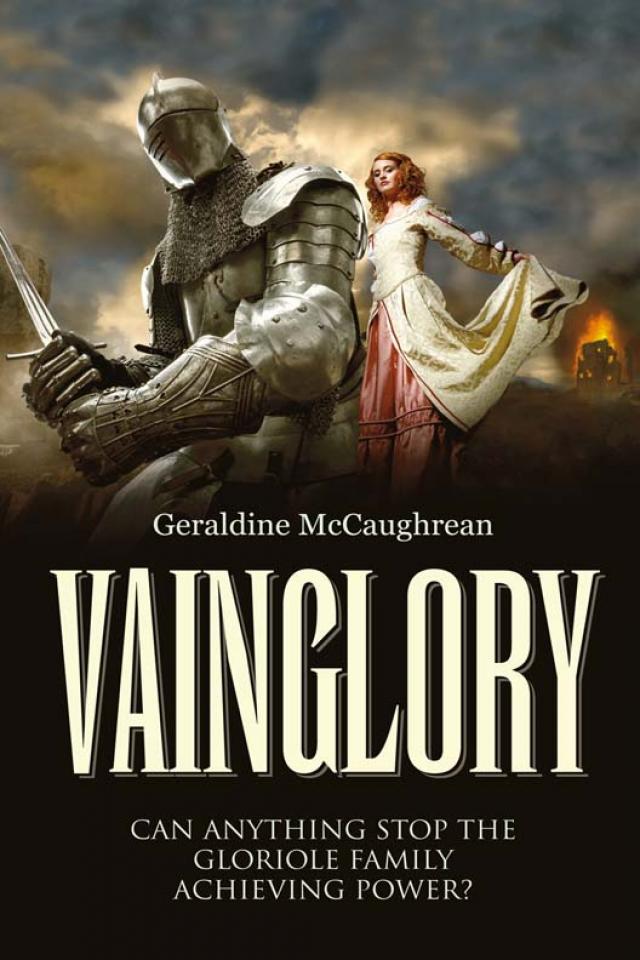
Geraldine McCaughrean
VAINGLORY
Can anything stop the Gloriole family achieving power?
Copyright © 1991 Geraldine McCaughrean
Geraldine McCaughrean has asserted her right under the Copyright Designs and Patents Act 1988 to be identified as the author of this work.
Romaunce Books
This book is a work of fiction and except in the case of historical fact any resemblance to actual persons living or dead is purely coincidental.
A CIP catalogue record for this book is available from the British Library.
This book is sold subject to the condition that it shall not by way of trade or otherwise be lent, resold, hired out or otherwise circulated without the publisher’s prior consent in any form of binding or cover, other than that in which it is published and without a similar condition, including this condition being imposed on the subsequent purchaser.
ISBN: 978-1-86151-577-3
for Ailsa
'From the Devil they came,
and to the Devil they shall go'
Saint Bernard
on the family of Henry Plantagenet
Table of Contents
List of Characters
PART I
ONE 1429
TWO White and Black
THREE Vigil
FOUR Taking Gloriole
FIVE The Chicheface
SIX Winning Approval
SEVEN A Made Man
EIGHT Just Rewards
NINE The Possession of Loss
PART II
TEN Out of the Pit
ELEVEN My God Is a Jealous God
TWELVE Solace
THIRTEEN The Kingdom of Caves
FOURTEEN The Nativity
FIFTEEN The Room of the Question
SIXTEEN Potence
SEVENTEEN The Collector
EIGHTEEN Now God Stand Up for Bastards
NINETEEN Daughter of Joy
TWENTY Clipping Wings
TWENTY-ONE The Moat
TWENTY-TWO The Lantern of the Dead
TWENTY-THREE The Chatelaine
TWENTY-FOUR Stepping Stones
PART III
TWENTY-FIVE Material Evidence
TWENTY-SIX The Good Christian
TWENTY-SEVEN Italian Sunshine
TWENTY-EIGHT Rachel and Bilhah
TWENTY-NINE Patience Rewarded
THIRTY Penance
THIRTY-ONE The Free Thinker
THIRTY-TWO Regression
THIRTY-THREE Buffoons
THIRTY-FOUR Reconciliation
PART IV
THIRTY-FIVE Thibault
THIRTY-SIX The Dragon of Saumur
THIRTY-SEVEN Masque
THIRTY-EIGHT The Unicorn
THIRTY-NINE The Salamander
FORTY The Duel
FORTY-ONE A Closed Circle
FORTY-TWO Treachery
FORTY-THREE The Tumult of Amboise
FORTY-FOUR On the Stairs
FORTY-FIVE The Storm
FORTY-SIX The Silent Stars Are Strong
FORTY-SEVEN Kingdom of Stone
FORTY-EIGHT King’s Favourite
FORTY-NINE Debts
FIFTY Rein Meilleur
List of Characters
PART I
The whole course of the interminable medieval wars between France and England was radically changed by the appearance on the scene of a young mystic called Jeanne Darc. Her talk of victory put heart into the uncrowned French Dauphin and into his troops. In 1429, Jeanne's avowal to lift the siege of Orléans brought the French Army – its whores and its heroes – to the valley of the River Loire
ONE
1429
‘The best or nothing,’ he told the page. He could hardly help it: a nervous reflex, a family cliché, a failed attempt to behave with panache. ‘The best or nothing,’ he said, but he did not mean it. He hoped the boy would not take him at his word and bring no one up from the yard below. He needed a woman. He needed something soft to touch before putting on the unrelenting hardness of armour. He needed something pretty before the ugliness of war. He needed an outlet for the surfeit of life that seemed to be bursting his heart and brain and bloodstream.
That day, Life flourished inside him – so sweet that his body felt powerless to contain it. The prospect of the coming campaign made him clench tight his eyes, his mouth, his hands to trap Life inside. And yet Victoire de Gloriole could almost see the face and figure of Death approaching – an oystermonger with a knife ready to prise his soul from its shell.
His armour lay waiting along the floor but suddenly looked too small for a body so engorged with the ambition to stay alive. It looked like the carapace sloughed off a crab leaving it soft-backed and vulnerable to the gulls. Truthfully, the whole seedy magnificence of Blois Castle, which now wrapped him round in its curtains of stone, was not big enough to encompass his lust for life. ‘The best or nothing,’ he had told the lewd, grinning face so eager to please. But he had no expectation of the best. The whole castle and its grounds were lousy with wriggling desperation, shrill with the need to laugh, debauched by the urgent need of three thousand men for one last creature comfort, one last comforting creature before the expedition to Orléans. The best of the whores would be already occupied. Let the page bring anyone, so long as he came soon. The good Dauphin Charles had God’s ‘Holy Maid’ to put heart in him. Lesser men must make do with something earthier.
Victoire slumped down in his chair with his boots resting on the end of the bed, legs crossed at the ankle. It was the way men sat while they were waiting for a woman: he had seen them do it. But he was no sooner settled than nervous energy twitched him to his feet again to look out of the window and chew the inner flesh of his cheek.
It looked more like market-day or mardi gras than the eve of battle. The whole castle courtyard was teeming with men and horses, priests and whores. Crucifixes had been rammed home into the brackets which usually held torches. Even a wooden Madonna had ventured out of the Church of Saint-Sauveur across the way, to stand on a trestle table, and half a dozen prayer-stools stood drunkenly in front of her, their feet in dung. Near by, a woman sat on a soldier’s knee to suckle her baby.
The courtyard was furry with dung. It gave off a sweet, wholesome savour and steamed a little, so that a fool might have mistaken it for a chamber of Hell and the crowds to be picking their feet trippingly over the infernal peat fires. The sergeants with their long forks-of-office made do for demons.
‘The best or nothing,’ he said, and the page brought him Lucette. He hustled her into the room, gripping her elbows from behind, steering her towards Victoire as though she might not find him otherwise in the dim, cavernous anteroom. She saw him. She rested her eyes on his face, but they were shineless, vacant eyes. The sockets were the shape of empty oystershells.
Still, none of her teeth were missing and her face was clean – even pretty. Lucette had come from beside the bonfire and smelt a little of woodsmoke: a charred smell. She also carried a silver spoon and a purse, on a leather cord under her skirt: cold against warm, hard against soft. She might not be the best, but on the morning of the ride towards Orléans, Lucette was a great deal better than nothing.
‘What are you, then?’ she said, afterwards, unwilling to go back down to the draughty courtyard. ‘Proper gentry?’
When he told her, ‘The Comte de Gloriole,’ her eyes widened, but no spark animated them. ‘You’ve a chateau, then? Lands?’
‘I have an inheritance. A seat,’ he said, and coloured slightly. ‘Not far from here, in fact. On the Sablois. Gloriole-sur-Sablois. But I was raised in Poictou. I’m of the house of Anjou. Somewhat,’ she thought him a liar. She thought him a sparrow putting on eagle plumes. He thought he could see it written in her face.
But all that was actually written in her face was self-interest. ‘A gentleman wouldn’t take twice what he’s only once paid for.’
He had not thought to have her twice. But his body had taken on an independent impetus, and he paid her a second time and somehow the cord got broken that dangled her purse and silver spoon – as if an unruly dog had escaped its leash.
Men bury their treasure before the enemy arrive. Victoire de Gloriole had precious little else to bury but his seed, and no better land to bury it in.
‘I’ve never seen my estates,’ he said, although he had not meant to admit it. ‘My grandfather lost them to the English. The dog Talbot has given it to some runt in his litter.’
‘So you hate the English, do you?’
‘Of course I hate them.’
Lucette only shrugged her indifference. ‘They’re all right. You men are all the same in bed anyway, aren’t you? Some of the women say Burgundies are worse, but what I say is you’re all the same in bed.’
She laid the blasphemy there, on the pillow. He was too slow turning his head, and he breathed in the sin of it. ‘You’ve slept with the English?’
‘Course. Burgundies, too, though they like to keep to their own kind. English are easy, no matter who. Anything in an apron for them. Had a couple of Scotsmen, too, but they’re so wild they’re not Christian hardly. Don’t think I could do it with a heathen. Or a blackamoor.’
He wanted to run, but he was lying against the wall, and to escape he would have to climb over her, lay hands on her. His gorge heaved: he was infected with her sin: it cleaved to him, sticky as tar. He was full of superstitious dread that he should inadvertently have coupled with this traitress. It was as in-auspicious as if a magpie
Lucette did not even notice his panic. ‘What’s the beast on your shield? Wolf, is it?’
‘No.’
She got up and began to pick over the pieces of his armour. She picked up his sword: her touch would make the blade brittle, the bindings fray. He fled the bed, snatching the things out of her hands, and began to accoutre, but without due regard for superstition. There was an order to be followed: mail -collar, greaves, poleyns, back and front …she made him neglect it, this woman of ill-omen.
‘I ought to have you drawn for an English spy,’ he mumbled. The smell of smoke on her hair was not from the bonfires at all, but from the stews of Hell. Her cheeks were red with subterranean scorching.
‘Why, then? Are the English worse than you Dauphin’s men?’ What gentleman’d fight for a bastard, eh? Bastard of Bourges, isn’t that what they call him? Ragamuffin bully …And you can give me back my spoon.’ Her bottom lip jutted like a child on the verge of tears. But the leather cord was wrapped tight round his arm and was as hard to free as a snake. She had to help him disentangle it.
Closeness once more implicated him in her sin, and he knew he would not have her flogged or branded for giving succour to the enemy. She was no older than he, and though sixteen had seemed the prime of manhood that morning, it seemed only a neighbour to childhood now. Like a child he sought reassurance that she would never again entertain Englishman or Burgundian. She was quicker than he could have hoped with her reassurances.
‘Oh no. Best keep with the winners now,’ she said. ‘Even rats know when to leave a ship that’s done for.’
It brought him up short. He did not want to exchange another word with her – and yet he longed to share that absolute certainty of hers. ‘You do acknowledge, then, that God will give the victory to the French,’ he jeered aggressively.
‘Oh, no question. Now they’ve got the Maid’s witchery to tell ‘em what and where and when.’
‘Witchery?’ he put his helmet on. He lowered his bevor. He shut out the sight of her. Worse and worse! Nothing would have been better than this! No one. ‘Jeanne Darc is God’s instrument on Earth. Witchery? You foul-mouth.’
‘Magic, then. Whatever you choose to call it. Now the Dauphin’s got himself a white witch, you won’t find me going with the English. They’re done for.’ She was in a hurry to be gone now. The trumpets were blowing to muster the army to Holy Sacrament. Unless she was quick, there would be no time to earn another handful of coins. Victoire was left shouting the Maid’s holy virtues down a draughty passageway, after the retreating shape of a beggarly whore.
The maid’s voice was shrill and penetrating. It ricocheted off the round towers of Blois, like shot from a culverin, and made horses shy and flick their ears. But when Jeanne Darc spoke, the wooden Madonna was forgotten.
Here was a Whitsun of renewed hope. The troops of Dauphin Charles did not fully understand just what had caught their imagination, only that the same magic had caught everyone they knew. They could beat the English: the Maid had told them so.
Now the fleur-de-lys blossomed in the windcrack of a thousand royal-blue banners. The skyward slant of every pike and bill and bow and banner and tentpole represented a scaling ladder up against the walls of Heaven.
Jeanne Darc knew where to cast her bread. She broke it with the Dauphin, then fed it to his troops. The politicking nobility she ignored. They had seen too many lost battles and too many convenient little miracle-workers arriving with messages from God. But the common soldiers believed; they wanted to believe, and she rewarded their belief by bringing them here, to the grandeur of this courtyard, and by sending servile priests flapping to and fro with bread and wine to wait on them like so many innkeepers’ daughters.
The soldiers swaggered under their shredded canopy of banners. Their sins drained away down the culverts like piss. They were washed clean with words, and if they felt spent, well then it was thanks to the Maid and nothing to do with the whores they had just left panting beyond the wall. She told her troops that they were the soldiers of God.
Victoire de Gloriole came down to the spectacle feeling as empty as an unworn suit of armour; hollow, so that the sanctified wine made his head spin. But as the Maid spoke, all the evil presentiments which had pressed against his heart melted away. Though his legs trembled a little, it was not with fear. The Maid filled him with her rhetoric, filled him like a grail with hot blood. It was the wooing of three thousand bachelors. She was God’s artillery. She picked them off, rank by regiment. She told them they would triumph in this world and the next.
So when she told them, too, that they had no need of whores, they believed her. When she told them that the camp-following harlots would sap their virtue, weaken their resolve and dull their radiance in the eye of God, they were overtaken by quite miraculous chastity. They were as eager to be rid of their sins as a drowning man is to kick off his boots. In their zeal, they ran from the courtyard, grabbing up pebbles and clods of dung. It was God’s work.
Like hounds leaping between the feet of hunters, the women bayed and yelped, snapped and tumbled – a rout colourful with red undershifts and stringy liripipe hoods. Their shawls made footclothes for the horses. It must have seemed like an ambush – these soft-hooved horses, these hard -handed men, all out of nowhere. This treachery.
No one could credit how slow the harlots were to understand. They wanted reasons. They wanted pity. They wanted to shout reminiscences at the men they recognized. They fouled this act of purification with calling on God and Mary and ‘Holy Jeanne’ for protection. Single infantrymen were cornered and beset by obstinate, agile girls plucking at them with questions and pleas or clinging to them bodily, on their knees, in the mud. The men’s hard resolve was dented by women’s foreheads banging into their groins, women’s fingers dragging on their hose. Shiny sallet helmets rolled in the mud as men ran for cover. Decisive action was needed, and yet it was the women who took the initiative and ran for the church of Saint-Sauveur to seek sanctuary. They must be headed off.
‘Go to it,’ said a knight, riding his horse into Victoire’s back as he stood, still unmounted, watching the farce from beside the castle gate. ‘Do you mean to wait out the war, boy?’ The knight drew his sword.
‘Lay blade to a woman?’ said Victoire, incredulous.
‘…not women …whores.’ The words were shot through with the screams of women trying to reach the castle and appeal to Holy Jeanne. The knight threw Victoire a weapon from his own saddle – a massively long wood truncheon, brass-bound at the tip and with a spike that all but took out his eye. ‘…if you won’t use a sword …some discipline, for Jesu’s …‘The sentence was torn apart by the mob of women.
The plançon was too long to swing on foot. Victoire mounted up and weighted it in his fist. His horse danced with terror at the unaccustomed shadow, and plunged off through the gate.
He wheeled between the church steps and the stampeded women, wielding his staff like a flail to separate the Devil’s tares from God’s wheat. Single-handedly he saved the church from desecration. So delicate a piece of riding was it that, for a time, he overlooked the absence of a war to justify it. Then the thought came, and marred all the pleasure.
This was not a chevauchée. Where was the pageantry? Where was the chivalry? There were only bleating women, terrified, or too stupid to be terrified.
And yet, like the shark who, at any touch on its jaw cannot help but chew and shake and rend, the chevaliers of the Royal Army routinely brought to bear all their noble arts. They started with shouts and brandishing. But soon trials of skill came into play: to cut laces with a sword-tip at full gallop, to lift skirts with a billhook, or clip rosaries from a belt with the tip of a lance. And when their aim was not so true (as can’t be helped with crude battle weapons), there was the show of blood, the scream of pain and that primordial pang of pleasure that overrides all.


