

A tale of two dragons, p.1
A Tale of Two Dragons, page 1


For Joe – G. M.
Keith Micklewright for all his wisdom, support, and friendship over the years – P. M.
American edition published in 2021 by Andersen Press USA,
an imprint of Andersen Press Ltd.
www.andersenpressusa.com
First published in Great Britain in 2021 by Andersen Press Ltd.,
20 Vauxhall Bridge Road, London SW1V 2SA
Text and illustrations copyright © Geraldine McCaughrean, 2021
All rights reserved. No part of this book may be reproduced, stored in a retrieval system,
or transmitted in any form or by any means—electronic, mechanical, photocopying,
recording, or otherwise—without the prior written permission of Andersen Press Ltd.,
except for the inclusion of brief quotations in an acknowledged review.
Distributed in the United States and Canada by
Lerner Publishing Group, Inc.
241 First Avenue North
Minneapolis, MN 55401 USA
For reading levels and more information, look up this title at www.lernerbooks.com.
Library of Congress Cataloging-in-Publication Data Available
978-1-7284-6783-2
1–TL–9/1/2021
The Kingdoms of Arbor
and Pomosa stood
back-to-back. Each had a
castle bristling with guards.
Arbor was plush with trees
in every shade of green:
woods and orchards full of
mushrooms, fruit, and birds.
Pomosa was rich too: golden
with wheat fields, silver lakes,
and creamy, milkful cows. A
high thorn hedge separated
the two territories.
Sometimes, it’s true, the
people of Pomosa would
look across at the plush
forests and say, “If only
we had trees. It is hard
to make wheat-flour into
loaves without wood to
heat the bread ovens.”
And the children heard
them say it.
Sometimes the people
of Arbor would look
across at Pomosa
and say, “If only we
had wheat and rice
we could make into
pies and porridge
and pancakes.”
And the children heard
them say it.
If only the thieving children of
Pomosa had not found a way
through the hedge and gathered
fallen branches and dragged
them home for firewood, to
please their mothers.
But they did.
If only the thieving children of
Arbor had not come creeping at
night to cut corn and milk cows
and tiptoe home to surprise the
grown-ups with sheaves of grain
and buckets of milk.
But they did.
As the thieves became more
and more daring, the two
kings grew more and more
annoyed, “Post guards with
swords and torches! This
stealing must stop!”
But either the guards were
lazy or they looked the other
way, because—do you know
what?—not a single child
thief was caught or thrown
into a dungeon.
The kings threw tantrums
and shook their fists at
one another.
“A dragon! Find me a dragon!” the King of Arbor told his ambassadors.
“The biggest you can find!”
The ambassadors sailed for China to seek out a dragon.
Much to their surprise, one agreed to come in return for a
wage of plums, pears, and pine cones.
Watched from the battlements of both castles, she stepped out along
the Arbor Highway, her scales catching the sunlight. A creature of such
pure power that the King of Arbor dared not go down to greet her.
“Guard my country!” he shouted down. “Kill any Pomosa thieves!”
The King of Pomosa sulked and
stamped, “I want a dragon!
I need a dragon to guard my
country from that ugly
great beast!”
Ambassadors were sent to
China and, much to their
surprise, a dragon was found
who agreed to come in
return for ginger,
gooseberries, and goldfish.
Watched from the battlements
of both castles, he came striding
along the Pomosa Highway.
“Fearful!” murmured the men.
“Huge!” whispered the women.
“But it’s so beautiful!” they all agreed.
Both nations gasped in amazement.
Neither dragon noticed. They were busy eyeing each other, scales rippling.
The colors pulsed in their arched backs. Smoke trickled out of nostrils
and ears. There was no reading the thoughts behind their glittering eyes.
Children hid behind their mothers’ skirts. There would be no more
thieving of wood or wheat.
But bakers still needed wood to heat their ovens, and winter
nights are cold without logs for the fire. Woodsmen need
bread and porridge, and growing children need milk.
From their rooftops, the people watched the dragons patrol. So
exquisite, so exotic . . . so terrifying. As one walked west, the other
ambled east, with only a thorn hedge between them. (Naturally,
each country thought its own dragon was the best.)
We must have timber!” said the King of Pomosa.
“Order my dragon to kill that monster next door!”
“We must have milk and bread,” said the King of Arbor.
“Tell my dragon to kill that creature next door.”
Dragons are noble beasts. Was it their good manners
that kept them from refusing to fight?
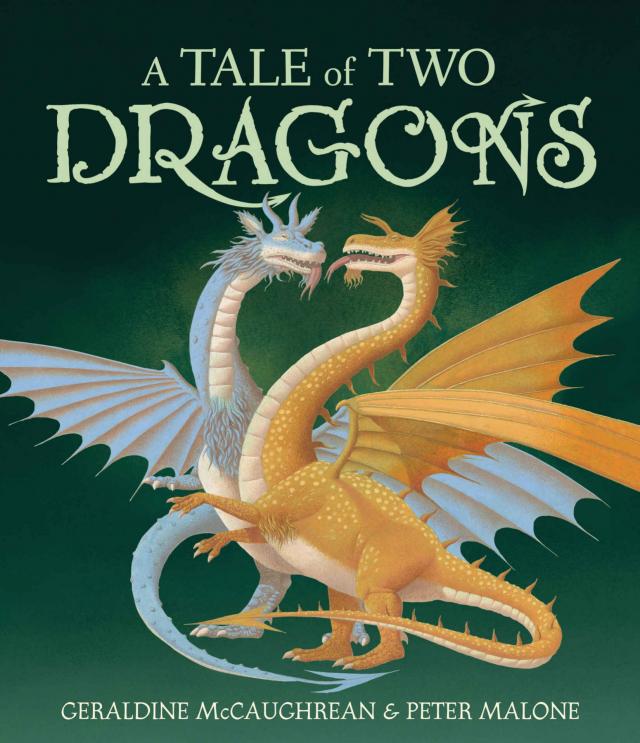
The she-dragon reared up on her
hind legs. The he-dragon stood tall.
No one could tell what they
were thinking.
They fought.
“Stop them!” cried the people of Arbor. “We didn’t want this.”
Dragon fire blazed.
“Stop them!” cried the people of Pomosa. “We never asked for this!”
But the dragons fought on, ears torn and snouts bleeding, coughing up
black smoke.
“Stop them!”
But the kings watched with snarling glee.
“If mine wins, your kingdom belongs to me!”
“If mine wins, your kingdom belongs to me!”
The dragons fought until they could fight no more.
Both toppled at the same moment and lay,
long necks overlapping, their fire out.
Their blazing colors had faded to gray.
Then people ran from
their houses.
They brought
milk and pine cones, gooseberries
and hot water. They brought herbs and honey to
spread on the wounds and stroked the big heads.
They plucked thorns out of soft, dragon armpits.
“He was so beautiful. He was our dragon.”
“She was so brave. She was ours.”
A long, long tongue slithered out between
the she-dragon’s lips and licked a nearby snout. The he-dragon
opened his gray eyes. A strangely dragonish voice murmured,
“We have done what we came to do. Now they understand.”
The two kingdoms of
Arbor and Pomosa
stand shoulder-to-
shoulder.
There is a line
somewhere
parting the two
countries, but it is
hard to see: the baby
dragons’ tails scuff it
out as they play. And
their parents lie
back-to-back feeling
each other’s warmth.
There are no kings
now. Somehow no
one could remember
what kings were for,
and sent theirs away
to find out. And since
everyone needs bread
and wood, birdsong
and honey, apples
and milk, the people
freely come and go,
to and fro every other
day or so.
But on Dragon Day, they do nothing but dance.
The End
Geraldine McCaughrean, A Tale of Two Dragons
Thanks for reading the books on GrayCity.Net


