Borderline a jack mcmorr.., p.1
Borderline: A Jack McMorrow Mystery, page 1


Praise for Gerry Boyle’s Borderline
“{Boyle’s} style is poised and pointed” …
—New York Times
“Boyle, a Maine newspaper writer himself, makes McMorrow a credible crusader, equally confortable in the quiet woods and small town courthouses. The narrative moves briskly as McMorrow eliminates several suspects on his way to a surprise solution.”
—Publishers Weekly
“Stay healthy, McMorrow. You’re fun to have around.”
—Washington Times
This is a work of fiction. Names, characters, places, and incidents either are the product of the author’s imagination or are used fictitiously. Any resemblance to actual events or persons, living or dead, is entirely coincidental.
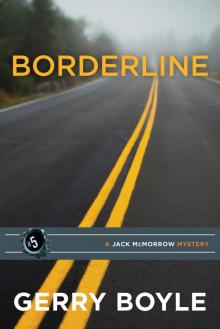
BORDERLINE
First Islandport edition/November 2015
Printing History
Berkley Prime Crime Hardcover 1998
Berkley Prime Crime Paperback February 2000
All Rights Reserved.
Copyright © 1998 by Gerry Boyle
ISBN: 978-1-939017-79-6
Library of Congress Control Number: 2014959880
Islandport Press
PO Box 10
Yarmouth, Maine 04096
www.islandportpress.com
books@islandportpress.com
Publisher: Dean Lunt
Cover Design: Tom Morgan, Blue Design
Interior Book Design: Teresa Lagrange, Islandport Press
Cover image courtesy Blue Design
Printed in the USA
CONTENTS
Acknowledgements
Introduction
Chapter 1
Chapter 2
Chapter 3
Chapter 4
Chapter 5
Chapter 6
Chapter 7
Chapter 8
Chapter 9
Chapter 10
Chapter 11
Chapter 12
Chapter 13
Chapter 14
Chapter 15
Chapter 16
Chapter 17
Chapter 18
Chapter 19
Chapter 20
Chapter 21
Chapter 22
Chapter 23
Chapter 24
Chapter 25
Chapter 26
Chapter 27
Chapter 28
Chapter 29
Chapter 30
Chapter 31
Chapter 32
Chapter 33
Chapter 34
About the Author
ACKNOWLEDGEMENTS
Thanks go to Tom M., who knows homicide; to my friends and colleagues in the newspaper business, who still fight the good fight; and especially to Mary Marsh Grow, whose generous and meticulous assistance is, and will always be, appreciated.
INTRODUCTION
This is the novel in which Jack McMorrow followed most closely in my footsteps.
Always interested in history, I was captivated by Benedict Arnold’s trek up the Kennebec River Valley to Quebec City, a brutal slog that ended with the Americans’ ignominious defeat. McMorrow was, too.
I was fascinated by small and isolated Maine towns that develop their own culture, their own reality. McMorrow was, too.
In my reporting days I had come across police chiefs in these self-contained places who had developed their own rules, the first of which was most important: This is my town. What I say goes.
McMorrow hit that wall, too.
Borderline began with an assignment we took on together. We would follow Arnold’s route from Popham Beach, on the Maine coast, up the Kennebec River, all the way to the Chaudière River in Canada, and on to Quebec. McMorrow would write about it for a travel magazine. I would write about it for Borderline. Along the way we’d encounter interesting characters, some who had captivated me for years, some who I still see.
So off we went, McMorrow and I. We traveled the lower Kennebec River, from Bath to Popham. I poked around the fort there, and McMorrow did, too. We made our way upriver where I put a canoe in just south of the town of Skowhegan and paddled my way south for twenty miles. Along the way I saw some of the locations that would be re-created in the novel: slow stretches of river split by wooded islands worthy of Huckleberry Finn. Riverbanks lined with scraggly willows, and marked by the occasional drinker’s encampment. McMorrow would spend some harrowing hours in this very same place.
That part of the river committed to memory, I made my way north, where the Dead River wends its way, where the Chaudière meanders through Quebec farmland. Returning to the United States, I arrived at the border crossing in Jackman, disheveled and unshaven, with a fishy story about why I’d been to Canada. McMorrow did, too.
Jack would make his Arnold Trail trek in the book and move on. But oddly enough, I find myself moving in and out of the world of Borderline to this day.
I often find myself thinking of characters like Robie and Rob-Ann, siblings living on the fringe—mostly tolerated, sometimes abused. I regularly see Robie on his bicycle, or, more precisely, various Robies, picking up bottles, riding through convenience-store parking lots. I see him sitting on some small-town sidewalk, enigmatically watching the traffic roll by.
And there are low-level thugs like Howard and Damian, predators and schemers who prowl the roads and tenements in search of victims like a crow patrols for roadkill. Their criminal acumen might be limited, but their ambition and propensity for violence are unbridled. I see them, too, walking the streets, their sneering mug shots staring from the newspaper pages.
And, of course, the central character in this tale—a guy who left his small town to see what was out there, and discovered that when he returned he could reinvent himself. Leave town as not much; come back as a big deal. All it takes is some nerve and a vivid imagination. I’ve learned never to underestimate the power of reinvention, the ability to become the person you want to be. I also find myself wondering whether we know who people really are, or if we just know the people they would like us to see.
In the end, these characters are more than types. They’re archetypes, the pieces that make up the whole in towns like Scanesett, Maine. Next time you drive through a town like this, pull over and sit. Better yet, take a walk down the block and back. Take a hard look at the people who live there, maybe have never left. And then realize that this is their turf. You are the trespasser. And these are places that can welcome a stranger with open arms or suck a visitor into a quagmire of deadly deceit.
When the visitor is someone like McMorrow—knocking on doors, asking questions, refusing to take “Go away” for an answer—a town like Scanesett can be a very dangerous place.
In many ways, Borderline has been a hard book to leave behind. I spend considerable time on the Kennebec River to this day, mostly boating its lower reaches, Merrymeeting Bay and south. And when I’m headed upriver from Bath to Gardiner, I picture Arnold and his men, rowing to their doom.
I travel the same roads McMorrow does in this story, and often I find myself in a forgotten river-valley town. I look out at a black stretch of river, or across to a convenience store where a beer sign is glowing in the night. And the characters from Borderline will materialize, as real as you and me.
Howard and Damian looking for their next mark; Robie pedaling his way to his—well, you’ll just have to read the book.
—Gerry Boyle, October 2015
1
The lunch stop was over, and the tour bus heaved its way out of the parking lot and headed north. I stood in the diesel haze with the Chamber of Commerce lady, Sandy something-or-other, and a big guy on a small bicycle, who, with the patience of a scavenger, sat ten feet away and listened.
Sandy had me by the left upper arm. She was telling me that I should write a story about her little shoe-factory town, Scanesett, Maine.
I listened. Smiled. Tried to break her grip but couldn’t. I explained that my story, for Historic Touring magazine, was supposed to be about Benedict Arnold and his march to Québec. Arnold went through Scanesett, at least what there was of it in 1775, but he didn’t stay long. If it hadn’t been for the falls, he wouldn’t have gotten out of his boat. I just wanted to know if there were any historical museums in town. Scanesett might get a couple of sentences. It might get a paragraph.
“But maybe another time,” I said.
Sandy held tight. Smiled her best cheerleader’s smile. The heat shimmered off the asphalt. The big guy on the bicycle moved closer. Sandy turned toward him.
“Robie, do you mind?” she hissed. He rolled back and she switched her smile back on.
“We have two major motels, one that has Triple-A rating, and a heated indoor pool, and there’s all kinds of fishing, and every August at the fairgrounds—this would be perfect for a magazine—they have the custom-car show. People come from, like, Massachusetts and Connecticut, just for that. I could put you in touch with this friend of mine. He’s in charge of the whole thing. I could take you to his office. It’s right around the corner. I just saw him at lunch, he’d be glad to—”
And then the bus was back.
Sandy paused and loosened her grip. The bus, which had left bound for Québec City from Boston, belched and roared, then pulled back into the parking lot and stopped in front of us. The door hissed open. The driver, a blond machine-tanned guy who only minutes ago had been Mr. Geniality as he tried to look down the front of Sandy’s blouse, bounded out.
“
“Seen who?” I said.
“The bozo who isn’t on the bus. I get a mile up the goddamn road and this lady says this guy’s not in his seat. God almighty, I gotta be in Québec City, at the hotel, at seven. Now I’m gonna be babysitting all afternoon, hanging around this dump just because some guy—”
This dump. Sandy winced.
“What does he look like?” I asked.
“How the hell should I know? Just some guy. Nobody’s been here?”
I shook my head.
“Goddamn it,” the driver said.
Robie, the guy on the bicycle, rolled closer. We looked around, and then a gray-haired woman appeared at the top of the bus steps, turned sideways, and eased her way down.
“He got back on,” she said, starting right in with the chronology. “He was at lunch and then he got back on and sat down, and then he said he was going to go to the men’s room. He said he didn’t feel well. Not that I cared where he was going. I said to myself, ‘You don’t need to tell me your every move. Go to the men’s room. What do I care?’ ”
“And he never came back?” I said.
“Well, no. I figured he was still in the john. But he wasn’t in his seat, either. So I sat there—what do I care, right?—and then people keep getting on and the bus is filling up and then off we go.”
“I asked if that was everybody,” the driver said, glaring up and down the block.
“I thought he was in the bathroom, but then I saw this other woman go back there and go right in, so I figured he wasn’t in there. But he wasn’t in his seat, and where else can you go on a bus?”
“You sure he didn’t just sit down in another seat?” Sandy asked.
“Yeah, I’m sure,” the driver said, scowling so that his cheeks dimpled. “I did a head count.”
I wondered what the bus company did when a driver lost a passenger. Probably you had to fill out a lot of forms. I looked at the driver. There was perspiration running down his neck in shiny rivulets that disappeared under his white collar.
“So he was gone when you pulled out of here?” I said.
“Unless he beamed his way out. Son of a bitch.”
The driver strode to the rear of the bus and looked around. Sandy looked in the other direction, toward the downtown block. The gray-haired woman shaded her eyes with her hand and looked that way, too. Her fingers were bony and strung with jewels.
“What’s he look like?” I asked.
She put her hand down.
“Well, he’s not a big man. A little smaller than you.”
“How old?”
“Well, I would say fifty. But it’s hard to tell sometimes. Sometimes people look fifty and they’re forty. Sometimes they look fifty and they’re sixty. So gee, I wouldn’t want to be quoted on this, but I’d say fifty. Give or take because—”
“Dark hair? Light hair? Fat, skinny? Glasses? Bald? Black, white?”
She closed her eyes and put her jeweled fingers to her temples, as if the answer required the assistance of a higher power.
“Oh, white. No glasses. Not fat, but not skinny. And his hair, it was short and sort of, well, I guess it was just brown. And he was wearing shorts. Sort of tan shorts.”
The gray-haired woman opened her eyes and looked at me.
“But his legs weren’t tanned. They were very pale. And a polo shirt. The shirt was a dark color. Red or maroon or something.”
She looked at me. I looked back and smiled. She looked a little flushed, maybe from the heat, but also relieved, as if there had been a surprise quiz and she’d passed. The driver came back. He was glowering.
“Five minutes and we’re gone,” he said.
“You just leave him?” I said.
“I got forty-three other paying passengers who are going to Québec. I can’t play games.”
“What if he got really sick?” I said. “Tried to find a hospital or something. Or, I don’t know. Maybe he’s got some sort of mental illness.”
“Hey, I can’t chase some wingnut all over the place. These people have to get to Québec City. They got dinner reservations.”
“Seven-thirty,” the gray-haired woman said, her humanitarian duty fulfilled.
“Yeah, well, it appears like he isn’t here,” the driver said. “Maybe he heard somebody talking French and he thought we were there already. Not my problem, n’est-ce pas?”
“It’s going to be somebody’s,” I said. “Don’t you think you should leave his name with the police or something? In case they find him in a ditch?”
Sandy winced again, then brightened.
“Maybe we could find him—I mean, not in a ditch or anything—and the whole town could turn out to help him. Give him the key to the town. Put him up for the night. Give him dinner and some gift items. The businesses could donate things. Didn’t they do that for some lost foreign person in Bangor once?”
“This man wasn’t foreign,” the gray-haired woman said. “He was a regular person.”
“Any bars around here?” I said.
“He wasn’t drinking. I can smell it a mile away,” the gray-haired woman said.
“Maybe he just didn’t want to use the bus bathroom,” Sandy said. “You know how gross they are.”
She left the phrase hanging, her payback for the “dump” remark.
“It’s not gross,” the driver said.
“Maybe he thought he could find a real bathroom and then the bus left,” Sandy went on. “If he wasn’t feeling well.”
“I’d wait a few minutes,” I said.
“It’s gonna take me ten minutes to find his name,” the driver sputtered.
“Oh, I know his name,” the gray-haired woman said. “He told me. It was Ron. Or maybe Don. Don or Ron.”
The driver rolled his eyes. I noticed he was wearing a gold chain around his neck and it was caught in the creases of flab. The gray-haired woman said, “Well, that’s all I can tell you,” and started back up the bus steps. The driver shook his head in disgust and started up after her. Sandy was saying something about turning this into good news or Scanesett. Robie, the guy on the bicycle, sat there looking straight ahead, hands on his handlebars, big sneakered feet planted on the pavement.
I glanced at him. He was in his early twenties, big and paunchy under his T-shirt. There was something not quite right about him, a thickness in his mouth, or maybe just a vagueness in his eyes.
“Well, he’s got to be someplace, doesn’t he,” I said.
Robie turned quickly and looked at me. For a moment, our eyes locked. His gaze seemed to sharpen, like a lens twisting into focus, and then he looked away, embarrassed or rattled. He gave a shove with his feet, wheeled around, and pedaled off across the parking lot. As he rode away, I noticed there were odd attachments coming off the back axle of his bicycle.
“What’s his story?” I asked Sandy.
She looked distracted, her mind probably spinning with the possibilities for this next public relations coup: the rescue of the man with the runs.
“Who, Robie?” Sandy said.
“Yeah.”
“Oh, I’ve known him since grade school,” she said. “Him and his sister. They’re just, well, I shouldn’t say this, but they’re just sort of, well …”
I waited.
“Well, sort of numb,” Sandy said.
She gave an apologetic shrug, though I couldn’t tell whether she was apologizing for her bluntness or Robie’s condition. I followed his pedaling figure until it disappeared down an alley between Scanesett House of Pizza and an empty storefront.
“Is that right?” I said. “He didn’t look so numb to me.”
2
There was a museum, an old brick Cape Cod house that overlooked the Kennebec just north of Scanesett’s downtown. The handpainted sign beside the front door said the museum was open Tuesday and Thursday, from noon to 3 p.m., Saturday from 10 a.m. until noon, or by appointment. This was Friday. There was a number to call, so I walked back to the truck and dialed. A man answered. He sounded startled.
“This is Jack McMorrow,” I said. “Is this the right number to call about the museum?”
There was a fumbling noise. A muttered curse.
“Okay,” the man said. “I got it now.”
I tried again.
“I’m Jack McMorrow. I’m writing a magazine story about the Arnold Trail. Benedict Arnold. I wondered if your museum here would have anything of interest.”