

Some of them will carry.., p.1
Some of Them Will Carry Me, page 1


SOME OF THEM WILL CARRY ME
TO ELIZABETH, FOR THE BODY AND THE LINE
Copyright © 2022 by Giada Scodellaro
First edition
All rights reserved, including the right of reproduction in whole or in part in any form. This book is a work of fiction. Names, characters, places, and incidents either are products of the author’s imagination or are used fictitiously.
Thank you to the editors who first published these stories: “Hangnails, and Other Diseases” online at The White Review (2017); “The Ethics of Piracy” in BOMB (2022); “Barbershop” online at Granta (2022); “A Triangle” online at The New Yorker (2022), “540i” in Astra (2022).
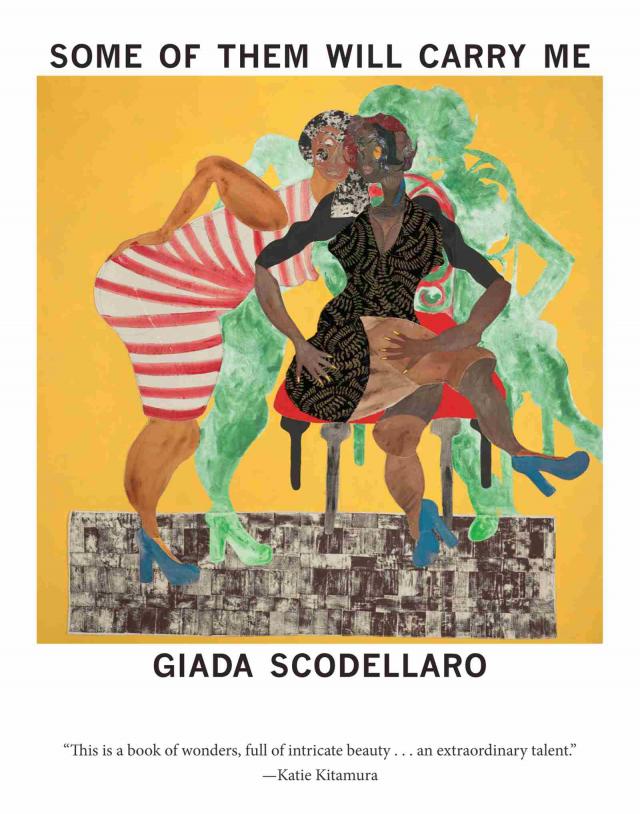
Art on cover:
Tschabalala Self
Two Women 3, 2021
Tulle, lace, velvet, thread, acrylic paint, digital print on canvas, and painted canvas on canvas
243.84 x 243.84 cm
96 x 96 in
Courtesy of the artist and Pilar Corrias, London
Copyright © Tschabalala Self
The publisher wishes to thank Edil Hassan and Sebastian Mazza.
Library of Congress Cataloging-in-Publication Data
Names: Scodellaro, Giada, 1988– author.
Title: Some of them will carry me / Giada Scodellaro.
Description: St. Louis, MO: Dorothy, a publishing project, [2022] |
Identifiers: LCCN 2022013903 (print) | LCCN 2022013904 (ebook) | ISBN 9781948980159 (paperback) | ISBN 9781948980166 (ebook)
Subjects: LCGFT: Short stories.
Classification: LCC PS3619.C58 S66 2022 (print) | LCC PS3619.C58 (ebook) | DDC 813/.6—dc23/eng/20220407
LC record available at https://lccn.loc.gov/2022013903
LC ebook record available at https://lccn.loc.gov/2022013904
ISBN: 978-1-948980-15-9
Design and composition by Danielle Dutton
Printed on permanent, durable, acid-free recycled paper in the United States of America
Dorothy, a publishing project books are distributed to the trade by New York Review Books
Dorothy, a publishing project | St. Louis, MO
DOROTHYPROJECT.com
SOME OF THEM WILL CARRY ME
GIADA SCODELLARO
DOROTHY, A PUBLISHING PROJECT
CONTENTS
The Cord
Freedom of White Boys in the Sand
George Washington’s Dentures
Barbershop
A Triangle
The Foot of the Tan Building
The Balcony
Leave a Fingerprint, Gnocchi
Three Months of Banana
YYYY
Pendergrass
Adult Head
Cabbage, the Highest Arch
The Misconduct of Sand, and the Seven
Forty-Seven Days Ago
Real Number
Spalding
There’s D’Angelo’s Gap
A Dry Drowning, Spaghetti Alle Vongole
Wet Sand Used as an Abrasive Element
Peach
Ceremony
False Lashes
The New Husband
Pasta, Fagioli + Cozze
540i
Bending
Haint
Pool
Hangnails, and Other Diseases
La Genovese
Catcalls
Constellations
In the Sand, the Nonconformity of Women Who Are Violently Shushed
The Ethics of Piracy
Appendix
Notes & Acknowledgments
I would not mind
if I were
a sinner,
but as it is
—let me assure you—
I sleep alone.
ALICE WALKER, ONCE
THE CORD
We met on a bus. It is not an ideal place to meet, the seats are too close, and everyone is ashamed to be there. To pause so often. When we met we were ashamed. In those too close seats, the blue cloth seats, I noticed his fingers right away, the clean cuticles. The fingers of men remind me of how they can be inserted. So I shifted the cotton, I lifted my hips. I grabbed his wrist. The pleats of my blue skirt moved against my thigh. Up. I guided the clean cuticles; I inserted them as we sat side by side on a bus.
He didn’t wait for instructions, his fingers moved: the three that were free to roam or rest, the one that pressed against my clitoris, the last that moved inside.
After a short time the fingers were pulled away, out. He stood. He grabbed the cord with the same hand, the right hand, a ding, and the bus driver is pressing on the break with his right foot, and all the bodies are leaning forward, bodies on a bus jerking forward then slightly back in unison, another pause in our collective journey. And now I’m on the cord, and soon others will pull it, strangers will pull it, and some of them will carry me.
FREEDOM OF WHITE BOYS IN THE SAND
The girl was staring at the white men, the way their hair moved like the wind, too easy. In the middle of the busy field the girl called out to them, shouting obscenities. There were other people there too, a crowd of people, but it was the white men she had come to see.
The dirt shifted around the men and the crowd and the girl without discipline. All those standing in the field would later find the grains in the curve of their ears and on the tips of their eyelashes.
Emmanuelle came here every Tuesday afternoon to see them. It was her day off. There were only a handful of the white men left and they couldn’t stop coughing. Their hair moved like the wind moved and she let her hands brush against their thighs.
Ambulances skipped along, howling in the distance as they gathered the dead and the almost dying. Birds made bird sounds; the crowd talked among themselves. The Enflamed Mountain hovered over them all.
The white men never paid attention to the girl, but she saw them as they walked and coughed and walked, shuffling their feet. She smiled at them sometimes, between her vulgar shouting, to see some acknowledgement from their bodies. But no, they could not pause, or hesitate. They were moving.
Unlike the white men, the crowd did notice the girl. Some were intrigued by her presence set against the yellow grass. They made up stories:
Maybe, they whispered, the girl is a widow who is tired of sleeping alone in a bed that is too large for her body, she hates rolling over in her sleep, you know, waking up alone, with her breasts askew, to that ever vacant side, a side devoid of any human chaos or warmth, so, so she’s looking for a husband or a wife, someone whose ivory suits she can hang outside with wooden clothespins, a body she can easily dislike. Or, or maybe she’s a ghost looking for the man who murdered her, murdered, she hadn’t seen his face when he strangled her, only his elbows, so she is studying them, studying all of our elbows to find him.
The crowd stayed on the paved road as they whispered about the girl, close together in three straight lines, so the soles of their shoes would not touch the yellow grass or the river or the mud. The smell of lavender in the air.
They all wore the tailored three-piece suits, dark blue and burgundy suits, gray and ivory suits. They felt more professional this way, even though the suits were not appropriate for the climate, and they were not required to wear them.
The three-piece suits had been found floating in the river, hundreds of suits. Those who discovered them found them beautiful, it was beautiful to see all the colors swimming about, the dark blue and burgundy, gray and ivory. No one knew if they were an offering from the Enflamed Mountain or a sign of a drowning.
No swollen bodies had ever followed the clothing, so after many days of debate the community decided to gather them gently from the river and distribute them among the crowd, and among the white men. They hung them with wooden clothespins in their backyards. The breeze rolled around the pants and vests and jackets as they dried, all of them dancing. The children watched the wind dress up and flail about, thinking anxiously about the day when their bodies would have to follow.
The crowd gave her a wave of their hand sometimes, or a nod of their head, hello girl. They presented her with their elbows. The girl noticed these gestures but didn’t let on. Their bleached shirts were fastened tight around their necks, the collars filled with the day’s sweat.
The white men are sightless, the girl thought. They could not perceive her or anyone else, they did not see the waving hands of the crowd, or the sleeves rolled up to reveal the elbows.
The girl bit her fingernails. Her hands were large, her fingers long. Her teeth snipping, clipping, clipping the nails, a repulsive habit. She bit them hard and fast, and she knew the white men would not notice this repulsiveness.
The girl’s father had taught her that one must be consistent in one’s oral compulsions. His had been the thumb, the men, and the cigarettes. Hers were the fingernails. He was dead.
The girl couldn’t remember her father without the appearance of his thumb there, like a cloud. The right or the left thumb, or his cigarette placed between his full lips, or all three hanging around his teeth—leftthumbcigaretterightthumb.
Though it was not her real purpose for being in the field, the girl also looked for her sister amid the growing mob of people on their way home—for her sister’s ears, which stuck out like splinters; or for her sister’s nose, which was prone to bleeding; and for the trail of dots her nose would leave, the red red red, red; or for her sister’s long oval nails, which once scraped the green-and-white wallpaper from their kitchen.
Emman’s sister had gone out one warm night, 24°C, half-dressed, hair undone, loose, to purchase a helicopter. After a dinner of roasted scallops with lemon zest and Greek yogurt and pecorino, smoked sea salt, russet potatoes roasted with onions, with mushrooms sautéed in wine and butter, with rosemary, she left.
In June she left.
The girl wanted to fly too, of course she did, but she couldn’t agree with this purchase. It was silly, irresponsible even, and she wasn’t sure where they would put it. Helicopter fatalities were up by thirty-five percent. She told her sister so, I’m not sure where we would put it, helicopter fatalities are up by thirty-five percent. But the sister had convinced her that the helicopter was necessary now that their father was dead (their mother was alive, but had already left to be with a white man, John).
Think of the rotors, the sister said, the thrust, to be able to land vertically, in a narrow space, or even the sound it would make, the crowd would look up at the sound, they would. Even the white men would look.1
After a while the girl stopped looking for her sister in the sky. She wanted to look, but resumed staring straight ahead at the white men. But she still listened for the sound of the propellers, the whoosh of them, or for her sister’s laugh. She might still be coming. The white faces were few and the girl heard only the birds wailing, and the wind, and the ambulances, the coughing, and the dirt accumulating bit by bit in her ear canal.
The girl’s legs were tired from standing.
She imagined these white men (who exhibited the straightness of their teeth and the reach of their arms and the quiet of their noses) as little boys. White boys pushing each other hard with their fingertips, silver braces tightening, smoking, peeing everywhere, laughing, comparing the length of their penises.
The abundance of freedom must be thrilling for little white boys, she thought, and she remembered how as a child she used to swim with them in the river. The girl and her sister and the naked white boys as they played together in the sand—their butts even paler than the rest of their bodies.
In the field the girl took off her earrings, the wide hoops left behind by her mother. They had the appearance of gold, but when she dropped them on the ground in front of her, first one, then the other, they made only a small noise. Not enough to stir the earth, or the white men. They were not real gold.
Without earrings on, she thought, I look like father.
And she did, with her short hair and her hairy arms, Emman looked definitively like her father. But her father had once been a beautiful boy, one the other boys had been jealous of, and even the white boys had been jealous of him. They would stare at him for hours, so it was not an unfortunate thing to resemble him.
The girl was thinking of him and of the smell of tobacco on his thumbs when she fell.
It is shocking to be thrown to the ground suddenly, ridiculous even, and yet that’s what happened to the girl as she dropped her mother’s fake gold earrings and thought about her father. The girl fell hard on her left wrist and hard on her lower back, letting out two pieces of air, one of them a burp.
The girl was clumsy, but this particular collapse wasn’t caused by her clumsiness. A boy was responsible. He was not one of the white men. He was a boy. He stood over her wearing a dirty ivory three-piece suit. The boy did not apologize for bumping into her, or for knocking her to the ground so suddenly, or for making her burp, or for any of the inconveniences that come with falling in front of a crowd. The crowd stared, and the girl stared at the boy, and the boy stared at the girl with confusion and what seemed like delight; the white men did not stare.
Her palms were full of dirt. The boy helped her up but did not provide her with his full strength (he really was no help at all), so when she grabbed hold of his small hands she still had to do most of the work to stand. The muscles in her legs burned, her knees spat.
While the girl tidied herself, the boy picked up the fake gold hoop earrings, putting them into his right pants pocket. He hoped she had not noticed this; he was a collector of things and wanted to keep them for himself.
The crowd was distracted by this collision—by this boy who chose to ride his silver bicycle home instead of walking, and by his dirty ivory suit, which should have been washed and hung to dry with wooden clothespins the night before. So even though they tried, the crowd could no longer stay within their three careful lines on the paved road. The soles of their shoes became covered with mud and they slid every which way—through the grass and up to the river and through the soil. They fell, everyone fell.
From the ground the crowd stared at the pair. The white men were troubled by the commotion, but did not stay on the ground, they didn’t slow down and did not stare. From the ground some of the crowd was desperately intrigued by this event and by the way the girl bit her lip, and the way the boy touched his right pants pocket, and with the confusion that persisted around the field, the yellow grass. They made up stories:
Maybe, they whispered, she’s found the right body to dislike in this boy, with his dirty ivory suit he’ll fill the vacant side, and she won’t have to fall asleep alone in a bed that is too large for her body, she’ll be able to roll over in her sleep and wake up in the night to a side full of chaos, or warmth, and she’ll have him pull on her nipples with his nails until the triangles of sun push through the thin curtains of the kitchen window.
The others disagreed, no, no, this ghost of a girl has finally recognized the murderous elbows, she’ll feel obligated to create an olecranon fracture in them both, using a hammer or a wooden stick; she’ll ruin his el-bows.
The crowd could see the weak outline of the gold hoop earrings in the boy’s right pocket as it pushed against his thigh. They knew they would see the girl in the field on the following Tuesday. The new pair stared at one another, they touched each other’s collarbones, and the crowd knew.
The pair left the field behind. They rode on the silver bicycle, traveling near the brown river where children were swimming and splashing. There were no white boys splashing, there were no white boys left. There were only the white men, who were beginning to get sick and would soon die—everyone knew.
The ride was bumpy; the silver bicycle hit many rocks and many pieces of gravel. The boy followed the instructions given by the girl who sat behind him; they made many turns. The girl had already forgiven the boy for making her fall. She could feel the bruises forming on her left wrist and somewhere near her lower back and buttocks. This was not the first time she had asked someone for a ride home. She delighted at the thought of sleeping with him.
The girl did not particularly care for his face, but she noticed that his hands were clean, tiny, and devoid of any calluses. The boy could feel her breathing on his neck and could smell the ivory soap on the girl and the lavender in the air. He began riding down an unfamiliar path with the Enflamed Mountain in the distance, red and hovering and ugly.
He hoped they might name the mountain after him one day, if he managed to do something heroic or memorable. He could be remembered for his stolen collection of goods, or for his soft unsoiled hands.
The girl held onto the boy’s ivory suit and then began stroking underneath his un-tucked shirt, under his wife-beater, and onto his curved back. While she rubbed he began speaking to her, telling her a story about a talking fish and about preparing lentils for the new year. It was not meant to be funny, but she laughed, she felt it would be rude not to laugh.
They arrived at the home. It was old but beautiful and the color of a peach. The boy noticed the opened windows and a pair of thin curtains blowing in and out. The smell of the river reached them, the smell was strong, the boy thought this immediately, but he did not say it aloud, he felt it would be rude to say so. He thought it again and again: a smell like mud.
They took off their leather shoes at the front door. They went immediately to the bed, passing the kitchen, the thin curtains, and the yellow kitchen wall with its drops of red red red, red. The pair sat on the mattress. They laid upon the mattress with their bare feet on white cotton sheets. They rubbed their bare feet together. The boy told the girl about all the objects he had gathered over the years, so many of them, a large collection of items. This recounting lasted for hours.





