I saw her die, p.1
I Saw Her Die, page 1


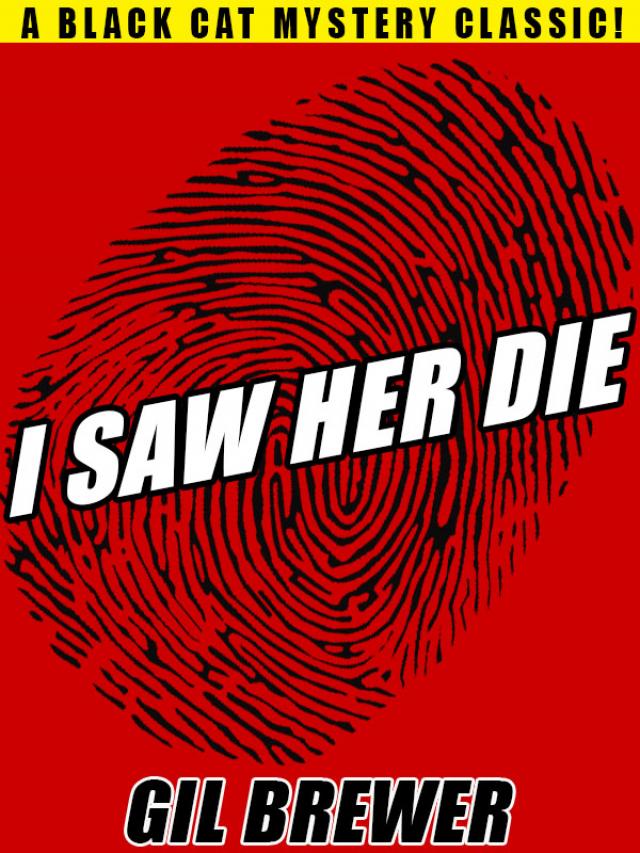
Table of Contents
COPYRIGHT INFORMATION
I SAW HER DIE
COPYRIGHT INFORMATION
Copyright © 1955 by Gil Brewer.
Originally published in Manhunt, October 1955.
Published by Wildside Press LLC.
wildsidepress.com | bcmystery.com
I SAW HER DIE
Lieutenant Grisson stretched a hairy hand across his desk and turned on the goose neck lamp. Outside, it was early dusk, but here in the police station it was dark. Blinding light flooded Grisson’s young-old face, winked in his gray eyes. He turned the lamp away toward the desk top, settled comfortably in his chair. He took his cap off, laid it on the floor, and mopped his head and face with a wadded handkerchief in his big hand.
“God damn, it’s hot,” he said.
Two policemen in plain clothes stood silently smoking by a row of lockers across the room. They were both of medium build. The blond one was Halliwell, the round-faced, dark-haired one was Dibble.
The door on the far side of the room opened and a small man stepped in. He closed the door very carefully.
“Here’s a customer,” Halliwell said. “Grisson just gets on duty and it starts.”
“We’re on duty, too,” Dibble said.
They shut up.
The small man stood by the door a moment, as if doubtful this was the right place. He wore overalls, the greasy straps cutting across bare, sunburned shoulders. The overalls were too large for him and they were heavy with dirt.
Grisson looked at the man, started to reach for his cap, mopped his face instead.
“Who do I talk to?” the man said. His voice was full of the Florida backwoods, fields of palmetto, snuff, and dark mossy river banks.
Grisson cleared his throat, glanced at Halliwell and Dibble, then back at the man.
“It depends,” he said.
“I got something here. I got to tell somebody, I reckon. I got to tell a cop.”
“You’re in the right place.”
The man moved toward the desk and Grisson waited. The overalls were so stiff with dirt it was as though the man moved inside a very large barrel. Grisson wondered if the man were drunk.
“They’s been a murder,” the man said. He lifted two huge, trembling, dirt-rutted hands and knotted them slowly into fists.
“Uh-huh,” Grisson said.
“I seen it.”
“Oh,” Grisson said. “All right. Tell me about it.”
“That’s why I come here,” the man said, lowering his fists and speaking slowly. “I reckon.”
Halliwell coughed.
Grisson cleared his throat again. “Go ahead.”
“Sho, now,” the man said, “just tell it?”
“Uh-huh.” Grisson grabbed the book and slammed it open on the desk. He snatched a pen from the inkwell and scratched in the time and date. “What’s your name?”
“Hewitt,” the man said. “Marvin P. J. Hewitt. Them middle ones stand for Purdy and Juke. I don’t never now use ’em, one or other.”
“Where you live, Mister Hewitt?”
“Over by Lake Seminole. We got a house, there. My wife and me, and the kids. I got five kids. We used to live in Tampa. Not any more, though.”
“Relax,” Grisson said. “You don’t have to be nervous.”
“It’s what I seen, does it,” Hewitt said. “Can’t help twitching.”
“All right. What’s your work, Mister Hewitt?”
“I’m a landscaper.” Hewitt didn’t know what to do with his hands. “Working yonder at Oak Summit, landscaping for Mulbrock’s Nursery. New development, over there. Setting out trees.”
Grisson closed the book, slid it across the desk, leaned back and sneezed.
“Should I tell it, now?” Hewitt said.
“Sure.”
“I was born near Ocala.” Hewitt said.
Grisson waited. Dibble lit another cigarette and sat on the small bench beside the lockers. Halliwell joined him.
Hewitt began to shake under the overalls. The shaking came and went in spasms.
“Just relax,” Grisson said. “You say you saw something. Go ahead and—”
“Murder!” Hewitt said.
“All right,” Grisson said. “Let’s take it one at a time. Where did you see this?”
Hewitt stared at Grisson. He opened and closed his mouth several times, very slowly.
“Look,” Grisson said. “You’ll have to calm down. Would you like a drink of water?”
“No, sir,” Hewitt said. “I’m all right now. It’s just what I seen, does it.”
“You’re all right now, then?”
“Reckon so. It was this afternoon. I was setting a palm out in this here back yard. There wasn’t nobody else around, and I heard a yell from three houses down. In the Florida room, sounded like.”
“I see.”
“Wasn’t nobody else around. Didn’t pay much attention. Then I heard one more yell.”
“What kind of a yell?” Halliwell asked.
Grisson lifted a hand, said, “Wait. Go on, Mister Hewitt.”
“It was a woman, yelled,” Hewitt said. “I cut down around the houses and came up by the Florida room and looked in. He was killing her.”
“What?”
“The man, there. He had this here gal down on the floor, hitting her. He hit the hell out of her. I could tell she was dead, but he kept on.”
“Kept on?”
“Hitting and hitting. She had on a red bathing suit.”
“How could you tell she was dead?” Halliwell asked.
Grisson held up his hand. “Go on, Mister Hewitt.”
“Well,” Hewitt said. “I was watching, like I say. I was scared. I didn’t know what to do.”
“For hell’s sake,” Halliwell said. Grisson turned slowly and looked at Halliwell.
Halliwell lit another cigarette, avoiding Grisson’s eyes.
“Then he had a knife in his hand,” Hewitt said. “He stood up and he bent down and drug the knife across her throat. Easy, like pie. She bled some,” Hewitt said. “He wiped the knife on her leg, good and clean. Then he folded it and stuck it in his pocket, and went into the bathroom.”
“How do you know this?”
“I snuck along the house,” Hewitt said. “He went in there and got a bunch of rags and come back and sopped it up. Then he looked up and he seen me.”
Dibble grunted.
“Let me get this straight,” Grisson said. “No,” he said. “Never mind. You say he saw you?”
“Looked right at me, sir. Yes, sir. We stared at each other through the window.”
“Then what?”
“I lit out,” Hewitt said.
“How long ago was this?”
“I come right from there.”
“Did he chase you?”
“He never come out of that house. I ran through the block, got in the truck and come over here. It’s a good ways.”
“Oak Summit,” Grisson said. “Yes, sir.”
“Wasn’t there anybody else around?”
“Not a soul on that block but me,” Hewitt said slowly. “Three blocks over they’re building, but that’s a long ways. Not a soul. My truck was parked across the block, like I say.”
“Did you see any cars?”
“They was a car front of the house. A blue Chevvy.”
“You saw that?”
“Yes, sir.”
“Ever see it before?”
“There’s lots of blue Chevvies. I lit out.”
“Did you know these people? Have you ever seen them before?”
“Seems like the man might be a salesman. Real estate. They got a office at Oak Summit, so they can show the houses.”
“But you aren’t sure?”
“Couldn’t swear to a thing. Just what I seen.”
Grisson stared at Hewitt.
“It’s a hell of a one,” Hewitt said. “He saw me. I can’t get that outa my head. He knows I saw him.”
Grisson turned and looked at Halliwell and Dibble. They stood up and came over by the desk and stared at Hewitt.
“Take him out there and see what this is all about,” Grisson said. “Phone in.”
“Let’s go,” Halliwell said to Hewitt.
Halliwell was a cynical man. He didn’t believe a word of what Hewitt said, because somehow it didn’t ring true. He knew Dibble didn’t believe it, either. He did not know what Grisson thought.
They drove out to Oak Summit.
“She must have been alive,” Dibble said. “Or she wouldn’t have bled when he cut her throat.”
“Said she bled some,” Hewitt told Dibble.
“You said he ‘sopped’ it up,” Halliwell said.
“Sopped, mopped—what would you say?” Hewitt said.
“All right.”
Halliwell could tell Hewitt was very nervous. The man kept looking out of the car window into the darkness.
“Tell me where to turn,” Halliwell said.
“Turn here. Just go right on down and your first right, and stop at the sixth house. That’s it.”
Halliwell did that. The crickets were loud. It was absolutely quiet out there, except for the crickets. It was very hot. There was no wind.
“Jesus Christ,” Hewitt said. “He saw me.”
“Let’s go,” Halliwell said. “Frank, you bring the flash.”
They crunched up the driveway and across the walk to the front door of the house.
“Mostly they leave the doors open,” Hewitt said. “Dur
“You know everything, don’t you?” Halliwell said.
“Easy, boy,” Dibble said.
“How come they leave the doors unlocked?” Halliwell asked.
“So folks can look.”
The door was open. They went inside. The place smelled of fresh paint and plaster and raw wood and wet cement. It was much hotter inside the house and the crickets were muted and far away after Dibble closed the door.
“Hardly breathe,” Halliwell said. “All right, Hewitt. Show us the body.” He turned the flashlight beam into Hewitt’s eyes.
“Right through there, in the Florida room,” Hewitt said.
They went into the empty Florida room. The rear door was open, leading into the back yard. Sand had blown through the door, and was drifted on the floor.
“It’s gone,” Hewitt said. He stood in the center of the room and looked around at the windows. “He saw me,” he said.
Halliwell turned the flashlight on him again and watched him shake.
“Show us where it was, Mister Hewitt,” Dibble said.
“It ain’t here,” Hewitt said.
“It never was here,” Halliwell said. “Right, Hewitt?”
Hewitt didn’t answer. He apparently was thinking about something, though. He kept looking at the windows of the Florida room. He seemed to shrink inside the overalls.
Halliwell turned to Dibble. “Go on outside,” he said. “Open the front door wide. Park the car so you can train the spotlight in here across the floor. All right?”
Dibble went outside. Pretty soon a spreading beam of white light lit the Florida room like daytime. The only tracks and scuffings on the sand-blown floor had been made by them.
Dibble came back.
“Not a sign of anything,” Halliwell said. “Asphalt tile floor. Perfectly dry.”
Hewitt stepped up to Halliwell and touched his arm.
“He could of thrown sand in the door,” Hewitt said. “The door Wasn’t open before.”
“Hell,” Halliwell said.
Dibble got down on his hands and knees. “You say about here, Mister Hewitt?”
Hewitt nodded. His mouth was open again, slowly moving, and he was watching the windows.
“I can’t see a thing,” Dibble said. “Not a sign. If she bled, it would have gotten into the cracks between the tile. You’d think so, anyway.”
“There’d be something,” Halliwell said. “Well,” he said. “That’s that.”
“You don’t believe me,” Hewitt said.
“We’d better check on the car,” Dibble said. “The blue Chevvy. He said something about the real estate office.”
Halliwell shrugged. “All right. Go report in, I’ll check the bathroom.”
Dibble left and Halliwell went into the bathroom with the flashlight. He could hear Dibble at the radio in the car. There was nothing in the bathroom aside from the usual furnishings, and a bucket of dried cement.
Halliwell returned to the Florida room. Hewitt wasn’t there, so he went on outside and closed the door. Hewitt was talking with Dibble.
“You’ve got to believe me,” Hewitt said as Halliwell came up to the police car “You’ve got to! I seen him, you hear? And he seen me. Jesus Christ.” Hewitt turned and looked at Halliwell and snapped his fingers three times.
“We’d better check out that car,” Dibble said.
“All right.” They ran down the head of the realty company and questioned him. They found him repairing a fishing rod in his garage. He told them that there had been a man working for them who was out there at Oak Summit and this man drove a Chevvy, only it was light green.
“It might have been that color—green,” Hewitt said.
“Only he’s in California,” the realty man told them. “He left for San Francisco three weeks ago.”
“What have I got to do to prove it to you?” Hewitt said as they walked back to the police car. “I tell you, I seen it! There must be some way to prove it to you.”
“Sure,” Halliwell said. He was mad. He could have been sitting on the bench back there at headquarters, smoking. Damn these hallucinating characters, anyway.
They drove back into town. Dibble didn’t have much to say.
“You got to believe me,” Hewitt said. “He could of dried the floor up, dusted it with sand, that way. Can’t you see that?”
“Look,” Halliwell said. “Let us worry about it. You reported it. It’s off your hands. You made a mistake, that’s all. We’re not mad at you.” He looked out the side window of the car, then continued driving carefully. “Where’s your car, Hewitt?”
“I left the truck by the police station.”
“All right. You get in it and drive on home. That it, up there?”
“That’s it,” Hewitt said. “Jesus Christ.”
They parked. They walked Hewitt over to his truck. It was a truck from Mulbrock’s Nursery. Hewitt climbed behind the wheel of the truck and looked down at them.
“I wish you boys would believe me,” Hewitt said. He gripped the steering wheel of the truck very hard. Then he looked at them and yelled in their faces. “I seen it! You hear! I seen it!”
“All right,” Halliwell said. “Go on home. Forget about it. Well be working on it.”
Halliwell and Dibble walked away. Hewitt sat there behind the wheel of the truck and watched them. He watched them pause on the steps of the police station and light cigarettes and blow smoke into the night. The awful bright sanctuary of the station made Hewitt almost sick to his stomach. He was sweating under his overalls.
He seen me, Hewitt thought. He seen me watching him.
He started the truck and drove off out of town. He felt dizzy and sick and he couldn’t stop shaking. He was scared so badly he kept his toes pressed tight up against the tops of his shoes. He had to go home and he didn’t want to go home. He wanted to go back there and just sit on those brightly lighted steps of the police station.
As he turned onto the road that led toward Lake Seminole, it seemed every car he saw turned and followed him.
One did.
* * * *
Halliwell and Dibble were sent out on it. It was five days later and a family at the end of Ninth Street, near the sand pits, had complained of a bad smell.
Halliwell and Dibble stood there on a mound of sand and looked at the two bodies laid out side by side. They were in a bad state of decomposition, but the red bathing suit and the dirty overalls were in good condition.
“Somebody’s going to catch hell for this,” Halliwell said through his handkerchief.
“Yeah,” Dibble said. “But Hewitt sure proved his point, didn’t he?”
Gil Brewer, I Saw Her Die
Thanks for reading the books on GrayCity.Net