

Dont ask, p.1
Don't Ask, page 1


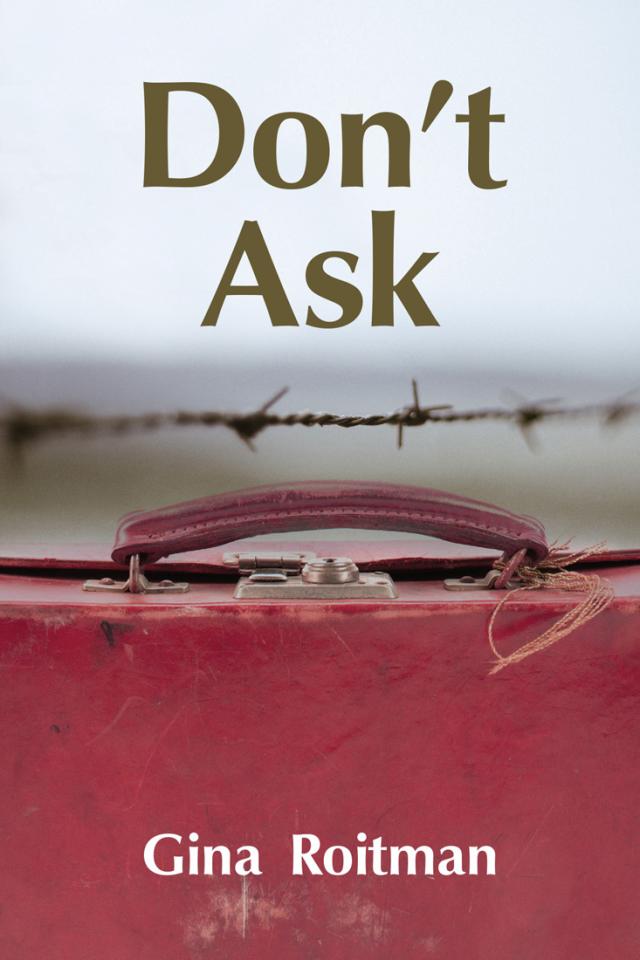
Copyright © 2022, Gina Roitman and Guernica Editions Inc.
All rights reserved. The use of any part of this publication, reproduced, transmitted in any form or by any means, electronic, mechanical, photo copying, recording or otherwise stored in a retrieval system, without the prior consent of the publisher is an infringement of the copyright law.
This is a work of fiction. Names, characters, places, and incidents are either the product of the author’s imagination or are used fictitiously. And any resemblances to actual persons, living or dead, businesses and companies, events is entirely coincidental.
Antonio D’Alfonso, Guernica Founder
Connie McParland, Michael Mirolla, series editors
Sonia Di Placido, editor
Cover design, Rafael Chimicatti
Interior design, David Moratto
Guernica Editions Inc.
287 Templemead Drive, Hamilton, ON L8W 2W4
2250 Military Road, Tonawanda, N.Y. 14150-6000 U.S.A.
www.guernicaeditions.com
Distributors:
Independent Publishers Group (IPG)
600 North Pulaski Road, Chicago IL 60624
University of Toronto Press Distribution (UTP)
5201 Dufferin Street, Toronto (ON), Canada M3H 5T8
Gazelle Book Services
White Cross Mills, High Town, Lancaster LA1 4XS U.K.
First edition.
Printed in Canada.
Legal Deposit—First Quarter
Library of Congress Catalog Card Number: 2021949330
Library and Archives Canada Cataloguing in Publication
Title: Don’t ask / Gina Roitman.
Names: Roitman, Gina, 1948- author.
Description: First edition.
Identifiers: Canadiana (print) 20210357800 |
Canadiana (ebook) 20210357819 | ISBN 9781771837118 (softcover) |
ISBN 9781771837125 (EPUB)
Classification: LCC PS8635.O443 D66 2022 | DDC C813/.6—dc23
For Benjamin and Jacob, and Axel for your abiding patience, support, and love.
Give sorrow words;
the grief that does not speak knits up the o-er wrought heart and bids it break.
—William Shakespeare, Macbeth
Glossary
w
A
Aroise gevorfeneh gelt Wasted money
B
Bist du eine Yideneh? Are you a Jewish woman?
Bratkartoffeln Home fries
Bundesstrasse Federal highway
D
Der Todesengel Angel of Death
Du bist eine narish kindt You are a foolish child
F
Feigelach Gays
Ferd Horse
Fetter Uncle
Fit wie ein Turnschuh In fine form
G
Geschichteh Story
Gotteinu God in heaven
H
Aleva ha’shalom May she rest in peace
Hilfspolizei Auxiliary police
K
Kaffeefahrt Leisurely drive
Köln Cologne
M
Maidel Girl
Meine teireh tochter My dear daughter
Mein Gott My God
Minyan A quorum of ten Jewish men required for prayer
N
Nicht müglich Not possible
Nisht tzu gloiben Not to be believed
Nu? Well?
O
Oberstleutnant Lieutenant colonel
P
Paskudniak Contemptible or nasty person
Parshah Weekly Torah portion
Puchineh kohldreh Feather comforter
Q
Quatsch Nonsense
Qvelling Taking pleasure
R
Rotkohl Red cabbage
Rundes yahr Round year (birthday marking a new decade)
S
Sauber Clean
Schvantz Penis
Schvartze Blacks
Shprintzeh Leah Coddled woman
Shtickel Piece
Sympatiche Genteel, Empathic, Responsive
T
Tovarishchi Comrades
V
Vati Father
Vilde chayeh Wild animal
W
Weihnachtsmarkt Christmas market
Z
Zhid Jew
Introduction
w
An old Jewish joke goes something like this: Every weekday, month after month, year after year, two men stand waiting for the bus to go to work.
After many, many years, one man suddenly turns to the other and quietly says, “Excuse me but I don’t understand something. More than twenty years now, we stand at this bus stop every day, waiting in silence for the bus, and not once did you ever look at me and speak. You’ve never said, ‘Hello. How are you? Let me introduce myself. My name is . . .’ More than twenty years! Not a word.”
Surprised by the sudden confrontation and feeling a little guilty, the man says, “You’re right, 110 per cent! I’m embarrassed. This is a shame. Twenty years and never one word between us. This minute, let us change that.” And he stretches out his hand. “My name is Sam. Nice to make your acquaintance.”
Taking the outstretched hand, the man says, “Bennie, my name is Bennie.”
“Bennie. Wonderful, wonderful!” Sam exclaims. “So, how are you?”
“Ach,” Bennie replies, “don’t ask.”
HANNAH
AUGUST 2000
o
CHAPTER ONE
w
She was running late. Punctuality was one of her mother’s many obsessions but Hannah, afflicted by an elastic sense of time, had never mastered Rokhl’s rule. She remembered well one of the first notes Rokhl had written in what eventually became their common mode of communication. It had read: When there was roll call in Auschwitz, late one minute meant dead the next.
Hannah shouldn’t have taken that last phone call, but the client had said he needed to speak to her immediately. Her best friend, Marilyn, maintained that Hannah was incapable of saying no to anyone who claimed to need her. “You’re a real estate agent, Hannah, a real estate agent, not a brain surgeon.” Friends since childhood, Marilyn had an annoying way of repeating certain phrases for emphasis. “Nobody will die if you don’t respond immediately, nobody.”
If she hadn’t taken the call maybe she wouldn’t be stuck in the stifling August heat, chewing on her cuticles, and endlessly replaying the fight she and her mother had had the night before. It had left Hannah deeply shaken. Open disagreement between them was as rare as motherly hugs. Long ago, Hannah had recognized that her mother wore silence as protective gear against the world. Sometimes that silence was a body shield, sometimes a sound barrier to force Hannah into silence as well. Last night, however, Rokhl had raised her voice for the first time in Hannah’s memory. The transformation in the woman who did nothing out of character for all of her 45 years had left Hannah shaken.
When she was a child, Hannah had believed that Rokhl’s voice was impaired, that it was physically unable to project above a certain soft range, and that using it too often was painful for Rokhl. But last night, her mother gave lie to that with a keening wail not heard even upon the death of Hannah’s father, Barak. It grew like a siren gathering strength and turned into a shrill, high-pitched harangue. It demanded that Hannah must not, under any circumstances, ever travel to Germany. Stunned by her mother’s new faculty for making herself heard, Hannah hastily made a promise. This morning, however, she was uncertain whether she could keep it. On her way to pick-up Rokhl for a doctor’s appointment, traffic had crept at a maddeningly slow pace. It was almost as if unseen forces were aware of Hannah’s reluctance to face her mother.
In an effort to drown out a replay of the previous night’s scene, Hannah had turned on the radio and was not surprised that there’d been an accident. Likely, everyone was taking their turn gawking at the disaster. What was this human compulsion, Hannah wondered, not for the first time, to bear witness to the misfortune of others? It was as if by surveying a calamity people imagined they could protect themselves from it. For her, it was a point of honour never to look.
Finally able to head off the expressway, Hannah accelerated down Barclay imagining Rokhl sitting in the front hall, twisting a tissue and staring balefully at the door. She pulled into the driveway of what she still thought of as her father’s house although Barak had been dead for two years. The stop was so abrupt her tires squealed — the screech tracing a shiver down Hannah’s sweaty spine, but when she opened the car door a blast of August heat momentarily knocked her back into the cool interior.
Recovering her nerve, she hurried up the crumbling concrete steps of the duplex — her spike heel catching in a crack as it had done so many times before. Nanoseconds before her knee made contact with the cement, she managed to regain her balance. Saved, she thought, although a battered knee was preferable to the bruised look she knew was on her mother’s face when she walked into the house. Hannah peered through the curtained window of the door then fumbled the key into the lock. Click. Click? That was the sound the bolt made when sliding shut — the door was open! Hannah’s brain was working hard to compute the information. Rokhl’s door was always locked. The August heat pressed against Hannah’s back, her blouse clinging to her like a frightened child. She leaned her forehead on the wood for a moment, turned the key again and pushed the door open entering the cool of the tiny vestibule. The old, flowered wallpaper exhaled its familiar dusty odour with a slight hin
“Ma?” she called out, entering the damp gloom. “Rokhl?” Her voice rustled through the flat like a broom on a linoleum floor. Sweat mushroomed on Hannah’s upper lip as her eyes darted into the dim hallway.
“Ma?” she called again, heading for the kitchen.
If Rokhl had left in a fury without her, there would be a note. But after checking all the familiar places: the front of the fridge, the tray under Rokhl’s myriad of medications, the utility drawer with the carefully separated rubber bands, twist ties, and ball of string, each time, Hannah came up empty. What is the matter with you? Her father’s words echoed in the still air of the hallway. You are our only child; the only family your mother has left. You are supposed to watch over and care for her. What she lived through in her life you’ ll never know. Don’t ask. But know you are all she has. Promise me you will watch over Rokhl when I’m gone. Promise me!
How many times had Barak hammered those words into her head, especially in the final stages of his cancer? Hannah reasoned that Rokhl must have left in a panic over being late for her appointment. If anything happened to her mother, it was Hannah’s fault. She should have been on time. But where is the note? Hannah took a tissue from her purse and dabbed at her brow and upper lip. The house was stifling hot despite the semi-gloom, but she forced herself to calm down and think. If Rokhl had taken the bus to get to the doctor’s appointment (a taxi being reserved strictly for life-or-death matters), she would still have left a note. There was always a note.
Hannah went back into the hall. Uncertain, she stood a moment scanning the uniformly beige walls for some inspiration. The decor in the duplex was sparse; a few cast off prints from Hannah’s first apartment were a sad attempt to introduce some colour but what still dominated was a family photo. It had been taken in a studio on Park Avenue when she was four. In it, Barak stands relaxed in an impeccable pinstripe suit; Hannah in a white blouse, a box-pleat skirt and a white satin bow almost lost in the sea of her dense, copper curls and Rokhl also in a white blouse buttoned to the neck in a dark, fitted jacket that shows off her tiny waist. Although facing forward, Rokhl isn’t looking into the camera. Instead, her eyes are locked on her husband with an expression Hannah was never able to interpret. Positioned between the two of them, Hannah had been made to sit on a stool but appeared to be straining forward as if ready to bolt. She had refused a smile despite the photographer’s best efforts to cajole one out of her. To this day, she still hated having her picture taken.
Frustrated, Hannah sat down at the wrought iron telephone table with its old black, rotary dial phone. Rokhl would not hear of replacing it saying that it was still perfectly good. Eventually, Hanna had stopped trying to get her to change her mind. She lifted the receiver and called the doctor’s office, waiting impatiently for each turn of the rotary dial to be completed.
“Hi Betty,” Hannah said when Dr. Rubin’s nurse finally answered. “I’m sorry to trouble you but is my mother there?”
“No, and I was getting concerned,” Betty said. “You guys are always so punctual. Is anything wrong?”
“No, no . . . of course not. I got caught at the office and I think my mother lost patience waiting for me. She’ll probably show up any minute. Would you mind having her call me when she does?”
“Sure, sure . . .” Betty said, already onto another task. “OK. Bye.”
“Bye,” Hannah said to the dial tone.
She raked her nails through her thick hair and examined the copper strands that came back laced between her fingers. When she was young, Rokhl used to whistle a high, bird-like trill as she brushed her daughter’s hair until it shone like a bright penny. As if mesmerized, Hannah would watch the arc of her mother’s arm complete a slow, downward stroke, the movement carried out in the same precise way each time. Rokhl’s pale skin was so delicate except for the scar on her forearm — a lumpy welt of red and blue like the tiny tableau of a mountain range. Rokhl’s whistling as she gently ministered to her daughter’s tangled mass — a silken thread of intimacy binding their daily lives in a way that comforted young Hannah.
Balefully stuffing the loose strands of hair into her pocket, Hannah absentmindedly opened the hall closet and was momentarily confused when she spied Rokhl’s purse. She reached in and turned it over slowly as if to reassure herself she wasn’t mistaken. It was a bag she knew well with all its little zippered compartments because it had once belonged to her, earmarked for the Pioneer Women’s annual bazaar until Rokhl snatched it from the pile. Her mother could not bear to throw anything out, a habit that she had transmitted to her daughter. In a corner of Hannah’s cedar closet, four shoeboxes — one for each decade and a fresh one marked 2000, printed in heavy black marker on the end of each box — contained Rokhl’s notes neatly stacked. Like the dream logs she had been keeping since her teens, Hannah planned to one day read them all at once. When she had to.
Ignoring the hammering of her heart, Hannah unzipped the main compartment. Her mother’s wallet which had also once been hers lay next to a crumpled cotton handkerchief with a faded embroidered rose on the edge and an old black comb. In the front compartment, Hanna found a scrap of paper. On it was Rokhl’s meticulous script. Her hands suddenly trembling, she pulled the note out of the bag and laid it in her lap. On the day her mother disappeared, Hannah read the last note Rokhl would leave her.
I am not her, it said.
CHAPTER TWO
w
Hannah waited 24 hours before calling the police, knowing Rokhl would have been mortified: O mein Gott! The police! To bring yourself to the notice of the authorities was something to be avoided at all costs. It was one of Rokhl’s many unspoken rules. If she was in the car with Hannah and a siren wailed, no matter how far away, no matter what kind of siren it was — ambulance, fire truck or police — Hannah had to immediately pull over to the side of the road and stop the car. And no one was allowed to move until the sound had died away. “You never know . . .” was all the explanation Hannah ever got and for Rokhl, that was saying a lot.
I am not her.
On the day Rokhl disappeared, in the gloom of the beige hallway, on the edge of the wrought iron seat next to a phone that rarely rang, Hannah sat folding and unfolding the note, as if by some magic its meaning would be revealed. What did Rokhl mean by ‘ her’? Was it a mistake? Didn’t Rokhl mean ‘I am not here?’ Not that it made any more sense. And if she could decipher it, what could it tell her except what was obvious? Rokhl had left home without her purse, no wallet so no means of identification and with no known destination in mind. Deep in Hannah’s belly a larva of worry was growing.
Hannah slid into the sweltering car. Almost instantly, sweat filmed her face and trickled down the curve of her clenched jaw. She stared out of the windshield at the front door of the duplex as if half expecting that by some miracle her mother would suddenly appear. For almost all of her 45 years, Hannah could predict Rokhl’s every move, although never her motives, never the why. Now this. Nothing had prepared her for this. Not even the shocking exchange she and Rokhl had had the night before. Like an anxious child, Hannah brought her thumb to her mouth and started chewing on the cuticle.
“You’re eating yourself up alive,” Marilyn would say, “... a classic case of self-cannibalization.”
Marilyn had a theory for and an opinion on everything. For a moment, phone in hand, Hannah thought about calling her best friend but hesitated. To call would be to admit that something serious had happened. There was no real proof of that, not yet. A thin line of blood trickled from Hannah’s thumb. Cause and effect. The sharp pain came as welcome relief. She began to coast up one block and down another, trolling through the streets of the area she knew like the contours of her mother’s face. She drove half-believing that she might spot Rokhl, or by some fluke, maybe someone familiar. But after so many years in Montreal, her mother’s smattering of acquaintances, those who hadn’t died, were living far away in Israel or Miami. Slowly rolling past rundown apartment buildings, Hannah worked on recalling anyone she might contact about Rokhl. No one came to mind.
Since her father’s death, Hannah had avoided thinking about how bereft of human contact her mother’s life had become. She did not want to consider how much Rokhl needed her every day. It was easier just to perform her duties: make the daily calls, take her mother food shopping for a large order once a week, chauffeur her to medical appointments, and share a Friday night dinner together at the duplex on Barclay. Hannah had tried to get Rokhl to do more but her mother didn’t want to leave her home, not even to have dinner at Hannah’s just for a change. It finally became clear, Hannah confided to Marilyn one day, that after Barak’s death Rokhl had closed herself up in a ghetto of her own making.


