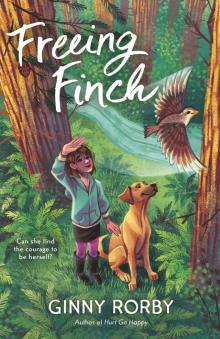
Freeing finch, p.3
Freeing Finch, page 3


“It’s dark. Stan, you go with him.” Cindee slaps his shoulder lightly.
“It’ll take me five minutes.” I don’t need him.
Cindee goes to the junk drawer where they keep batteries, rubber bands, twist ties, and multiple half-used tubes of Krazy Glue. She fishes out a small LED penlight. “Are you going on the trail or the road?”
“Road. Why?”
“Wear my white sweater so cars can see you. And walk facing traffic.”
“It’s a hundred yards.”
“For me. Okay?”
I shrug, take her cardigan off the hook by the door, and put it on over the shirt and my fleece vest. Cindee is almost as round as she is tall. I’m five-five and spindly. The sweater is huge on me.
The night is crystal clear. An airplane winks across the sky. On nights like this, Mom and I would sometimes pull the hammock from under the trees, huddle together in our sleeping bags, and fall asleep watching for shooting stars.
There are no streetlights this far out of town. I turn onto the dark road, but don’t bother with the flashlight. I’ve walked this short piece of pavement a thousand times.
From far down the road, I hear a car coming. I walk a little faster, my breath coming in misty puffs. I turn into Maddy’s driveway and dodge behind a tree so the lights won’t hit me when the car crests the hill. I like the idea of watching it pass without the driver knowing I’m here.
I see the dog caught in the momentary flash of the car’s headlights. He’s lying in the lower driveway next to Maddy’s car. I turn on the penlight and wish it were brighter. Another car is coming. I stay hidden behind the tree and watch for its lights to expose the dog again. By the time it passes, the dog has disappeared. Maddy said his routine is to eat and leave. What’s he still doing here?
Maddy has an upper driveway and a lower driveway. If it’s supposed to rain, she parks in the carport on the upper level because her sunroof leaks and she can get into the house through the back door to her bedroom without getting wet. The rest of the time, she parks on the lower level, near her front door, which is where the car is. It’s only eight thirty, too early for her to be asleep, but there are no lights on in the house. Maybe she is out playing bridge, but she wouldn’t have gone and not fed the dog.
From the upper driveway, I shine the thin flashlight beam at the chimney. The cap and screen are still missing, and there’s no smoke, so no fire in the woodstove. I go into the carport and knock on the back door. The only sounds, besides the muted tumble of the waterfall, are Maddy’s red-tailed hawk shaking itself to redistribute its feathers, and the short murmuring call of Otus, her ten-year-old screech owl.
Suddenly every nerve in my body tells me what’s wrong. “Maddy!” I run to the stairs that connect the upper-level driveway to the lower and take them down three at a time. “Maddy, where are you?” I shout.
Nothing. Not a sound.
“Maddy?” I round the front side of the house and trip over her. She’s lying half on, half off the walkway. Her body is on the walk, but her head is under a large hydrangea. She’s landed on her side, and her left arm is twisted at an odd angle.
Maddy moans and opens her eyes. “Finch?”
“It’s me.”
“Oh, Finch. Thank God. I’m so cold.”
I kneel beside her. “Let me help you up.”
“I can’t. My hip and arm are broken. Call 911.”
I step over her and try the door. “It’s locked, Maddy.”
She doesn’t answer.
“Maddy?”
“There’s a ladder in the carport.” Her voice is barely a whisper. “Use it to get onto the roof. The sliding glass door to my bedroom is open.”
I start across the front deck, then run back, pull off Cindee’s sweater, and put it across Maddy’s shoulder.
“Thanks, honey,” she whispers.
I race up the steps, lug the ladder down to the landing, open it, and lock the two crossbars. I climb high enough to step up onto the narrow edge of the roof that extends beyond the deck. It’s only about a foot wide and steep, so I hold on to the upright bars of the deck railing and don’t look down. The gate in the railing is open. I cross the deck, turn on a light, and search frantically for a phone. There isn’t one. I know where the downstairs phone is; I used it a million times to call home and check on my mother.
I run down the stairs, grab the cordless phone off Maddy’s messy desk, and dial 911. As it rings, I grab the throw off the sofa, unlock the front door, and turn on the porch light.
While we wait for the ambulance, Maddy drifts in and out of consciousness. I’m glad. When she’s awake the pain she’s in is horrible. It reminds me of Mom toward the end; she moaned even in her sleep.
Town is only four miles away. I begin to hear the siren pretty soon after I call and, a few minutes later, hear the ambulance turn onto McDowell Creek Drive. “They’re coming, Maddy.”
I can tell by how fast they’re driving they aren’t going to slow down in time to make the driveway. A second later the ambulance wails by, lights flashing.
McDowell Creek dead-ends about a mile past Maddy’s. They have to come back this way. After covering Maddy with the throw from the sofa, I’d put Cindee’s sweater back on. Now I strip it off and run up the driveway. When the wailing grows louder and I see the flashing red lights bounce off the trees, I turn on the penlight and wave the white sweater.
* * *
The paramedic pats my shoulder. “Are you her granddaughter?”
I feel a momentary shock at being recognized as a girl. “A neighbor,” I say.
“Don’t worry too much. She’ll be fine, but she’s very lucky you found her.” He closes the first side of the ambulance doors.
Maddy lifts her head. “Take care of my animals, Finch.”
“I will, Maddy.”
“And don’t forget the dog.”
CHAPTER 6
I
After the ambulance leaves, I turn out the lights and lock the house with the spare key Maddy keeps on the mantel. I shine the flashlight around looking for the dog, but he’s either gone or lurking in the dark somewhere. Maybe he was trying to get me to follow him earlier this afternoon—show me that Maddy had fallen. I’ll never know.
* * *
“Where have you been?” Stan demands. “I’ve been calling that house for an hour.”
I don’t answer. He’s exaggerating. Maddy’s phone was in my vest pocket. It never rang.
“You gonna answer me?” Stan says.
“Maddy fell. Didn’t you hear the ambulance?”
“We had the music on pretty loud,” Cindee says.
“Fell where?” Stan says.
“Off the roof. She’d been lying there for hours.”
“Oh, that poor old thing.” Cindee clasps her hands together. “How bad is she hurt?”
“Pretty bad. She broke an arm and her hip.”
“That’s not good,” Cindee tells Stan. “Old people who break hips often die. My grandmother did.”
“She’s not old and she won’t die,” I snap. Because Cindee’s a nurse’s aide, she thinks she knows everything.
“Of course she won’t, sweetie,” Cindee says. “My grandmother was a lot older than Maddy. How old is she, anyway?”
Stan shrugs. His head is back and he’s putting Visine in his eyes.
I know, but I’m not telling Cindee. This summer Maddy and I drove a bunch of baby swallows to a rehab center in Petaluma, and she got stopped for speeding. I dug her driver’s license out of her purse for her. She’s sixty-six.
“I’ll pray for her tonight,” Cindee chirps. “You have to let go and let God.” Cindee’s eyes glisten with tears.
“Been there,” I mumble.
I prayed my heart out for my mother to live and—if God exists—he let her die anyway. Cindee’s answer to everything is to put it in God’s hands, like she did when Stan lost his security job at the old Georgia-Pacific mill site. She’s convinced God will provide him with a new one. He must believe it, too, because he hasn’t bothered looking for another.
I once asked her if everything is God’s will, how come I’m a girl in a boy’s body? “God doesn’t make mistakes, Morgan. It’s a phase. You’ll grow out of it,” Cindee said.
I’ve always felt like a girl. “If it’s a phase, I’m at eleven and a half years and counting,” I said.
If I was going to pray for anything ever again, it would be to find my father. I’d try to be a boy for him.
I go into the kitchen, open the refrigerator door, and stare at the contents. There’s a carton of orange juice, but when I reach for it, my hand starts to shake, and the backs of my knees tingle.
“Morgan?” Cindee’s voice is far away. “Morgan.” Cindee pats my shoulder.
I open my eyes. Stan is holding a wet dish towel, and it’s dripping into a puddle of orange juice beside my head. Cindee helps me sit up.
“What happened?”
“You fainted.”
“I was reaching for the juice and thinking, if Maddy…” I stop.
If Maddy dies, I’ll have no one.
II
That night, I set my alarm to get up an hour earlier. I’ll need time to feed Maddy’s animals before school. At the moment, she only has her permanent residents: Otus, her owl; Ravenous, a cranky red-tailed hawk, nicknamed Rav; her cats; and now that creepy-acting dog. At least it’s not like summer, when people bring her baby birds that have left the nest too early, or fallen to the ground, or been caught by a cat. Those Maddy raises and releases—except the swallows. Baby swallows have to be taught how to catch insects by adult birds, so Maddy raises them until they can fly, then drives them to the rescue center in Petaluma.
I always go with her. Baby birds get hungry every twenty minutes, and the drive is two and a half hours. Last summer there’d been eight babies to feed—four barn swallows and four cliff swallows.
I loved dropping mealworms into their gaping beaks. As babies, their beaks are ringed with rubbery yellow skin that, with the dandelion-like puffs of down on the tops of their heads, makes them look like frowning, crabby old men. But what I liked best about feeding baby birds was the soft, chirpy, hiccupy sound they make when they’re full.
* * *
Maddy uses Otus, who is blind in one eye, and Rav in her educational programs at local schools. She starts by telling kids that, with few exceptions, every animal she ends up with is there because of something a human did to hurt it. Rav is an example. He has only one wing. The other was splintered by a hunter’s buckshot and had to be amputated.
There’s a small freezer in Maddy’s carport where she keeps the frozen mice and baby chicks she feeds to Otus and Rav. I get two mice out of the freezer, one for each of them, lay them aside to defrost, and go down to feed her three cats.
The two females—Risty, a calico, and Cory, a black-and-white tuxedo cat—don’t like anyone except Maddy, but they know me well enough not to run and hide. Both are sitting in the bay window when I unlock the front door, like they’re watching for Maddy to come home. Rufus, who is yellow and old, is asleep in front of the Monitor heater.
Cory and Risty jump down, run to their empty dishes, and start to meow. Maddy must have fallen before she got a chance to feed them last night, and I didn’t think to do it after the ambulance left.
The remains of three cans of food are in the fridge, which means Maddy is still catering to their individual likes and dislikes. There’s beef, fish, and senior diet for Rufus. I fill the dry-food bowl, clean the dry bits of yesterday’s breakfast from their dishes, empty the three cans into their separate bowls, and leave it to them to sort out who eats what.
I clean the litter box, put seed in the bird feeders, and get a half dozen mealworms out of a container in the fridge for Otus. I lock the house and am headed across the front deck when I see the dog. He’s sitting at the top of the driveway, watching me.
I make a U-turn and go back into the house for a dish. I open all the cabinet doors until I find a bag of kibble under the sink.
“Here.” I set the bowl on the deck, thinking it’s too bad Maddy started feeding him in the first place. It only encourages him to hang around. I use the water in a rain barrel to fill another bowl with water and put it beside his food dish.
The dog lies with his front paws stretched out in front of him and his head up. He looks a little like pictures of the Sphinx in Egypt.
“Suit yourself,” I say. “The jays and ravens will eat it if you don’t.”
There are six walk-in cages on the little rise above Maddy’s carport, three on either side of a center path. They are plywood on three sides with evenly spaced thin wooden lath slats in front. Hardware cloth lines the inside of the lath to keep rodents out and small birds from escaping through the slats. The dimensions and design are dictated by the California Department of Fish and Wildlife, from which Maddy has a permit to rehabilitate wildlife.
I open Otus’s cage and step inside. Otus has always liked me and seems to remember I used to feed him. He bobs his head trying to focus his one good eye and makes little snapping sounds with his beak before flying to land on my head. His talons are sharp and his grip painful. I put the defrosted mouse on the redwood stump in the middle of his cage, scrape him off, and set him beside it. He must be lonely because he ignores his mouse and flies to the top of my head again. I lift him off, put him on my shoulder, and give him a mealworm. He takes it, flies to one of his perches, eats it, and flies back to the top of my head.
“I don’t have time to play with you.” I take him off again and bribe him to stay on the redwood stump with two mealworms. I change his water and give him the last of the worms to make my escape.
Unlike Otus, Rav doesn’t like me at all. He isn’t too crazy about Maddy, either, but he’ll come down off his perch for food. That’s how Maddy catches and hoods him for the trips to schools, where he stares at students with menacing yellow eyes. He probably holds a grudge against humans for shooting him out of the sky. One minute he was soaring, drifting in effortless circles, and the next he tumbled to earth. I’d be mad, too.
When I slip into his cage, every feather on his head and shoulders rises threateningly. Something about Rav reminds me of my grandfather, and I feel sorry for him.
My mom’s dad was like that, using anger to keep some control over his life after he lost first one leg then the other to diabetes. He took every act of kindness as patronizing. It even made him mad when someone held a door for him. But inconsiderate people, who didn’t hold a door, infuriated him.
Mom and I would pick him up at the Sherwood Oaks Nursing Home every Sunday and take him to breakfast at the Home Style Café. He got mad at one person for driving too fast, another for driving too slow, and at teenagers for playing their car stereos so loud your chest vibrated. But people who threw trash out their windows topped his hate list. He said the world was full of people who thought the planet revolved around them. “Don’t grow up thinking the world owes you a living,” he told me, shaking a bony finger in my face. “It owes you nothing.”
“I won’t, Papaw,” I’d say.
Maddy has hung a series of branches, placing each within jumping distance of the other, so Rav can reach his food. He cries loudly when I enter and hops to the top branch, one wing spread and the nub of the other held out for balance. He glares at me as if I’m to blame for his limitations.
Before putting a mouse on his feeding platform, I change his water. He’ll come down instantly for his breakfast, and I don’t want him to have to work his way back up when I return with clean water.
Before leaving, I peek through the slats of the other four cages to make sure I haven’t missed a new arrival. They’re empty.
I wait until I’m hidden by the trees to look back at the dog. He’s coming down the driveway, head low, tail tucked. He looks pitiful, and I watch him start to eat before I take the trail home to get ready for school.
CHAPTER 7
I
Amanda is in the back of the bus with her clutch of friends. I take a seat near the front behind Rita, another of Amanda’s targets. Rita is the biggest girl in school but fights back against bullies by dressing outrageously and dyeing her hair different colors. I wish I had her nerve. But then, what do I know? She may be dying inside, too.
At the next-to-last stop on Sequoia Road, an old red Mustang convertible pulls up behind the bus, and the driver guns the motor. When the bus driver folds the stop arms, the Mustang pulls out and roars past. A girl with streaks of electric blue in her hair is driving. Her passenger’s wearing a hoodie.
“Another kid with a death wish,” the bus driver says.
When we arrive at school, I pick up my backpack and stand, but Amanda blocks my way to the aisle. “How many cat shirts do you have?”
I’m wearing my black shirt with rows of white cat faces, denim shorts, black leggings, and my light blue Converse high-top All Stars. “I don’t know. Why?”
“Didn’t you wear it yesterday?” Amanda sneers. She’s trying to look disgusted, but if she ever saw what that look does to her face she’d never do it again.
I probably did. “No.”
“Eww! You did, too.” She shoves past me.
Her friends laugh.
II
I’m slouched in my desk watching Amanda, who is two rows in front of me, gluing glitter on the boy’s name she’s written inside her notebook. She blows the excess onto the floor, leaving GABE to sparkle. He’s the new kid.
Lauren, who is the nicest girl in school, glances at me and smiles. She and I used to be friends when Mom was alive and would drive me to parties. I think we’d still be friends if I lived closer to town.
The final bell rings and Ms. Dixon clears her throat. “Let’s get started.”
The classroom door opens and in strolls the passenger from the Mustang. She’s still got the hood up on her sweatshirt.