Hour of the gremlins, p.1
Frost on Glass, page 1


Jerry eBooks
No copyright 2024 by Jerry eBooks
No rights reserved. All parts of this book may be reproduced in any form and by any means for any purpose without any prior written consent of anyone.
A famous, creatively-blocked, novelist faces exile or execution unless he can write a new story in the title novella of this collection; and the theme of writing threads through the pages of the entire book.
As well as eleven dazzling stories that explore strange pasts and new futures; there are pieces drawn from the writer’s life, substantial commentaries on the origins and development of each of the stories; and a major new essay on how ideas are developed.
Both a magnificent gathering of fiction and a penetrating examination of the craft of writing; Frost on Glass memorably showcases and analyses the storytelling genius of Ian R. MacLeod.
PS PUBLISHING LTD
www.pspublishing.co.uk
A famous, creatively-blocked, novelist faces exile or execution unless he can write a new story in the title novella of this collection, and the theme of writing threads through the pages of the entire book.
As well as eleven dazzling stories that explore strange pasts and new futures, there are pieces drawn from the writer’s life, substantial commentaries on the origins and development of each of the stories, and a major new essay on how ideas are developed.
Both a magnificent gathering of fiction and a penetrating examination of the craft of writing, Frost on Glass memorably showcases and analyses the storytelling genius of Ian R. MacLeod.
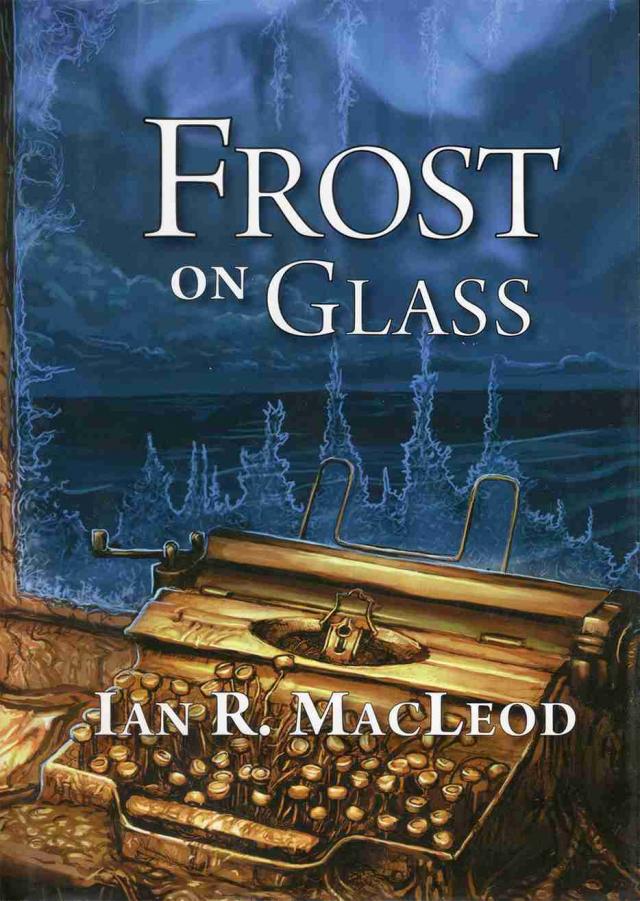
FROST
ON
GLASS
FROST ON GLASS Copyright © 2015 Ian R. MacLeod
COVER ART Copyright © 2015 Jethro Lentle
The right of Ian R. MacLeod to be identified as Author of
this Work has been asserted by him in accordance with
the Copyright, Designs and Patents Act 1988.
Published in July 2015 by PS Publishing Ltd. by
arrangement with the author. All rights reserved by the author.
FIRST EDITION
ISBN
978-1-84863-888-4
978-1-84863-889-1 (Signed Edition)
This book is a work of fiction. Names, characters, places
and incidents either are products of the authors imagination
or are used fictitiously. Any resemblance to actual events
or locales or persons, living or dead, is entirely coincidental.
Story credits appear at the end of the book.
Design and layout by Alligator Tree Graphics.
Printed and bound in England by T.J. International.
PS Publishing Ltd
Grosvenor House
1 New Road
Hornsea, HU18 1PG
England
editor@pspublishing.co.uk
www.pspublishing.co.uk
CONTENTS
INTRODUCTION DON’T LOOK BACK
FICTION
THE DISCOVERED COUNTRY
AFTERWORD: SILVER MACHINES
HECTOR DOUGLAS MAKES A SALE
AFTERWORD: A CUL-DE-SAC IN LOS ANGELES
NON-FICTION
FOREWORD: DIFFERENT WARTS AND ALL
A TRUNCATED LIFE IN BOOKS
THE COLD STEP BEYOND
AFTERWORD: THE FUTURE ISN’T REAL
A CONCISE AND READY GUIDE
AFTERWORD: BLOODY DRAGONS
AN EMPTY GREY CELL OF ONE’S OWN
RE-CROSSING THE STYX
AFTERWORD: ON BEING DARK
SAD SONGS, WITH LOTS OF DRUMMING
THE TRAVELLER AND THE BOOK
AFTERWORD: ON WRITING RUBBISH
I’VE GOT THIS IDEA FOR A STORY . . .
THE CRANE METHOD
AFTERWORD: REJECTION
THE DECLINE OF THE ENGLISH GHOST STORY
LETTER TO WILL
AFTERWORD: THOSE WHO CAN’T . . .
ME AND THE MUSHROOM CLOUD
TUMBLING NANCY
AFTERWORD: OTHER WRITERS
FROST ON GLASS
AFTERWORD: WRITER’S BLOCK
ENTANGLED
AFTERWORD: VOLCANOES AND DINOSAURS
INTRODUCTION DON’T LOOK BACK
YOU should never lookback; especially when it comes to short stories.
They re like flings or affairs rather than the marriages of novels, and it’s all too easy to get drawn away from the road ahead by picking over old joys, regrets and what-might-have-beens. Still, any collection such as this cannot help but cast a glance over its shoulder, and I, both as a reader and a writer, have an abiding interest in how fiction is written—something I intend to explore in this book.
Writing is at least as much a craft as it is an art, and one of the things I aim to do in these pages is to offer some insight into how various aspects of my stories came about. I’ve written a long new story, “Frost on Glass,” which gives this collection its name and is itself about writing, and the frustrations of trying to master and control something so evanescent, along with a substantial new essay “I’ve Got This Idea For a Story . . .” which is both an examination and a spirited defence of that most fundamental and tricky of writerly subjects. I’ve also included various other non-fiction pieces I’ve written here and there over the years, which touch in one way or another on the process of writing.
As for the stories, and despite all the things I say about them, I hope that they speak for themselves.
FROST
ON
GLASS
THE DISCOVERED COUNTRY
THE trees of Farside are incredible. Fireash and oak. Greenbloom and maple. Shot through with every colour of autumn as late afternoon sunlight blazes over the Seven Mountains’ white peaks. He’d never seen such beauty as this when he was alive.
The virtual Bentley takes the bridge over the next gorge at a tyrescream, then speeds on through crimson and gold. Another few miles, and he’s following the coastal road beside the Westering Ocean. The sands are burnished, the rocks silver-threaded. Every new vista a fabulous creation. Then ahead, just as purple glower sweeps in from his rear-view over those dragon-haunted mountains, come the silhouette lights of a vast castle, high up on a ridge. It’s the only habitation he’s seen in hours.
This has to be it.
Northover lets the rise of the hill pull at the Bentley’s impetus as its headlights sweep the driveway trees. Another turn, another glimpse of a headland, and there’s Elsinore again, rising dark and sheer.
He tries to refuse the offer to carry his luggage made by the neat little creature that emerges into the lamplit courtyard to greet him with clipboard, sharp shoes and lemony smile. He’s encountered many chimeras by now. The shop assistants, the street cleaners, the crew on the steamer ferry that brought him here. All substantially humanoid, and invariably polite, although amended as necessary to perform their tasks, and far stranger to his mind than the truly dead.
He follows a stairway up through rough-hewn stone. The thing’s name is Kasaya. Ah, now. The east wing. I think you’ll find what we have here more than adequate. If not . . . Well, you must promise to let me know. And this is called the Willow Room. And do enjoy your stay . . .
Northover wanders. North over touches. Northover breathes. The interior of this large high-ceilinged suite with its crackling applewood fire and narrow, deep-set windows is done out in an elegantly understated arts- and-craftsy style. Amongst her many attributes; Thea Lorentz always did have excellent taste.
What’s struck him most about Farside since he jerked into new existence; on the bed in the cabin of that ship bound for New Erin; is how unremittingly real everything seems. But the slick feel of this patterned silk bedthrow . . . The spiky roughness of the teasels in the flower display . . . He’s given up telling himself that everything he’s experiencing is just some clever construct. The thing about it; the thing that makes it all so impossibly overwhelming; is that he’s here as well. Dead; but alive. The evidence of his corpse doubtless already incinerated; but his consciousness—the singularity of his existence, what philosophers once called “the conscious I”, and theologians the soul, along with his memories and personality the whole sense of self which had once inhabited pale jelly in his skull—transferred.
The bathroom is no surprise to him now. The dead do so many things the living do, so why not piss and shit as well? He strips and stands in the shower’s warm blaze. He soaps, rinses. Reminds himself of what he must do, and say. He’d been warned that he’d soon become attracted to the blatant glories this world, along with the new, young man’s body he now inhabits. Better just to accept rather than fight. All that matters is that he holds to the core of his resolve.
He towels himself dry. He slips on his watch—seemingly a Rolex, but a steel model, neatly unostentatious—and winds it carefully. He dresses. Hangs up his clothes in a walnut panelled wardrobe that smells faintly of mothballs, and hears a knock at the door just as he slides his case beneath the bed.
“Yes? Come in . . .”
When he turns, he’s expecting another chimera servant. But it’s Thea Lorentz.
This, too, is something they’d tried to prepare him for. But encountering her after so long is much less of a shock than he’s been expecting. Thea’s image is as ubiquitous as that of Marilyn Munroe or the Virgin Mary back on Lifeside, and she really hasn’t changed. She’s dressed in a loose-fitting shirt. Loafers and slacks. Hair tied back. No obvious evidence of any makeup. But the crisp white shirt with its rolled up cuffs shows her dark brown skin to p erfection, and one loose strand of her tied back hair plays teasingly at her sculpted neck. A tangle of silver bracelets slide on her wrist as she steps forward to embrace him. Her breasts are unbound and she still smells warmly of the patchouli she always used to favour. Everything about her feels exactly the same. But why not? After all, she was already perfect when she was alive.
“Well . . .!” That warm blaze is still in her eyes, as well. “It really is you.”
“I know I’m springing a huge surprise. Just turning up from out of nowhere like this.”
“I can take these kind of surprises any day! And I hear it’s only been—what?—less than a week since you transferred. Everything must still feel so very strange to you.”
It went without saying that his and Thea’s existences had headed off in different directions back on Lifeside. She, of course, had already been well on her way toward some or other kind of immortality when they’d lost touch. And he . . . Well, it was just one of those stupid lucky breaks. A short, ironic keyboard riff he’d written to help promote some old online performance thing—no, no, it was nothing she’d been involved in—had ended up being picked up many years later as the standard message-send fail signal on the global net. Yeah, that was the one. Of course, Thea knew it. Everyone, once they thought about it for a moment, did.
“You know, Jon,” she says, her voice more measured now, “you’re the one person I thought would never choose to make this decision. None of us can pretend that being Farside isn’t a position of immense privilege, when most of the living cant afford food, shelter, good health. You always were a man of principle, and I sometimes thought you’d just fallen to . . . Well, the same place that most performers fall to, I suppose, which is no particular place at all. I even considered trying to find you and get in touch, offer you . . .” She gestures around her. “Well, this. But you wouldn’t have taken it, would you? Not on those terms.”
He shakes his head. In so many ways she still has him right. He detested—no, he quietly reminds himself—detests everything about this vast vampiric sham of a world that sucks life, hope and power from the living. But she hadn’t come to him, either, had she? Hadn’t offered what she now so casually calls this. For all her fame, for all her good works, for all the aid funds she sponsors and the good causes she promotes, Thea Lorentz and the rest of the dead have made no effort to extend their constituency beyond the very rich, and almost certainly never will. After all, why should they? Would the gods invite the merely mortal to join them on Mount Olympus?
She smiles and steps close to him again. Weighs both his hands in her own. “Most people I know, Jon—most of those I have to meet and talk to and deal with, and even those I have to call friends—they all think that I’m Thea Lorentz. Both Farside and Lifeside, it’s long been the same. But only you and a few very others really know who I am. You can’t imagine how precious and important it is to have you here . . .”
He stands gazing at the door after she’s left. Willing everything to dissolve, fade, crash, melt. But nothing changes. He’s still dead. He’s still standing here in this Farside room. Can still even breathe the faint patchouli of Thea’s scent. He finishes dressing—a tie, a jacket, the same supple leather shoes he arrived in—and heads out into the corridor.
Elsinore really is big—and resolutely, heavily, emphatically, the ancient building it wishes to be. Cold gusts pass along its corridors. Heavy doors groan and creak. Of course, the delights of Farside are near-infinite. He’s passed through forests of mist and silver. Seen the vast, miles-wide back of some great island of a seabeast drift past when he was still out at sea. The dead can grow wings, sprout gills, spread roots into the soil and raise their arms and become trees. All these things are not only possible, but visibly virtually achievably real. But he thinks they still hanker after life, and all the things of life the living, for all their disadvantages, possess.
He passes many fine-looking paintings as he descends the stairs. They have a Pre-Raphaelite feel and, from the little he knows of art, seem finely executed, but he doesn’t recognise any of them. Have these been created by virtual hands, in some virtual workshop, or have they simply sprung into existence? And what would happen if he took that sword which also hangs on display, and slashed it through a canvas? Would the painting be gone forever? Almost certainly not. One thing he knows for sure about Farside’s vast database is that it’s endlessly backed up, scattered, diffused and re-collated across many secure and heavily armed vaults back in what’s left of the world of the living. There are very few guaranteed ways of permanently destroying anything, least of all the dead.
Farther down, there are holo-images, all done in stylish black and white. Somehow, even in a castle, they don’t look out of place. Thea, as always, looks like she’s stepped out of a fashion-shoot. The dying jungle suits her. As does this war-zone, and this flooded hospital, and this burnt-out shanty town. The kids, and it is mostly kids, who surround her with their pot bellies and missing limbs, somehow manage to absorb a little of her glamour. On these famous trips of hers back to view the suffering living, she makes an incredibly beautiful ghost.
Two big fires burn in Elsinore’s great hall, there’s a long banqueting table, and the heads of many real and mythic creatures loom upon the walls. Basilisk, boar, unicorn . . . Hardly noticing the chimera servant who rakes his chair out for him, Northover sits down. Thea’s space at the top of the table is still empty.
In this Valhalla where the lucky, eternal dead feast forever, what strikes Northover most strongly is the sight of Sam Bartleby sitting beside Thea’s vacant chair. Not that he doesn’t know that the man has been part of what’s termed Thea Lorentz’s inner circle for more than a decade. But, even when they were all still alive and working together on Bard On Wheels, he’d never been able to understand why she put up with him. Of course, Bartleby made his fortune with those ridiculous action virtuals, but the producers deepened his voice so much, and enhanced his body so ridiculously that it was a wonder to Northover they bothered to use him at all. Now, though, he’s chosen to bulk himself out and cut his hair in a Roman fringe. He senses Northover’s gaze, raises his glass and gives an ironic nod. He still has the self-regarding manner of someone who thinks himself far better looking and cleverer than he actually is.
Few of the dead, though, choose to be beautiful. Most elect for the look that expresses themselves at what they thought of as the most fruitful and self-expressive period of their lives. Amongst people this wealthy, this often equates to late middle age. The fat, the bald, the matronly and the downright ugly rub shoulders, secure in the knowledge that they can become young and beautiful whenever they wish.
“So? What are you here for?”
The woman beside him already seems flushed from the wine, and has a homely face and a dimpled smile, although she sports pointed teeth, elfin ears and her eyes are cattish slits.
“For?”
“Name’s Wilhelmina Howard. People just call me Will . . .” She offers him a claw-nailed hand to shake. “Made my money doing windfarm recycling in the non-federal states. All that lovely superconductor and copper we need right here to keep our power supplies as they should be. Not that we ever had much of a presence in England, which I’m guessing is where you were from . . .?”
He gives a guarded nod.
“But isn’t it just so great to be here at Elsinore? Such a privilege. Theas everything people say she is, isn’t she, and then a whole lot more as well? Such compassion, and all the marvellous things she’s done! Still, I know she’s invited me here because she wants to get hold of some of my money. Give back a little of what we’ve taken an all. Not that I won’t give. That’s for sure. Those poor souls back on Lifeside. We really have to do something, don’t we, all of us . . .?”
“To be honest, I’m here because I used to work with Thea. Back when we were both alive.”
“So, does that make you an actor?” Wilhelmina is looking at him more closely now. Her slit pupils have widened. “Should I recognise you? Were you in any of the famous—”