

Childe 08 the chantry.., p.1
Regency Miss, page 1


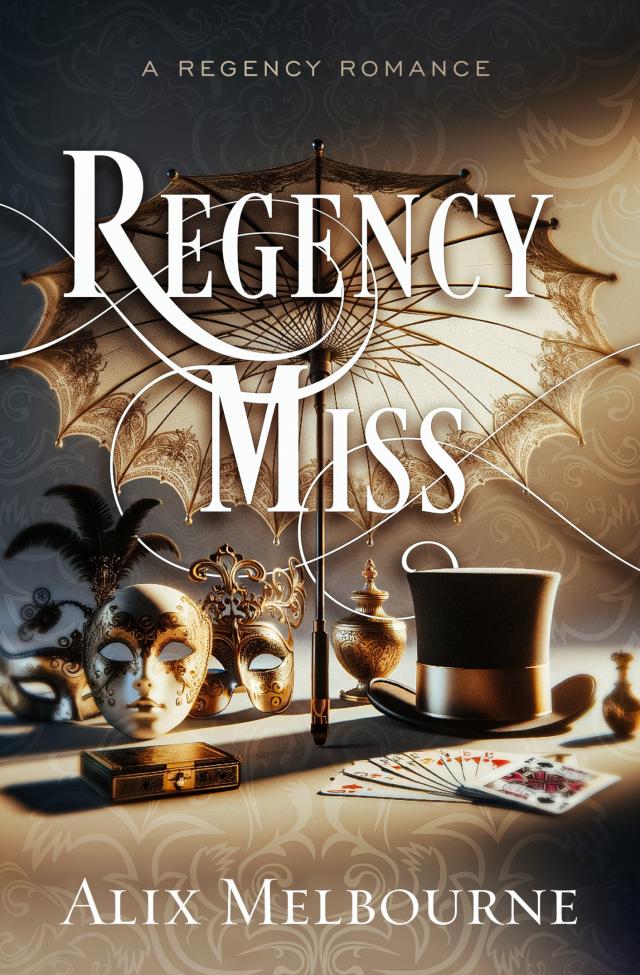
Regency Miss
A Regency Novel
Alix Melbourne
For Christine, Betsy, Nancy, and Thais
Prologue
1806–The Man in the Inn
He had been drinking since the afternoon, but the oblivion he sought eluded him. He was drunk, but he could not forget the events of the morning, the sight of his friend’s body on the dueling ground.
All he had left of him now was the heavy ring, with its rough uncut emerald; nothing else remained of the young rakehell who had laughed and drunk with him since they had been boys…. And the man who had killed him had been a friend as well. Now he was gone to take the first boat to America, possibly never to see England again.
He rubbed the ring mechanically and drained the last bottle. He sat in a daze, not thinking, not feeling—perhaps the wine was taking effect at last. He let the fire die down to a few embers, and was soothed by the darkness in the room.
At first he could not make out what the noise was, or where it came from, but then it occurred to him that it was someone tapping very lightly on the door.
“Come in, although what you can want at this time of night, I can’t imagine.”
The door opened, and a figure wrapped in a hooded cape could be seen in the dim light.
“I don’t require anything more.”
“I am not a servant, sir.” It was a female voice. A young lady who was annoyed at being taken for a servant, he guessed.
“And who the devil are then, then?”
“That is none of your concern. I have come to ask a favor of you, but there is no need for you to know my name.”
She moved closer to the dim light of the fire. She seemed very young.
“I do not grant favors to those I am not acquainted with, as a rule. But you may ask.”
“I wish you to make love to me,” she said as calmly as if she were asking directions to Brighton.
He laughed harshly. “You sound too young to even know what that means. I have no taste for children. Why should I do such a thing?”
“Again, I do not wish to be ill-mannered, but it is no concern of yours. It can make little difference to a man who paid the chambermaid to sleep in his bed last night—tonight you will not have to pay. And I am not as young as I seem.”
“I do not find virgins of great interest,” he drawled. “And even less the seducing of a lady of quality, which your voice reveals you to be. What of your family?”
Her voice was very cold. “Doubtless you will think yourself preferable to the ostler downstairs.”
“So it’s come to that—myself or an ostler,” he murmured, almost smiling. The wine was clouding his brain, but he knew that he should tell her to leave. However, the girl knew what she was dealing with, and came closer still. She opened her cloak, revealing a gown that concealed very little.
He tried again, knowing his resolve was slipping as he imagined her body under his. “You do not really wish me to do this. Once done it cannot be undone, and I doubt you will enjoy it overmuch the first time.”
She was annoyed by his speech. “I know rather more than you may imagine. You are my only opportunity; I must make the best of it. Do not make me go down to that foul-smelling boy.” This was said in the tone of a governess dealing with a rather unsatisfactory pupil.
This speech and her calmness provoked him, and he was driven to call her bluff. He stretched out his hand and placed it firmly on the curve of her breast. She did not move at all, but he could feel that her breathing had quickened.
“Well, then,” he said consideringly, “I will do as a gentleman should, and give the lady what must please her.”
She turned and smothered the remaining coals under the ashes.
“I do not wish you to see me,” she explained.
“That is not what interests me,” he said, pulling her to him. In the pale moonlight he saw that she would not turn her face to him.
“You must be brave,” he said, lifting her chin.
“I am.”
“Kiss me then, or am I to teach you that as well?”
Stung, she kissed him as expertly as she knew how.
The kiss changed matters for him, and he drew her to the bed and lay her down on it. She said nothing as he took off her cloak and then her gown. When he took his place beside her, he felt her body stiffen.
“I have made a mistake …” she whispered.
He did not answer, but kissed the hollow of her neck tenderly. She tried to push him away.
“Can you not see that it is already too late?” he said gently, smoothing her hair back from her face.
She rose from the bed five hours later and searched for her clothes in the darkened room. He heard her, and without opening his eyes, asked sleepily, “Why did you do this?”
She stood at the door, wrapped again in the cloak.
“Because I did not wish to be like the other women of my class: a virgin before marriage and a whore afterwards.”
With that she left him.
One
September 1813
1: A Rash Action
The letter from London had come at precisely the moment that Alicia Tierney was desperately trying to find a way to leave Tierney Chase. In the letter, an unknown solicitor, one Alexander St. Clair, had requested an interview with the only daughter of Isabel Latham Tierney, on a matter of extreme importance. Alicia had no idea of what this matter could be, or why her mother, who had been dead for twelve years, should be mentioned; but she had every intention of finding out. She had planned to order some suitable clothes, since she had none, write her godmother, Lady Mary, and leave for London in a month. But a nasty quarrel with her brother and sister-in-law made her lose her temper and decide to leave hastily and without preparation.
Her brother William had come to live at Tierney Chase after their father had died, and had brought with him his wife, Amelia, a delicate blonde who had disliked Alicia immediately. Alicia, long used to running the estate for her father, was forced to calmly accept the manner in which her brother and Amelia made her feel that she was a burden to them. But it was not until she rejected the hand of James Lanyon that a serious quarrel developed. Her brother warned her that she would never do better. James was wealthy and kind. He had dangled after her for years. Alicia agreed that he was all those things, but that she had not the slightest desire to marry him.
“I am past twenty-one, William, and I shall not brook your interference in my affairs!”
He turned a choleric red. “As long as you are under my roof—” Alicia, white with anger, did not stay to hear the rest of his tirade. The letter was in her pocket, and she had an excuse to go to London. She would sell the few jewels she had if Lady Mary would not house her, but she would go.
Her maid, Jellicoe, who had known her since her birth, tried to remonstrate.
“Do not pretend you wish to stay, Jelly! They have been worse to you than to me….
“Red-haired temper, that’s what it is,” muttered Jellicoe.
“I am twenty-five, not twelve, and I am leaving. When my father was alive, this place meant something to me, but now it is no home to me at all. You may stay if you wish.”
Seeing that Alicia would not even discuss this rash action, never mind change her decision, Jellicoe gave in and went to find a coachman. No one from the estate could be expected to drive them, and it took her the rest of the afternoon to find someone who would agree to the journey. She returned with the news that the blacksmith’s son, Jim Taylor was willing. He was to have gone to London in a week’s time to visit his uncle.
“Of course, I could have driven,” Alicia said innocently. “Cousin Freddy taught me, you know.”
Jellicoe stiffened. “Don’t be thinking of it, Alicia! What’s allowed on country roads isn’t seemly on the turnpikes. You’d get some nice treatment from the ostlers, I’ll be bound.”
Alicia started to laugh. “Jelly, you didn’t think I was serious!”
“Any young woman who would go off to London without a full day’s notice, would count on imposing on a great lady without even sending a letter ahead—”
“Is capable of driving her own coach. Yes, yes, I daresay you are right.”
The next morning the chaise, which had been surreptitiously loaded the night before, was waiting in the woods near the main road. Alicia found that she was unprepared for her feelings as she looked back at the house in which she had spent her life. Jellicoe unabashedly shed a few tears.
“No, no, Jelly, don’t cry. Life will be exciting. No more Amelia, no more William. You’ll see, we’ll be happier than we’ve been in years!” Alicia wondered why her own words sounded so unconvincing.
Several hours later, Alicia was forced to admit that things were hardly promising.
“I do hope we won’t have an accident. The boy is very young,” Jellicoe had been fretting since the rain had started. The combination of the rain, the young driver, and the bumpy road had made her anxious.
“We won’t have an accident. Jim is very good. You will feel better when we stop, which should be soon.” Alicia said this with a cheerfulness she was far from feeling. It had been raining since they left Lincolnshire, and the muddy roads had slowed them down. Now they were outside of Bedford, and she had hoped they might reach London late that night. But now it seemed that they would have to spend the night in an inn. The money she had in her possession was just enough to pay for the changes of horses and one night in an inn. But if there were some accident, some unforeseen contingency, she would be
It was with relief that Alicia heard Jim Taylor call out that they were stopping at the next inn. Jim had never been away from Grantham, but he found the best inn in Bedford for them.
The Bridge was an imposing edifice, and the innkeeper’s wife greeted them warmly. There was roast beef and mutton for dinner, news which cheered them greatly.
The room to which Alicia was led was both comfortable and elegant. The mahogany bed with the painted cornice and dainty curtains promised a good night’s sleep. Examining the blue Staffordshire jug and basin and the sash windows, which had both blinds and curtains, Alicia felt she could happily stay in this room forever.
When it was time to go down to the private dining room, Jellicoe announced that she was too tired to get dressed again—she would have a tray brought up to her room. Alicia had no objections to this, she had wished to be alone after the enforced sociability in the chaise.
The dinner she was served seemed wonderful. She was brought beef, fruit pie, and Cheshire cheese. Only after she had satisfied her hunger did she take the trouble to examine the other diners.
Two officers, who had obviously been drinking for some time, sat in the near corner, and two gentlemen, whose clothes, even from a distance proclaimed London, sat in the far corner, reading newspapers.
As Alicia was finishing her cheese, she heard the officers quarrelling and cursing loud enough for her to hear. The younger one said that the other should not speak so in the presence of a lady. The second officer turned and looked in Alicia’s direction.
“But perhaps she is no lady at all: let us discover the truth of the matter.”
He approached Alicia’s table.
“Do continue eating, madam. I merely wish to see if you are a drab or a duchess.”
“Whether I am a lady or not can be no concern of yours, but it is clear that you are no gentleman.”
The officer disliked her answer and was moved to assert himself. He wrenched her out of her chair, and bent her arm behind her back. She was about to kick him when she felt herself suddenly freed. The soldier and one of the men from the other table exchanged blows. But his opponent proved to be unusually adept with his fists, and the soldier was quickly floored.
Her rescuer returned to his table without so much as a glance in her direction and began to read his paper again. His former companion had left, probably just prior to the fight. Despite his forbidding air, she resolved to thank him. She made her way past the officer, whose friend was reviving him, and approached the gentleman’s table.
“Excuse me, sir, but I must thank you for saving me from an unpleasant situation,” she said with a charming smile.
But her display of good manners did not even cause the man to look up from his paper.
“I have always had a horror of being a hero in scenes,” he said languidly, “and a greater antipathy to ladies in distress. Please say no more about it. You are quite welcome.” Observing for the first time his starched linen neckcloth, rigidly perfect in its arrangement, the spotless blue coat with its creaseless fit, and the shining Hessian boots, it dawned on Alicia that this man must be a member of the dandy set. This no doubt explained his foppish air and dislike of gratitude. She was about to walk away, but then stopped.
“Of course,” she said with a little laugh, “it was very silly of me to thank you. You can have no need of the world’s approval when your own opinion of yourself is so high.” She smiled gaily and had the satisfaction of seeing him look up at last. He appeared disconcerted, but only for a moment. His face was not as remarkable as his height; he had clear gray eyes which were rendered more intense by what seemed permanently tanned skin—he had been in a southern climate, perhaps—but the mouth was proud, the smile mocking. He looked to be about thirty-five, and as if he had never done a day’s labor, despite his physique. She continued to regard him with the air of a visitor to an animal menagerie until he spoke.
“There was something else you wished to say, Miss—”
“Tierney. Yes. I wished to inform you that you may find me at my godmother’s, Lady Terbury, 12 Grosvenor Square, London; I will be glad to replace your waistcoat, which is clearly important to you. Since it is my fault, I feel it is the least I can do to—express my gratitude.”
Her emphasis on the last word was ironic, and the ghost of a smile could be seen in the gentleman’s eyes as he inclined his head, as if dismissing her.
He had undoubtedly been surprised at the address, Alicia thought. Later, as she undressed, she had to admit that she could not have looked very elegant in these old black things. If he could judge her by her clothes, she could do the same. He was a dandy—what her father had always called a tailor’s dummy, a clothes-wearing man. Alicia had better reasons to be prejudiced against the dandies as a group. Their influence on the young men of her acquaintance had been pernicious. The true dandy might be elegant, controlled, lucid, and, above all, refined; but the young men of Grantham admired their other qualities of pride and indifference to emotion. Style was considered more important than ambition or passion; both romantics and merchants were to be despised, and politicians were not even to be mentioned.
Her rescuer’s insulting indifference, his assumption of superiority, conformed exactly to Alicia’s conception of dandy behavior. She could laugh at his pretensions, but she dearly hoped that this was not a foretaste of London society.
The next day was sunny and clear, and Alicia arose in the best of moods, remembering that she would not have to see either her brother or his wife. She was having her coffee when Jellicoe burst in with the news that Jim had taken sick.
“What exactly is wrong with him?”
“Something he ate, or drank. Perhaps a kind of influenza. He feels weak and he could not keep his breakfast down. Could have been the mutton. Smelled odd to me. I told him—”
“All right, I shall go and see him. You try and see if there is anyone else to drive the coach.”
Alicia saw that Jim was too weak to drive, but she did not think there was anything seriously wrong with him. It had most likely been something in the food.
When Jelly returned with the information that every man who could drive had already been engaged, Alicia made up her mind. The sight of Jim’s coat on his chair had given her an idea. She would wear the long coat and the conical coachman’s hat and would drive them the rest of the way herself. She was tall, she could disguise her voice, her hair was already cropped, and the hat would cover it anyway. All that was needed was a pair of boots, and Jelly could purchase them for her.
The scene Jellicoe made at this suggestion was brief but intense. Having no other choice, she finally agreed, but she warned darkly that Alicia would be quite ruined if anyone were ever to hear of it
“No one would believe it,” said Alicia. “I have always been just what a young lady should be. And I am tired of it—bored to death, in fact.”
They finally left the inn before noon, with Jim driving until they were a mile or so out of sight. Alicia, who was already wearing pantaloons and a shirt under her dress and cloak, changed places with him. Jim said she looked like a proper coachman and settled in beside Jellicoe, who was fearfully afraid she would contract what she persisted in referring to as his “disease.”
Alicia took the reins and started the horses. After ten minutes, she decided that she had missed her calling: surely a coachman was the happiest of men! She felt an increasing sense of exhilaration as she felt the wind against her face, and the painful memories of her father’s death and her last months in the house she had loved were softened. There was life beyond Grantham, and now she was part of it—part of the landscape with the neat white fenced cottages, the beautifully enclosed estates, the striking church spires.
They had made good time and stopped only to change horses. They were less than an hour from London when Jellicoe decided she was coming down with the “disease.” Alicia knew that the lunch basket was empty and realized that Jellicoe must simply be hungry. She stopped at the nearest tavern and went inside to get some sandwiches and tea for her two passengers.
The woman behind the counter was very friendly. She would have a hamper sent out to the chaise while the young gentleman had a drink in the front parlor, if he wished. This idea immediately attracted Alicia. She knew it was risky, but her curiosity was strong. What were men like when they drank together, without their wives or sweethearts? She nodded to the counterwoman and went in.


