

Lady violet attends a we.., p.1
Lady Violet Attends a Wedding, page 1


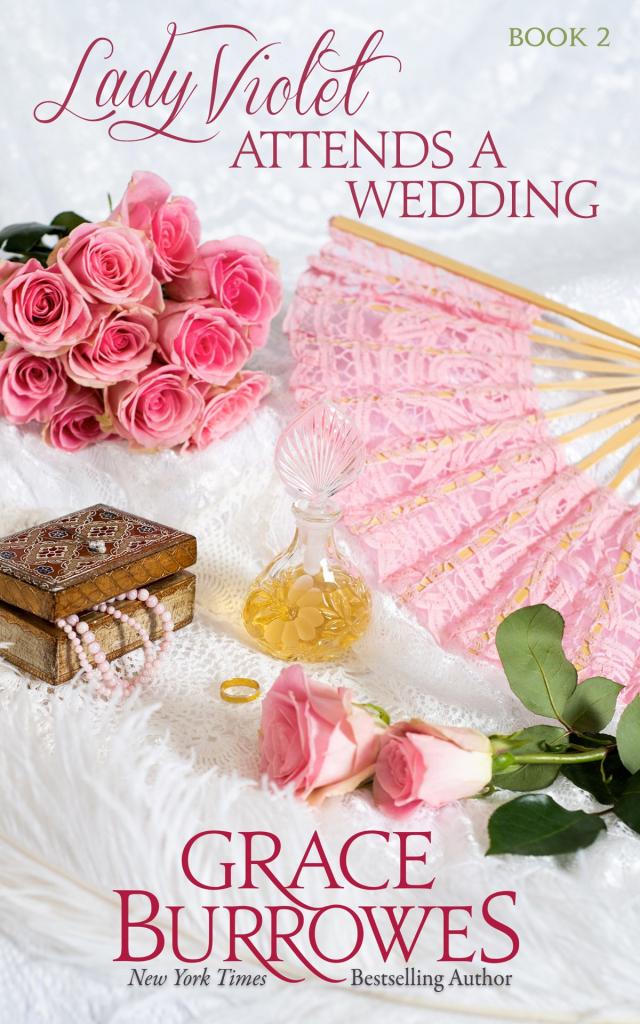
Lady Violet Attends a Wedding
The Lady Violet Mysteries—Book Two
Grace Burrowes
Grace Burrowes Publishing
Lady Violet Attends a Wedding
Copyright © 2021 by Grace Burrowes
All rights reserved.
No part of this book may be reproduced in any form or by any electronic or mechanical means, including information storage and retrieval systems, without written permission from the author, except for the use of brief quotations in a book review.
If you uploaded this book to, or downloaded it from, any free file sharing, torrent, or other pirate site, you did so in violation of copyright laws and against the author’s express wishes.
Please don’t be a pirate.
* * *
Cover design: Wax Creative, Inc.
Cover photo: Cracked Light Studio
Contents
Dedication
Chapter 1
Chapter 2
Chapter 3
Chapter 4
Chapter 5
Chapter 6
Chapter 7
Chapter 8
Chapter 9
Chapter 10
Chapter 11
Chapter 12
Chapter 13
To my dear readers
Lady Violet Finds a Bridegroom—Excerpt
Dedication
This series is dedicated to my nephew, Jackson.
Chapter One
The best way to get to know a man is not to share a bed with him, but rather, to share a coach with him in the middle of a deluge on what is euphemistically referred to as the King’s highway.
This experience befell me en route to my brother Felix’s wedding. My escort on the journey was Monsieur Hugh St. Sevier, a skilled physician and the most cordial of men under most circumstances. He sat across from me, his Gallic charm having been jettisoned within an hour of leaving London.
“My lady, in all the vast reaches of the great, untamed wilds of the English language, I could not find profanity sufficiently vile or voluminous to describe my contempt for His Majesty’s roads.”
St. Sevier, though heir to a French title, had spent many years in England. His accent thickened as his normally gracious manner eroded. At present, that accent was the consistency of the mud miring the wheels of my traveling coach.
“My contempt is reserved for the English weather,” I replied, tightening my grip on the leather strap dangling from the ceiling. “I have never seen rain like this.”
We’d left London amid a mere downpour, but as the day had advanced, the downpour had intensified, at times creating such a thunderous roar on the coach roof as to render conversation impossible. We had changed teams frequently, for the going was bad enough to tire the stoutest of equines.
“We should find an inn,” St. Sevier said. “We must find an inn before one of the horses is lamed by this mud and we are stranded by the side of the road.”
He’d assayed that opinion previously, and every other sensible traveler was likely of the same mind. The inns would thus offer nothing but a stinking, clammy trial to the nerves in a crowded common, even for me, an earl’s daughter and a widow of means.
I dealt with crowds even less graciously than St. Sevier was dealing with the weather.
“We must press on,” I said, trying for a cajoling tone. “We are less than ten miles from Derwent Hall, and my family is expecting us. If I fail to arrive as scheduled, they will fret, and when my family frets, the peace of the realm is at risk.”
I was the youngest of five siblings, which was all well and good, but the other four offspring of the Earl of Derwent were male, each one louder and more opinionated than the one before. Felix, the youngest of the brothers, was only the second to marry. My oldest brother, Mitchell, Viscount Ellersby, had been married for more than five years.
Mitchell had yet to sire a son, and Papa was agitating for more grandchildren, of course. Until his sons presented him with grandsons—note the plural—he would not consider the earldom’s succession secure.
The coach lurched, and St. Sevier began cursing in a river of low, inventive French.
“Violet, my esteem for you is without limit, but this journey has become a nightmare. We must stop at the next opportunity.”
The carriage righted itself, and I breathed a sigh of relief. I loved my traveling coach, from the heavily padded benches to the clever compartments designed to hold food and drink. The lamps were exquisite, the leather sumptuous. The floor held a compartment for heated bricks, and the lap robes were soft merino wool dyed to match the chocolaty leather.
I had good memories of traveling in this coach with my late husband. Good, married memories, for the two benches cleverly folded out to create what amounted to a bed. Freddie Belmaine had believed in getting comfortable before we’d passed the first tollgate out of London, though even he would have been hard-pressed to manage connubial joy amid the jouncing I endured with St. Sevier.
“We will be on Derwent land soon,” I said. “When the terrain is less hilly, the road will improve.”
St. Sevier had tended the wounded on battlefields all over the Continent, and I’d seen him face down Society gossips with only an elegantly raised eyebrow. He was an attractive man, chestnut-haired, brown-eyed, suave, and soft-spoken.
Sitting across from me in the coach, he looked as if he’d been dragged through a hedge backward by drunken demons under a witch’s moon.
“You English,” he said, in tones that were less than respectful of his host country. “You cannot build a road to save yourself. The Romans, using donkeys and common sense, built roads that yet endure. You are still using the roads they left you nearly fifteen hundred years ago. But depart from the Roman roads, and your country is reduced to traveling cart tracks that no civilized—Dieu nous préserve!”
This time, the coach did not immediately right itself, but sat at an awkward angle, the back end of the vehicle slanting downward most alarmingly. Shouting and whinnying sounded above the pounding of the rain. A whip cracked, and the coach heaved back upright.
“Violet, we are being foolish,” St. Sevier said. “I did not survive years at war to lose my life in some English ditch.”
“St. Sevier, I know you can swim.” As could I, thanks to an inadequately supervised country upbringing, but what good would those skills do us if our coach were to fall into any of the rivers rising so quickly beneath the many venerable bridges we had to traverse?
“We stop at the next inn, Violet,” St. Sevier said, his expression grim. “As the escort whom you requested to accompany you on this journey, I am making that decision, and you will not argue with me.”
“I have long suspected that steel lies beneath your fine manners and bons mots.”
“Not steel, my lady, a fervent wish to live to see the dawn.”
We said nothing for the next several miles, and I began to hope that we’d reach Derwent Hall in one somewhat bruised and bedraggled piece. My coachman was a tough old Scot who also apparently sought to live to see the dawn, for he took no risks, letting the horses slog along as best they could without foolish displays of speed even when the going was somewhat better.
“We’ll be there soon,” I said as we clattered out of the village that served my father’s estate. The gaggle of buildings arranged around a now-sodden green had fascinated me as a child. I’d watched the smith at his forge and fancied him Vulcan in the underworld. The apothecary and lending library had been full of adult women speaking in half-humorous code about odd ailments and troubled marriages.
What would they have said about my union with Freddie Belmaine?
“You truly did grow up in the country, didn’t you?” St. Sevier asked, peering at the damp green world beyond the windows.
“I miss it.” I’d reached that conclusion some weeks earlier, at a house party I hadn’t particularly wanted to attend. I’d found myself stealing away with a book to this or that quiet meadow or pretty garden path. “I’ve been thinking of leaving London.”
St. Sevier left off scowling at the wet countryside. “Leaving London for where?”
I considered him a friend and strongly suspected he was willing to be more than a friend. “Would you miss me?”
“I’d visit you, assuming I was welcome, and assuming all of England does not wash into the ocean in the next twenty-four hours.”
I’d visit you. He did not specify in what capacity, and I did not press the matter. As a physician, Hugh had advised me to get out of London for the duration of that house party, and his guidance had been sound. I’d come home a stronger, less anxious person.
Had I come back happier? “I’m not sure where I’d go,” I said, “but I miss fresh air and true quiet. London is never quiet.” Nor did London ever smell even faintly alluring, much less fresh.
My emotions put me in mind of the stream running beside the road. I’d built my share of dams in that stream. The rains had swollen a placid little burn into a raging torrent surging well past its banks. The current sluicing by the coach was swift and roiling, with branches and debris bobbing wildly in muddy rapids.
That peaceful little country burn was dangerous now, and the restlessness I’d brought back to London with me felt equally untrustworthy.
“Not so long ago,” St. Sevier said, cocking his head, “you were reluctant to leave your house or put off your weeds. Now you propose to flee London altogether?”
“I’m not sure
“Your brother’s wedding will bring back difficult memories,” St. Sevier said. “I’m sorry for that.”
“Why must you be so perceptive?” I’d been a happy bride, also an ignorant one.
St. Sevier and I shared a smile, one of many that made me feel as if I could tell him anything, and he’d receive my confidences in a spirit of compassion and shared humanity. I liked Hugh so very much, and he was forthright about letting me know that he—
Several things happened in the same instant. A crack of thunder sounded as if God had dropped his fist on the very roof of our coach. Horses whinnied and iron-shod hooves thumped and scrabbled on the wet planks of the bridge. The coach lurched crazily, and a sharp snap accompanied an abrupt slide toward the water roiling beneath the bridge.
St. Sevier dove across the coach to grab for me as the door flew open. Then I was falling, with nothing to hold on to.
Two men were having a difference of opinion. The argument raged in French and English with a smattering of medical Latin. I perceived the altercation through a groggy haze of fatigue and pain.
My first thought was that I was having a megrim. They befell me often, and my maid, Lucy, could sometimes talk me into using a tot of the poppy if the discomfort became unbearable. The result was usually sleep, but also the substitution of one sort of pain—piercingly sharp, throbbing, and vile—for another sort—dull, heavy, foggy, thirsty, and also vile.
No megrim in my experience had left me without sight, though. My world was as black as a crypt at midnight, for all I was sure my eyes were open.
“Halloo,” I croaked, but what issued from my mouth was more like, “Haaa…” The arguing ceased, and heavy boots thumped closer to where I lay.
“I told you she would waken.” That was Hugh St. Sevier, sounding very French. “Violet, please do not try to sit up or move your bandages. You have suffered a blow to the head, among other tribulations, but you will come right in time.”
“Why you couldn’t tarry another day in London, I do not know,” another man said. “My nuptials will be remembered because the sister of the groom attended the ceremony sporting prodigy of a shiner. Say something, Violet.”
That order was given by my youngest brother, Felix, trying to sound annoyed, but instead coming off terrified.
“I can’t see,” I said, “and my head hurts.”
“Your head is swaddled in bandages,” Felix said. A weight sank into the bed. “St. Sevier pulled you from the river, but you were clobbered by a cow or a house or something caught up in the flood. You might well have broken your nose, according to your pet quack.”
“Monsieur is not a quack.”
Another weight settled on my other side. “Monsieur,” St. Sevier said, “is most unhappy. Not only have you suffered a blow, you got a soaking and took a bad chill. We must add a possible lung fever to the conditions I’ll be treating you for.”
St. Sevier grasped my wrist, his touch warm but clinical.
“You got a soaking, too, then, if you rescued me,” I said, though I recalled none of this. I remembered a painfully loud crack of thunder and not much else.
“You had made it nearly to the bank when a branch came along and dashed you in the head. You do indeed have a prodigious black eye. I barely got my boots wet.”
St. Sevier, like most men of my acquaintance, would treasure his custom-made tall boots.
“Thank you,” I said, “for getting your boots wet. When can the bandages come off?”
Felix scooted around on the bed, making me bounce about. “Katie said we should leave them on until your bruises fade. You’re a bit banged up, Vi.”
That likely meant I was horribly and permanently disfigured, about which I should probably be upset. I wasn’t vain, mostly because I wasn’t particularly pretty, but neither was I a crone. Freddie had once called me “remarkably unremarkable”—medium height, brown hair, blue eyes. I was nicely curved rather than generously endowed, I played the pianoforte passably, and my French was serviceable.
I could not in that moment muster any concern for my damaged appearance or for much of anything.
“St. Sevier, did you dose me with the poppy?”
“I did not, nor will I allow anybody else to. For head injuries, opium is unwise.”
Any of my other brothers might have argued, but Felix had seen combat and thus knew more about serious injury than our siblings did.
“I’m sleepy,” I said.
St. Sevier patted my knuckles. “Then you should rest, but we will wake you regularly to ensure you do not pass into a coma.”
“It would not do,” Felix said, leaving the bed, “to detract from Katie’s special day by requiring the guests to attend a funeral immediately after the wedding. See that you recover, Vi.”
He kissed my cheek, or I surmised it was he, based on the slightly horsey scent that accompanied the kiss.
“I will do my best.”
St. Sevier touched my arm and rose. “I’ll return in a moment.”
The door latch clicked, and I heard male voices again, this time muted and indistinct. Felix would convey news of my wakening to the rest of the family, and I would likely be subjected to a parade of concerned menfolk until such time as I grew impatient with their solicitude.
“You had him worried,” St. Sevier said as the door latch clicked again. “You had me worried. I was too intent on getting you out of the river to see the tree bearing down on you, and then…” He resumed his seat on the bed. “I have known battle and seen the enemy galloping toward me, sword drawn, murder in his eyes. I would cheerfully face that again rather than relive the moment the torrent plucked you from my grasp.”
Now I regretted the bandages, for I’d like to have seen Hugh’s eyes. Characteristic of the Gaul, he was often philosophically witty about serious matters, and now he sounded grave about a mishap.
“I thought you said I was almost at the bank.”
“And then you were gone, snatched away by the current and the branches of some hapless sapling. I caught hold of your cloak. Thank the good God for English seamstresses, the cloak held fast, and so did I, but it was a bad moment, chérie. A very bad moment.”
He took my hand and kissed my knuckles. He’d apparently reproached me as much as he was going to regarding my determination to reach Derwent Hall on schedule.
“What time is it?” I asked.
“Past ten o’clock in the evening. You were unconscious for some time. You should have something to eat and drink, if you can, though it might not sit well.”
“Do I smell peppermint tea?”
With my eyes bandaged, I needed assistance to even drink a cup of tea. Hugh put the cup in my hands, guided it to my mouth, and took it from me when I’d had my fill.
To be helpless, weak, and blind was an odd feeling when I had begun my day with a brisk determination to get the traveling behind me. Much like the early days of my bereavement, my emotions seemed to have taken up residence a short remove from my body.
“Is Lucy here?” I asked. “I mean, in this room?”
“I sent her down for some supper. She’ll be back shortly. Your aunt Florence is on hand as well, but she was adding to the drama of the moment rather than being sensible.”
She would. Aunt Fluttery was one of my late mother’s sisters, and she bided much of the year at Derwent Hall. A household dominated by males of the strutting, cursing, pugilistic variety was more than her delicate nerves preferred, but I suspected she was dependent on Papa’s charity. She’d retreated into chronic distraction upon the death of her husband, and she hadn’t spoken a decisive word since.
I felt around under the covers and tactilely confirmed that I was wearing my flannel nightgown.


