

Nun shall sleep, p.1
Nun Shall Sleep, page 1


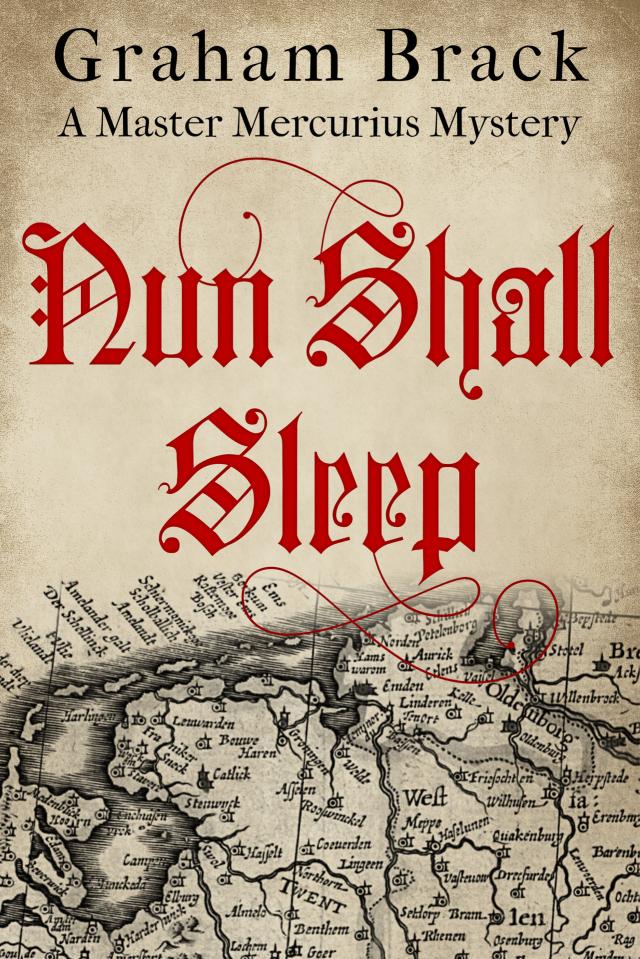
NUN SHALL SLEEP
Master Mercurius Mysteries
Book Nine
Graham Brack
Since I started writing this series I have had a lot of response from readers who have made very kind comments about the stories. I wanted to pay tribute here to one particular reader who has been supportive from the very start.
As a priest in the Church of England I serve in the Diocese of Peterborough, and there I come into regular contact with our Bishops. John Holbrook, Bishop of Brixworth, has had a number of discussions with me about these stories and has been a constant encouragement. While I was writing this story he decided to retire. I set myself the deadline of completing it before he laid down his office and I am pleased to say that I met it with a month to spare.
As is usually the case, Bishop John will move away from his former work area on retirement, so I imagine that further meetings with him will be very limited, which will be a great loss to me. He is regarded in the Diocese with a great deal of affection and his humour and compassion will be sorely missed.
This tale will be something for him to read in retirement and is dedicated to him with respect, admiration and thanks for his friendship.
Table of Contents
PROLOGUE
CHAPTER ONE
CHAPTER TWO
CHAPTER THREE
CHAPTER FOUR
CHAPTER FIVE
CHAPTER SIX
CHAPTER SEVEN
CHAPTER EIGHT
CHAPTER NINE
CHAPTER TEN
CHAPTER ELEVEN
CHAPTER TWELVE
CHAPTER THIRTEEN
CHAPTER FOURTEEN
CHAPTER FIFTEEN
CHAPTER SIXTEEN
CHAPTER SEVENTEEN
A NOTE TO THE READER
ALSO BY GRAHAM BRACK
PROLOGUE
One of the welcome benefits of William of Orange’s successful invasion of England in 1688 was that he stayed there. I do not mean that in any disparaging way, but so long as he was in one country and I was in a different one it seemed unlikely that I would be summoned to give him any assistance with one of his “little jobs”. If this sounds jaundiced, let me remind the reader that in 1674 he almost had me stabbed in a back alley in Utrecht, in 1676 I was kidnapped and held with a knife to my throat in London, in 1684 I was sent to Amsterdam and had to endure an entire evening of viol music, in 1685 I was imprisoned and almost hanged in England and in 1688 I was made to look either credulous or mendacious to an entire county, and all of these calamities befell me as a result of being in his service.
Against that, once he was safely in London he sent for Princess Mary, who was now there too, and the pair of them had been crowned joint monarchs by my old friend Henry Compton, Bishop of London, after the Archbishop of Canterbury declined to do so since he had promised loyalty to the previous king, James II, who was still alive. Compton had done the same, but considered himself released from the promise by James’ desertion of his kingdom. I am sure that Compton did not allow the fact that James had suspended him from office to weigh in his consideration of the matter, and he had hardly concealed his feelings about James when he was one of the seven signatories of the letter inviting William to invade. [Manuscript note: my scribe Van der Meer asks what the correct form is for inviting someone to invade your country. I have never seen the letter, so I don’t know. Such actions are generally strongly discouraged and I doubt that templates are widely available.]
Anyway, interesting though this is [yes, it is, Van der Meer, don’t argue] I must press on with my story. I’m not getting any younger and I have a lot of tales still to tell while I can remember them.
It was in the nature of my work that my involvement in solving mysteries was not widely known, and those who commissioned me often had good reason to conceal the fact, so between summons I was able to lead a comparatively quiet and normal life. I had, if memory serves, just completed the third volume of my Commentary on the Nicomachean Ethics of Aristotle, and was engaged in a pithy attempt to explain Ockham’s views on the univocity of being as described by Duns Scotus, this being, in my view, widely misunderstood, particularly by undergraduates. This endeavour found me in the library whenever I could find a moment, not because it contained useful texts — I had already read them all — but because it was the quietest place I knew. Much as I enjoy Steen’s Inn on the Langebrug I cannot write there, being assailed by potboys offering to refill my beaker or prostitutes hoping to distract me from my work.
Despite this lack of celebrity, a small number of people were aware of my activities and this led, occasionally, to pleas for help. Some of these were from ladies who had lost one glove of a pair and hoped I might find it, but once in a while a more intriguing case came my way, and that which I now relate is one of these. It may involve few of the great and good of that time, but it was a particularly satisfying puzzle to solve.
It has become my habit to answer letters from readers here. Juffrouw A. S. asks whether Van der Meer is still married. Indeed he is, to a charming woman who is far too good for the likes of him. She must be a saint to put up with all those odd snorts and grunts he emits. She has given him, I believe, four children, which must have involved her allowing at least four acts of intimacy, something I find barely credible where Van der Meer is concerned.
Mijnheer G. v. L. asks how much actual teaching I do at the University of Leiden. Too much — at least when it involves the undergraduates. Of course, I also teach the postgraduates who are studying theology, who are men of the highest character and erudition. Some of my former students are now men of great note in the land, and I like to think that I have played some small part in their formation. He also enquires whether I have ever been tempted to teach in a foreign university, to which the answer is that I have not. I have three reasons for this:
Item 1: Nobody has ever invited me.
Item 2: Anywhere other than Leiden would be a step downwards.
Item 3: The problem with foreign universities is that they are all abroad, with all that this entails.
However, the particular story that I am about to tell took place abroad, so I am not wholly averse to travel, in the right circumstances, and with the right people.
That does not include Van der Meer.
Leiden, The Feast of St Gregory Thaumaturgus, 1722
CHAPTER ONE
I cannot deny that I was feeling a little excited that morning in May 1689. The sun was shining, the gardens of the university were looking particularly colourful, and in the kitchen all was peaceful because Albrecht, the kitchen master, had gone to visit a new meat supplier and his absence afforded us the prospect of an edible midday meal cooked by his wife Mechtild. Admittedly, he had undertaken to be back in time to cook supper but we were not going to let that dampen our spirits.
I had been accorded unusual kitchen visiting rights and was sitting at a table sampling the first batch of tartlets issuing from the oven. They were divine, little kisses of pastry in each of which sat a little nub of fruit dappled with an exquisite syrup. If, as I hope, I get to Heaven, I fully expect to dine on such dainties each day, or Heaven is not worthy of the name.
Mechtild poured me a beaker of small beer. ‘So you’re decided then, Master,’ she said.
‘I am, Mechtild, and it’s all thanks to you.’
She fluffed up her side curls in appreciation of my compliment. It was not idle flattery. She was, indeed, the source of my happiness and the origin of my plan for the summer.
Nearly ten years before this I had lost my last living relative, since which time I had passed each holiday in Leiden, except, of course, for those frequent occasions when the Stadhouder, William of Orange, was preparing to have me killed in his service. A little while earlier Mechtild had suggested that I might use the summer to visit some of the great cathedrals of western Europe, a splendid idea which had immediately engaged my attention. I had seen Notre Dame when I was studying in Paris some years before, but I longed to see Cologne, Trier, Aachen, perhaps Ghent; I doubted that I could get as far as Florence or Milan in the time available.
With the help of some of my colleagues I had worked out a route and identified guest houses or reputable inns where I might stay on my journey, and as the day of my departure drew ever nearer I felt a new spring in my step. I had even found a primer in the library which was enabling me to learn some of the German language. It sounds a little like Dutch, though not, of course, so melodious. The chief difficulty is that the Germans persist in printing their books with lumpy black characters that seem to consist of little lobster claws. I find them very hard on the eye.
I had resolved to lay aside Ockham, and Duns Scotus, and a host of other worthies from the past, and devote myself entirely to the present, and, more particularly, to my present. This holiday was my little offering to myself, the small treat with which I was rewarding myself for nearly thirty years as a lecturer in the service of Europe’s leading university. [Of course I mean Leiden, Van der Meer. Stop interrupting!]
Such was my enthusiasm that I had even decided to get myself some holiday clothes, eschewing my conventional minister’s black as evidence that I was on vacation. This outfit included a particularly fine pair of mulberry silk breeches, some yellow leather gloves and a cloak of plum-coloured velvet. On the advice of one of our botanists who was a seasoned traveller to warm climes I invested in some voyager’s small clothes, namely, drawers made of lightweight silk that could be washed and dried overnight, and undershirts with concealed pockets
‘What if they steal my small clothes too and leave me naked?’ I asked the botanist.
‘Ah, then you must hide what you can in your bodily orifices,’ he replied.
‘What — you mean…?’
‘Yes,’ he confirmed. ‘But I wouldn’t try to save any diamond rings that way.’ He winced as if recalling an unpleasant memory.
I had a secondary reason for not wanting to wear my usual apparel. In 1664 I had been secretly ordained as a priest in the Catholic Church. My bishop instructed me to keep this to myself until he told me otherwise; he wanted some priests available to maintain the Church if persecution came and those who were openly Catholic were arrested. A quarter of a century had passed and I had very rarely been able to show my true colours. If it had become known that I was a Catholic I would probably have been discharged in disgrace by the university, and one of the aspects of this that I found most difficult was to be insulted by Catholics for my supposed Protestantism. Better not to wear any distinctive clothing that announced my status, so I resolved to leave my clerical clothes at home.
As usual, the difficult part of packing was deciding which books to take with me. Since I would have to carry them, and I hoped to find more worth buying en route, I took only a few choice items, including my missal which was cunningly bound in such a way as to appear to be a book devoted to gardening. This disguise usually ensured that any curious official who picked it up took one look at the spine and immediately handed it back.
Comparatively few students had chosen to defend a doctoral thesis on any subject that I taught, so as May gave way to June I found myself with nothing to do for the rest of term. That being so, it crossed my mind to pay a visit to the Rector and ask whether I might be excused attendance so that I could add a few extra days on my tour.
The famed Charles Drelincourt had handed on the Rectorship to one Jacobus Trigland Junior. Longtime readers will recall that I have remarked here that anyone named “the younger” is to be pitied and avoided, since they will spend their lives trying to live up to the fame of whoever was “the elder” and tend therefore to be quite ruthless towards any who get in their way. How much more this must apply to one like Trigland, son of Cornelis Trigland whose brother was Jacobus Trigland the Younger and whose father was Jacobus Trigland the Elder. Now, I do not mean to disparage the whole family. Cornelis was one of the tutors of the Stadhouder, who thought highly of him, and Jacobus the Elder was a former Professor of Theology at Leiden and therefore clearly a man of intellect. In fact, he was only just dead when I arrived here, so I never met him.
We need not trouble ourselves with Jacobus the Younger, so far as this story is concerned anyway, but can turn our attention immediately to Jacobus the third, or Junior, or Youngest, depending on how you look at it. He was also a Professor of Theology and the Hebrew language. I am told by those better qualified to judge than I that he was extraordinarily accomplished in Hebrew and well able to maintain a learned correspondence with rabbis across Europe. I can say, however, that his Latin was exquisite too. If only he had learned to smile once in a while he would have been a delightful companion. That is to say, he was not a man given to small talk, and once his business with you was concluded he returned at once to his work. I was never invited to have a cup of wine with him, and I know of nobody else who was.
‘Good morning, Dr Mercurius,’ he said.
‘Good morning, Rector,’ I replied.
The pleasantries ended at this point and we got straight to business.
‘Rector, I find I have no lectures to give nor dissertations to examine and wondered therefore whether I might be given leave to go abroad a little early.’
‘No lectures? No theses? What do we pay you for?’
‘Precisely these; which I have performed diligently for some years. I have planned to go to Aachen, Trier and Cologne this summer.’
‘Why?’ he asked.
‘Why?’
‘Yes, why?’
‘Well, to see the great cathedrals there.’
‘They are Catholic cathedrals.’
‘Indeed, Rector.’
‘You’re not a secret Catholic, are you, Mercurius? Because if you were to come back as a Papist I could hardly allow you to resume your post.’
I did not lie. I just smiled feebly, which he took to be an acknowledgement of his little joke.
‘I have no objection to your early departure, with two caveats. One, that you can hardly expect to be paid for days when you are not here, and two, that you remain until next Sunday when we have a ceremony for those staff who are retiring.’
Staff at Leiden rarely retire. Usually they just stop doing anything but keep their titles and honours as long as they can. More commonly, they die in harness which, I suppose, achieves the same thing for them, with the added bonus that they will still have been drawing a salary. [No, Van der Meer, obviously the university stops paying you when you are dead. Unless, of course, you are such a recluse that they do not realise that you have not left your room for some weeks and are beginning to smell worse than usual. I mean you can draw a salary despite being to all intents and purposes retired.] I could not think of anyone who was retiring, but I agreed to the conditions, at which point all conversation stopped, so after an awkward moment or two I bowed and made for the door.
Over the next few days I made further plans, but most of my time was devoted to trying to find out who was leaving and whether I was expected to contribute to a gift for them. Clearly the size of the gift had to mirror the importance of the departing person, so it was out of the question to buy a gift and have it ready just in case; and, of course, a Professor of Medicine would need a very different type of gift to, say, a porter. As it happened, on Sunday after Divine service I sat there while a number of names were called out, none of whom I knew. I vaguely recognised the old fellow who cleaned the stables, though I had thought him dead for some time; he looked to be on his last legs when I was a student here over thirty years ago. Not keeping a horse, I had made little use of his services, but he was a loyal and long-term servant of this university, so I put a reasonable contribution in the box for his gift.
After the service I gathered up my hat and was about to return to my rooms when my old friend Johannes Voet hailed me.
‘Mercurius! How good to see you again!’
I returned his greeting warmly. It is a curious feature of university life that men can spend whole weeks there without crossing each other’s path. I suppose that I had not seen him for a couple of months.
‘What are you doing now?’ he enquired.
‘I’ve been looking at some aspects of the thought of Duns Scotus —’ I began, before he interrupted me.
‘I meant right this minute. Why not come home with me to dinner?’
‘Surely I would be an imposition? Your wife will not be expecting a guest.’
‘Tush! Magdalena has lived with me a decade or more. Nothing that I do surprises her. There is always more food than we need on the table and she will enjoy the company, especially of someone she already knows well. Come on! It’s a fine day and it’ll be a nice walk.’
‘Forgive my asking, but why wasn’t your wife at Divine service?’
‘Two reasons, Mercurius. First, it’s a university event and she feels out of place unless wives are specifically invited — and when was the last time that happened?’
‘I don’t know,’ I replied. ‘I don’t have a wife to invite.’
‘It’s time we did something about that,’ he replied, then grinned to show me that he was teasing. ‘I’ll tell you, Mercurius. The last time Magdalena was invited was when I assumed the professorial chair. There were one or two social events when I was Rector, of course, but she organised those so she wasn’t invited in the strict sense of the word.’
‘And the second reason?’
‘She went to the church we usually go to, where she is probably being questioned about my whereabouts by all the other wives, just in case I’ve died or divorced her.’
I was quite shocked by the mention of divorce. Voet was a devout Calvinist, and therefore divorce was only possible in very limited circumstances. He and his wife had not been blessed with children, but I was sure the marriage must have been consummated, though that is not the kind of thing that even a close friend can ask. I have no idea how one could phrase the question with propriety.


