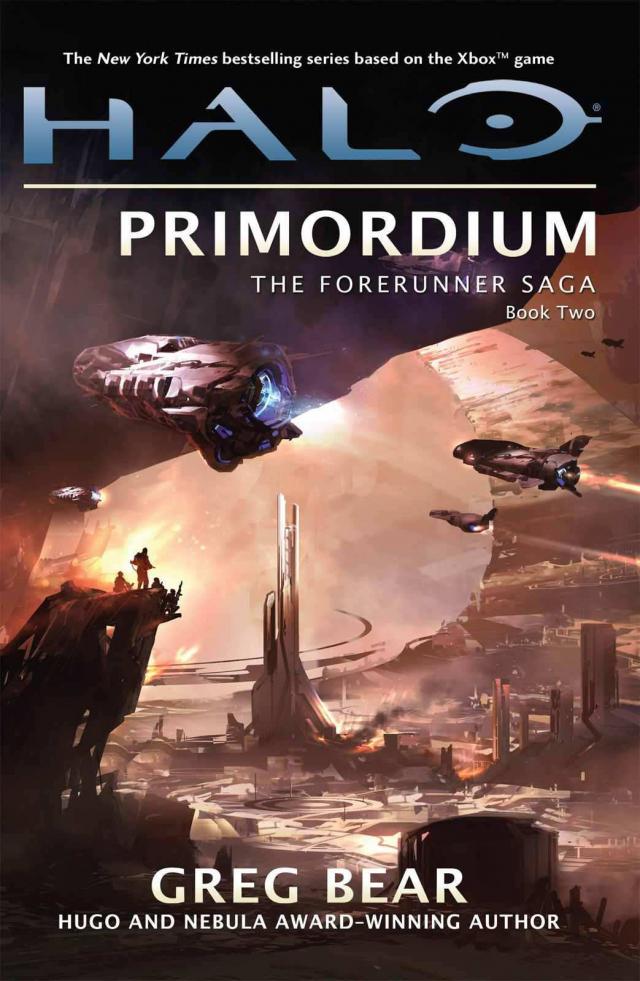
Halo primordium, p.1
Halo: Primordium, page 1


Greg Bear and the team at 343 would like to
dedicate this volume to
Claude Errera
in gratitude for ten years of faithful support for
the Halo universe.
HALO/SHIELD ALLIANCE 631
Record of communications with Autonomous Mechanical Intelligence (Forerunner Monitor).
SCIENCE TEAM ANALYSIS: Appears to be severely damaged duplicate (?) of device previously reported lost/destroyed (File Ref. Dekagram-721-64-91.)
Machine language records attached as holographic files. Incomplete and failed translation attempts deleted for brevity.
TRANSLATION STYLE: LOCALIZED. Some words and phrases remain obscure.
First successful AI translation: RESPONSE STREAM #1351 [DATE REDACTED] 1621 hours (Repeated every 64 seconds.)
What am I, really?
A long time ago, I was a living, breathing human being. I went mad. I served my enemies. They became my only friends.
Since then, I’ve traveled back and forth across this galaxy, and out to the spaces between galaxies—a greater reach than any human before me.
You have asked me to tell you about that time. Since you are the true Reclaimers, I must obey. Are you recording? Good. Because my memory is failing rapidly. I doubt I’ll be able to finish the story.
Once, on my birth-world, a world I knew as Erde-Tyrene, and which now is called Earth, my name was Chakas. . . .
Multiple data streams detected. COVENANT LANGUAGE STREAM identified.
SCIENCE TEAM ANALYSIS: Prior contact with Covenant likely.
Break for recalibration of AI translator.
SCIENCE TEAM LEADER to MONITOR: “We realize the difficulty of accessing all parts of your vast store of knowledge, and we’d like to help you in any way we can, including making necessary repairs . . . if we can be made to understand how you actually work.
“What we’re having difficulty with is your contention that you were once a human being—over a thousand centuries ago. But rather than waste time with a full discussion of these matters, we’ve decided to proceed directly to your narrative. Our team has a dual focus for its questions.
“First question: When did you last have contact with the Forerunner known as the Didact, and under what circumstances did you part ways?
“Second question: What goals did Forerunners hope to achieve in their ancient relations with humans? . . .”
RESPONSE STREAM #1352 [DATE REDACTED] 2350 hours (first portion lost, nonrepeating):
CONTENTS
ONE
TWO
THREE
FOUR
FIVE
SIX
SEVEN
EIGHT
NINE
TEN
ELEVEN
TWELVE
THIRTEEN
FOURTEEN
FIFTEEN
SIXTEEN
SEVENTEEN
EIGHTEEN
NINETEEN
TWENTY
RISER’S STORY
TWENTY-ONE
TWENTY-TWO
TWENTY-THREE
TWENTY-FOUR
TWENTY-FIVE
TWENTY-SIX
TWENTY-SEVEN
TWENTY-EIGHT
TWENTY-NINE
THIRTY
THIRTY-ONE
THIRTY-TWO
THIRTY-THREE
THIRTY-FOUR
THIRTY-FIVE
THIRTY-SIX
THIRTY-SEVEN
THIRTY-EIGHT
THIRTY-NINE
FORTY
FORTY-ONE
FORTY-TWO
ONE
. . . LOOKED ACROSS THE deck of the star boat at the Didact—a massive, gray-black shadow with the face of a warrior god. He was impassive, as usual. Far below, at the center of a great gulf of night filled with many ships, lay a planet under siege—the quarantined prison world of the San’Shyuum.
“What will happen to us?” I asked.
“They will punish,” Riser said gloomily. “We’re not supposed to be here!”
I turned to my small companion, reached to touch the long, dry fingers of his outstretched hand, and shot an angry glance at Bornstellar, the young Manipular that Riser and I had guided to Djamonkin Crater. He would not meet my eyes.
Then, faster than thought or reflex, something cold and bright and awful carved up the distance between us, splitting us apart in blue-white silence. War sphinxes with passionless faces moved in and scooped us up in transparent bubbles. I saw the Didact and Bornstellar packed away in their own bubbles like trophies. . . .
The Didact seemed composed, prepared—Bornstellar, as frightened as I was.
The bubble sucked in around me. I was caught in sudden stillness, my ears stuffed, my eyes darkened.
This is how a dead man feels.
For a time, surrounded by senseless dark or flashes of nothing I could understand, I believed I was about to be ferried across the western water to the far grasslands where I would await judgment under the hungry gaze of sabertooths, hyenas, buzzards, and the great-winged eagles. I tried to prepare myself by listing my weaknesses, that I might appear humble before the judgment of Abada the Rhinoceros; that Abada might fend off the predators, and especially the hyenas; and that his old friend the Great Elephant might remember me and nudge my bones from the dirt, back to life, before the time that ends all.
(For so I have seen in the sacred caves.)
But the stillness and silence continued. I felt a small itch in the pit of my arm, and in my ear, and then on my back where only a friend can reach. . . . The dead do not itch.
Slowly, with a flickering rhythm, like the waving of a fan, the stiff blue silence lifted, scattering visions between shadows of blankness and misery. I saw Riser wrapped in another bubble not far from me, and Bornstellar beside him. The Didact was not with us.
My ears seemed to pop—a painful, muffled echo in my head. Now I heard distant words . . . and listened closely. We had been taken prisoner by a powerful Forerunner called the Master Builder. The Didact and the Master Builder had long opposed each other. I learned as well that Riser and I were prizes to be stolen from the Didact. We would not be destroyed right away; we had value, for the Librarian had imprinted us at birth with ancient memories that might prove useful.
For a time, I wondered if we were about to be introduced to the hideous Captive—the one my ancient ancestors had locked away for so many thousands of years, the one released by the Master Builder’s ignorant testing of his new weapon-toy, a gigantic ring called Halo. . . .
Then I felt another presence in my head. I had felt this before, first while walking over the ruins at Charum Hakkor, and then later, witnessing the plight of humanity’s old allies, the once beautiful and sensuous San’Shyuum, in their quarantined system. Old memories seemed to be traveling across great distances to reassemble, like members of a tribe long lost to each other . . . struggling to retrieve one personality, not my own.
In my boredom, thinking this was merely a strange sort of dream, I reached out as if to touch the jittering pieces. . . .
And was back on Charum Hakkor, walking the parapet above the pit, where the Captive had been imprisoned for more than ten thousand years. My dream-body—oft-wounded, plagued with aches and motivated by a festering hatred—approached the railing and looked down upon the thick-domed timelock.
The lock had been split wide like the casing of a great bomb.
Something that smelled like thunder loomed behind me. It cast a shimmering green shadow—a shadow with far too many arms! I tried to turn and could not. . . .
Nor could I hear myself scream.
Soon enough I lapsed back into a void filled with prickly irritations: itching but unable to scratch, thirsty but without water, muscles both frozen and restless. . . . Viscera trying to writhe. Hungry and nauseated at the same time. This long, weightless suspension was suddenly interrupted by violent shaking. I was falling.
Through the filters of my Forerunner armor, my skin sensed heat, and I glimpsed blossoms of fire, searing blasts of energy trying but failing to reach in and cook me—then, more buffeting, accompanied by the gut-wrenching shudder of distant explosions.
Came a final slamming impact. My jaw snapped up and my teeth almost bit through my tongue.
Still, at first there was no pain. Fog filled me. Now I knew I was dead and felt some relief. Perhaps I had already been punished sufficiently and would be spared the attentions of hyenas and buzzards and eagles. I anticipated joining my ancestors, my grandmother and grandfather, and if my mother had died in my absence, her as well. They would cross rich green prairies to greet me, floating over the ground, smiling and filled with love, and beside them would pad the jaguar that snarls at the sabertooth, and slither the great crocodile that darts from the mud to put to flight the ravenous buzzards—in that place where all hatred is finally extinguished. There, my good family spirits would welcome me, and my troubles would be over.
(For so I had seen in the sacred caves.)
I was not at all happy when I realized yet again that this darkness was not death, but another kind of sleep. My eyes were closed. I opened them. Light flooded in on me, not very bright, but after the long darkness, it seemed blinding. It was not a spiritual light.
Blurry shapes moved around me. My tongue decided to hurt horribly. I felt hands tugging and fumbling at my arms and legs, and smelled something foul—my own scat. Very bad. Spirits don’t stink.
I tried to raise my hand, but someone held it down and there was another struggle. More hands forcibly bent my arms and legs at painful angles. Slowly I puzzled this out. I was still wearing the broken Forerunner armor the Didact had given me on his ship. Stooped and bent shapes were pulling me from that stinking shell.
When they had finished, I was laid out flat on a hard surface. Water poured cool and sweet over my face. The crusted salt of my upper lip stung my tongue. I fully opened my puffy eyes and blinked up at a roof made of woven reeds thatched with leaves and branches. Sprawled on the cold, gritty platform, I was no better than a newborn: naked, twitching, bleary-eyed, mute from shock. Cool, careful fingers wiped my face clean, then rubbed grassy juice under my nose. The smell was sharp and wakeful. I drank more water—muddy, earthy, inexpressibly sweet.
Against flickering orange light I could now make out a single figure—black as night, slender as a young tree—rubbing its fingers beside its own broad nose, over its wide, rounded cheeks, then combing them through the hair on its scalp. It rubbed this soothing skin-oil on my chapped, cracked lips.
I wondered if I was again being visited, as I was at birth, by the supreme Lifeshaper whom the Didact claimed was his wife—the Librarian. But the figure that hovered over me was smaller, darker—not a beautiful memory but solid flesh. I smelled a woman. A young woman. That scent brought an extraordinary change to my outlook. Then I heard others murmuring, followed by sad, desperate laughter, followed by words I barely understood . . . words from ancient languages I had never heard spoken on Erde-Tyrene.
How then could I understand them at all? What kind of beings were these? They looked human in outline—several kinds of human, perhaps. Slowly, I reengaged the old memories within me, like digging out the roots of a fossil tree . . . and found the necessary knowledge.
Long ago, thousands of years before I was born, humans had used such words. The assembled shadows around me were commenting on my chances of recovery. Some were doubtful. Others expressed leering admiration for the female. A few grinding voices discussed whether the strongest man in the village would take her. The tree-slender girl said nothing, merely giving me more water.
Finally, I tried to speak, but my tongue wouldn’t work properly. Even without being half-bitten through, it was not yet trained to form the old words.
“Welcome back,” the girl said. Her voice was husky but musical. Gradually my vision cleared. Her face was round and so black it was almost purple. “Your mouth is full of blood. Don’t talk. Just rest.”
I closed my eyes again. If I could only make myself speak, the Librarian’s imprint from ancient human warriors might prove useful after all.
“He came in armor, like a crab,” said a low, grumbling male voice. So many of these voices sounded frightened, furtive—cruel and desperate. “He fell after the brightness and burning in the sky, but he’s not one of the Forerunners.”
“The Forerunners died. He did not,” the girl said.
“Then they’ll come hunting him. Maybe he killed them,” another voice said. “He’s no use to us. He could be a danger. Put him out in the grass for the ants.”
“How could he kill the Forerunners?” the girl asked. “He was in a jar. The jar fell and cracked open when it hit the ground. He lay in the grass for an entire night while we cowered in our huts, but the ants did not bite him.”
“If he stays, there will be less food for the rest of us. And if Forerunners lost him, then they will come looking for him and punish us.”
I listened to these suppositions with mild interest. I knew less about such matters than the shadows did.
“Why?” the dark girl asked. “They kept him in the jar. We saved him. We took him out of the heat. We will feed him and he will live. Besides, they punish us no matter what we do.”
“They haven’t come for many days to take any of us away,” said another voice, more calm or more resigned. “After the fires in the sky, the city and the forest and the plain are quiet. We no longer hear their sky boats. Maybe they’re all gone.”
The voices from the milling circle dulled and faded. None of what they said made much sense. I had no idea where I might be. I was too tired to care.
I don’t know how long I slept. When I opened my eyes again, I looked to one side, then the other. I was lying inside a wide meeting house with log walls. I was naked but for two pieces of worn, dirty cloth. The meeting house was empty, but at my groan, the dark girl came through the reed-covered doorway and kneeled down beside me. She was younger than me. Little more than a girl—not quite a woman. Her eyes were large and reddish brown, and her hair was a wild tangle the color of water-soaked rye grass.
“Where am I?” I asked clumsily, using the old words as best I could.
“Maybe you can tell us. What’s your name?”
“Chakas,” I said.
“I don’t know that name,” the girl said. “Is it a secret name?”
“No.” I focused on her, ignoring the silhouettes of others as they filed back in through the door and stood around me. Other than the tree-slender female, most of them kept well back, in a wide circle. One of the old men stepped forward and tried to pluck at the girl’s shoulder. She shrugged his hand away, and he cackled and danced off.
“Where do you come from?” she asked me.
“Erde-Tyrene,” I said.
“I don’t know that place.” She spoke to the others. No one else had heard of it.
“He’s no good to us,” an older man said, one of the shrill, argumentative voices from earlier. He was heavy of shoulder and low of forehead and smacked his thick lips in disapproval. All different types of human being were here, as I had guessed—but none as small as Riser. I missed Riser and wondered where he had ended up.
“This one fell from the sky in a jar,” the older man repeated, as if the story was already legend. “The jar landed in the dry short grass and cracked and broke, and not even the ants thought he was worth eating.”
Another man picked up the tale. “Someone high above lost him. The flying shadows dropped him. He’ll just bring them back sooner, and this time they’ll take us all to the Palace of Pain.”
I did not like the sound of that. “Are we on a planet?” I asked the girl. The words I chose meant “big home,” “broad land,” “all-under-sky.”
The girl shook her head. “I don’t think so.”
“Is it a great star boat, then?”
“Be quiet and rest. Your mouth is bleeding.” She gave me more water and wiped my lips.
“You’ll have to choose soon,” the old, cackling one said. “Your Gamelpar can’t protect you now!”
Then the others went away.
I rolled over.
Later, she shook me awake. “You’ve slept long enough,” she said. “Your tongue isn’t bleeding now. Can you tell me what it’s like where you come from? Up in the sky? Try to speak slowly.”
I moved lips, tongue, jaw. All were sore, but I could talk easily enough. I propped myself up on my elbow. “Are you all human?”
She hummed through her nose and leaned forward to wipe my eyes. “We’re the Tudejsa, if that’s what you’re asking.” Later I would put this word in context and understand that it meant the People from Here, or just the People.
“And this isn’t Erde-Tyrene.”
“I doubt it. Where we are is a place between other places. Where we came from, we will never see again. Where we are going, we do not want to be. So we live here and wait. Sometimes Forerunners take us away.”
“Forerunners . . . ?”
“The gray ones. The blue ones. The black ones. Or their machines.”
“I know some of them,” I said.
She looked dubious. “They don’t like us. We’re happy they haven’t come for many days. Even before the sky became bright and filled with fire—”
“Where do they come from—these People?” I waved my arm at the silhouettes still coming and going through the door, some smacking their lips in judgment and making disapproving sounds.
“Some of us come from the old city. That’s where I was born. Others have gathered from across the plain, from river and jungle, from the long grass. Some walked here five sleeps ago, after they saw you fall from the sky in your jar. One fellow tries to make people pay to see you.”