The well of hell alex hu.., p.1
The Well of Hell: Alex Hunter 10, page 1


About The Well of Hell
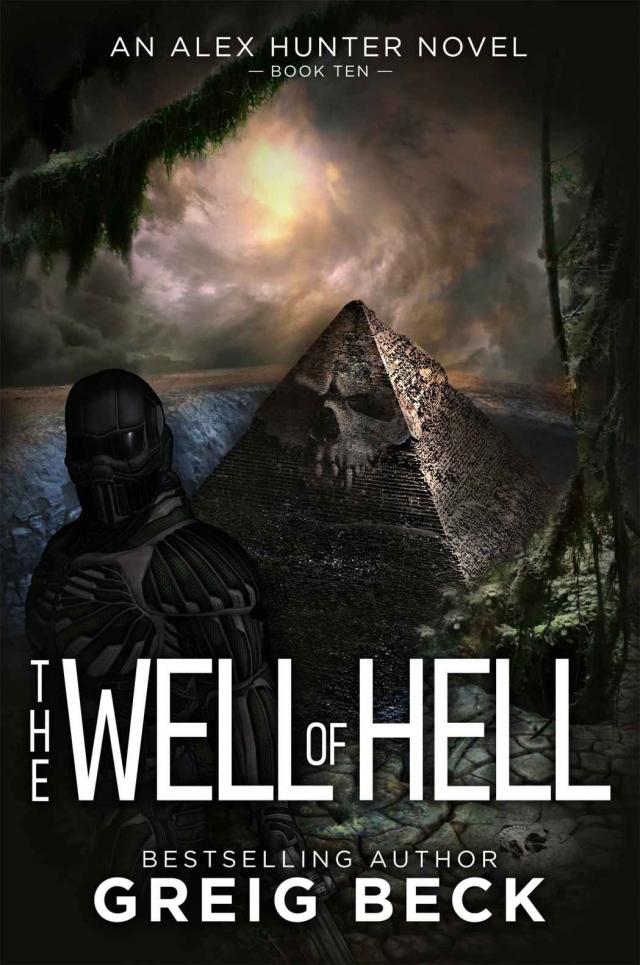
In the forbidden deserts of Yemen, a structure has been found – a buried pyramid – thousands of years older than anything previously known. And indications are, it was buried on purpose.
What is discovered inside could prove that we’re not alone in the universe. And terrifyingly, after 7000 years, there is a biological obscenity that remains, not yet dead.
Ancient writing suggests the pyramid’s builders have been taking humans for reasons that will tear at all sanity, and when evidence is found that in remote corners of the world people are still disappearing, the HAWCs are called to action.
In a final battle across two worlds – with the fate of the planet at stake – Alex Hunter and his team will be pushed to their very limits as they confront a horrifying and deadly army.
In The Well of Hell, bestselling author Greig Beck constructs a tale of blood-curdling, Lovecraftian horror – this latest battle for honor, family and the world cements his status as one of the premier action-horror writers today.
Contents
About The Well of Hell
Epigraph
PROLOGUE
INCIDENT 01
CHAPTER 01
CHAPTER 02
INCIDENT 02
CHAPTER 03
CHAPTER 04
CHAPTER 05
CHAPTER 06
CHAPTER 07
CHAPTER 08
CHAPTER 09
INCIDENT 03
CHAPTER 10
CHAPTER 11
CHAPTER 12
CHAPTER 13
CHAPTER 14
CHAPTER 15
CHAPTER 16
CHAPTER 17
CHAPTER 18
CHAPTER 19
CHAPTER 20
CHAPTER 21
CHAPTER 22
CHAPTER 23
CHAPTER 24
INCIDENT 04
CHAPTER 25
CHAPTER 26
CHAPTER 27
INCIDENT 05
CHAPTER 28
CHAPTER 29
CHAPTER 30
CHAPTER 31
CHAPTER 32
CHAPTER 33
CHAPTER 34
CHAPTER 35
INCIDENT 06
CHAPTER 36
CHAPTER 37
CHAPTER 38
CHAPTER 39
CHAPTER 40
CHAPTER 41
CHAPTER 42
CHAPTER 43
CHAPTER 44
CHAPTER 45
CHAPTER 46
CHAPTER 47
CHAPTER 48
CHAPTER 49
INCIDENT 07
CHAPTER 50
CHAPTER 51
CHAPTER 52
CHAPTER 53
CHAPTER 54
CHAPTER 55
CHAPTER 56
CHAPTER 57
CHAPTER 58
CHAPTER 59
CHAPTER 60
EPILOGUE
AUTHOR’S NOTES
About Greig Beck
Also by Greig Beck
Copyright
Eventually, all things that were hidden will be found.
Time does that for us, whether we want it to or not.
— Greig Beck
The Well of Hell (aka the Well of Barhout) is a giant sinkhole in Yemen’s Al-Mahara desert. It has a circular entrance that measures around 100 feet across at the surface and drops to nearly 400 feet deep.
Local folklore says the cave was created as a prison for demons, and superstition has it that objects near the hole can be sucked toward it. To this day, locals never visit there, and some think that it’s bad luck to even talk about it.
PROLOGUE
5021 BC – City of Allonia, in what will one day be Yemen
An abomination.
The king stared at the huge cage as if in a trance. It was covered over now so none could see the horrifying thing that his beautiful son had become.
He barely heard his advisors, wise men, and spiritual leaders all talking at once. Because he didn’t want to.
He was the first great king of Allonia and had united most of the land under his single centralized monarchy. His kingdom was a land at peace, bountiful, and was at the crossroads of many civilizations so he grew rich on trade and taxes. And Akmezdah was the first leader to be called a living god by his people.
But the title of god did not sit well with him because it was the time of the eighteenth season, the moon was hidden once again, and the real gods had returned.
The first time he had laid eyes on them he felt the blood freeze in his veins – the horror of them – nearly twice as tall as a man and with faces that belonged on the reptiles that hunted the waterways. And with them were their vile servants; crawling abominations that tore at a man’s sanity.
When they first appeared they called for tribute – but not of gold, or food, spices, or fine cloth, but instead it was the youth they wanted, young, strong men and women, who were taken and never came home to their families again. Every eighteen years it was the same.
In return they shared secrets of fantastic machines that could count time, or follow the lights in the heavens, or show them advancements in architecture that had enabled them to make huge buildings like their own pyramids that reached up to the sky. The visitors’ gifts had made the city of Allonia wealthy, safe, and strong, and he thought if he just looked away, just for a week once every eighteen years, his city would be safe.
But then they had taken his only son, Zadahsen, in just his twelfth year. Akmezdah was in agony and knew he should have stayed silent like the rest. But he could not. After all, who were these so-called gods to demand one of royal blood?
The king knew the old gods had once again made their home in the great pit beyond the first desert. And he had set out with his army to make war on them.
For days they had battled and eventually fought their way into the pit, and there found the hidden pyramid. Of his ten-thousand-strong army, the mightiest in the land, there were just a few hundred remaining with the rest burned to ash, or captured to be taken to a fate that, he now knew, was far worse than death.
A war-weary Akmezdah had succeeded and retrieved his son, but he felt no elation from the deed because he knew the war had doomed his city.
The king turned again to the covered cage. Tears streamed down his face and his stomach roiled as he remembered what his beautiful son had been, and he refused to even attempt to look at him again.
His last act would be to give little Zadahsen a grand burial, in his son’s own pyramid – even though the king knew that somewhere in that obscene thing the boy had become, he somehow still lived.
INCIDENT 01
Eventually, all things that were hidden will be found. Time does that for us, whether we want it to or not.
CHAPTER 01
June 7, 1925 – The great desert beyond Harbarut – Yemen–Oman border
“They’ve found something, hurry.” Iraqi archeologist Atafi An Omar turned, his grin showing through a face covered in yellow dust. “They say it is a wall.”
His colleagues, Mohammad Marboosh, a Saudi, and the English dig leader, Phillip Saunders, hurried along the freshly excavated trench to join him in the passageway beneath the arid desert.
At the end of the tunnel, Omar stood aside. “See here.”
Saunders stepped forward and lightly, almost reverently, touched the flat stones with his fingertips. “Carved granite, and it’s old, so very old.” He slid his fingers along the hard surface, finding some areas of unusual smoothness. “This was once polished to a glassy sheen but has been exposed to the elements for perhaps thousands of years.”
Marboosh lifted his lantern. “Then buried and forgotten for thousands more.”
Saunders turned to smile. “Until now.”
“The legends are true then?” Marboosh whispered. “A great civilization was here, one that might have even rivalled the Egyptians.”
“The ancient Egyptians rose to greatness 5000 years ago. But if the legends are true, these people were here thousands of years before them.” Saunders continued to explore the stone with his fingertips. “All we know has come from a shard of ancient pottery, and some oblique references from tomb wall carvings – a mighty race existed here around 7000 years ago, and then they vanished, almost overnight. Wiped out by some catastrophe.”
“But who were they?” Omar asked.
Saunders leaned forward to blow dust from an area of the wall. “Yemen has long been at a crossroads of cultures and civilizations, but this might be an entire race of people that we have never come across.” The Englishman turned and smiled. “We could be meeting them for the first time.”
Omar cleared away a little more sand. “We need to get the men to excavate further.”
“Agreed.” Saunders looked up. “We’re only about twenty feet down. We’ll bring in a larger team and take the layers off, come down at it from above so we miss nothing.”
Marboosh grinned. “I feel we are on the precipice of finding something truly magnificent. Let’s begin immediately.”
***
Hundreds of workers toiled like an army of ants over the site, removing thousands upon thousands of bucketloads of sand, soil, and dust every hour. Working in continual shifts right around the clock, three weeks later they had excavated down another forty feet.
The three archeologists now stood looking into the massive crater, but it wasn’t empty, because
“It’s only got three sides,” Saunders said. “Unlike the Egyptian structures that have four.”
“It’s unique.” Omar turned. “Maybe this is a prototype pyramid as it was constructed long before even the Pyramid of Djoser that dates back to around 2630 BC.” He turned back to the excavation. “It’s perfect, but who had the technology back then to build it?” he asked.
“Indeed, that is the question.” Saunders looked around at the hills surrounding their site, and then back at the debris that had been excavated. “And one more thing. The heavy stones that were laid up against the structure were not from around here. They were brought in. That tells me that the elements alone didn’t bury this site. I think this pyramid was covered over on purpose.”
“Why would they do that?” Marboosh asked.
“Royal tombs were hidden, but it was only the accursed that were weighted down to stop their souls ascending to the afterlife,” Omar replied. “But in this culture, we can only guess.”
A cry came from the excavation pit, and the three men stared down at the commotion. Omar was first to decipher the yells.
“They’ve found an opening – a door.”
Saunders smiled. “Bring the equipment.”
The workers were pulled back from the pit, and the three men made their way down to stand before the huge doorway – it was bricked in as was standard with sealed tombs.
Saunders ran a finger down between two stones and then used a knife to scrape at the line. “Gypsum mortar – soft, but effective. It should be easy to make a hole in between them.”
Saunders called for the long auger drill that would create an opening just an inch in diameter. It had a crank handle that could be operated by two men, and Omar and Marboosh turned it slowly, grinding and sinking in between the hard stones.
At around the eleven-inch insertion mark, the drill suddenly sunk in fast. “Through,” Omar exclaimed.
He removed it slowly, and then waved a hand in front of the hole toward his face, sniffing deeply. “Breathable.” He sniffed again. “Strange odor, musky; it’s dead air, but not toxic,” he said.
“Good, we won’t need gas masks.” Saunders pointed to a place a foot lower than their first hole. “Sink the sight-hole here.”
The two junior archeologists drilled another hole below the first, and when done, they held a lantern up to the first hole while Omar crouched and placed his eye to the lower opening.
“What do you see?” Marboosh asked.
“Wonderful things.” Omar looked up and grinned at his Howard Carter joke. “Kidding, nothing so far; just an empty space.”
Saunders helped him up. “Alright, let’s get the men to take out several stones and make a larger opening. We’re going in.”
It took the workers another two hours to remove around a dozen of the two-foot blocks to create an opening big enough for them to enter. Marboosh was chosen to go first.
“History will remember me.” Marboosh smiled and turned back to the impenetrably dark hole. He paused to draw in a deep breath. “And may all the gods and prophets hold back their curses on this day.” He held his lantern up and stepped through.
Saunders and Omar waited a moment and then followed. They found that the empty space was actually a long corridor and high enough for them to be able to stand upright.
“It is the only path forward,” Marboosh observed.
“Then …” Saunders motioned forward, and the trio followed it for around a hundred feet.
Omar consulted a small compass, but then frowned. “I can feel we’re tracking downward, maybe at an angle of fifteen degrees. But the compass is going mad, spinning.”
“Maybe because there’s …” After a moment Marboosh shrugged. “I have no idea.”
“Leave chalk marks,” Saunders suggested.
After another half-hour Saunders exhaled in a whoosh. “Getting thick down here. I’m betting the stale air is heavy and settling in the lower passages. It’ll be more toxic the deeper we go. Any thicker and we’ll need breathing equipment.”
“Stale, but I smell cloves and salt; embalmer’s tools.” Marboosh tied a scarf around his lower face and the others did the same. “We can go a little further, I think.” He made another chalk arrow on the wall. “It opens up just ahead.”
In a few minutes more the trio entered a large room, and around the walls were fresco-style art that, even after all the millennia, was still richly colored in ochre, black, reds, and white.
“This is magnificent.” Saunders held his arms wide. “This is who they were, here, it’s all here in their story.” He pulled out his notebook.
“I can’t understand it,” Marboosh said. “Some symbols are familiar, but not quite like anything I’ve ever seen before.”
“Or anything anyone has seen for many millennia.” Saunders paced around the room, trying to find the beginning of the pictorial sequence. “This here …” He indicated an image of the night sky with what could be the sun, Earth, and moon all in a direct line. He turned. “Is this an image of an eclipse? But if it is, how did this race even know about the planets in the solar system?”
His men just shrugged.
“Amazing.” Saunders blew air through pressed lips. “This looks a little like ancient Sabaean, or maybe a proto version of it. I think I can read it, or at least some of it.” He found the start. “Here their story begins.”
He cleared his throat. “The city of Allonia, the greatest city in the world.” He smiled over his shoulder at his colleagues. “So now we know who they were, Allonians; in the kingdom of Allonia.” He turned back to continue reading. “The gods have returned to heaven once again,” he intoned. “And their pitiful slaves left behind will sleep and await their return.” He held up his lantern. “Yes, look here.”
There were images of tall beings that bore a resemblance to some forms they had seen before. Saunders quickly sketched the familiar figures before glancing up at them again.
“Recognize them?” Saunders asked.
“Sobek – the alligator-headed god – but how could it be?” Omar asked. “He was the ancient Egyptian god who was supposed to bring life to the land of the Nile – and he wasn’t worshiped for thousands more years.”
“True. And yet here he is. Or something like him.” Saunders moved his light closer to the images. “Oh my god,” he whispered.
Up close, the alligator-headed creature was grotesque and not like a normal reptile. It had six eyes up a long tooth-studded face, and each eye was blood-red. Even after all this time it was clear the artist had managed to capture a glint of intelligence and malevolence in them.
“Maybe not such a benign god then,” Saunders mused.
“And what do you think these represent?” Marboosh asked.
The others joined him and looked up at the pictures. The men were silent for a moment, but Saunders felt a chill on his neck.
“Are they supposed to be giant spiders?” he asked.
There were creatures that looked to be helping the people build a pyramid-type structure.
“Or are they the slaves they mentioned?” Omar whispered.
“Maybe it is just meant to be allegorical, like a representation of action or desire,” Saunders replied and held his lantern closer – its light showed a strange entity that had multiple arms and legs, ten of them, but they were human limbs.
“Here’s another,” Marboosh breathed. “Ach, even worse.”
This one was a four-legged figure that had human arms all the way up its sides and a long torso like a centipede. Each hand was holding a tool of some kind. There was a head end, of sorts, but there were no features discernable – or even an actual head, as the neck seemed to end in a stump.
“I’ve never seen anything like this.” Omar turned to the tall Englishman. “Perhaps, as you say, they are just meant to represent hard work, or something like it. We don’t know enough about this culture and its deities yet.” He smiled, but it seemed fragile.
“Many hands make light work, as they say.” Saunders turned and grinned but noted that his companions didn’t share his humor that day.
He sketched a few of the images in his leather-bound notebook and then turned to another part of the wall. He soon found more writing. He began to translate, but the messages made no sense to him, and he questioned if he was interpreting them correctly. But how could he know if he was, he asked of himself, seeing he might be the first in 7000 years to read it?