

What nails it, p.1
What Nails It, page 1


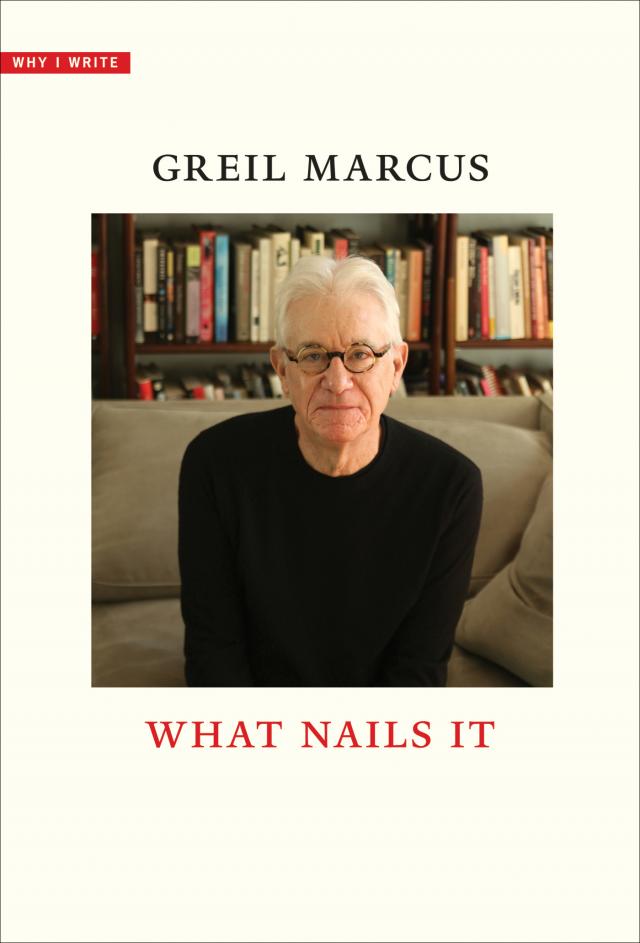
WHAT NAILS IT
WHAT NAILS IT
GREIL MARCUS
THE 2023 WINDHAM-CAMPBELL LECTURE
YALE UNIVERSITY PRESS
NEW HAVEN AND LONDON
The Why I Write series is published with assistance from the Windham-Campbell Literature Prizes, which are administered by the Beinecke Rare Book and Manuscript Library at Yale University.
Copyright © 2024 by Greil Marcus.
All rights reserved.
This book may not be reproduced, in whole or in part, including illustrations, in any form (beyond that copying permitted by Sections 107 and 108 of the U.S. Copyright Law and except by reviewers for the public press), without written permission from the publishers.
Yale University Press books may be purchased in quantity for educational, business, or promotional use.
For information, please e-mail sales.press@yale.edu (U.S. office) or sales@yaleup.co.uk (U.K. office).
Set in Yale and News Gothic BT type.
Printed in the United States of America.
Library of Congress Control Number: 2023952231
ISBN 978-0-300-27245-1
(hardcover : alk. paper)
A catalogue record for this book is available from the British Library.
This paper meets the requirements of ANSI/NISO Z39.48-1992
(Permanence of Paper).
10 9 8 7 6 5 4 3 2 1
To Jenny, Cecily, and Paula
For the spring and summer of 2022
In memory of Emily Marcus
December 10, 1969–January 31, 2023
CONTENTS
1. Greil Gerstley
2. Pauline Kael
3. Titian
Sources
Acknowledgments
WHAT NAILS IT
1
Greil Gerstley
I write for fun. I write for play. I write for the play of words. I write to discover what I want to say and how to say it—and the nerve to say it.
The key word for me here is not fun, play—but discover. I live for those moments when something appears on the page as if of its own volition—as if I had nothing to do with what is now looking me in the face.
In 1965, Bob Dylan described his song “Like a Rolling Stone” as “twenty pages of vomit,” boiled down to a point of hatred—well, he said later, maybe ten pages—but much later, almost fifty years later, he described it very differently. “It’s like a ghost is writing a song like that,” he said, talking to Robert Hilburn of the Los Angeles Times. “It gives you the song and then it goes away, it goes away. You don’t know what it means. Except the ghost picked me to write the song.”
That’s a very evocative, very romantic account of what anyone who engages in any sort of creative activity experiences at any time. For a lot of people, that sense of an evanescent gift, the genie granting you a wish even if you never asked for it—that sense of visitation—is what it’s all for: a moment of inexplicable clarity. “When you put the music with words and things together, the songs just make themselves,” the 1950s New Orleans rock ’n’ roll pianist and singer Huey “Piano” Smith once said; he wrote Frankie Ford’s “Sea Cruise,” he wrote “Don’t You Just Know It,” but he’s best remembered for “The Rockin’ Pneumonia and the Boogie-Woogie Flu”—a follow-up, “Tu-Ber-Cu-Lucas and the Sinus Blues,” was not so hot. But he went on: “After you listen on it,” he said of putting things together, “it says something of its own self, that you hadn’t planned.” Talking about stand-up comedy, Richard Belzer said the same thing. “The greatest thing for me,” he said, “is when I make the audience laugh in a moment that could only happen that night with that audience”—when Bob Dylan recorded “Like a Rolling Stone,” live in the studio with a six-piece band, over two days and twenty-four takes, twenty-four stabs, false starts, breakdowns, only twice did they make it all the way through the four-verse, six-minute song, and the second time was all trip, stumble, and fall. That’s what Richard Belzer was talking about, that single moment when what you’re writing, painting, singing, telling, speaks in its own voice, which is and isn’t yours: “Sometimes I laugh with the audience because I’m hearing the joke the same time they are.”
That feeling of no, I didn’t think that, I didn’t write that, where did that come from?—and I mean that literally, absolutely having no memory of creating, composing, fashioning, what is there staring at you, saying, Alright, here it is, what are you going to make of this?—I remember the first time it happened.
It was 1973. I had dropped out of graduate school at Berkeley after finishing my course work and barely passing my orals—I sat for three hours outside the room where I’d met with three professors, going through every stage of grief, denial, disbelief, fury, and finally not caring. Then I was offered the chance to teach the American Studies Honors Seminar—a two-semester, year-long course for sophomores, with one teacher each from History, English, and my department, Political Science. I was preening over the prestige: no graduate student had ever taught it. I had taken it over 1964 and 1965, with Michael Rogin from Political Science and Larzer Ziff from English. It was a revelation; it introduced me to the terrain, and the conversation, that for good or ill would lie behind what I would end up doing for the rest of my life. It was that classroom engagement, when an atmosphere is conjured up where anything can be said and anything can be understood, where any idea or any argument opens up instantly and naturally into another, until finally the whole class finds itself at the top of a pyramid, dizzy with the notion that now, with the day’s class over, you have to find a way down, which is a version of that out-of-nowhere sentence showing up on a page and asking you if you can take the next step, or fail it, fail the dare it’s throwing at you, abandon it as if was never there at all.
That’s a translation of how the class actually worked. In the evening a number of us would gather in the seminar room, which was on an upper floor of the great main library, and which was also a library in itself, the books the class was made of—Perry Miller’s biography of Jonathan Edwards, a battered but intact original edition of John Adams’s Discourses on Davila. We’d stay, reading and talking, long after the library was locked up for the night, and at one or two in the morning climb out of a window on a rope, one by one. It fell to the last person out to show up the next morning when the library opened and pull up the rope.
Through most of graduate school I’d been writing for Rolling Stone, then Creem. Starting in 1968, I’d been sending in record reviews to Rolling Stone; they were printing them. It was a professional operation, at least compared to the so-called underground newspapers of the time. I was shocked after the first review ran to find a check for $12.50 in the mail a week later. A few months after that I met someone who worked for the paper—that’s what it was called then, a fold-over newsprint tabloid—and started complaining about the record review section: it was all writing about lyrics, nobody was writing about music, nobody was writing about how anything felt, how anything moved, how anything moved you. A few days later I got a call from the editor, Jann Wenner, who I’d met when we were both freshmen at Cal, though this was five years later and we hadn’t seen each other since. “This is Jann,” he said, as if we’d been talking that day before and he was just picking up the conversation where it had left off. “If you think the records section is so terrible, why don’t you edit it?” So I did, for six months, until after the murderous Rolling Stones show at Altamont at the tail end of 1969, the most violent day of my life, when I was burned out. I recruited the late Ed Ward to replace me, and I kept writing, until I was fired six months later. I went on to the much scruffier and much more try-anything Creem magazine, from Detroit—Rolling Stone in 1968 and 1969 was very try-anything, because there were no rules, except that we were making our own, and Creem wasn’t making any rules at all.
Then in 1972 I left graduate school. I’d always assumed I’d become a professor. I had such great professors at Berkeley—along with Michael Rogin and Larzer Ziff, John Schaar and Norman Jacobson. They were inspiring figures. They were devoted to students. They looked you in the eye. They let you know that they believed you had something to contribute, in a class, in a paper, even to the field, the discipline, the discourse, the conversation that had been going on for centuries, and you felt called to try to live up to that. But as a teacher myself, I wasn’t. I had no patience, and a teacher without patience is not a teacher. Instead of “Tell us what you mean” when a student said something that seemed wrong, I heard “How could you say that?” coming out of my mouth. When I thought everyone was missing the point I’d pontificate for five minutes and shut everyone up for the rest of the class. When I taught again, after nearly thirty years of never stepping inside a classroom, I was ready to learn that if there was a point that absolutely needed to be made, an idea that simply had to be addressed, even a fact that needed to be stated, if I could keep quiet for five minutes, someone in the class would find their way there. I found out that the ideal class would be one in which I didn’t say a word—once, at Princeton, it actually happened.
But at Berkeley I came home from every class angry and in despair. I had wonderful students, three of whom are close friends to this day. But I was cheating them out of their own education. I’d had enough bad teachers not to want to become one. I realized I couldn’t spend the rest of my life doing something I didn’t like and wasn’t good at. At that point the other thing I knew how to do was write. So now, after four years as a journalist, I was trying to write a book.
It was a book
Right off, maybe the next night, someone composed the street ballad “Stagolee and Billy.” Within days it was traveling up and down the Mississippi. Within a decade or two, with the real facts behind the song forgotten or never known—never mattering: who cared where a song came from when the story it told was so good everyone wanted to claim it?—people would tell you they remembered Stagger Lee, heard about him, knew someone who knew him, in Chicago, Memphis, New Orleans, even New York. Lloyd Price, from Kenner, Louisiana, now home of the Louis Armstrong International Airport, remembered growing up and watching local pimps and gangsters with their colored zoot suits and Cadillacs: to young boys like him “they were all Stagger Lees.” Stationed in Korea, he staged a play based on the old ballad. When he took his version of the song to the top of the charts in 1958, “Stagger Lee” was stomping through every town in the country; the whole nation sang the song.
Lee Shelton would have heard it himself, in dozens of versions, over the next decade after Billy Lyons was buried and into the decade after that, in and out of prison, until he died there in 1912. But as a song it was also a legend, a myth that from its start traveled through the next century and beyond, as music, in novels, in movies, by 2008 even a porn film, starring Sasha Gray and directed by one Benny Profane.
But all that history was written later. With no facts at hand, even after months of searching, it was the myth I was writing about. I was trying to imagine who Stagger Lee would be, how he would act, how the world would open up before him or close around him. He was a hero. He played out his string. Then it snapped back around his neck. I started with a declarative sentence. After that, some uncanny cadence took over the words. As if in a trance, the words were making their own rhythm:
Stagger Lee is a free man, because he takes chances and scoffs at the consequences. Others gather to fawn over him, until he shatters in a grimy celebration of needles, juice, and noise. Finally he is alone in a slow bacchanal, where his buddies, in a parody of friendship, devote themselves to a study of the precise moment of betrayal.
What came down, I think, what appeared, were those words “slow bacchanal.” That was the prize, that was the treasure. I just had to figure out what to do with it, find out what it wanted, what images it was making, what the story was that was hidden in the two words.
So that’s why I write: to reach the state where that can happen, and then to see if I can still find my way in and out of that cave. But of course there’s more to it than that—or anyway another version of the same story.
Writing is not only an odd craft, a keeping company with ghosts giving you songs and visitations giving you words. People may say, to other people or to themselves, that they want to become a writer, as if it’s a status or a profession where you get a degree and then you’re a writer. Writers write. They can’t help it. They can’t not. At some point defeated, without readers, or without a subject, without something that calls out to be put into the world, without riding on the belief that nothing exactly the same has been in the world before, they might give up. Then they aren’t writers. People sometimes ask writers if they’re going to retire. You don’t retire from writing any more than you retire from breathing. Perhaps at a certain point you can’t do it anymore. For some people what stops them from writing is whatever it is that stops them from breathing. For ten months in 2022 that was how I lived; for ten months I didn’t write a word that went into the world. I couldn’t believe how easy it was.
Writing is rooted in memory: in some alchemy of responses, particular to everyone, with no one’s translation of life the same. My writing is rooted in a doubled memory. It’s a memory of an actual incident, but inside that memory is a false memory, an attempt to remember something that can’t be found.
I was ten in 1955. My family had just moved into a new house in Menlo Park, now famous as the site of the headquarters of Facebook, then famous for nothing. People might tell you it was named for the town in New Jersey where Thomas Edison invented the phonograph. In our house, in a library room where you could squirrel yourself off from everyone else, there was a big tube radio console, and I’d play with the radio at night, trying to pull in the drifting AM signals from stations across the country, from Salt Lake City, Cincinnati, even dance bands from hotels in New Jersey, as if that made some kind of loop back to where I was. One night, a few lines came out. “When American GIs left Korea,” the radio said, “they also left behind countless fatherless babies. Once, everyone talked about this. Now, nobody cares.”
Those words bothered me at the time, but I put them out of my mind. Or so I thought. For the next twenty years, that radio incident would reappear—crashing into whatever I was thinking like an invisible meteorite. As I got older, I realized this was an echo of something other than what the words on the radio actually described—I knew it was an echo of an absent memory, a phantom memory of my own father, whose name was Greil Gerstley, who was lost in a typhoon in the Pacific when his destroyer went down. Those were all of the facts present at the time, and for so long after: no date, no details, no story. I was born Greil Gerstley, but when those words came out of the radio, I wasn’t Greil Gerstley anymore. And although those words made me an echo chamber for the memory they called up, I had nothing to remember: the memory that was called up was silent and blank.
Still, we all have memories of things we didn’t experience: cultural memories that have taken up residence in our minds, built houses, filled them with furniture and appliances, and commanded that we live in them. I never saw Ty Cobb or Babe Ruth play, but they were as real to me growing up as President Eisenhower: I was raised with tales of their hero sagas, even the story of a great-aunt who supposedly slept with Babe Ruth, even with the fact that, when I was a baseball history–mad ten-year-old, Ty Cobb himself lived in Menlo Park. (Afraid he might spike me, I never knocked on his door; I did send him a postcard for an autograph, which he sent back with a signature so fresh-looking it could have been made in 1911, when, my baseball Hall of Fame book said, he hit .420. Many years later, I found that his door was open: friends of mine were at his house all the time, asking for the old-timer stories he was happy to tell. What I wouldn’t give now to have had a little more nerve in 1955!)
These sorts of memories, these cultural memories, come to us from all sources, but especially from movies. There is that blank memory, but what explained it to me, as if it lay behind it, was one particular movie: David Lynch’s Blue Velvet.
The famous opening of this 1986 picture seems to parody the American fantasy of home, peace, quiet, and appliances—that is, the all-but-trademarked American dream. But what’s most interesting about what’s happening on the screen is that it may have no satiric meaning at all.
The title sequence has shown a blue velvet curtain, swaying slightly from some silent breeze, casting back to the black-and-white velvet or satin backgrounds of the opening credits for 1940s B pictures. The theme music is ominous, alluring, at first suggesting Hitchcock’s Vertigo, then a quiet setting where predictability has replaced suspense, then horns cutting off all hints of a happy ending. Bobby Vinton sings “Blue Velvet,” his soupy number-one hit from 1963—but with the sound hovering over slats of a white picket fence with red roses at their feet, the song no longer sounds soupy, or for that matter twenty-three years in the past. It sounds clean and timeless, just as the white of the fence and the red of the roses, shot from below, so that you look up at them as if at a flag, are so vivid you can barely see the objects for the colors. For an instant, the viewer is both visually and morally blinded by the intensity of the familiar; defenses are stripped away.





