

Science fiction oddities, p.1
Science Fiction Oddities, page 1


15-11-2023
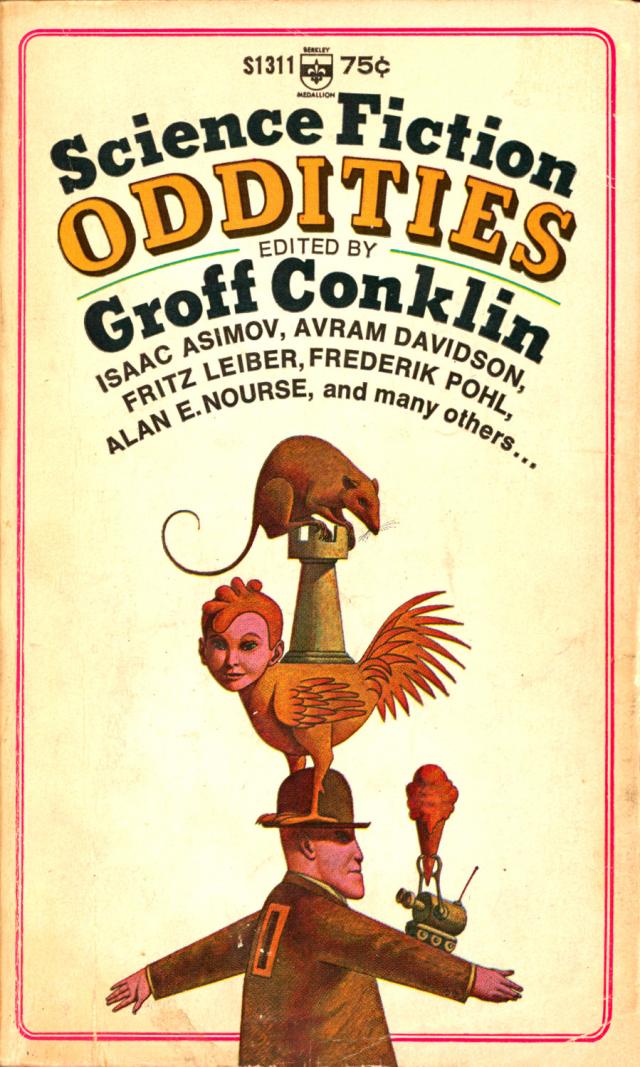
SCIENCE FICTION ODDITIES
Groff Conklin, one of the most highly regarded anthologists in the field of science fiction, has put together an SF anthology that is truly different. He has selected nineteen science fiction stories, which are unusual and entertaining—and a little strange. Just how strange, you will find out …
Included are stories by Isaac Asimov, Avram Davidson, Fritz Leiber, Frederik Pohl, Alan E. Nourse, and many others.
Science Fiction
EDITED BY
Groff Conklin
A BERKLEY MEDALLION BOOK published by
BERKLEY PUBLISHING CORPORATION
COPYRIGHT © 1966 BY GROFF CONKLIN
Published by arrangement with the Editor
ACKNOWLEDGMENTS
Alan Arkin, “People Soup.” Copyright © 1958 by Galaxy Publishing Corporation. Reprinted by permission of the author and Artists Agency Corporation from Galaxy, November 1958.
Isaac Asimov, “What Is This Thing Called Love?” Copyright © 1961 by Ziff-Davis Publishing Company, me. Reprinted by permission of the author from Amazing Stories, March 1961, where it appeared under the title, “Playboy and the Slime God.”
Stephen Barr, “Callahan and the Wheelies.” Copyright © I960 by Mercury Press, Inc. Reprinted by permission of the author from Magar zirte of Fantasy and Science Fiction, August I960.
R. Bretnor. “Mrs. Poppledore’s Id.” Copyright © 1952 by Mercury Press, Inc. Reprinted by permission of the author from Magazine of Fantasy and Science Fiction, February 1952.
Avram Davidson and Sidney Klein, “The Teeth of Despair.” Copyright © 1961 by Mercury Press, lac. Reprinted by permission of Scott Meredith Literary Agency from Magazine of Fantasy and Science Fiction, May 1961.
G. C. Edmondson. “The Galactic Calabash.” Copyright © 1960 by Mercury Press, Inc. Reprinted by permission of Robert P. Mills from Magazine of Fantasy ana Science Fiction, May 1960.
H. F. Ellis, “Space-Crime Continuum.” Copyright © 1954 by Mercury Press, Inc. Reprinted by permission of Ben Roth Agency from Magazine of Fantasy and Science Fiction, September 1954, which in turn reprinted it from Punch with the permission of the Proprietors of Punch.
Charles L. Harness, “The Chessplayers.” Copyright © 1953 by Mercury Press, Inc. Reprinted by permission of the author from Magazine of Fantasy and Science Fiction, October 1953.
R. A. Lafferty, “What’s the Name of That Town7” Copyright © 1964 by Galaxy Publishing Corporation. Reprinted by permission of the author from Galaxy, October 1964.
Fritz Leiber, “Rump-Titty-Titty-Tum-TAH-Tee.” Copyright © 1958 by Mercury Press, Inc. Reprinted by permission of the author and the author’s agent, Robert P. Mills, from Magazine of Fantasy and Science Fiction, May 1958.
Robert Lory, “Rundown.” Copyright © 1963 by Galaxy Publishing Corporation. Reprinted by permission of the author from IF Science Fiction, May 1963.
Edward Mackin, “The Trouble with H.A.R.R.I.” Copyright © 1957 by Hamilton & Co. (Stafford) Ltd. Reprinted by permission of the author and his literary agent, E. J. Carnell, from Authentic Science Fiction, 1957.
Winston K. Marks, “The Water Eater.” Copyright © 1953 by Galaxy Publishing Corporation. Reprinted by permission of the author and the author’s agent, Scott Meredith Literary Agency, from Galaxy, June 1953.
Robert Nathan, “A Pride of Carrots.” Copyright © 1959 by Robert Nathan. Reprinted by permission of the author from Magazine of Fantasy and Science Fiction, December 1959.
Gerard E. Neyroud, “The Terra-Venusian War of 1979.” Copyright © 1959 by Mercury Press, Inc. Reprinted by permission of the author from Magazine of Fantasy and Science Fiction, December 1959.
Alan E. Nourse, “The Coffin Cure.” Copyright © 1951, 1952, 1953, 1956, 1957, 1961 by Alan E. Nourse. Reprinted by permission of David McKay Company, Inc., Publishers, from Galaxy Magazine and Tiger by the Tail and other Science Fiction Stories.
John Novotny, “On Camera.” Copyright © 1956 by Mercury Press, Inc. Reprinted by permission of the author from Magazine of Fantasy and Science Fiction, April 1965.
John R. Pierce, “See No Evil.” Copyright © 1966 by Berkley Publishing Corporation. Here published for the first time by permission of the author.
Frederik Pohl, “Punch.” Copyright © 1961 by H. M. H. Publishing Co., Inc. Reprinted by permission of the author from Magazine of Fantasy and Science Fiction, January 1963.
BERKLEY MEDALLION EDITION, NOVEMBER, 1966
BERKLEY MEDALLION BOOKS are published by
Berkley Publishing Corporation
15 East 26th Street, New York, N.Y. 10010
Berkley Medallion Books ® TM 757,375
Printed in the United States of America
Contents:-
Introduction
People Soup ALAN ARKIN
What Is This Thing Called Love? ISAAC ASIMOV
Callahan and The Wheelies STEPHEN BARR
Mrs. Poppledore’s Id R. BRETNOR
The Teeth of Despair AVRAM DAVIDSON AND SIDNEY KLEIN
A Galactic Calabash O. C. EDMONDSON
Space-Crime Continuum H. F. ELLIS
The Chessplayers CHARLES L. HARNESS
What’s The names of That Town R. A. LAFFERTY
Rump-Titty-Titty-Tum-TAH-Tee FRITZ LEIBER
Rundown ROBERT LORY
The Trouble With H.A.R.R.I. EDWARD MACKIN
The Water Eater WINSTON K. MARKS
A Pride of Carrots ROBERT NATHAN
The Terra Venusian War of 1979 GERARD E. NEYROUD
The Coffin Cure ALAN E. NOURSE
On Camera JOHN NOVOTNY
See No Evil JOHN R. PIERCE
Punch FREDERICK POHL
Introduction
Not so many years ago, when the otherwise quite independent words “molecule” and “biology” were being more and more often associated in the scientific press, a questioning student is said to have asked one of his professors—no doubt a cynical type—what, exactly, “molecular biology” was.
The professor is rumored to have answered, undoubtedly with a knowing smile, “The best definition that I can formulate for you on a moment’s notice is that it is the content of any paper that appears in a journal having the phrase ‘molecular biology’ in its title.”
This, it so happens, is analogically an excellent way to describe the contents of the present collection of curious literary objects. The stories are science fiction because each and every one of them appeared in some magazine having the words “science fiction” in its title or subtitle.
Other than that, these tales for the most part follow their own vision, and adhere to no established pattern or concept or definition. They are better described by the word “oddities” in the title of this book than by the first part of the phrase. Odd most of them are, and delightfully so. Science fiction (at least according to the standard definitions by the more erudite students of the subject) the large majority are not.
It is true that two or three representatives of the genre in its rigidly classical sense have been included, but that is only because I personally was enamored of them. On the whole, however, the stories you are about to encounter in this volume are solely intended to please, not to fit some pre-tailored straitjacket defining what science fiction should be. So—forget categories, and simply enjoy yourself!
GROFF CONKLIN
People Soup
ALAN ARKIN
The kind of comedian I like is one who knows how to act funny—not just act himself. Too many comedians are simply exhibitionists, and their work is as much a comment on their characters as on their inadequate act-ting abilities.
Alan Arkin is obviously a genuine comic actor: otherwise he would not have been able to write such a quietly insane bit of science nonsense as ‘
‘People Soup.” His stage acting speaks for itself: his hilarious doings in the Broadway stage hits, “Enter Laughing” and “Luv,” his earlier work with the famous Second City improvisational group, and, most lately, his starring role in the 1966 movie hit, “The Russians Are Coming, The Russians Are Coming.”
Unfortunately, Arkin has limited his “acting of the pen” to the classic bit that follows, plus one other Galaxy tale, “Whisk-Boom”; but he also wrote the music for an Off-Broadway play in which he had the lead part, and has on hand a “brilliant” (his word) “unproduced” (also his word) movie script
Bonnie came home from school and found her brother in the kitchen, doing something important at the sink. She knew it was important because he was making a mess and talking to himself. The sink drain was loaded down with open soda bottles, a sack of flour, corn meal, dog biscuits, molasses, Bromo-Seltzer, a tin of sardines and a box of soap chips. The floor was covered with drippings and every cupboard in the kitchen was open. At the moment, Bonnie’s brother was putting all his energy into shaking a plastic juicer that was half-filled with an ominous-looking, frothy mixture.
Bonnie waited for a moment, keeping well out of range, and then said, “Hi, Bob.”
“’Lo,” he answered, without looking up.
“Where’s Mom?”
“Shopping.”
Bonnie inched a little closer. “What are you doing, Bob?” she asked.
“Nothing.”
“Can I watch?”
“No.”
Bonnie took this as a cue to advance two cautious steps. She knew from experience how close she could approach her brother when he was being creative and still maint
Bonnie moved in a bit closer. “Are you making another experiment?” she asked.
“Who wants to know?” Bob answered, in his mad-scientist voice, as he swaggered over to the refrigerator and took out an egg, some old bacon fat, a capsuled vitamin pill, yesterday’s Jello and a bottle of clam juice.
“Me wants to know,” said Bonnie, picking up an apple that had rolled out of the refrigerator and fallen on the floor.
“Why should I tell you?”
“I have a quarter.”
“Where’d you get it?”
“Mom gave it to me.”
“If you give it to me, I’ll tell you what I’m doing.”
“It’s not worth it.”
“I’ll let you be my assistant, too.”
“Still not worth it.”
“For ten cents?”
“Okay, ten cents.”
She counted out the money to her brother and put on an apron. “What should I do now, Bob?”
“Get the salt,” Bob instructed.
He poured sardine oil from the can into the juicer, being very careful not to let the sardines fall in. When he had squeezed the last drop of oil out of the can, he ate all the sardines and tossed the can into the sink.
Bonnie went after the salt and, when she lifted out the box, she found a package containing two chocolate graham crackers.
“Mom has a new hiding place, Bob,” she announced*
Bob looked up. “Where is it?”
“Behind the salt.”
“What did you find there?”
“Two chocolate grahams.”
Bobby held out his hand, accepted one of the crackers without thanks and proceeded to crumble the whole thing into his concoction, not even stopping to lick the chocolate off his hands.
Bonnie frowned in disbelief. She had never seen such self-sacrifice. The act made her aware, for the first time, of the immense significance of the experiment
She dropped her quarrel completely and walked over to the sink to get a good look at what was being done. All she saw in the sink was a wadded, wet Com Flakes box, the empty sardine tin and spillings from the juicer, which by this time was beginning to take on a distinctive and unpleasant odor. Bob gave Bonnie the job of adding seven pinches of salt and some cocoa to the concoction.
“What’s it going to be, Bob?” she asked, blending the cocoa on her hands into her yellow corduroy skirt.
“Stuff,” Bob answered, unbending a little.
“Government stuff?”
“Nope.”
“Spaceship stuff?”
“Nope.”
“Medicine?”
“Nope.”
“I give up.”
“It’s animal serum,” Bob said, sliced his thumb on the sardine can, glanced unemotionally at the cut, ignored it “What’s animal serum, Bob?”
“It’s certain properties without which the universe in eternity regards for human beings.”
“Oh,” Bonnie said. She took off her apron and sat down at the other end of the kitchen. The smell from the juicer was beginning to reach her stomach.
Bobby combed the kitchen for something else to throw into his concoction and came up with some oregano and liquid garlic.
“I guess this is about it,” he said.
He poured the garlic and oregano into his juicer, put the lid on, shook it furiously for a minute and then emptied the contents into a deep pot
“What are you doing now, Bob?” Bonnie asked.
“You have to cook it for ten minutes.”
Bobby lit the stove, put a cover on the pot, set the timer for ten minutes and left the room. Bonnie tagged after him and the two of them got involved in a rough game of basketball in the living room.
“BING!” said the timer.
Bob dropped the basketball on Bonnie’s head and ran back into the kitchen.
“It’s all done,” he said, and took the cover off the pot. Only his dedication to his work kept him from showing the discomfort he felt with the smell that the pot gave forth.
“Fyew!” said Bonnie. “What do we do with it now? Throw it out?”
“No, stupid. We have to stir it till it cools and then drink it.”
“Drink it?” Bonnie wrinkled her nose. “How come we have to drink it?”
Bobby said, “Because that’s what you do with experiments, stupid.”
“But, Bob, it smells like garbage.”
“Medicine smells worse and it makes you healthy,” Bob said, while stirring the pot with an old wooden spoon.
Bonnie held her nose, stood on tiptoe and looked in at the cooking solution. “Will this make us healthy?”
“Maybe.” Bob kept stirring.
“What will it do?”
“You’ll see.” Bob took two clean dish towels, draped them around the pot and carried it over to the formica kitchen table. In the process, he managed to dip both towels in the mixture and bum his already sliced thumb. One plastic handle of the pot was still smoldering, from being too near the fire, but none of these things seemed to have the slightest effect on him. He put the pot down in the middle of the table and stared at it, chin in hand.
Bonnie plopped down opposite him, put her chin in her hands and asked, “We have to drink that stuff?”
“Yup.”
“Who has to drink it first?” Bob made no sign of having heard. “I thought so,” said Bonnie. Still no comment. “What if it kills me?”
Bobby spoke by raising his whole head and keeping his jaw stationary in his hands. “How can it hurt you? There’s nothing but pure food in there.”
Bonnie also sat and stared. “How much of that stuff do I have to drink?”
“Just a little bit. Stick one finger in it and lick it off.”
Bonnie pointed a cautious finger at the tarry-looking brew and slowly immersed it, until it barely covered the nail. “Is that enough?”
“Plenty,” said Bob in a judicious tone.
Bonnie took her finger out of the pot and stared at it for a moment. “What if I get sick?”
“You can’t get sick. There’s aspirin and vitamins in it, too.”
Bonnie sighed and wrinkled her nose. “Well, here goes,” she said. She licked off a little bit Bob watched her with his television version of a scientific look. “How do you feel?” he inquired.
Bonnie answered, “It’s not so bad, once it goes down. You can taste the chocolate graham cracker.” Bonnie was really enjoying the attention. “Hey,” she said, “I’m starting to get a funny feeling in my—” and, before she could finish the sentence, there was a loud pop.
Bob’s face registered extreme disappointment.
She sat quite still for a moment and then said, “What happened?”
“You’ve turned into a chicken.”
The little bird lifted its wings and looked down at itself. “How come I’m a chicken, Bob?” it said, cocking its head to one side and staring at him with its left eye.
“Ah, nuts,” he explained. “I expected you to be more of a pigeon thing.” Bob mulled over the ingredients of his stew to see what went wrong.
The chicken hopped around the chair on one leg, flapped its wings experimentally and found itself on the kitchen table. It walked to the far corner and peered into a small mirror that hung on the side of the sink cabinet “I’m a pretty ugly chicken, boy,” it said.





