

7 trips through time and.., p.1
7 Trips Through Time and Space, page 1


25-09-2023
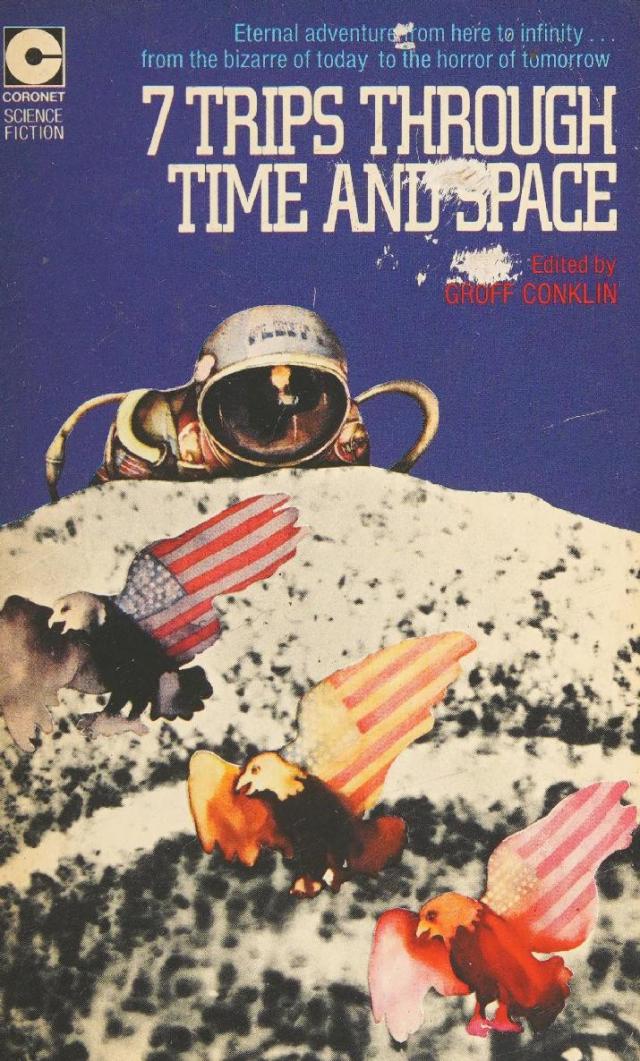
Eternal adventure from here to infinity… from the bizarre of today to tne horror of tomorrow
Seven excellent tales included
Seven Trips
Through
Time and Space
Edited by Groff Conklin
CORONET BOOKS Hodder Fawcett Ltd., London
Copyright © 1968 by Fawcett Publications, Inc.
Coronet Books Edition 1969
Second impression 1972 •
Third impression 1973
The characters and situations in this book are
entirely imaginary and bear no relation to any real
person or actual happening
This book is sold subject to the condition that
it shall not, by way of trade or otherwise, be
lent, re-sold, hired out or otherwise circulated
without the publisher’s prior consent in any
form of binding or cover other than that in
which this is published and without a similar
condition including this condition being
imposed on the subsequent purchaser.
Printed and bound in Great Britain for
Coronet Books,
Hodder Fawcett Ltd,
St. Paul’s House, Warwick Lane,
London, EC4P 4AH
by Hazel I Watson & Viney Ltd,
Aylesbury, Bucks
ISBN 0 340 10866 5
INTRODUCTION
In the September 16,1967, issue of The New Yorker, the department entitled “The Talk of the Town” presented a report on the twenty-fifth annual World Science Fiction convention, held in New York City at the Statier Hilton hotel. The piece opened by stating that The New Yorker had “learned that a debate has been going on between the Old Fashioned Futurists, who want science fiction writers to keep on writing about the future as they always have, and the New Waveicles, who are determined to drag the genre-kicking and screaming, if necessary—into the twenty-first century” where, according to one of the New Waveicles himself, what’s wanted is “total freedom” —“real sex, real drugs, really shocking ideas about society.” William Burroughs was mentioned as a model for these “advanced” science fiction writers to follow.
Now, we have nothing against this New Wave in theory, nor against any effective effort to broaden and enrich science fiction with new concepts and materials, always provided the stories are good. The trouble seems to be that the works of many of the avant-garde S.F. writers have little to recommend them except their shock value, and that is not enough.
So let me set your mind at rest: In the present collection of Old (but not tired!) Wave science fiction, there are, of course, some really shocking ideas about society, since that is one of the major concerns of adult science fiction and always has been; but there is little if any of the merely verbally shocking stuff that characterizes much post-adolescent writing today.
Furthermore, every one of these tales is set solidly —not in the twenty-first century (which really will turn out to be little more than the latter third of the twentieth century, carried to extremes), but in various far more distant times in the development of space travel, when men will be skittering out among the stars, investigating unimaginably distant and different species. What these stories tend to demonstrate is how much these remote polities can logically be expected to reflect the nascent growth, diversification, judgmental errors and suicidal insanities of our own sadly defective world.
The “new” is almost always the old and familiar, dressed up in the seemingly outlandish rigging of future scientific and technological advances. The truly novel, on the other hand, is found in stories of the imagination that extrapolate from the science of today, and describe worlds and peoples of possible tomorrows so that they ring true and at the same time give the reader the unforgettable experience of stretching his imagination’s wings. It is that sort of novelty that you will find in the seven exciting tales that comprise the contents of this book.
GROFF CONKLIN
Contents:-
INTRODUCTION
FLATLANDER - Larry Niven
THE CRIME AND THE GLORY OF COMMANDER SUZDAL - Cordwainer Smith
OVERPROOF
Johnathan Blake Mackenzie
POOR PLANET - J. T. McIntosh
SHAMAR’S WAR - Kris Neville
THE TACTFUL SABOTEUR - Frank Herbert
MINISTRY OF DISTURBANCE - H. Beam Piper
THE TACTFUL SABOTEUR by Frank Herbert, copyright © 1964 by Galaxy Publishing Corporation. By permission of Lurton Blassingame. From Galaxy Science Fiction, October 1964.
POOR PLANET, by J. T. McIntosh, copyright © 1964 by Mercury Press, Inc, By permission of Lurton Blassingame. From The Magazine of Fantasy and Science Fiction, August 1964
OVERPROOF, by Jonathan Blake Mackenzie, copyright © 1965 by Cond6 Nast Publications, Inc. By permission of Randal Garrett and Scott Meredith Literary Agency Inc. From Analog Science Fiction—Science Fact, October 1965.
SHAMAR’S WAR, by Kris Neville, copyright © 1964 by Galaxy Publishing Corporation. By permission of Kris Neville and Scott Meredith Literary Agency, Inc. From Galaxy Science Fiction, February 1964.
FLATLANDER, by Larry Niven, copyright © 1967 by Galaxy Publishing Corporation. By permission of Larry Niven. From Worlds of If Science Fiction, March 1967.
MINISTRY OF DISTURBANCE, by H. Beam Piper, copyright © 1958 by Street and Smith Publications, Inc. By permission of Charles Piper, administrator. From Astounding Science Fiction, December 1958.
THE CRIME AND GLORY OF COMMANDER SUZDAL, by Cordwainer Smith, copyright © 1963 by Ziff-Davis Publishing Company. By permission of Harry Altshuler. From Amazing Stories, May 1964.
FLATLANDER
Larry Niven
I
The most beautiful girl aboard turned out to have a husband with habits so solitary that I didn’t know about him until the second week. He was about five feet four and middle-aged, but he wore a hellflare tattoo on his shoulder, which meant he’d been on Kzin during the war thirty years back, which meant he’d been trained to kill adult kzinti with his bare hands, feet, elbows, knees and whatnot. When we found out about each other he very decently gave me a first warning, and broke my arm to prove he meant it.
The arm still ached a day later, and every woman on the Lensman was over two hundred years old. I drank .alone. I stared glumly into the mirror behind the curving bar. The mirror stared glumly back.
“Hey. You from We Made It. What am I?”
He was two chairs down, and he was glaring. Without the beard he would have had a round, almost petulant face … I think. The beard, short and black and carefully shaped, made him look like a cross between Zeus and an angry bulldog. The glare went with the beard. His square fingers wrapped a large drinking bulb in a death grip. A broad belly matched broad shoulders to make him look massive rather than fat.
Obviously he was talking to me. I asked, “What do you mean, what are you?”
“Where am I from?”
“Earth.” It was obvious. The accent was Earth. So did the conservatively symmetrical beard. His breathing was unconsciously natural in the ship’s standard atmosphere, and his build had been forged at one point zero gee.
“Then what am I?”
“A flatlander.”
The glare heat increased. He’d obviously reached the bar way ahead of me. “A flatlander! Dammit, everywhere I go I’m a flatlander. Do you know how many hours I’ve spent in space?”
“No. Long enough to know how to use a drinking bulb.”
“Funny. Very funny. Everywhere in human space a flatlander is a shnook who never gets above the atmosphere. Everywhere but Earth. If you’re from Earth you’re a flatlander all your life. For the last fifty years I’ve been running about in human space, and what am I? A flatlander. Why?”
“Earthian is a clumsy term.”
“What is WeMadeltian?” he demanded.
“I’m a crashlander. I wasn’t bom within fifty miles of Crashlanding City, but I’m a crashlander anyway.”
That got a grin. I think. It was hard to tell with the beard. “Lucky you’re not a pilot.”
“I am. Was.”
“You’re kidding. They let a crashlander pilot a ship?”
“If he’s good at it.”
“I didn’t mean to pique your ire, sir. May I introduce myself? My name’s Elephant.”
“Beowulf Shaeffer.”
He bought me a drink. I bought him a drink. It turned out we both played gin, so we took fresh drinks to a card table… .
When I was a kid I used to stand out at the edge of Crashlanding Port watching the ships come in. I’d watch the mob of passengers leave the lock and move in a great clump toward customs, and I’d wonder why they seemed to have trouble navigating. A majority of the starborn would always walk in weaving lines, swaying and blinking teary eyes against the sun. I used to think it was because they came from different worlds with different gravities and different atmospheres beneath differently colored suns.
Later I learned different.
There are no windows in a passenger spacecraft. If there were, half the passengers would go insane; it takes an unusual mentality to watch the blind-spot appearance of hyperspace and still keep one’s marbles. For passengers there is nothing to watch and nothing to do, and if you don’t like reading sixteen hours a day then you drink.
The ship grounded at Los Angeles two days after I met
knew almost as much about each other as anyone knows about anyone. In a way I was sorry to see him leave.
“You’ve got my number?”
“Yah. But, like I said, I don’t know just what I’ll be doing.” I was telling the truth. When I explore a civilized world I like to make my own discoveries.
“Well, call me if you get a chance. I wish you’d change your mind. I’d really like to show you something of Earth.”
“I decline with thanks. Good-by, Elephant. It’s been fun.”
Elephant waved and turned through the natives’ door. I went on to face the smuggler baiters. The last drink was still with me, but I could cure that at the hotel. I never expected to see Elephant again. I really never did.
Nine days ago I’d been on Jinx, I’d been rich. And I’d been depressed.
The money and the depression had stemmed from the same source. The puppeteers, those three-legged, two-headed professional cowards and businessmen, had lured me into taking a new type of ship all the way to the galactic core, thirty thousand light-years away. The trip was for publicity purposes, to get research money to iron out the imperfections in the very ship I was riding.
I suppose I should have had more sense, but I never do, and the money was good. The trouble was that the core had exploded by the time I got there. The core stars had gone off in a chain reaction of novas ten thousand years ago, and a wave of radiation was even then (and even now) sweeping methodically toward known space.
In just over twenty thousand years, we’ll all find ourselves in deadly danger.
You’re not worried? It didn’t bother me much either. But every puppeteer in known space vanished overnight, heading for Finagle knows what other galaxy.
I was depressed! I missed the puppeteers and hated knowing I was responsible for their going. I had time, and money, and a black melancholia to work off. And I’d always wanted to see Earth.
II
Earth smelled good. There was a used flavor to it, a breathed flavor, unlike anything I’ve ever known. It was the difference between spring water and distilled water. Somewhere in each breath I took were molecules breathed by Dante, Aristotle, Shakespeare, Heinlein, Carter and my own ancestors. Traces of past industries lingered in the air, sensed if not smelled: gasoline, coal fumes, tobacco and burnt cigarette filters, diesel fumes, ale breweries. I left the customs house with inflated lungs and a questioning look.
I could have taken a transfer booth straight to the hotel. I decided to walk a little first.
Everyone on Earth had made the same decision.
The pedwalk held a crowd such as I had never imagined. They were all shapes and all colors, and they dressed in strange and eldritch ways. Shifting colors assaulted the eye and sent one reeling. On any world in human space, any world but one, you know immediately who the natives are. Wunderland? Asymmetric beards mark the nobility, and the common people are the ones who quickly step out of their way. We Made It? The pallor of our skins in summer and winter; in spring and fall, the fact that we all race upstairs, above the buried cities and onto the blooming desert, eager to taste sunlight while the murderous winds are at rest. Jinx? The natives are short and wide and strong; a sweet little old lady’s handshake can crush steel. Even in the Belt, within the solar system, a Belter strip haircut adorns both men and women. But Earth—!
No two looked alike. There were reds and blues and greens, yellows and oranges, plaids and stripes. I’m talking about hair, you understand, and skin. All my life I’ve used tannin secretion pills for protection against ultraviolet, so that my skin color has varied from its normal pinkish-white (I’m an albino) to (under bluewhite stars) -tuxedo black. But I’d never known that other skin dye pills existed. I stood rooted to the pedwalk, letting it carry me where it would, watching the incredible crowd swarm around me. They were all knees and elbows. Tomorrow I’d have bruises.
“Hey!”
The girl was four or five heads away, and short. I’d never have seen her if everyone else hadn’t been short too. Flatlanders rarely top six feet. And there was this girl, her hair a topological explosion in swirling orange and silver, her face a faint, subtle green with space-black eyebrows and lipstick, waving something and shouting at me.
Waving my wallet.
I forced my way to her, until we were close enough to touch, until I could hear what she was saying above the crowd noise.
“Stupid! Where’s your address? You don’t even have a place for a stamp!”
“What?”
She looked startled. “Oh! You’re an offworlder.”
“Yah!” My voice would give out fast at this noise level.
“Well, look.” She shoved her way closer to me. “Look, you can’t go around town with an off worlder’s wallet. Next time someone picks your pocket he may not notice ’till you’re gone.”
“You picked my pocket?”
“Sure! Think I found it? Would I risk my precious hand under all those spike heels?”
“How if I call a cop?”
“Cop? Oh, a stoneface.” She laughed merrily. “Learn or go under, man. There’s no law against picking pockets. Look around you.”
I looked around me, then looked back fast, afraid she’d disappear. Not only my cash, but my Bank of Jinx draft for forty thousand stars, was in that wallet. Everything I owned.
“See them all? Sixty-four million people in Los Angeles alone. Eighteen billion in the whole world. Suppose there was a law against picking pockets? How would you enforce it?” She deftly extracted the cash from my wallet and handed the wallet back. “Get yourself a new wallet, and fast. It’ll have a place for your address and a window for a tenth-star stamp. Put your address in right away, and a stamp too. Then the next guy who takes it can pull out the money and drop your wallet in the nearest mailbox, no sweat. Otherwise you lose your credit cards, your ident, everything.” She stuffed two hundred odd stars in cash between her breasts, flashed me a parting smile as she turned.
“Thanks,” I called. Yes, I did. I was still bewildered, but she’d obviously stayed to help me. She could just as easily have kept wallet and all.
“No charge,” she called back, and was gone.
I stopped off at the first transfer booth I saw, dropped a halfstar in the coin slot and dialed Elephant.
The vestibule was intimidating.
I’d expected a vestibule. Why put a transfer booth inside your own home, where any burglar can get in just by dialing your number? Anyone who can afford the lease on a private transfer booth can also afford a vestibule with a locked door and an intercom switch.
There was a vestibule, but it was the size of a living room, furnished with massage chairs and an autovendor. There was an intercom, but it was a flat vidphone, three hundred years old, restored at perhaps a hundred times its original cost. There was a double door of what looked like polished brass, with two enormous carved handles, and it stood fifteen feet high.
I’d suspected Elephant was well off, but this was too much. It occurred to me that I’d never seen him completely sober, that I had in fact turned down his offer of guide, that a simple morning-after treatment might have wiped me from his memory. Shouldn’t I just go away? I had wanted to explore Earth on my own.
But I didn’t know the rules!
I stepped out of the booth and glimpsed the back wall.
It was all picture window, with nothing outside. Just fleecy blue sky. How peculiar, I thought, and stepped closer.
Elephant lived halfway up a cliff. A sheer mile-high cliff.
The phone rang.


