

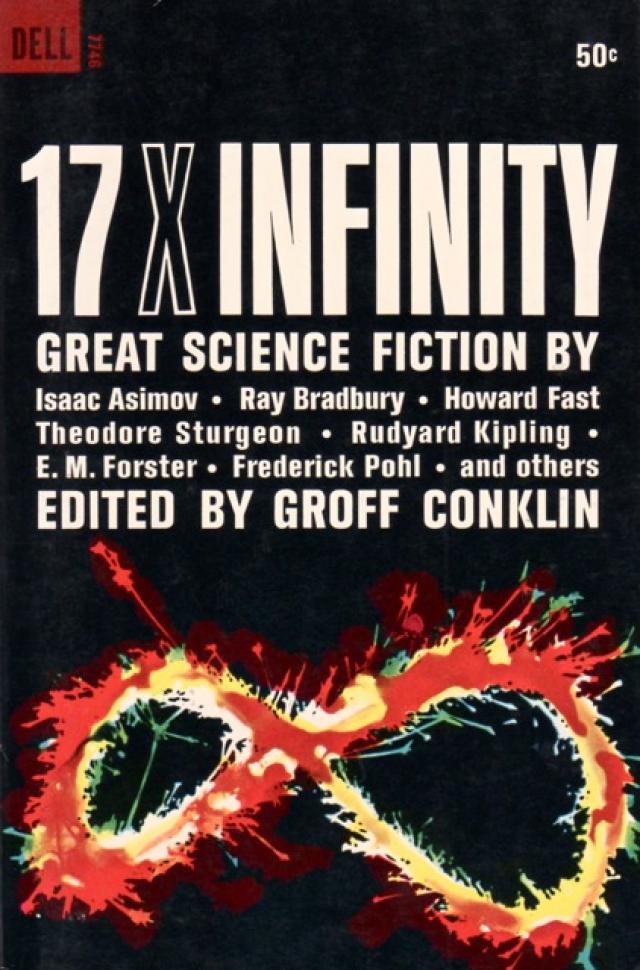
17 x infinity 1963 antho.., p.1
17 X Infinity (1963) Anthology, page 1


Copyright © 1963, by Groff Conklin
Dell First Edition
641409, Dell Publishing Co., Inc.
All rights reserved.
First printing—August, 1963
Printed in U.S.A.
17 X Infinity
Teaser
About the Editor
Acknowledgments
Introduction
Groff Conklin
THE SIMIAN PROBLEM
Hollis Alpert
STRIKEBREAKER
Isaac Asimov
COME INTO MY CELLAR
Ray Bradbury
MS FND IN A LBRY
Hal Draper
CATO THE MARTIAN
Howard Fast
THE SPACEMAN COMETH
Henry Greigor Felsen
THE MACHINE STOPS
E.M. Forster
FRANCES HARKINS
Richard Goggin
THE DAY THEY GOT BOSTON
Herbert Gold
A-W-F, UNLIMITED
Frank Herbert
AS EASY AS A.B.C.
Rudyard Kipling
SILENZIA
Alan Nelson
WHAT TO DO UNTIL THE ANALYST COMES
Frederik Pohl
SHORT IN THE CHEST
Idris Seabright
THE LAST OF THE SPODE
Evelyn Smith
NEVER UNDERESTIMATE
Theodore Sturgeon
BROOKLYN PROJECT
William Tenn
NEVER UNDERESTIMATE BY THEODORE STURGEON
When his wife told him that sex was hotter than science, the great scientist decided to perform an experiment—in human chemistry.
WHAT TO DO UNTIL THE ANALYST COMES BY FREDERIK POHL
It wasn’t habit forming; it couldn’t… hum . . . hurt you, or… ah . . . make you sick. It just kept you from . . . oh . . . um . . . doing A.N.Y.T.H.I.N.G!
STRIKEBREAKER BY ISAAC ASIMOV
His job was different, so different that no one would touch him, talk to him, marry him—but 30,000 were willing to die for him.
—Just three samples of the unusual and ingenious tales awaiting you in 17 X INFINITY.
GROFF CONKLIN is famous as a discriminating science fiction anthologist. His many distinguished and original collections include: INVADERS OF EARTH, SCIENCE FICTION MUTATIONS, SUPERNATURAL READER, and SIX GREAT SHORT NOVELS OF SCIENCE FICTION, available in a Dell edition.
ACKNOWLEDGMENTS
The following selections in this anthology are reproduced by permission of the authors, their publishers, or their agents:
Hollis Alpert, THE SIMIAN PROBLEM. Copyright © 1960 by Mercury Press, Inc. Reprinted by permission of the author from The Magazine of Fantasy and Science Fiction, July 1960.
Isaac Asimov, STRIKEBREAKER. Copyright © 1956 by Columbia Publications, Inc. Reprinted by permission of the author from Science Fiction Stories, January 1957.
Ray Bradbury, COME INTO MY CELLAR. Copyright © 1962 by Ray Bradbury. Reprinted by permission of Harold Matson Co. from Galaxy Magazine, October 1962.
Hal Draper, MS FND IN A LBRY. Copyright © 1961 by Mercury Press, Inc. Reprinted by permission of the author from The Magazine of Fantasy and Science Fiction, December 1961.
Howard Fast, CATO THE MARTIAN. Copyright © 1960 by Mercury Press, Inc. Reprinted by permission of the author and Paul Reynolds & Son from The Magazine of Fantasy and Science Fiction, June 1960.
Henry Gregor Felsen, THE SPACEMAN COMETH. Copyright © 1956 by Mercury Press, Inc. Reprinted by permission of the author from The Magazine of Fantasy and Science Fiction, April 1956.
E. M. Forster, THE MACHINE STOPS. Copyright © 1928 by Harcourt, Brace & World, Inc.; renewed in 1956 by E. M. Forster. Reprinted by permission of the author; Harcourt, Brace & World, Inc., for the United States; and Sidgwick & Jackson, Ltd., for world rights with the exception of the United States. From The Collected Short Stories of E. M. Forster.
Richard Goggin, FRANCES HARKINS. Copyright © 1952 by Mercury Press, Inc. Reprinted by permission of the author from The Magazine of Fantasy and Science Fiction, December 1952.
Herbert Gold, THE DAY THEY GOT BOSTON. Copyright © 1961 by Mercury Press, Inc. Reprinted by permission of the author and James Brown Associates, Inc., from The Magazine of Fantasy and Science Fiction, September 1961.
Frank Herbert, A-W-F UNLIMITED. Copyright © 1961 by Galaxy Publishing Corporation. Reprinted by permission of Lurton Blassingame from Galaxy, June 1961.
Rudyard Kipling, AS EASY AS A.B.C. and MacDONOUGH’S SONG. Copyright © 1912 by Rudyard Kipling. Reprinted by permission of Mrs. George Bambridge, Doubleday & Co., Inc., the Macmillan Company of Canada, Ltd., Messrs. Macmillan & Co., Ltd., and A. P. Watt & Son, from A Diversity of Creatures, by Rudyard Kipling.
Alan Nelson, SILENZIA. Copyright © 1953 by Mercury Press, Inc. Reprinted by permission of the author from The Magazine of Fantasy and Science Fiction,
September 1953.
Frederik Pohl, WHAT TO DO UNTIL THE ANALYST COMES. Copyright © 1955 by Greenleaf Publishing Co. Reprinted by permission of the author from Imagination, 1955, where it was titled “Everybody’s Happy But Me!”
Idris Seabright, SHORT IN THE CHEST. Copyright © 1954 by King Size Publications, Inc. Reprinted by permission of Margaret St. Clair from Fantastic Universe, July 1954.
Evelyn Smith, THE LAST OF THE SPODE. Copyright © 1953 by Mercury Press, Inc. Reprinted by permission of the author from The Magazine of Fantasy and Science Fiction, June 1953.
Theodore Sturgeon, NEVER UNDERESTIMATE. Copyright © 1952 by Theodore Sturgeon. Reprinted by permission of the author from If, January 1952.
William Tenn, BROOKLYN PROJECT. Copyright © 1948 by Love Romances Publishing Co., Inc. Reprinted by permission of the author from Planet Stories, Fall, 1948.
INTRODUCTION
If it were not for the rigidly established convention that all anthologies, science fictional and otherwise, must have introductions by their editors—on the theory, I suppose, that if they didn’t do that bit of work they’d be collecting all those juicy dollars for practically nothing at all except reading—I would leave this volume totally unattended. For it needs no introduction whatsoever. What can one say about the infinity of possible tomorrows that is not better said by the contributors themselves? Or take your own person, dear reader: if you just let your mind wander, I am sure you’ll be able to think up a whole unwritten bookful of possibilities, all highly intriguing, I am sure.
But—tradition is tradition, so here is the Introduction. It introduces a truly varied and colorful assortment of dreams—more nightmares, perhaps, than otherwise—about the future. It is, indeed, one of the most important functions of science fiction to create this sort of extrapolation; and it is the editor’s hope that he has managed to select an extra-intelligent and pointed group of tales about what the future may bring, thus exhibiting modern (and not so modem) science fiction at its best. There even is one story that shows a tomorrow that is just about the same as today, only seen from an outsider’s viewpoint, so that we can “see ourselves as others see us.”
Avid collectors of science fiction will find some previously used favorites in this book—a break with a tradition of mine that I have indulged only a couple of times before in all my years of editing. I do not refer to the use of one or two hitherto unanthologized stories which have appeared in collections of the authors’ own tales, such as those by Howard Fast and Frederik Pohl, to name just two. Rather, I speak of the reappearance of some tales which I myself, as well as others, have previously included in science fiction miscellany: a kind of auto-cannibalism that might seem reprehensible were it not for the fact that the stories involved are so inevitably perfect, so without-question-necessary to a book based on the present theme, that they literally forced their way in.
The fact of the matter is that there are not enough truly superior stories of this type that have not yet been anthologized to make up a really worthwhile new one. Therefore there have to be a few repetitions. It may be said that all of these repeaters appeared in anthologies that are now out of print and therefore unavailable, which makes them quite novel to the new reader. As for the older fans—why, they can just read them again, as I have, and find them even more to the point than they were five, ten, even fifteen years ago, when they were first included in one or another of the innumerable science fiction anthologies that have come and gone since the boom began in 1946.
On the other hand, there are almost a dozen brand-new gems that will add luster to anyone’s treasure-hoard of science fiction. For these stories, I can only be thankful to the gods (and the authors inspired by them) for the eternal well-springs of imagination, satiric and otherwise, that continue to bubble forth these effervescences about the nature of man and the incredible society he has created for himself—a society which literally no science fiction writer could possibly spin out, so outrageously unlikely is it in reality.
It is also important to emphasize that every one of these stories about the future is, in actuality, wholly about the present! This may seem paradoxical: but it is no more paradoxical than the fact that Gulliver’s Travels was a book devoted primarily to a critique of the times of Swift (and, of course, of human nature in general), and not to its ostensible subject, some “foreign” lands in a “different” time.
In this connection it is worth remarking that there are literally no “utopias” in the present anthology, with the sole exception—and what an ou
Today, we seem to have graduated, temporarily at least, from that sort of daydreaming. We have a more urgent need, as exemplified time and time again in the present volume: to expose the dangerous or foolish or wasteful or simply screwy tendencies of our own society, by carrying them logically forward into a tomorrow where these tendencies have been permitted to exfoliate until they dominate parts or all of the world in which we will then live. The exceptions to this generalization which you will find in this book—and they are very few—are included because of their intrinsic merit, rather than because they add anything to the general pattern.
On the whole, this is an ominous, grim, gloomy collection—even though it is lots of fun to read! At least, that is my feeling about it. If you want to forget all the Social Significance and just enjoy, enjoy, enjoy (a phrase for which Harry Golden will deservedly go down in history, I am sure), well, that is your privilege. Otherwise, approach this anthology with a proper amount of spiritual and intellectual fortitude: for it is tough, friends; it is no-holds-barred, on the whole; and the futures it envisages are bleak indeed, even those which are only hinted at or (in one instance) left wholly to the imagination.
But still, let me assure you that you will find it a thoroughly worthwhile intellectual adventure, an exciting glimpse into the not-yet-real which, let us all devoutly hope, will—for the most part, at least—remain in that never-never land!
GROFF CONKLIN
THE SIMIAN PROBLEM
HOLLIS ALPERT
From the Editor’s Introduction to Adam to Atom: The Revolution in Evolution, Harcourt-Harper-Harvard-Hawthorne-Holt-&-Houghton, Inc., Nueva Boston, 1985: “In preparing this collection of essential papers in the history of human mutation from (as Norbert Huxley has wryly put it) “Monkey to Monkey,” it occurred to the editor that it might be worthwhile recalling to those with faulty memories or insufficient years, the horrifying (at the time) “thalidomide plague,” a non-genetic but congenital catastrophe of the early 1960s. Thalidomide was a synthetic tranquillizer perfected in Germany in the late 1950s, which in the years 1961-1962 was found to cause gross malformations in most infants born to mothers who took the pills during the first months of pregnancy. Almost 6,000 babies, from Wales to New South Wales, were born with no limbs or useless limb stumps—an ironic inversion of our present calamitous situation, with our infants’ and young people’s “limb” sprouting as a result of uncontrolled atomic fallout. It is particularly ironic, indeed, that during the hysterical excitement over the shocking thalidomide births the United States and the Soviet Union each conducted one of their crucial series of nuclear weapons tests that now has ended by presenting this planet with the unalterable overbalance of mutation-producing isotopes in the atmosphere, leading to our present predicament. One thing mankind seems to learn always too late is that man never learns in time.
Reprinted from the Proceedings of the Third Annual Convocation of the Society of American Geneticists, October 4,
1973. Place: The Benjamin Franklin Institute, Philadelphia, Pennsylvania. Speaker: Robert Crindall, B.S., M.S., Ph.D., Visiting Professor, Institute for Advanced Studies, Princeton University. Professor Crindall’s remarks follow.
Gentlemen:
Science, in the words of Huxley, has fulfilled her function when she has ascertained and enunciated truth. Were I not aware that a larger audience than the esteemed members of this body closely follows our proceedings, I would confine my report to a summation of present-day fact and theory concerning the Simian Problem, including relevant statistical information, and leave broader implications to the journalists and commentators who are here today in such extraordinary numbers. Under the circumstances, it has been thought wise by the officers of this society and, I should mention, by certain high officials of our government, that some one of us attempt a more generalized appraisal of the Problem than has been customary at these meetings. I hesitate to describe the contents of my remarks as a popularization. Let us say that I intend to be non-technical—which is not meant to imply that I mean to be scientific.
As many of you are aware, my connection with the Problem has been a relatively long one, and I am therefore in a position to adopt a somewhat more historical point of view than those pursuing strictly specialized lines of research. My own beginnings, so far as the Problem is concerned, were accidental (accident, too, has its place in science) and I cannot honestly wear the mantle of omniscience that has so often been attributed to me by the press. Nor, to say the least, can I take even the gloomiest satisfaction in the knowledge to which our researches have led.
As few as eight years ago, none of us in this society had the slightest inkling that our branch of learning would rise to its present high prominence. Dr. Crab well’s study, “Fallout: Early Phases,” had appeared in our journal and attracted considerable international attention among scientists, but it was regarded mainly as a source work, one that indicated certain new directions of research on genes and radioactivity. None of us, myself included, was aware of the historic importance of the section devoted to “Evolutionary Possibilities, Strontium and Carbon 14 Variety.” The oversight was undoubtedly due to the fact that the section was primarily speculative. One columnist, coming across the study, wrote that Dr. Crabwell had gone out on a limb. I daresay that the laughter generated by his pun would sound hollow today.
Nor, the following year, did anyone relate to that study my own inquiries into “Suicide Rates in the Eastern and Southern States, 1965 compared with 1955.” A current misconception has it that Dr. Crabwell’s study influenced the nature of my work at that time. Chronologically speaking, this is not true. I did refer to Dr. Crabwell’s study in 1966, but when I began my statistical examination of suicide rates the figures were planned for use as an appendix in my contemplated broad work on “Suicide, Geographic and Economic Factors.” That work had, of necessity, to be halted while the intriguing possibilities opened up by the comparison of suicide rates were explored.
To those of you without personal experience in the early period of the branch of genetic research that has dealt with the Simian Problem, there can be little awareness of the puzzling nature of the data phenomena we encountered at the time the shadow of the problem first emerged. We were,. putting it mildly, flabbergasted, when struck by the high incidence of double suicide in 1965 as compared with 1955. In New York State, for instance, the rate was approximately seven times that of the 1955 rate. This rate rose to thirteen times the norm in Arkansas (using 1955 for that figure) and eleven in Florida—a scattered pattern that was almost uninterpretable. A brilliant young assistant of mine, Casper Smith (now Professor Smith, and a member of the President’s committee on Simian Control), made correlations according to race, religion, and economic status, but found little to clear up the mystery. He did show that the rates were higher for the very low and the very high income groups.





