

Episodes, p.6
Episodes, page 6
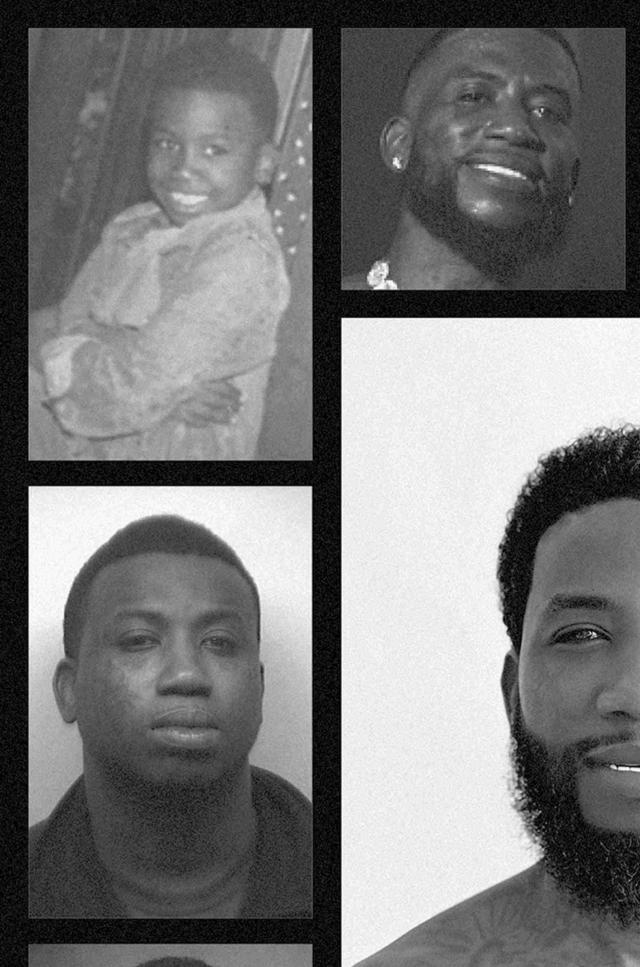


The first time I spoke to Gucci on the phone, he was in jail. It was probably like 2011. I wanted to cast him in Spring Breakers. Obviously, I had been following him for a while—with all of his early tapes—and I had been a fan for a long time leading up to that. Then we reached out to him. I met him in Atlanta pretty soon after he was released. He was still in “Trap God” mode. Since the very beginning, he was so much a part of his music and the persona, and there was nothing that wasn’t authentic about him. He was Guwop; it wasn’t like he took a cape off. At the same time, there was something also very sweet about him. There’s the mythology that surrounds him, there’s the music, and there’s the lore that surrounds him. But there’s also something—that’s in the music as well—like a comedic element, where you know he also has a sense of humor. He’s hyper-intelligent; dimensionally intelligent. He’s playing chess, and at the same time he’s also really a core artist. I think a lot of people forget that at his core, yes, there’s the mythology and there is the trap side of things, but he’s a pure artist. He’s constantly creating. There’s a complexity to Gucci. That’s why he’s such an interesting person.
I’ve been with him at times where I can see a switch go off. I’ve seen that when someone has said something to him or there’s a situation or something and you can see him go from one extreme to another in like a hair trigger. Very quickly you can see him become another person, like a classic villain out of a film. It’s like, he goes… street. The way I always interpreted it was that he’s been through his own personal Vietnam. He’s been through things and seen things. It’s obvious. It’s also in the music. That’s why people love the music, because he can go so deep into that. It’s the thing of having lived through it, and also not just lived through it, but also being at the top of the food chain. It’s like you’re a soldier, and there is that mode in him.
The eyes are the first thing in him that you notice. It’s like they go black and like cold and hard. It’s almost like his appearance completely shifts. It’s very apparent, and there’s no denying that he can very easily become another person. It makes sense that Lean accentuates that; I’m sure in a lot of people that’s a reaction. But it was almost like a character that someone would create, but at the same time it’s Gucci, so you have to process it through all the lore and the mythology that comes with it.
I understand that there is this big part of him that loves the pressure. I remember once, he came down, I think he played a show at a strip club in Nashville. We drove a bus down, and he had a crew—a lot of younger guys were with him. I remember that bus ride because it was the first time I had ever heard of the Migos. He was telling me about these kids from Atlanta called Migos and how great they were. And I’ll never forget they were sitting on the tour bus, and everyone was like getting zonked. They were watching these bootleg gangster documentaries—I think you can find these types of things on YouTube now. A lot of times people just have music in the background, but they were just playing these loud docs about gangsters, and I’ll never forget the sounds of bullet shots were ringing on the film. It was like at an ear-deafening level and was giving me such anxiety. The way a guitar person might go and listen to ambient music and light incense, the gunshots ringing out were almost like his background music.
But that’s how Gucci would relax. This is how he would unwind.
It was a state of unrest though, right? It was a state of existence, because he was so in it. He was so in it, and the music was so much a reflection of that. It was like that’s what he wanted. He wanted to almost live inside of it. There’s no way you can make the music that he made back then and be in a healthy state. The interesting thing is that era of Gucci, that music that he made is the thing that all of these kids fetishize. That’s the era where he kind of designed the blueprint of what Trap would be or the model of Trap music. The pictures he was painting, the sound, the things he was doing with Zaytoven and OJ… the whole thing really became the template. I don’t think you can make that music without having one foot in both worlds. He’s an anomaly in that way, where there is really no one else like that. He’s really a mix of all of that stuff: he’s got the street life, he’s a businessman, he’s a hustler. But he’s a pure artist, so you have all of the things that artists deal with psychologically that are mixed in with the street life. He has the ability to both be in it and then rap about it in a way that I had never heard before.
I visited him at the Terre Haute Correctional Facility, where I spent the day with him. I saw the transition; it was like a year before he was out. At that point he was already getting help; he was off all that stuff. He was very clear. Physically, he was in shape. His mind was very sharp, and it was a lot of just talking about life and what he was going to do. And the thing that’s interesting is, you would think when someone’s locked up that they’re going to just say, “I’m going to do X, Y, Z, when I get out. I can change.” All that stuff. But he implemented it in a way that was like miraculous and in a way that I had never seen.
I would have never thought that the person that went in was the person who came out.
—HARMONY KORINE
When Harmony reminded me of that time on my tour bus, watching documentaries about violence, I had to take a moment. I remember it happening, but not how it made me feel. If your brain is fired up, you’re supposed to calm it down. Maybe it’s quiet time, low light, or even calming music. It’s certainly not the sound of loud gunshots, keeping you on high alert. Loud noises and booms can give someone war flashbacks, to where they nose-dive into corners like they’re escaping a hidden bomb. My body was reclining to those sounds as my mind was repeatedly triggering itself. Some might argue there’s a comfort to familiarity. In this case, it’s the familiarity of chaos. But what I didn’t know was that I was pushing myself to my limits. Over and over and over again.
I had given up.
There’s a duality that comes from defeat. On one hand, it had gotten to the point with me where I didn’t know who I was anymore. I didn’t look the same; I didn’t talk the same; I didn’t act the same. Everyone saw it, yet only a few people addressed it. And I didn’t know how to fix it. So in that respect, I accepted defeat. This was who I was then. On the other hand, I was a superstar. I was more famous than I had ever been in my entire life. All of those things that I said I was gonna do—be successful, make a lot of money, sign artists—that was all happening! So even if my body was breaking down and my brain wasn’t working to full capacity, there was still a part of it saying, “Hey, Gucci! Look at all this stuff happening! Maybe this is all worth it.”
For a good while it was.
Checkered in, though, was me having this up-and down relationship with the media where they love my music, but they also love talking about everything I did wrong. And instead of fighting them, I let them defeat me. They won. I was gonna be the villain. The villain everyone still loved somehow. My core fans weren’t deterred by any of it. The higher-ups in the music industry might have been, but the people on the ground supporting me? They stuck by this new character. People had some idea that I wasn’t right. They had to. But it came to be like it all came with the package. I was doing sporadic stuff, I was acting out of pocket, and nobody was outwardly encouraging it. But they were entertained.
I was a showman, so I might as well give them a show.
I never liked the lights in those office conference rooms. They do something to my eyes. Artificial lighting. You can’t always wear shades and sometimes they don’t even help. People start talking and the noise starts building. I was supposed to be there to talk about some more sponsorships and some partnerships for me, music, my artists, everybody.
They don’t want you here…
I whispered to myself, “Yes, they do.”
Well, they’re gonna try and rob you. They’re paying everybody more money.
So I started yelling. Maybe I was drowning out the voice in my head or maybe I was listening to it and letting everybody in the room know that they weren’t gonna rob me.
Everyone started staring, I got self-conscious, and so I started yelling more. My reaction to simple questions was not proportionate to the ask itself. I started offending people, and in my mind I was still going to win because I had the fans, right? Well, that didn’t really go as planned, even though everyone was still tuned into what I was going to do next. I started missing show dates. I don’t even know what else I was doing, but I simply didn’t go. Maybe I was back in the studio—cutting more tracks that I would be paid to perform and then be a no-show—or I was just out robbing more people for more money to keep building. Most of all, I was just too high to function. Here were all of these opportunities, and I just squandered them. I wish somebody would’ve told me (or I would’ve told myself) that the money I was leaving on the table was more than the money I was making from pulling guns on people. If my conscience wasn’t going to take over, the math surely would have.
In the fall of 2009, I checked into rehab. Again. The opportunities didn’t stop coming, though, so I had to keep chasing them. My mixtape Wasted: The Prequel had just dropped, and so did the title track. I had an album coming, too, so I snuck out of rehab to go back and forth to the studio to record. I was riding a wave, and no rehab or pretending to dry out was going to get in the way of me and my money. I was booked to perform at the BET Hip-Hop Awards in Atlanta a few weeks later. That wasn’t something I could just sneak out and do, though. I had to bring someone, like a chaperone, to watch me. I got on stage, performed, and then I left. The irony, though, is that I performed “Wasted” while I was heading right back to rehab.
Living life high, every day, clique wasted. Wasted.
Sipping on purple stuff, rolling up stanky. Wasted.
A walking paradox. A hypocrite on stage. Everyone chanting the hook back at me. “Wasted. I’m wasted. So wasted. So wasted.” BET had me record a PSA to air along with the performance. “I want y’all to know that I do make party records, and it’s all fun. But on a serious note, I’m taking my own sobriety very seriously. And this is for real. It’s coming from ya boy Gucci. Be safe.” Did I mean it? I don’t know. I had to say it, though, and then I was in a car headed back to rehab. Everyone else got to go to the after-parties. They got to mingle. They got to have fun. I had to return to my bed.
On December 8, 2009, I released The State vs. Radric Davis just as I left rehab and entered jail. Again. While I was in rehab, I was sentenced to twelve months for probation violation. I hadn’t done my community service, but most of all, I’d failed my drug tests. It was my first major label release, and I spent it behind bars. We had cut the third single, “Lemonade,” right before I went into rehab. We were at the Palms Casino in their $25,000 suite. It comes with a recording studio, and I recorded the song there, where I was just saying things. I wasn’t even thinking. They had to later piece that song together in the studio, because my mind was just going everywhere and the lyrics reflected it. And while the Platinum plaques started stacking, I was experiencing none of it. But my demand was still high.
When I got out of jail in the middle of 2010, I was angry. Really angry. My drugs were a feast or famine, where over the course of a year I was in this tidal wave of long benders followed by stretches of drying out. My body was yelling at me. On top of that, here I was on probation (again), so I couldn’t travel like I wanted to, and in my mind, I was working so hard on this career. Meanwhile everyone else was getting to celebrate it, and I was not enjoying the spoils because I was either in rehab or in jail.
By that September, I was scheduled to attend the MTV VMAs and walk the red carpet. In the days leading up to the show, I was drinking, I was drugging, and I wasn’t sleeping. We were out in Los Angeles, so with all of the pre-award-show events, I wasn’t gonna just sit in my hotel room. Not when I felt like I’d missed most of my career in the last year because of either rehab or jail. No, I was gonna have my fun no matter what. After all of this, I wasn’t denying myself that.
When it was award show day, I looked like myself, I guess. Whatever this version of myself was. It was 95 degrees in LA, yet I was in this thick black zipped leather hoodie with matching leather pants. I had on my big ice cream chain and my shades. But again, I was angry. Gucci Mane showed up to the VMAs—as far as everyone could visibly see—but that wasn’t Gucci Mane on the carpet. The heads of Asylum at the time were Todd Moscowitz and Joie Manda, and they were there to meet me at the red carpet to give me my passes. I pulled up and looked around. Police were everywhere.
They’re here because they don’t trust you.
“Nah,” I said out loud. “They just here to keep the artists separate.”
They’re here to keep YOU separate. People got beef with you. Don’t forget that. They might not even let you in.
“Y’all gonna fuckin’ let me in?” I asked the police directly. I don’t even know how I got away with that, but I did. “Fuck y’all,” I mumbled, as I walked to the carpet. As I got escorted in the front of the photographers, the camera lights started flashing, and people started yelling my name.
Tick… tick… tick
Nobody can see under my shades that I don’t know what to do with my eyes.
They’re all looking at you… give them a show.
I had about ten grand in my back pockets. I pulled it all out, and I threw it in the faces of the police, the cameras, people, the press, everybody. As the hundreds floated through the air like tiny green wings, they were replaced by people’s arms flying into the tornado of bills. Some flapped around, catching money, while others dove to the ground, scraping up the carpet. They looked like a flock of hungry birds, devouring seeds in the park. It gave me some brief satisfaction. But by the time they’d all left, the money was all gone. There weren’t even photos of it, because everyone was too busy taking the money to snap a picture of it happening. Waka Flocka Flame was standing to the side of me, and he looked stunned. He had never seen me like this before. It was like I walked in cool, and then suddenly I wasn’t.
I just couldn’t stop.
I kept walking up to people, and the fear in their eyes only made me more aggressive.
Look at how scared they are. They don’t trust you… Nobody wanted you in here, but you’re here now. Give them hell. Give them all hell.
I couldn’t calm down. I was rude to everyone I talked to. I don’t remember any faces but Katy Perry’s. Her big blue eyes were popped out as I was storming through the backstage area. Waka kept pulling me, and I was getting more and more upset. I realize now that he was just trying to protect me. By the time we sat down, I looked around, and it felt like all eyes were on me. I was seated with Waka and Master P. While we were watching the show, that’s when the shame hit.
You really made a fool out of yourself.
I felt tears forming under my shades. They started rolling down my face. I couldn’t tell in that moment what I was more humiliated by. Was it that I’d just spent $10,000 on a stunt that had more people robbing me than anything else? Or was it that everyone was staring at me and I couldn’t control their fear because I just kept being scarier? Maybe now it was that I was sitting at an award show, and while everyone was having fun, I was here crying to myself.
There’s a word for it all: “manic.”
When you’re in a manic state, you don’t even need sleep. You can stay up for hours and hours, even days. Your body is constantly ready to go. Your mind is racing, and you can either be super happy or super mad—while being as inappropriate as possible, doing and saying things with no remorse. Little things can mess you straight up, and then you just continue the cycle and start over when new stimuli trip the wires in your brain. Could be bright lights, could be loud noises. Even voices, louder than the ones in your head. It’s probably the worst high you can ever have, but when you add to that high with drugs? Well, that’s really when all hell breaks loose. But then there’s the aftermath of it all: the exhaustion, the shame, and even the bouts of depression. It’s only then that you’re aware of what’s happening, so you start looking around and wondering what the hell even happened. It makes you sad. It makes you cry.
I might not have understood that then, but I know it now. Underneath it all, though, there was this act of rebellion. The paparazzi were snapping my photos at that award show, not knowing that right before I was thinking security was out to get me. They didn’t hear the inner dialogue; they just saw a rapper throwing money and smiling. Like a star. And that’s the part that keeps feeding you, right? So even if a part of me felt intense shame—to the point where I was crying at the Nokia Theatre while everyone else was laughing and smiling—I was still gonna smile when they were looking at me. Scared or not, they were gonna see me looking carefree. The question is: Who’s more scared of whom?
To be honest, I was just… done.
So much of that time, I just kept pushing myself and pushing myself. I showed up, I recorded, I acted up, I got arrested, I went to jail, I got back out. It was a cycle, doused with Lean and more pills. I had a whole canon of songs, enough to release countless mixtapes and albums. Some of the music never saw the light of day (and never will), because I was just so incoherent that it didn’t even sound like songs. It all just sounded like a mess. There is this one song, though, that I released later on called “I’m a Star.” I don’t remember much of the day when I recorded that song, only that I was practically the highest that I had ever been. I had popped pills, drunk some Lean. I was so high that I was barely pronouncing the words on that song. Somehow… somehow… I stayed on beat. But most importantly, I really believed that this was what stardom was.
“I’m a star.”
And I couldn’t even put words together. Something had to give.
* * *
Tick tick tick…
I saw his fist getting closer and closer to my face out of the corner of my eye. I didn’t even flinch.





