

We move, p.18
We Move, page 18


‘It’s delicious, Auntie,’ David said.
‘So, Lata,’ Jackie said, cutting him off. ‘How’s the PhD?’
If looks could kill. Lata finished another glass before speaking. ‘I quit.’
‘For real?’ David said.
‘Sorry I didn’t quite – did you say quit?’ Meena said.
Lata gave what sounded like a rehearsed speech. Jackie didn’t really listen, watching, instead for Meena’s reaction. Meena and Lata talked, and Jackie and David ate. And then Meena asked a question.
‘Did you know?’
‘It was only a few weeks ago,’ Jackie said.
The look of surprise on Meena’s face made Jackie realise she’d been talking to David.
‘You told Jackie before me?’ she said.
‘No, it’s not like that,’ Lata said. ‘It just came up.’ She took another drink and then tried to change the subject. ‘So, David says you’re actually going on that trip.’
‘Well,’ Meena said. ‘That’s not in stone.’
‘Excuse me?’ Jackie said.
‘Well, it’s not definite, is it?’
The aubergine dish was aggressively plain. Jackie took another bite.
‘You don’t want to go?’ David said, oblivious.
‘I do,’ Meena said. ‘It’s just, there’s work.’
‘I don’t understand. I thought we’d agreed,’ Jackie said.
‘It’s not that simple.’
It really was.
‘Is it the money?’ David said. ‘Cos–’
‘Don’t be silly.’
‘Honestly, Auntie. It’s no problem.’
Meena was going red. She looked down at her plate, her roots showing. Jackie kept eating, if anything, to stop herself from saying something else. It helped that the lamb was so chewy.
There was a silence, or rather, four separate silences. It felt like a scene out of one of Meena’s soap operas; the camera showing a close-up of each character before a dramatic cut to the break. Jackie finished her food and excused herself.
With the bathroom door locked behind her, Jackie traced her finger along the top of the cupboard and felt dust. She washed her hands and sat on the toilet even though she didn’t need to pee. She opened Twitter, already logged in to her burner account. Then she searched for Sketch.
People were saying horrible things. She clicked a tweet that said ‘Not even worth dissing Sketch imo. Everyone knows he’s fake as fuck.’ Jackie commented: ‘You’re just jealous of someone with actual talent. Get a life.’ She pressed send and then saw her own profile photo next to the comment – a picture of her and Meena from way back, holding the kids – not the anonymous avatar of her burner account. And there was her name. Mother of God. She deleted the comment as fast as she could, but by the time she’d figured out how, it already had a handful of likes.
She felt like she might be sick. Then she got a notification. Someone had tagged her: ‘Lmfaaaaoooo @SketchHQ fully got his mum fighting his battles @Jackie_Addo.’ They’d screenshotted her comment before she’d deleted it. She wanted to throw her phone out of the window. David would probably be looking at it right now downstairs. Someone would send the screenshot to Chronicle, and he’d use it in another song. David’s manager would be furious. She could say she got hacked. She would say she got hacked. Or maybe it would just go away; it could just go away.
She heard music downstairs. She wanted to stay locked in but had a childish thought that if she stayed any longer, they’d think she was doing a poo. She flushed the toilet in case anyone was listening and washed her hands again. She was shaking. Fix up, Jackie! These things happen. Must happen all the time. Something was always happening.
David was probably telling Meena and Lata. They were probably planning an intervention. Maybe travelling alone was a good idea. She could just disappear.
She forced herself down the stairs. Lata and David were in the kitchen, washing up. Lord see me through. Was this a panic attack? Had she ruined her son’s career? He didn’t even look at her. She walked into the living room, expecting Meena to say something horrible. ‘It’s nice to have a full house again,’ she said.
Classic Meena to be all cryptic about it, tease it out. Jackie wanted to be back in the tank, in the dark. She poured herself another drink. Meena nodded at the speakers. ‘This is the kind of stuff my parents used to listen to.’
Meena showed her what album was playing: The Evergreen R. K. Mistry. The audio was grainy, like old photos. Jackie wished she could go back to the two of them watching those Bollywood films, everything solved with a dance, the kids playing upstairs. She remembered Meena explaining the concept of playback singers, that the actors only mimed singing. It was obvious when you thought about it, like the wrestling matches David used to love, of course it was all fake. But did that change the fun? She thought of the fake meat that David had been eating since going straight edge – sometimes it did.
Meena continued. ‘I haven’t listened to Mistry in decades. But a few weeks ago – did I tell you this? – the girls at my dance class were talking about her. This new woman had joined, and she said that she knew Mistry well – Mistry was the playback singer the studios went to if they couldn’t book Mangeshkar or Bhosle – and this woman said that not only did she know Mistry in the 70s, but that she used to sing for her. Apparently, her voice sounded just like Mistry’s and they came up with this scheme. The woman would sing a quarter of Mistry’s bookings in secret, at her home studio. This would allow Mistry to take on more bookings and they both made more money. She said the two of them recorded dozens of songs and no one found out. I’ve been listening to her all week, but I can’t hear any difference at all in any of the recordings. This woman must have been lying.’
‘Or she was telling the truth and they really did sound the same,’ Jackie said.
They sat, drinking their wine and listening to the music, two different realities in the room.
10
David was doing the dishes when his phone buzzed. He dismissed a bunch of notifications and opened the email from his manager with the diss track lyrics attached.
‘The devil works fast.’
He forwarded the lyrics to Lata.
‘I beg you actually record this,’ she said, unable to keep a straight face.
He had a look and could see why she was laughing. The writers were so fucking moist. He watched Lata finish her wine. She set the glass down, a small bit of liquid left at the bottom. His mouth was dry. After thinking it through, he opened the cupboard under the sink, the vodka still in its place. Might even have been the bottle they watered down as teenagers.
He poured two glasses and Lata added lemonade. He paused before taking a sip.
As Lata poured a second – or was this the third? – he put on one of the new instrumentals.
‘Time to end this,’ he said.
He filmed Lata rapping the diss track lyrics, wearing his cap. She could hardly make it to the end of a line – they were both dying. When she finished, he sent the video to his manager. He was almost tempted to post it on his socials. Would have been fitting, he thought, the creator of his career the one to destroy it. He saw another email from his manager, but before he could read it, his phone died. He could have sworn it had ‘Mum’ in the subject.
‘I’m a triple threat,’ Lata said, finishing another glass. ‘We’re out,’ she added, holding up the bottle.
They went into the living room. ‘We’re going shop,’ he told their mums. ‘Want anything?’
He avoided his mum’s gaze. He didn’t want her saying anything about the drinking.
The same guy was behind the till at the corner shop. He went to their school. David remembered playing football with him a couple times. Lata went to get the drinks and for old time’s sake, David picked out some sweets. Maybe he could go travelling with his mum in Auntie Meena’s place, he thought. It had been years since they’d last gone Ghana. He could reset.
The guy started to babble incoherently, and finally asked for a photo.
‘Say less,’ David said, going behind the counter, wishing he could remember his name. Lata took the photo and they left, sharing a pack of Magic Stars. He grabbed her arm as they passed the lamppost.
‘Close one,’ he said.
‘Swear down,’ she said, sounding like her old self.
‘She didn’t seem that upset,’ David said, as they approached the house. ‘Your mum.’
‘I don’t know. It’s like I know she wants me to live this life she couldn’t. Don’t get me wrong, stuff she had to go through – there weren’t exactly options. And here I am, I can do anything, and I choose to quit. Like, I know she sits at home and compares me to you.’
‘If it helps,’ he said, ‘until the music, my mum was always saying I should be more like you.’
He remembered how she’d take out Lata’s schoolbooks, and point to different pages, ‘Why aren’t you doing this?’ This one time, he was so annoyed that he took Lata’s special pen, the one with the invisible ink, and wrote swear words over a bunch of her books, hoping it would get her in trouble. But nothing ever happened.
Their mums had finished the wine. He’d never really been drunk with his mum, let alone Auntie Meena. She was slouching on the sofa. He hadn’t realised how perfect her posture always was until now. Where his mum got quieter, Auntie Meena got more talkative. He poured four glasses. There was old music playing and Lata queued a song.
‘You’ll like this,’ she said.
David sat down and let the three of them talk. He tried to listen but couldn’t focus, the edges on everything softening. He looked at Lata. He thought of that meme she used to quote all the time: ‘there is much pain in the world but not in this room.’
The song that she put on caught him off guard. It was a slowed & reverb version of the title track from The Rapture. His voice was pitched down, and everything was slow-motion, almost unrecognisable. He watched the music video, a short clip from an old anime of a man floating upwards on loop.
‘I can finally understand you,’ Auntie Meena said, laughing.
Lata hummed along to the song. David’s glass was empty, everything moving. He laughed, not sure why. His mum was speaking. His glass was empty again. The music changed and something familiar returned. Came back to him in waves, a song from their childhood. Lata got up to get another drink but when she returned, she didn’t sit down. She stood up there, stepped to the left and then the right, and lifted her arms. David rose and moved with her, retreading those old steps, muscle memory kicking in. Instead of watching like they used to, their mums got up to join them. They danced, they dance.
Acknowledgements
For reading that first line in 2017 and telling me to keep going, thank you Devi Joshi.
For the edits and guidance, thank you to the teachers and students at Manchester’s Centre for New Writing 2016–2019.
For reading my manuscript in July 2020, thank you Maya and Zoe Mahoney, Anne Marie Ryan, Isaac Layton and Haraman Johal.
Thank you to my agent, Laurie Robertson, for taking a chance on this book in October 2020 and for all your help since.
To my teacher and editor, Luke Brown, thank you for encouraging me to send out my first story in 2018, thank you for publishing my first collection in 2022. Your edits transformed this book and I’m forever grateful.
Thank you, Hannah Westland, Graeme Hall, Peter Dyer, Anna-Marie Fitzgerald, Flora Willis, Mila Melia-Kapoor, Angana Narula, Fiona Brown and the team at Serpent’s Tail for all your work and support.
For that last minute edit in September 2021, thank you Ravi Mahey.
For a mix of the above and so much more, thank you Sophie Whitehead, Holly Stott and Aashfaria Anwar.
For making this all possible, thank you, Mum, Dad, Nani Ji, Nana Ji, Bibi Ji and Baba Ji.
Copyright
First published in Great Britain in 2022 by
SERPENT’S TAIL
an imprint of Profile Books Ltd
29 Cloth Fair
London ec1a 7jq
www.serpentstail.com
Copyright © Gurnaik Johal, 2022
Lines from ‘Object Permanence’ from Ordinary Beast by Nicole Sealey © 2017 by Nicole Sealey.
Used by permission of HarperCollins Publishers.
1 3 5 7 9 10 8 6 4 2
Typeset in Tramuntana Text by MacGuru Ltd
Designed by Nicky Barneby @ Barneby Ltd
Printed and bound in Great Britain by Clays Ltd, Elcograf S.p.A.
The moral right of the author has been asserted.
All rights reserved. Without limiting the rights under copyright reserved above, no part of this publication may be reproduced, stored or introduced into a retrieval system, or transmitted, in any form or by any means (electronic, mechanical, photocopying, recording or otherwise), without the prior written permission of both the copyright owner and the publisher of this book.
A CIP catalogue record for this book is available from the British Library.
ISBN 978 1 78816 946 2
eISBN 978 1 78283 920 0
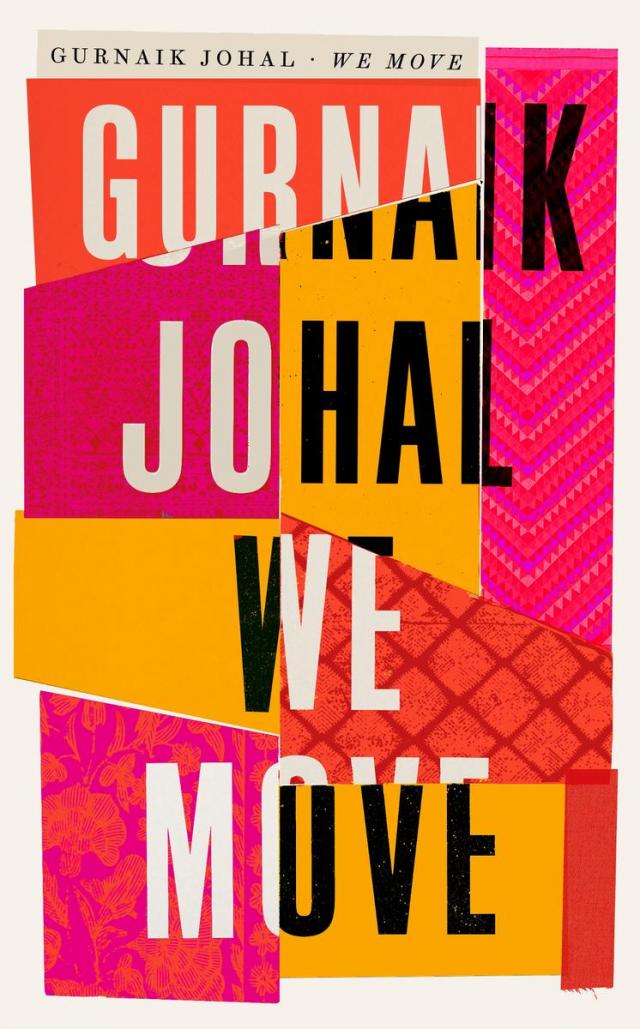
Gurnaik Johal, We Move


