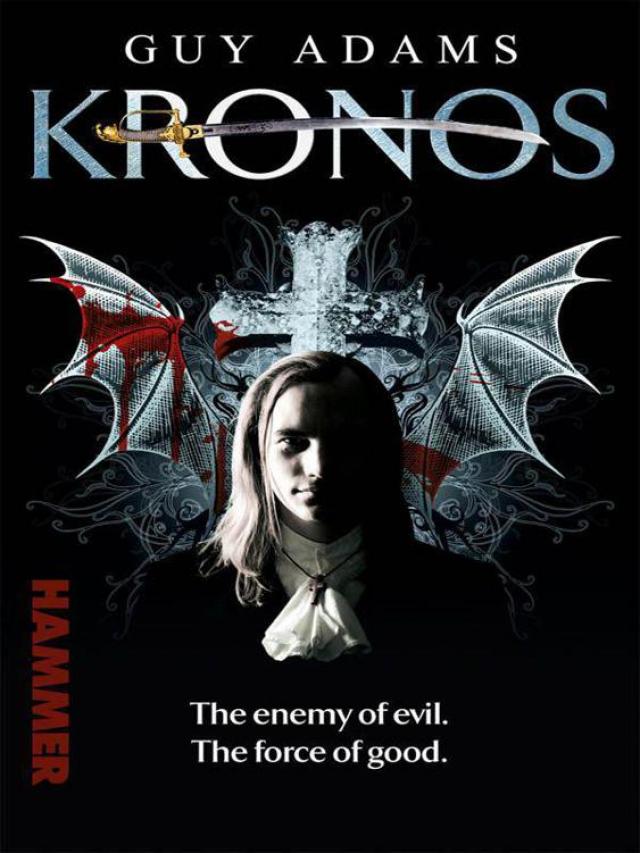
Kronos, p.7
Kronos, page 7


Also some strangers have arrived and they are staying with Dr Marcus, so I hear. One of them – a foreign gentleman – dresses like he’s in the army and was seen wandering around the forest with several wooden boxes. Clyde Lorrimer, a man who it doesn’t pay to believe too easily, reckons they were filled with …
Seventeen
Carla Learns The Trade
‘FROGS?’ I ASK, not quite able to believe what I’m seeing.
‘Toads, actually,’ says Grost. ‘Though, strictly speaking, there is no biological difference between the two. If it makes it any more palatable they’re quite dead.’
‘Toads,’ I say, more to try the word out for size than through any real hope that it’ll make sense. ‘Dead toads.’
‘Absolutely!’ says Grost, dropping the floppy thing into a box and closing the lid. ‘You see, it’s like this …’ He adopts a stance that is already only too familiar. Grost is a lovely man but he does so love to tell people things, whether they want to know them or not. ‘If a vampire crosses the path of a dead toad, said amphibian will become reanimated. It will become a vampire toad, sucking the blood from other toads and generally being a terrifying nuisance.’
I stare at him. I think that perhaps he has completely lost his mind. In fact, if I watch long enough maybe it’ll start pouring out of his ears.
‘All right,’ he admits, ‘that last bit was a lie. They do come back to life, though.’
‘Really?’
‘Yes, really! It’s a very useful method for identifying the presence of the undead.’
‘Really?’
‘Yes, really! Insufferable woman … I’ll have you know I’ve been doing this for years – I do know what I’m doing, I hope you realise.’
‘Who discovered it?’ I ask.
‘I beg your pardon?’
‘Who realised that vampires bring toads back to life? And how? Did they just happen to have lots of dead toads lying around when a vampire came in and, all of a sudden, the toads were hopping around? And how come the vampire didn’t kill the person concerned before he could pass on the amazing new fact that he’d discovered?’
‘Yes,’ says Grost, a little put out, ‘well … a lot of what we know is somewhat anecdotal, passed down over the years. Who knows who first noticed the effect? The important thing is: it works. Now, are you going to help me dig or do I have to do it on my own?’
I smile. He’s a sweet old thing and I wouldn’t really want to upset him.
‘I’ll help,’ I say. ‘Sorry.’
Grost smiles back, and it’s a lovely smile, soft and genuine. Not a type of smile I’ve seen that often. Back in the village where I grew up, people smiled when something bad had happened to someone else – or perhaps was just about to happen and they considered themselves lucky enough to be in a position to watch. Smiling was a sign of cruelty to come. It was not a nice village.
‘Where do you come from?’ I ask.
‘Oh,’ he sighs, ‘I have moved round a great deal.’
Oh no, I think, I’ve set myself up for another long answer. As it happens, he surprises me:
‘I don’t think it’s places that we come from, anyway,’ Grost says. ‘We are the children of history, not geography.’ He squats down and begins to dig a hole. ‘Though I suppose one could inform the other,’ he continues, having thought about his own point a bit too much, as usual, ‘if you lived somewhere horrid.’
‘I did,’ I admit. ‘Really, really horrid.’
‘Still,’ he replies, ‘I dare say it was the people rather than the place, wasn’t it? The place itself was probably quite nice – it was the awful pigs living in it that caused you unhappiness.’
I laugh and admit he’s right.
‘Yes,’ he continues, ‘same for me, really. Intolerance and mockery all the way.’ He gestures at his back.
‘Oh,’ I say, ‘I’m sorry. It must have been horrible.’
Grost nods but grins at the same time. ‘Absolutely horrible. But it made me who I am and I like to think that that, at least, means something good came out of it.’
And with that simple little spark of goodness he makes me love him all the more. ‘Something good, indeed,’ I agree. ‘If mad on the subject of vampires.’
‘Oh yes,’ he agrees with mock earnestness. ‘Quite mad.’
He drops the box with a dead toad in it into the hole he’s dug and fills it in. We move on.
‘What first interested you in them?’ I ask. After all, he must have a pretty good reason – it’s certainly never occurred to me to be obsessed with vampires.
‘It was my father,’ Grost says. ‘When I was six or so I became suspicious of him. He rarely left the house and would often fly into the most terrible tempers. He had a smell to him, a sickly sweet odour that followed him around the house like a storm cloud. I was terrified of him but my sister was worse. She was a few years older than me, a beautiful girl whose natural happiness and humour I saw crushed slowly by my father’s violence over the years. At night I would hear him creep into our room and one night I saw his face as it hovered over her, lit by the moon. There was a shadow of black around his mouth … blood! I was sure of it! I was convinced he was a vampire, feeding off my sister … Even my young mind realised that I had to act or she would face the consequences.’
‘What did you do?’ I ask.
‘One night I lay in wait for him. I used the sheets and pillow to make it look like my bed was occupied and then I hid behind the door. I have never been good at standing for long periods – my spine burns like a blacksmith’s poker after a while. Still I waited, knowing that if I lost my courage now I might never be able to act again. Eventually, I heard his footsteps on the floor-boards. He was a big man, heavy, and the wood creaked beneath him as if it found it as hard to bear him as we did.
‘He came into the room and looked towards my bed. Satisfied that I was asleep, he walked slowly over to where my sister lay. She too pretended to sleep, his eyes tightly closed, her breathing heavy. I knew it was fake: I had lain awake listening to her often enough to know what she really sounded like when she was alseep. She just hoped it would keep him away. I often wonder if she knew what I had been planning, whether she was aware of me watching over her. Maybe …
‘Father didn’t care if she was sleeping or not. He had his appetite and his hunger had grown too strong to ignore. He drew closer, leaning over her bed, his huge broad back blocking out the faint white light from the window behind him.
‘I ran at him, holding the sharpened wooden stake that I had spent the day preparing firmly in my hands. The wood had come from a broken chair-leg and my fingers were full of splinters. I was a clumsy child, determined yet gawky.
‘I shoved the stake as hard into him as I could. Still, it was a terrible, lousy attempt. It is very hard to puncture someone’s heart with a piece of wood using only the strength in your arms. Especially when you’re just a weak child.
‘It hurt him, though, and it hung from the wound in his back, bouncing up and down as he jumped around the room trying to reach for it.’
Grost stands there, a dead toad in one hand, an empty box in the other. Today’s tasks are quite forgotten; his mind is lost in his own history.
‘I was terrified,’ he continues. ‘I didn’t know what to do. Then I thought of the knife …’
He looks at his hand as if still expecting to see a weapon in it. Instead, he finds only a dead toad. He drops it in the box, buries it and we move on.
‘It was the knife that I’d used to sharpen the stake,’ he explains, ‘and it was still hidden under my mattress.
‘I watched my father bouncing around the room, trying to pull the stake from his back. I knew that if I didn’t keep fighting then he would surely kill me, maybe even my sister too. She was sitting up in bed, looking from him to me, the fear on her face so strong that it almost broke my heart. I think that’s what made me move in the end, that awful look of sheer dread on my lovely sister’s face.
‘I grabbed the knife and ran at the old man, swinging it at him, stabbing and slashing in a panic, only knowing that if I moved quickly enough he might not have a chance to fight back. If he had he would certainly have won. He could have picked me up and thrown me across the room with little effort.
‘There was a lot of blood.’
Grost stops talking then and the look on his face tells me that he thinks he’s said too much. Caught up in his own story, he has opened up more than he’s comfortable with.
‘It’s all right,’ I say, touching his arm, ‘I understand.’
The look on his face is confused. He is partly grateful and partly angry: you can tell that he thinks understanding this moment from his childhood is something only he is capable of.
‘He died,’ he says simply, closing the door on the memory. ‘And I ran away from home that very night. I could hardly stay, after all.’
‘But surely … if he was a vampire …’
Grost shakes his head. ‘He wasn’t a vampire – that was just a child’s imagination doing its best to understand something that was beyond it. No,’ he says, wistful again, ‘he was perfectly human. But he was also the most terrible monster I’ve ever faced.’
He stoops down and begins digging. For a moment I think he’s not going to talk any more, that he’s scared himself into silence. I underestimate him, though: he is stronger than that.
‘I wandered around, working for food and learning what I could about monsters. I met Kronos years later,’ Grost says as he stands up from the small hole he has made. I fetch a box and drop a dead toad in it. It feels disgusting but I want to help. ‘And in him I saw a man as broken by his own family as I was. I also saw a man who understood the nature of monsters, someone indeed who knew the most important thing of all.’
‘And what’s that?’ I ask.
Grost smiles. ‘He knew, my dear, that they must be fought!’
Eighteen
Father Volk Faces His Demons
THERE CAN BE little doubt that we are living in an age without God. At what point He abandoned us I could not say but abandon us He most certainly has. One only has to look at the faces in my weekly congregation to find proof. Has any other heavenly envoy been faced with such an uphill climb of sin and perdition?
Clyde Lorrimer, his face the colour of yew berries, reeking of last night’s ale and tobacco. He always sits at the back of the church, in the belief that I will not see him doze away during my sermon, preferring his dreams of full tankards to my offer of redemption.
Hollis won’t be far away, either. He’s the landlord of the White Hart and the source of most of my congregation’s weaknesses. He thinks I don’t know that he has a couple of doxies flipping customers in one of the inn’s upstairs rooms. A village the size of ours and still we’re awash with drunkards and whores.
Come forward a row and we find Morris Blake, footman to the Durwards (who have not graced my company for so long that I have washed my hands of their shabby souls). Morris would have no need to pay for his carnal sin – he is a handsome young man and knows it. Like all members of his trade, a more vain and polished creature cannot be imagined. Yet by all accounts – and yes, I mean the gossip that floods across the church step like the Red Sea itself, catching the impure up in its waves – he has no interest in the women of the village. Which makes him the strangest footman I ever heard of.
Then we come to the Gluckhavens, a mother and father as aged as Methuselah himself, leaning on one another for support while their son – born to Dorothy Gluckhaven at an age when one might think such things were quite beyond her – gazes across the pews and dreams of freedom. No chance of that with old Ernest Gluckhaven’s cows to look after. They are a weighty beef millstone around that young lad’s neck, for sure.
But where does Freddie Gluckhaven’s gaze fall while he dreams? On the form of Sally Somerton, of course, though if her father ever caught him looking he’d likely smite him with all the wrath of God Himself. Somerton is a man of violence, arms as big as oak trunks that look uncomfortable crammed into his shirtsleeves, as if they were made to pound and punch rather than stay inactive. His temper is as well-known as the protectiveness he feels for his daughter. For Freddie Gluckhaven, even looking at Sally might get him in the same state as the dried-up cows his father raises for slaughter.
Here is Dr Marcus, a man who professes to believe in God and yet spends all his days thinking that he can second-guess His work. I have no time for physicians: you can be sure that their arrogance will find them out when the Last Trump sounds.
Then the Sorrells: the angry son, the vacant father and the daughter who holds them all together. If they could but understand that God provides all the answers they need then perhaps they could get on and stop looking so miserable all the time. It’s hard to preach the enriching scripture when faced with such damp clay.
Of course, today won’t help as we gather to bury another of their number alongside what was left of young Petra Wilkins. Ah! Petra Wilkins! A fine-looking girl in her time, a real testament to the artistry of the Lord. I would often gaze down on her during prayers: she knelt on such a beautiful pair of knees and made prayer seem all the more beautiful when uttered through such full lips. She is naught but a sack of filth now. Praise the Lord.
The service is briefer than I might like but the families are so distracting, what with their sobbing and the intrusion of words of remembrance. If only they would understand that this is a religious ceremony, where we remember how God can strike us down on a whim if He so desires. It’s not an excuse to waffle on about how lovely someone was – they’ve plenty of time for that unconstructive nonsense when they get home. Will I ever save their souls?
Finally, the graves are filled with dirt and I can escape the sunshine and the congregation’s persistent sobbing. (The dead girls are in Heaven, for goodness’ sake: why are you so upset?) The church is the only place to keep cool in these long days of summer and I often stroll along the nave, thinking on the miracle of God and giving my robes a good waft to encourage a blessed cooling updraught.
I listen to the villagers file away, back to their lives of sin and corruption, and am relieved to have them gone. It is clear to me that the one thing that really ruins the life of a church is its congregation. Things are so much better without them.
Through the window – a rather bland representation of St George at its centre, killing the dragon in a most lacklustre manner – I can see Dr Marcus talking to young Paul Durward. Had I not been thinking of that family earlier? I see he’s placing a wreath at the base of his father’s statue. Awful eyesore it is: how is a man to commune with God when he has that ugly thing looming over him? It is such a trial.
I gaze upon the shadow of the crucifix on the wall and take comfort from it. It reminds me that I’m not the only holy man who has had to suffer.
While I watch, the arms of the cross flex and bend and I’m struck dumb by the implications. Is my Lord to bestow upon me His gracious presence? Can He be stepping down from his place of execution – a representation of it, at least – in order to share in my suffering?
‘My Lord?’ I ask, turning away from the moving shadow to look towards what has cast it.
‘If you wish,’ comes the reply and there is a hot swipe across my cheek as its hand lashes out and the nails dig delicate furrows. It flashes through my head that I should offer this lunatic my other cheek but I decide that that particular passage of the New Testament can be safely ignored for now.
I run towards the altar. My way out of the building is blocked.
‘Dear God!’ I call but there is no answer as I feel the creature’s nails dig into the back of my skull like a crown of thorns. I reach out, hoping to snatch something and pull myself to safety. My hands grab a rope and I realise that I shall die listening to the sound of our stupid little church bell. How often have I said that we deserve something finer? This tin monstrosity should be hanging round a cow’s neck …
It is my only modicum of relief, knowing that I will never have to listen to the noise of that wretched piece of metal again. The blood fills my ears and I die to a sound of pealing as if the bell were chiming underwater, like that of a vessel lost at sea.
Nineteen
Marcus Feels the Need to Pray
IT IS CLEAR that Lady Durward will not condescend to meet me. I am saddened by her determination – a determination unsoftened by the passage of seven long years since her husband died in my care – but I accept it. Paul climbs inside the carriage and the footman, a handsome young man called Blake, lifts the steps and closes the door behind him. Sparing me a rather apologetic look, Blake taps the side of the coach and the driver urges the horses on as the footman hops onto the back. The vehicle moves away.
I have been snubbed. But no matter, there are far more important matters than the sensibilities of the local gentry to concern me at the moment.
As I’m walking back past the church, the bell begins to ring. Too late, Father, I think, your congregation has left, heartily sick of your waffle.
As I’m stepping through the lychgate I hear a cry from inside the building and I turn on my heels to see what the problem is. No doubt Volk has given himself rope-burn by tolling his silly little bell.
It is not a burn that has caused him to scream.
Volk is hanging from the bell rope like a pendulum, his always ruddy face now a disgusting purple, his tongue bloated like one of Grost’s toads and hanging from between his lips. I run to help but it’s clear that I’m too late even as I slip in the viscera that have spilled from a large gash cut across his torso.