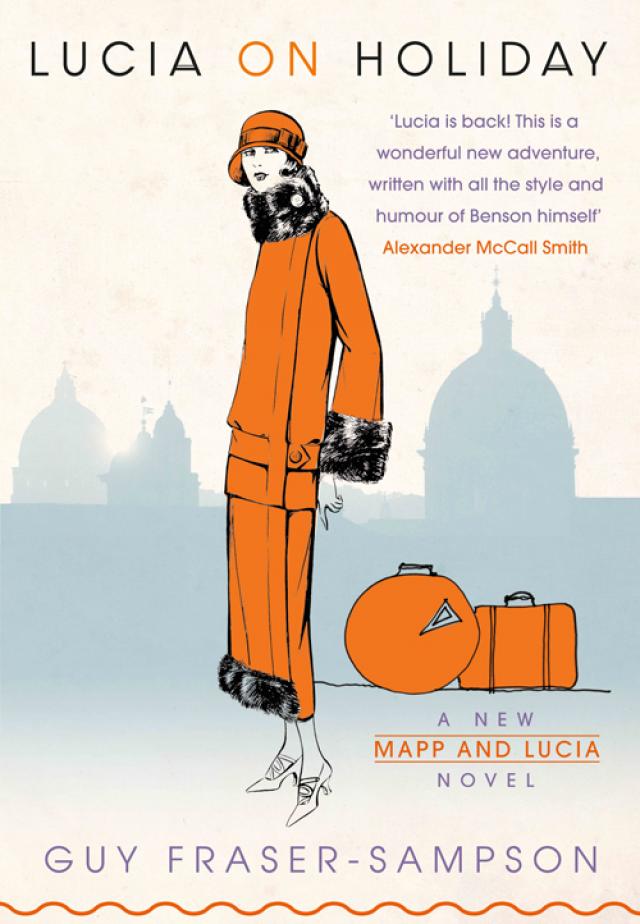
Lucia on holiday, p.1
Lucia on Holiday, page 1


First published 2012 by Elliott and Thompson Limited
27 John Street, London WC1N 2BX
www.eandtbooks.com
Published in both print and electronic formats
978-1-907642-51-7 (printed edition)
978-1-907642-52-4 (epub edition)
978-1-907642-91-3 (mobi edition)
978-1-907642-99-9 (PDF edition)
Text © Guy Fraser-Sampson 2012
The Author has asserted his right under the Copyright, Designs and Patents Act, 1988, to be identified as Author of this Work.
All rights reserved. No part of this publication may be reproduced, stored in or introduced into a retrieval system, or transmitted, in any form, or by any means (electronic, mechanical, photocopying, recording or otherwise) without the prior written permission of the publisher. Any person who does any unauthorized act in relation to this publication may be liable to criminal prosecution and civil claims for damages.
9 8 7 6 5 4 3 2 1
A CIP catalogue record for this book is available from the British Library.
Typeset by PDQ Media
This edition is not for sale in the United States of America.
Printed and bound by CPI Group (UK) Ltd
Author’s Note
Those readers with even a passing knowledge of history will notice that Lucia on Holiday makes use of certain real-life events, the timing of which may not appear to sit easily within whatever chronology can be discerned from Benson’s own novels. By way of mitigation, it can however be safely submitted that Benson himself was obviously not much concerned with the time and space continuum of the physical world. Anyone who can change the spelling of people’s names (a proud tradition occasionally also practised by the writer), allow characters to disappear without explanation, move an entire town at will from one county to another, and completely ignore any mention of the First World War is most unlikely to have been troubled by such trifles as international conflicts, the fall of thrones, and the gyrations of financial markets. Thus it is to be hoped that any readers who exhibit a tiresome attachment to reality may be prevailed upon to treat any such aberrations as occasions when Homer has nodded.
The Bugatti Royale, known more prosaically as the Type 41, was indeed intended by Ettore Bugatti to be owned only by royalty. However, in the event just seven were ever built, partly because the Great Depression affected even royalty, and partly perhaps because Bugatti was rather too choosy about his customers. As well as rejecting requests from numerous millionaires, it is said that he refused to supply one crowned head because he disapproved of His Majesty’s table manners.
Of the seven, four are now on permanent exhibition in museums, one is in private ownership (thought to be that of a Swiss millionaire), and one is owned by the relatively prosaic marque of Volkswagen, who now also own the rights to the Bugatti name itself. The seventh went missing in mysterious circumstances which this narrative may perhaps seek to explain.
While the cars themselves proved an expensive flop (Bugatti had planned on selling at least twenty) the overall project became a great commercial success as it was discovered that the cars’ great engines could be used to power railway locomotives, and nearly two hundred were bought for this purpose by the French railways, the locomotives remaining in service until the late 1950s. Since one of these was officially clocked at an average speed of 122 miles an hour while pulling a train, the effect of driving a car similarly powered, but with 1920s brakes and steering, and without a train to encumber it, is perhaps better imagined than experienced. Surely Major Flint cannot have been alone in finding it a challenging task.
Throughout the book there are passing references to certain other artistic works. Each is intended by way of what is now in America called an ‘homage’ (pronounced, naturally, in an affected French manner), in other words an affectionate and respectful nod, carrying comforting overtones of nostalgia and massive intellectual superiority. In the hope that the writer may be reckoned to be just as affected and superior as the next pretentious intellectual, astute readers may spot such nods to the likes of Frank Richards, Sapper, E.M. Forster, Clive James, Dorothy L. Sayers, and Daphne du Maurier. However, no prize is offered for correctly identifying these, other than the natural comfort of knowing that, compared with you, your family and friends are irredeemably ill-read.
Certain liberties have been taken with the plot and locations of Manzoni’s classic I promessi sposi, which are in truth much more complex (‘tarsome’?) than would have been convenient, but the truth is fundamentally as stated.
While on the subject of other works, habitués of the internet will hopefully have come across the Mapp and Lucia Glossary, tirelessly maintained by Deryck Solomon and an invaluable ready-reference tool, which the writer has plundered shamelessly.
Bellagio is a real place, and quite as delightful in the flesh as it is here described. The hotel is similarly painted from life, though disguised with a different name. The writer has stayed there, yes, and danced an Argentinian tango to its piano trio too.
Turkish cigarettes were once in common use, at least outside the United States, where the good old no-nonsense domestic Virginia tobacco always enjoyed a near-monopoly, but though polite society would indeed have had their cigarettes handmade to their own specifications, few would have been as exotic as those used by Francesco. Devotees of period fiction will know that it was considered good form to have both in one’s cigarette case when offering it to a third party (‘Fancy a gasper? Turkish on the right, Virginia on the left.’). However, by the time our story takes place (whenever that may be) Turkish cigarettes have been almost completely supplanted by Virginia, partly on grounds of cost, and have come to have a very louche image indeed, the word ‘gasper’ now being employed to mean specifically a Virginia cigarette as opposed to one of those nasty, effete, foreign jobbies, which are chiefly reserved for Armenian art dealers, Russian emigré ballet dancers, and the more culturally pretentious residents of Hampstead and Bloomsbury.
Those unversed in the history of horticulture may be mystified by Lucia’s reference to John Transcendent. Come to that, so might horticultural experts. It is likely that she actually had in mind John Tradescant, who designed the gardens at Hatfield House.
Mapp’s grasp of the French language is of course either legendary or infamous, depending on your viewpoint. Even having made allowances for her not knowing that ‘cracher’ is ‘to spit’ rather than ‘to crash’, and that ‘rognons’ are kidneys rather than onions, what are we to make of ‘tout égout’? It is likely that what the dear lady really meant was ‘tout égal’, as in ‘c’est tout égal à moi’ (it’s all the same to me), whereas ‘égout’ is of course a sewer. Her unfortunate substitution for ‘carte blanche’ (full discretion) is explained in the text. There again, it is possible that Mapp is deliberately avoiding being heard to speak French well for fear of being accused of having had a grammar-school education.
For the financially curious, Lucia’s description of fractional reserve banking is perfectly accurate (as indeed is her grasp of a control premium). Nor were she and Brabazon Lodge alone in assuming that a situation could never arise in which all the depositors of a bank would ask for their money back at the same time. Readers will be happy to know that fractional reserve banking is alive and well, having survived the Wall Street Crash and been practised subsequently by every bank in the world, including Lehman Brothers and Northern Rock.
Incidentally, Brabazon, apart from being the name of one of many ill-fated projects launched by the British aircraft industry in heroic defiance of commercial logic, was one of the various names, both real and assumed, used by the British writer James Hadley Chase, best known for The Postman Always Rings Twice and No Orchids For Miss Blandish.
Finally, there really is a vintage Bugatti at the bottom of Lake Como. It was dumped there by an irate Italian businessman as a protest when it was about to be confiscated and auctioned for unpaid taxes, thus proving the old proverb that you can do what you like to an Italian’s wife, provided both of you exercise all proper discretion, but that if you wish your various body parts to remain properly connected to each other then you should keep your hands off his daughter, his mistress, and his car.
Chapter 1
Emmeline Pillson, known universally as ‘Lucia’ in honour of her late Italophile husband, Philip (‘Pepino’) Lucas, was staring at the financial pages of her newspaper so intently that she entirely failed to notice when her current husband entered the room and sat down opposite her at the breakfast table. It was only when he greeted her with a diffident ‘Good morning, Lucia’ that she looked up and acknowledged his presence with something of a start.
‘Oh, good morning, Georgie,’ she replied. ‘I’m so sorry, my dear, I didn’t hear you come in.’
She seemed in two minds whether to continue with her newspaper or lay it down. After a few seconds’ wavering she chose the latter course – in consequence, she would doubtless have pointed out had anybody enquired, of her marital responsibility to engage her husband in conversation. Had anybody asked Georgie, he would have suggested that it may have had rather more to do with the smell of the fresh toast which Grosvenor had just placed before them. It was as well, therefore, that no third party was in fact present to raise any such issue, since Georgie’s explanation would have caused Lucia to stare at him coldly and silently over her reading glasses before saying in a voice of stone, ‘Whatever the case, Georgie, I did put it down.’
The sort of tone, in fa
ct, which she had used on so many occasions in the old days back in Riseholme, to quell the occasional dissident element in her kingdom (not for nothing was she known as ‘Queen Lucia’) or to ensure the smooth running of the many Elizabethan pageants which only she could possibly organise, despite her well-worn protest of ‘How you all work me so’. Naturally for such events there could be no other conceivable candidate to play the role of the great Elizabeth herself. Indeed there had been one celebrated occasion when she had scathingly told the local fishmonger, masquerading as a sixteenth-century royal adviser, ‘Must is not a word to be used to princes, little man,’ with such majestic menace that a halberdier had dropped his weapon with a dreadful crash, and two turnspits had fallen clean off the stern of the Golden Hind. Georgie, though he was standing fully ten feet away, had felt a cold hand clutch at his vitals, and poor Daisy Quantock had let out an involuntary screech of terror which she had tried to camouflage by pointing at the luckless turnspits, by now splashing disconsolately in the village pond.
It was a tone of voice which had already seen her through one term of office as mayor of Tilling and, it was rumoured, would shortly secure her a second. It had been used to good effect on those Tillingites who had dared to doubt her claim to have entertained a Duchess to dinner, and on many occasions on recalcitrant workmen when their plans for a tea break had clashed with her own idea of a proper working schedule. It was one of many weapons in Lucia’s considerable armoury, all designed and kept properly oiled and sharpened for one purpose only: to get her own way no matter how difficult the circumstances might seem, and no matter how insuperable the obstacles that might be placed in her way. Truly, Lucia was the irresistible force for which no immovable object seemed to exist.
Only once had the irresistible force met its match, during the celebrated Tilling mayoral lectures, which she had inaugurated. Mr Noel Coward had been sufficiently ill-bred as to refuse five separate invitations addressed to him in her own fair hand to come and lecture the intellectual cream of Tilling on the technique of the modern stage. ‘Really!’ Lucia had finally commented in exasperation. ‘You would think the man would jump at an opportunity to become better known.’
However, the irresistible force had simply eddied and flowed around the immovable object, as irresistible forces are wont to do, and had substituted members of the Tilling Society as lecturers. Lucia herself had naturally spoken on Shakespeare, on which subject she was a self-proclaimed expert, culminating in a performance of Lady Macbeth’s sleepwalking scene of a dramatic intensity that would surely have been instantly acclaimed by John Gielgud or Herbert Marshall, had either gentleman been able to accept her invitation to attend.
Major Benjamin Flint, now officially Mapp-Flint since his marriage to the redoubtable Elizabeth Mapp but known widely as Major Benjy, had equally naturally spoken on tiger-shooting, and in a finale no less gripping then Lucia’s sleepwalking scene had demonstrated how he had once hit a tiger smartly across the nose with his riding crop before seizing his trusty Mauser to despatch the beast with a single shot. Actually firing the Mauser had perhaps been taking verisimilitude too far, but a collection was taken up for the broken window, and everyone agreed afterwards that in all the several dozen times they had heard the Major’s tiger stories, never had they been rendered better.
Irene Coles had been enlisted to talk about modern painting, while Mr Bartlett the vicar (known as ‘Padre’) was asked to speak on the Power of Free Will and the Origins of Evil, but he got rather mixed up and talked about the Power of Evil instead. Diva Plaistow spoke on cake-making, Mr Wyse on social etiquette, and Georgie on the techniques of needlepoint. Only Elizabeth Mapp-Flint had not been called upon since, as Lucia innocently explained, she was unable to think of a single subject on which dear Elizabeth might possibly have anything of interest to say.
For the moment, the irresistible force was spreading marmalade on a piece of toast with a slightly distracted air.
‘Do you know, Georgie,’ she purred contentedly, ‘moving my money into shares from those boring old bonds was the best decision I ever took.’
‘Really?’ asked Georgie, not because he was truly interested but rather because some sort of response was clearly expected of him. Georgie’s mother had held very firm views about speculation, claiming it to be a short cut to the workhouse, and he had never really approved of Lucia’s forays into South African goldfields and American motor manufacturers. His own money was held, as it had always been, in British government bonds.
‘Georgie!’ Lucia said more sharply, as though aware that he was not really paying attention. ‘Do you have any idea how much profit I have made so far this year? I was just totting it up in my head when you came in.’
‘I’m sure I haven’t the slightest idea,’ he replied vaguely, reaching for the teapot.
‘Eight thousand pounds!’ cried Lucia triumphantly.
Gratifyingly, this had the intended effect. Georgie’s hand remained suspended in mid-air and his jaw dropped a good inch. After a few seconds his mouth started to open and close and he formed the words ‘eight thousand pounds’ soundlessly a few times as though he was working them around on his tongue to see if he enjoyed their taste. Lucia arched her eyebrows and waited for him to recover the power of speech.
‘But that is a simply enormous amount of money,’ he gasped at last. He remembered from the days of Lucia and Elizabeth Mapp (as she then was) being presumed lost at sea that it was exactly the amount that Major Flint had been told to expect as the value of Miss Mapp’s entire estate. So in the space of a mere six months the gains on Lucia’s share portfolio had been equivalent to Mapp’s total worldly worth, grimly husbanded and, where possible, augmented over several generations.
‘Yes, isn’t it?’ said Lucia delightedly. ‘It’s a gain of ten per cent, but as it’s only over half a year then I suppose that really means twenty per cent. What do you think, Georgie? That must be right, mustn’t it?’
Georgie’s mind seemed to be elsewhere, however. He was performing some rapid mental arithmetic based on his recollection that at much the same time as Major Flint had been told to expect eight thousand pounds, he himself had been warned to expect ten times that amount. He remembered the Major’s involuntary ejaculation of ‘Congratulations!’ before he had realised that such sentiments may not be deemed in the best of taste.
‘Hang on, do you mean to say that you have put all your money into shares?’ he cried in horror. ‘Oh really, Lucia, how could you? It’s too bad of you. Very irresponsible, I must say. Tut, tut!’
‘Oh, fie to your ‘tut, tut’, Georgie,’ came the spirited response. ‘Fie and pish and tush and … whatever else you care to,’ she finished, slightly lamely. ‘Eight thousand pounds is eight thousand pounds.’
‘Well, there’s no arguing with that,’ agreed Georgie, ‘but suppose you were to lose eight thousand pounds instead – you could just as easily, you know.’
‘Fiddlesticks!’ snapped Lucia. ‘Where is your sense of adventure, Georgie? Where is your courage?’
As she uttered the last word, Lucia’s voice dropped an octave and gave off a dramatic vibrato. Georgie groaned inwardly as he saw a distinctly Elizabethan glint come into her eyes. He knew what was coming next: a quotation. He was not to be disappointed.
‘Does Shakespeare not say …’ She paused for dramatic effect, squared her shoulders and drew a deep breath, as was only proper when quoting the immortal bard; it was perhaps the literary equivalent of her Beethoven face.
‘Be strong and of a good courage; be not afraid. Neither be thou dismayed.’
Being quoted at by Lucia could be a disturbing experience, as the Riseholme fishmonger could well attest. She did so in the best dramatic tradition, albeit the dramatic tradition of a bygone age now happily departed. Her eyes flashed and her chest heaved, and she frequently crumpled slightly at the end as though to indicate the emotional effort which she had put into the phrase, leaving herself spiritually spent.
As she dropped her head to allow the unfathomably deep feelings which Shakespeare always aroused in her to drain away, she doubtless felt that she had carried all before her, and that there would be no more carping from her hopelessly defeated consort. In this she was to be disappointed, as Georgie reached for the milk jug and said quietly, ‘It’s the Bible actually.’