

Mister mister, p.1
Mister, Mister, page 1


This is a work of fiction. Names, characters, places, and incidents either are the product of the author’s imagination or are used fictitiously. Any resemblance to actual persons, living or dead, events, or locales is entirely coincidental.
Copyright © 2023 by Guy Gunaratne
All rights reserved. Published in the United States by Pantheon Books, a division of Penguin Random House LLC, New York, and distributed in Canada by Penguin Random House Canada Limited, Toronto. Originally published in hardcover in Great Britain by Tinder Press, an imprint of Headline Publishing Group, an Hachette UK Company, in 2023.
Pantheon Books and colophon are registered trademarks of Penguin Random House LLC.
Library of Congress Cataloging-in-Publication Data
Name: Gunaratne, Guy, [date] author.
Title: Mister, Mister : a novel / Guy Gunaratne.
Description: First American edition. New York : Pantheon Books, 2023
Identifiers: LCCN 2023014388 (print). LCCN 2023014389 (ebook). ISBN 9780593701423 (hardcover). ISBN 9780593701430 (ebook).
Subjects: LCGFT: Novels.
Classification: LCC PR6107.U55 M57 2023 (print) | LCC PR6107.U55 (ebook) | DDC 823/.92—dc23/eng/20230407
LC record available at https://lccn.loc.gov/2023014388
LC ebook record available at https://lccn.loc.gov/2023014389
Ebook ISBN 9780593701430
www.pantheonbooks.com
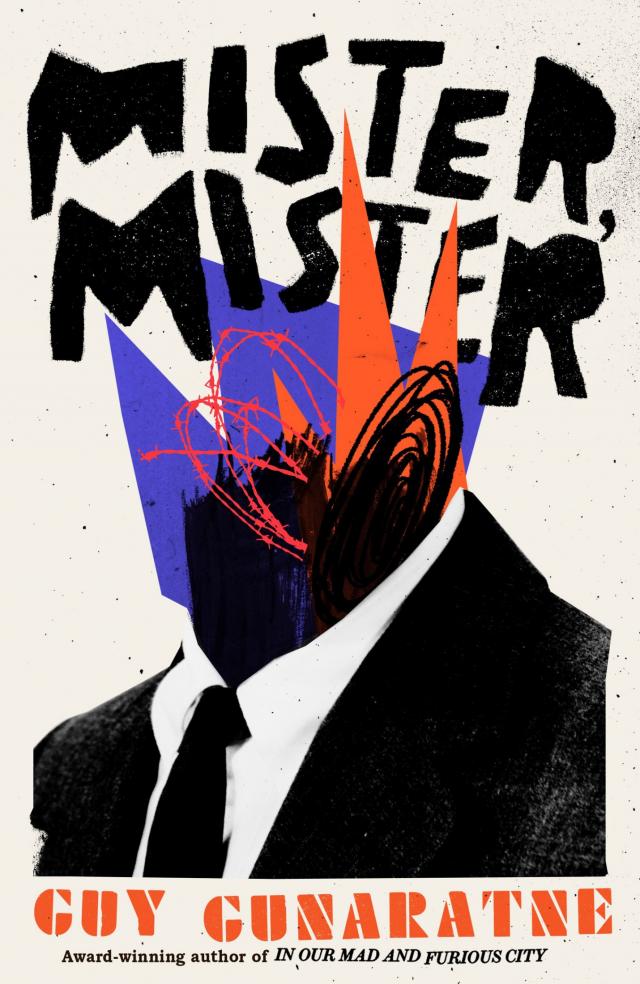
Cover illustration and design by Jack Smyth; (suit and tie) Getty Images
ep_prh_6.1_145068698_c0_r0
For my mother Deepa
and my daughter Liah
Contents
Part I: 1990–2005
Idiot Boy
Boukie-Head
Yah! Yah! Yah!
Part II: 2010–15
Al-Bayn
Zeinab
Yahya Bas
Acknowledgements
_145068698_
I
1990–2005
Idiot Boy
Mister, I have lost my tongue. A quick cut with a cinch, little jerk of the wrists. Easy, clean, deed done. I suppose you’d say it was madness, psychosis, insanity – but no, not likely. An act of liberation, that’s what. Permanence is what I was after. A final, effective riddance at the root – so, snitch! – since tongues do not grow back.
I’ve little pieces of cotton packed into my cheeks now, Mister. And a cup of salty water to soothe my blackened mouth. Magic beans to heal the rest of it. And them nurses take regular swabs of my sutured pits. The discomfort is nothing. Not compared to the satisfaction I feel from knowing that I’ve won back – no less, with an act of bloody violence – what has always been mine. By which I mean, of course: the right to tell my own story.
I can put down what I really mean to say now, God willing.
And this time, Mister, you may even have my consent. You may listen. Though, I know, you’ll be wary. Not least, because you’ll have no control over what’s to be said. But then, what’s left to a person after speech is lost to them? Recollections and memories alone. And what harm can these silent things do, really, without a tongue to lift them to other people’s ears?
1. LETTERS I intend now to write down the rest of it. Get scribbling on these here pages you’ve sent me. I do this in the spirit of reconciling what has happened. Naturally, there are questions. But you should know there will be no half-truths to my telling. Nothing invented, nothing untrue – you should mark that in your official report. And I’ve agreed, honestly, to tell you all this, not because your bully courts frighten me, or because you have Her Majesty’s crest on your pin, or because you, yourself, intimidate me, Mister, sat there fiddling with your pen. It’s because I am guilty of everything you say that I did. Guilty of treason. Guilty of inspiring bad men. Guilty of all of it. And more. So, do me in after I’ve finished. Have me drawn, quartered, stoned into a pulp for all I care – have at it!
But for now, I just want you to listen.
I have plenty to say.
2. GREAT BRITAIN To return to your question, well – likely is, you’ve already made up your mind, Mister. I can tell from the sorts of questions you’ve already asked me, like why I hate your country. I don’t doubt it seems a little strange coming from me, but believe me when I say that I do not, not really.
Truly, I have missed your Great Britain. I’ve missed your old British mores, Mister. Your pasties and that. Your cuppa-teas. Your John Cleese. And your poets.
This country has always been a home for me. Only place that’s ever really claimed me, or that I could ever claim. I think about my childhood, my rambling half-cocked education, and then, my rise into fame and fortune.
It all happened here – right here for me, in this city, in this United Kingdom of the Great British Isles.
Nostalgia, call it. Remembrance maybe. I’m pining for the parts I was raised in. East Ham, that is, East London. Among local muftis, many mothers, wide boys, punters and clerics. Wouldn’t call the feeling patriotic – nothing as waxy as a word like that – but it does beg a better question. One that I’d quite like to put to you now, Mister, and that is this:
If the greatness of your Britain remains so assured, then why is it so difficult to hear someone hate it?
Everything I’ve ever written, from the poetry to the long stories I’ve told – a litany of my many offending verses – every word was written under this same English sky, Mister, under which I was born, same as you!
My uncle Sisi Gamal – him, the old soapbox muezzin, who was always so clear about these things – said to me once: Boy, there is nothing great about Britain – it’s a madhouse! A place only fit for slumlords, field hands and rabble. I didn’t know what he meant by it then. I was young. Too busy making faces in the mirrors, shadows on the walls, to notice your taste for bully justice. But now, here I am. Sat in this cell. Enduring a barrage of questions as to why this, why that, why whatever hatred, and why now…when to me, it’s obvious. As it should be to you.
It brings to my mind a saying, one from where my father is from, which translates from the Arabic like this: As you sow, you shall so reap. It’s a saying that graces all scripture.
So, let that be my answer, Mister. For any more, you must ask my Allah. Since mine is a life He chose for me, and at a time He chose for me to live. Otherwise, you’re better off asking the times for answers. Since it was the times that also made me. Made my tongue. And by times I mean the world out there, the big bright-wide: the West. Into which I was born, raised upright, lived an antic life, and did my best to scribble a little poetry and pray.
3. NAMES You asked my name. I’ve had so many over the years. I collect them like stamps or old stones. Some names were given to me with love and seriousness. Granted by those who wished I’d grow old and become rich and famous in the world. Other names were given to me in spite. Along the way I’ve discarded old names like old hats and borrowed new ones to replace the ones that grew tired.
It was your newspapers, all them red tops and magazines, who gave me my many aliases. The Jihadi Boy-Poet, they called me. The Hateful Fanatic, they said. I was the Internet’s Ayatollah for a time, and the Pound Shop Prophet of Stepney Green and Newham…
Now, I know these titles were only ever meant to mock me, ridicule me, sway public opinion against me. But knowing what I know now, Mister, I’d say your papers didn’t go far enough! At the height of my fame, I was the most widely read poet in your England. And it’s my verses today, my own particular poems, written under any number of monikers, that have me sat before you now, scribbling away.
My first – that is to say, the name my mother gave me – was Yahya Bas. Bas comes from my father. I was Yahya throughout my youth. I’ve had others, but most know me by my nom de plume, my nom de guerre, my Arabic kunya – my poetic name: Al-Bayn.
But where do I begin?
If I’m to unravel my life, I’ll begin where I like.
So, here’s the order we’ll follow:
A birth, then a death, then rebirth, then death and birth again.
First, birth…
4. BIRTH (MYTH) Bismillah ir rahman ir rahim. As a child, I was told I had no origin. I was moulded out of existence itself. A rush of swampy nothingness – and then pop! Birthed under moonlight along an estuary in paradise…Or at least, this was the myth told me. The first myth of many others. One had me born blue. No breath in the chest. Cold to the touch and silent. An almighty smack was administered to me then, upsetting the boy into a gasp of new breath. And yet another: I was told that I came into the world feet first, Mister, and all bloody, bent a little too, at the hip, with my legs limp like watery jelly.
Which of these stories comes closest to the truth, I don’t know. Most likely there’s a little bit of truth to them all. Most likely, Mister, I was born breech as it’s called – pulled by the ankles out my mother’s womb. A stubborn, slippery creature, delivered gnarled up. Goes some way to explaining my hip. A disjointedness at the sides, Mister, which has burdened me with a wide and irregular gait. To this day I imagine myself meeting the world this way: half in this world and half in another. And then some panicky smack forcing a cry out of me, forcing me to swallow great gulps of air, Mister, my first proper breaths in fright and pain.
In all probability, I was actually born on a white-tiled floor in a bathroom stall in our communal home in East London . My two acting doulas, my Mother Sadaf and Mother Miriam, would have been there alongside my uncle Sisi Gamal. It was my own mother – my white, English mother, Mister, her name was Estella Stevens – she was the one who kept up my more fantastical myths. Her, with her powdery pallor, fingers like clawed-at white candles, who’d sometimes whisper to me, when she was lucid enough to speak, saying softly: …and then pop! Along an estuary in paradise…in that thin, thrown voice. After which she’d stop, cover her mouth, as if she’d let slip some shameful thing.
Nobody else confirmed my mother’s telling of it. Nobody denied the story either. But then again, Mister, my mother was an unwell woman. She was a liar. Though, even in her lies, she made my beginning, all beginnings, sound beautiful and bright.
5. BIRTH When I picture the first days of my new life, I see others gathered around me like moon-faces, squatting in them stalls, clearing blood from my mouth, hands coddling me, ringed fingers patting me down worriedly. And me there, squirming, smarting from that cold hard slap to the arse.
Were they charmed or repulsed when they first set eyes on me?
Well, I remember my Mother Sadaf telling me once – no, telling me a few times – that I was never a pretty child. I had paler skin than my mother. As white as a bone, she said. I was cursed with a sour white nose, fleshy nostrils, a fat lower lip which sagged as I suckled on my bloodless little fingers, and large, black, empty eyes, Mister, which must have struck my other Mothers as monstrous.
I heard their voices before anything else. My Mother Sadaf first – my dark Mother with arms like big black boughs, and her terrifying mouth always open – tossing me over, clean-ing my folds, cutting my cord and then saying: Boh! – see this baby – whiter than milk – just look! And then my Mother Miriam there too, gentler, sweeter, quietly muttering prayers to herself, while peering over them shoulders to look: Oh…oh, see his father’s nose – yes, your nose, Gamal! – See how he stares and stares and stares…
And then probably my uncle, my Sisi Gamal, would have spat on the floor and declared he recognised more of my mother in me. I imagine the old man stroking my mother’s tired and silent head, his round-rimmed glasses reflecting back her blank gaze. It was at this moment, as I now recall the story, that my mother stirred and whispered the name into my uncle’s ear: Yah…Yah…Yah…To which he nodded, added Bas, before saying a short prayer.
6. JINNA In Arabic, the word for foetus is janin, which shares a root with demon, ill-spirit or invisible creature – a jinn. I think because both are jinna, meaning hidden. So, I imagine my uncle’s prayers were meant for all things concealed. And probably, Mister, my uncle was also thinking of my father – his foolish younger brother, whose name was Marwan Bas, born, as he was, poor in Northern Iraq – long gone by then, lost to the desert and presumed, on all accounts, to be dead.
7. GOD’S OWN My mother survived my freakish birth. I was laid out on top of her, onto her low sunken stomach, after making my first little stifled mumbles. It was one of the few moments she ever held me close, Mister, or even seemed to notice me there.
In her eyes I saw myself reflected – or should I say refracted? A better word, more tricksy and suggestive of my untidy beginnings – the sight of me seemed to offend her. She picked me up, looked at me, and quickly moved as if to push me aside and turned to the wall.
I don’t blame her, Mister. Apart from the purpling bruise at my sides, my face was also riddled with conflicts. My eyes were too far apart. My poking-out ears were somehow ungainly and weird. And my skin, glue-like and thin, must have revealed enough to suggest something unseemly.
Mine then was a face unwelcomed by the world. The old seers in them mountains had a term for boys like me – God’s Own, they called them. Offering the phrase for babies born disfigured, Mister, misshapen, or else left orphaned by the war. My Sisi Gamal adopted it for me, saying: You are God’s Own, Yahya. It was easier to claim me for Allah, I think, than to offer me some tidier origin.
8. EARLY MEMORIES These early memories appear in the mind, Mister, tucked away in my head alongside scenes I’d rather misremember. But don’t believe anyone who tells you the thoughts of newborns are too flimsy to retain. I can recall them early days in rude little glimpses…
…like the cloth my uncle wrapped me in, how I’d cry into that cloth, and how, after a while, the colour in my uncle’s eyes began to darken. It was difficult for him. One hand on my mother’s ailing shoulder, the other under my wailing head. Lucky for me, Mister, that my other Mothers were near so that he could lob me off when he wanted. Ach! Away from me! This bloody child’s bloody bawling…I will send a letter! This bloody arrangement will be done! – it might have been obvious to anyone watching that my Sisi Gamal could not cope.
I’d started crawling and scuttling about after that. I started exploring, Mister, and then everything began to arrive at me with lightness, loudness, flashes and bangs and floods. Tempers flared and turned solid and stuck. Figures fashioned themselves into shapes and colours and form. I got the measure of how days would follow darkness. How smells swapped from body to body, from room to room. I remember the taste of sourness on my tongue, the sweetness and texture of tepid milk. I recall even my uncle struggling with the bottle. He’d hold me in the crook of his arm while at the same time leafing through a novel.
He’d hold me there for far too long, Mister. I’d sometimes turn and start suffocating in his armpits. It’d often take my Mother Miriam to snatch me away from him – The boy cannot breathe your underarm stink! she’d hiss, to which my uncle would throw a finger – Ach! – and return to whatever page he’d been interrupted from reading. I believe all this left me with the impression, Mister, that the world was a precarious place. Crowded with put-upon faces and desperate fits of impatience.
9. LOVE You asked if my uncle really loved me. Well, who’s to say, really? My Sisi Gamal never wanted children. And I don’t blame him for finding it difficult. I was told it was a difficult time to have been born into. This was circa ’91, Mister. This was your Thatcher in decline, poll tax and riots, and robber-barons scheming to starve the needy and the weak.
So, have pity on my poor uncle. Sentenced to a lifetime of picking up the pieces after his brother. But then again, lucky him too – lucky the both of us, Mister – for having been surrounded by these women. The ones I’d end up calling my Other Mothers. And, in particular, my Mother Sadaf and Mother Miriam.
So, now, a little on them…
10. OTHER MOTHERS There was some anxious clucking about the boy. The neglected bruise at my hips had developed into a sort of protrusion. And my skin had turned a worrying yellowish hue. Even the whites of my eyes had turned yellow. Too much blood in the blood, was how my uncle described it, before stepping aside for my Mothers to take a look.
I can imagine my Mother Miriam poking her head into the kitchen – only a child herself at the time, about nineteen – she’d have been there, Mister, pulling at her scarf, fingers pressed against her plump wetted cheeks, chewing on stray strands of dark hair. My Mother Sadaf would have looked closer, that coal-coloured crone. She’d lay me out sprawled on a tabletop next to her blackened wooden spoon, Mister, her crusted measures and her dried rotting roots which she’d picked and forgotten about from the garden. There I lay – a baby born deathly blue and now a sickly yellow – staring up at them, unblinking and blotchy, my breath uneven. They’d prod at my belly and shake limbs, examining me for strange little marks or further discolouration.
– Maybe he will not die, muttered my Mother Sadaf, clicking her tongue, maybe not death, but not a good life, anyway…
She announced the diagnosis with a sweep of her burly arms, scratching her hair pinned back in a bun, and then, in some fit of irritation, scowling at my Mother Miriam, whose face was looking down in dismay. She flicked a hard finger at the younger Mother’s forehead – flap! – cussed at her, and then attempted another – flap! – which was dodged, and then she cussed at the air, thumping the floor with her foot.
– Boh! – I’ve had enough of your face always dripping! Go now and take your tears elsewhere! I will deal with the child in my own time. Go now and get out!


