

Rebekah and isaac, p.1
Rebekah and Isaac, page 1


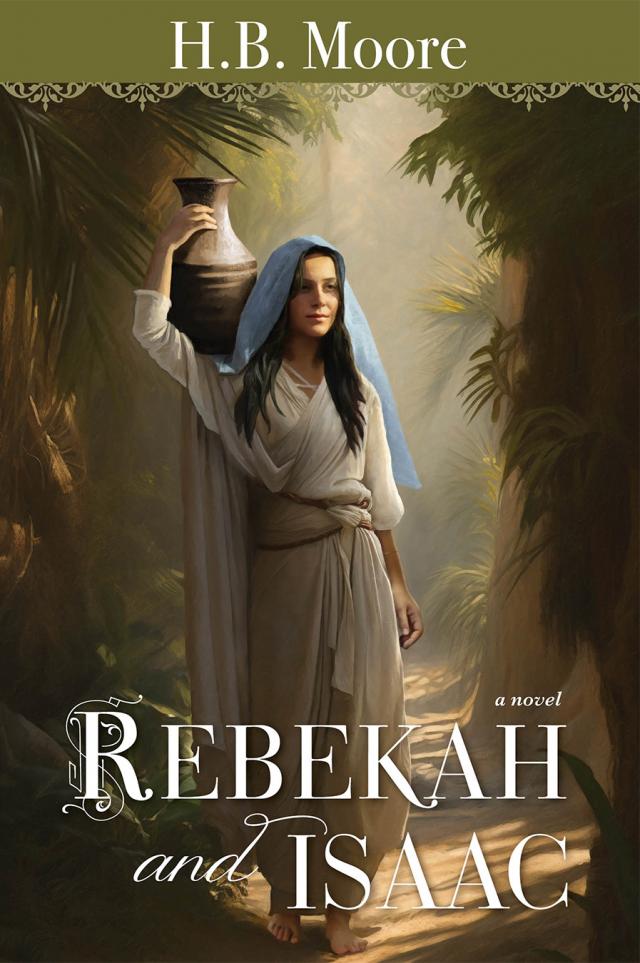
Cover image Rebekah and Isaac © Robert A. Boyd; for more information go to RobertABoyd.com
Cover Design by Christina Marcano, Map by Julie Olson © 2024 by Covenant Communications, Inc.
Published by Covenant Communications, Inc.
American Fork, Utah
Copyright © 2024 by H.B. Moore
All rights reserved. No part of this book may be reproduced in any format or in any medium without the written permission of the publisher, Covenant Communications, Inc., PO Box 416, American Fork, UT 84003. This work is not an official publication of The Church of Jesus Christ of Latter-day Saints. The views expressed within this work are the sole responsibility of the author and do not necessarily reflect the position of Covenant Communications, Inc., or any other entity.
This is a work of fiction. The characters, names, incidents, places, and dialogue are either products of the author’s imagination, and are not to be construed as real, or are used fictitiously.
Library of Congress Cataloging-in-Publication Data
Name: H. B. Moore
Title: Rebekah and Isaac / H. B. Moore
Description: American Fork, UT : Covenant Communications, Inc. [2024]
Identifiers: Library of Congress Control Number 2023951564 | ISBN 978-1-52442-533-3
LC record available at https://lccn.loc.gov/2023951564
First Printing: July 2024
Characters
Historical Characters
Rebekah
Bethuel
Laban
Deborah, nurse to Rebekah
Abraham
Sarah
Isaac
Eliezer
Keturah
Hagar
Ishmael
Fictional Characters
Jael, Rebekah’s mother
Zeresh, Laban’s wife
Micah, son of Laban
David, son of Laban
Tamar, daughter of Laban
Caleb, beggar
Elizabeth
Dinah
Ahira, servant girl
Letushim
Dan, military commander
Benjamin, blacksmith
Sons of Eliezer:
Joel
Eli
Levi
Shem
And Abraham was old, and well stricken in age: and Adonai had blessed Abraham in all things.
And Abraham said unto his eldest servant of his house, that ruled over all that he had, Put, I pray thee, thy hand under my thigh:
And I will make thee swear by Adonai, the God of heaven, and the God of earth, that thou shalt not take a wife unto my son of the daughters of the Canaanites, among whom I dwell:
But thou shalt go unto my country, and to my kindred, and take a wife unto my son Isaac.
Genesis 24:1–4, KJV
Chapter 1
Rebekah
“You must find out which girls your age will be at the festival, Rebekah,” Jael said. She stood framed by the entrance to her tent in the predawn light, while leaning heavily on a pomegranate-wood cane.
Jael, Rebekah’s mother, seemed to talk about nothing but marriage. Who to marry, who was eligible, how much wealth did they have, and what bride price would be offered?
“And find out which fathers have been paying visits to other fathers,” Jael continued. “Be discreet about it, though, my daughter. We don’t want the word to go out that you have no marriage prospects, other than Benjamin, the apprentice blacksmith.”
“I cannot very well ask such questions without receiving the same questions in return,” Rebekah countered. “You know how quickly rumors grow in our settlement.”
Jael scoffed, her copper-brown eyes looking heavenward for a moment. She’d once been carefree and filled their family tent with laughter, but over the past year, her expression had hardened. New wrinkles had formed, and her words were clipped with worry. This was all due to their decrease in herds when they’d lost half of their flock to cattle thieves.
When Jael refocused on Rebekah, her next words took on a sharp edge. “Do you want to be living in the back of Benjamin’s family tent? Waiting for a husband who will come home each night filthy with black soot?”
Rebekah opened her mouth to respond. There was nothing specifically wrong with Benjamin, save that he worked for his father’s blacksmith shop and the inheritance was small. Benjamin was not much older than she. At least a blacksmith would bring a steady living, and she couldn’t say that about her own father and brother.
It might be nice to be married to a quiet man. What were a few soot stains on his clothing and hands?
Rebekah hated the thought of questioning the other girls at the well this morning as if she were someone who reveled in gossip. Besides, if she agreed to marry Benjamin, then this pressure from her mother would finally stop. All the arguing, all the bitter comments, and all the demands. “Benjamin is an honorable man, and blacksmithing is a steady living.”
Her mother’s hand shot out, and she gripped Rebekah’s arm. Her long, dark hair, woven with strands of gray, fell forward across her shoulders. “Do not settle for less than you are worth,” she hissed. “I have not sold some of my jewelry to provide you with fine clothing that enhance your beautiful features, only to have you marry a poor tradesman.”
A command with a compliment and an insult—all wrapped into one. That was her mother’s way nowadays. Rebekah swallowed against her increasingly drying throat to stop herself from pointing out her mother’s hypocrisy. Their own family were shepherds. A necessary profession, but it was barely supporting her older brother’s growing family.
“I understand,” Rebekah said, her voice faint, resentment already burning hot in her chest. Tonight’s festival couldn’t come fast enough. She could only hope that Mother would be pleased with the results—which would mean that Rebekah had sufficiently paraded herself before eligible men. Men who apparently were not blacksmiths-in-training.
Jael gave a firm nod, then released her grip. For a woman who complained about painful and swollen feet and ankles, her grasp was very strong. “Even Letushim would be better than Benjamin.”
Rebekah flinched at the name. Not that she did not want to marry, and she wasn’t trying to be too choosy. But Letushim was widowed and only wanted a new wife to raise his three children. She bit back her comments once again.
“Now go,” Mother said. “You should be the first one there so when the other girls arrive, they will speak of your hard work and dedication.”
With a nod, Rebekah turned and stooped to pick up the jar she’d set outside the tent. Balancing it on her head, she walked through the settlement of scattered tents, pens of goats, and blackened campfires, toward the road that wound to the small oasis just beyond the first rise of the hills. The breeze was still cool, although it would pick up as the sun rose, heating air and sand along the way. This was one reason the women visited the well in the early mornings. With the rising sun, the heat of the day would quickly become oppressive.
She hummed to herself as she walked, trying to push out of her mind the demands of her mother. Rebekah didn’t want to harbor ill feelings toward her mother, but they sat like a rock in her stomach anyway. Why did the family’s well-being have to be dependent on Rebekah’s future marriage? It wasn’t her fault the flocks were stolen, and it wasn’t her fault that her father had no other skills, and it wasn’t her fault that her brother was not as reliable as he should be.
Selfish. She knew she was being selfish, but could anyone blame her?
She was being sent to the well to engage in petty rumors, and then tonight, she’d have to somehow pull off a miracle. Only Adonai could perform such miracles. Maybe she should tell her mother that.
The sound of approaching donkeys distracted Rebekah from her swirling thoughts. Glancing behind, she saw two soldiers riding fast-moving donkeys. She moved to the side of the road quickly and stepped behind an acacia tree, then pulled the mantle on her head higher to shield herself from their gazes.
They were likely heading to the city gates after some errand. There’d been a rash of thievery lately, and additional soldiers manned the gates and walls of the city of Haran. Ironically, the Haran elders weren’t as concerned about outside invasion from a foreign country as they were in trying to protect the trade routes.
The soldiers’ donkeys slowed but didn’t stop, and thankfully, neither soldier called out to her. Yet, as they passed, she felt their lingering gazes. Her cheeks bloomed with warmth. She’d never spoken to a soldier before, and she knew men like that would never meet with her family’s approval. They were men of violence and were gone for many weeks at a time, carrying out orders.
Rebekah kept to the patches of shade from the acacia trees edging the road. No other travelers were about yet, heading into the city for market trading. The well was surrounded by clusters of trees, and several other women and girls were already filling jars with water. She’d walked too slow to be the first at the well. The shepherds would come later with skin buckets—usually in the afternoon or early evening—and fill the troughs for their sheep. Maybe Rebekah wouldn’t tell Mother she’d been late.
“Hello, Rebekah,” one of the younger women said, her embroidered mantle draped prettily about her shoulders.
Rebekah hid a wince. Elizabeth was one of those women who loved to go ssip. Anything Rebekah said or did would be spread about—just as Mother wanted. Resentment was bubbling up in her chest again, so she put on a smile.
“You’re here early, Elizabeth,” Rebekah answered.
“I awaken early now that I’m halfway through my pregnancy.” Elizabeth settled a hand on her stomach as if to emphasize her point. “My energy has returned, but that will be short-lived, I am told.”
Rebekah’s smile stiffened. She always felt a stirring of awkwardness when Elizabeth continually spoke of her child about to be born, and then followed it with . . .
“Have any young men visited your father lately offering a bride price?” Elizabeth touched the gold nose ring she wore, as if emphasizing the jewelry she’d received upon her betrothal.
Ah. Here it was, and Rebekah hadn’t even brought it up. “No one has visited my father since you asked me a few days ago,” she said as sweetly as possible.
“Hmm,” Elizabeth mused. “Are you going to the festival tonight? I am sure you’ll want to look your best.”
“I will be going.” Rebekah took a deep breath, her mother’s words floating through her mind. “Who else will be there?” She didn’t need to elaborate that she referred to other unmarried women. Elizabeth was sharp-minded.
Her eyes gleamed. “There will be competition, but only from Puah, who is beautiful like you. Miriam and Anna are planning on going too—but you won’t have to worry about them stealing the attention.”
Heat rose in Rebekah’s cheeks, but she pretended that Elizabeth wasn’t about to take all this back to the settlement. “Are you going?” she asked, avoiding commenting on the other girls’ prospects.
“No, it will be too taxing.” Elizabeth put her hand on her stomach again.
Rebekah nodded. “Of course.” Then she’d had all she could take and moved past Elizabeth before she could ask more questions. Her mind turned with thoughts of Puah, Miriam, and Anna.
Rebekah knelt next to the stones that circled the well’s opening. Across from her, another woman named Dinah, who was a friendly woman about her mother’s age, pulled up the rope that connected to the bucket containing water from the bottom of the well.
“Elizabeth is a nosy person,” Dinah said quietly. “She has an opinion on everyone and doesn’t mind sharing it.”
“She does.” Rebekah gave a false smile. She didn’t want to speak of Elizabeth to this woman either. It would all get back to her mother.
Dinah moved to her feet and picked up her jar, making the multiple silver bracelets on her wrists jangle. In a swift, practiced motion, she settled the jar atop her head. She glanced in the direction that Elizabeth had gone, then said, “I know your mother is fretting over your betrothal, but it will all happen soon enough.”
“That’s what I think too,” Rebekah said, although it felt like a betrayal to her mother speaking thus to Dinah. “I know that time has come . . . I don’t want to marry a man just because he’s available.”
Dinah’s long-lashed eyes crinkled at the corners. “Of course not, and between all the meddling of your parents and brother, I’m sure you’ll be paired with the very best possible option.”
Rebekah tried not to let the hope carry her away.
Dinah paused before going up the steps, setting her free hand on her hip. “How is your mother doing? And don’t worry; I’m not asking as a gossip.”
Rebekah felt the tension in her shoulders ease. Dinah was easy to talk to—reminding her of how her mother used to be. “Mother’s ankles and feet are still giving her trouble.”
“Tell your mother I’ll come by in the next day or two for a visit. I have a new embroidery pattern I would like to show her. I’ve done it along the edging of a few mantles.”
“She would love that. I will let her know.” Finally, something her mother would be pleased to hear.
Dinah moved toward the path back to the settlement, making room for another woman to kneel and fill her jar.
Talking to Elizabeth and Dinah had been enough for Rebekah. She finished collecting water, then headed away from the well. Puah, Miriam, Anna . . . all young women her age. Her mind filtered through the eligible men, the younger ones and the ones who were widowers . . . None of them made her heart leap with excitement. But she knew that was too much to ask.
“There you are, sister.” A man cut into the road ahead of her.
Rebekah focused on the man who seemed to appear out of nowhere. She’d been truly lost in her thoughts. Her brother, Laban, strode toward her, leading a donkey on a rope, and upon the donkey’s back sat a bundle.
“Here I am, brother.” Rebekah never knew if her brother was up to something good or something she should be wary about. “Have you been shepherding?”
“Not this morning.” Laban’s easy smile emphasized the faint lines about his eyes. He wore his turban draped over his shoulders instead of wrapped about his head—which he did for shepherding. His windblown dark hair was tied back with a leather string. “I’ve brought you something I think you’ll like.”
She wanted to ask him where he’d been, but Laban had drawn the donkey to a stop and was busily untying the bundle. From within the bundle, he drew out several colorful scarves. The breeze caught their edges, and the soft multicolored fabric fluttered.
“Where did you get those?” Rebekah took a step back, although she longed to feel their softness. “You know Father has been going to the market daily to trade precious belongings to keep everyone fed.”
“The caravan merchant was very generous in his trade with me.” Laban held the scarves out to Rebekah. “They’ll need to be washed, but they are very fine. You’ll certainly catch the eyes of many men at the spring festival.”
“Mother has already given me an expensive tunic,” Rebekah said, guilt knocking on her chest again.
Suspicion joined the guilt. Had Laban truly bought these from a caravan? Or had he stolen them? Marauders lived in the hills on the other side of the city, and more than once, authorities from the city had come to their homestead to ask questions. Laban was always ready with an answer. He simply spread his hands, flashed his smile, and offered the visitors hospitality in their parents’ large tent filled with rugs, cushions, sweet incense, and delicacies served on silver platters. Within the hour, the authorities had long forgotten their errand of censure as they partook of pomegranate wine and freshly baked fig cakes.
Rebekah knew her brother was only trying to help her parents since the loss of their flocks, but if he were accused as a thief, the family would only be worse off.
“These are very fine,” Rebekah said, “but food is more important.”
Laban chuckled. “What? Do you want me to chase down the caravan and tell them my sister doesn’t like their wares? You know my wife, Zeresh, will love all these, so you should choose the ones you want, then I’ll give the rest to her.”
Rebekah sighed. She and Zeresh shared many clothing items anyway. She reached for the scarves. The luxurious fabric slid between her fingers like the petals of a flower. She couldn’t help but bring the scarves to her cheek to relish in the softness.
Laban grinned at her reaction. “Take them with you. I’ll be back home soon after a couple more deliveries.”
Before she could ask him more questions, Laban headed off in the opposite direction. As it was, Father would be heading into the market today, selling off more of their belongings, while Rebekah now had in her possession finely woven scarves. Maybe next week, she’d be selling those off as well. But doubt plagued her mind as she walked back home . . . What if her brother was a thief?
Chapter 2
Rebekah
“Laban is right,” Zeresh said as she fussed over the colorful scarf covering Rebekah’s hair. They stood in Laban and Zeresh’s tent while baby Tamar slept, and her two boys, Micah and David, ran around outside—their screeches echoing about the homestead.
“The color brings out the green in your eyes,” Zeresh continued. “You look beautiful. You won’t have to worry about those other girls at all. Puah can have Letushim.”
Rebekah laughed, but her stomach had knotted like an old tree trunk. It was almost time to leave for the festival. Laban would be representing Father—which Rebekah wasn’t sure she was happy about. And Mother was in a mood again—the news about Puah, Miriam, and Anna hadn’t been taken well.


