Young kit carson, p.1
Young Kit Carson, page 1
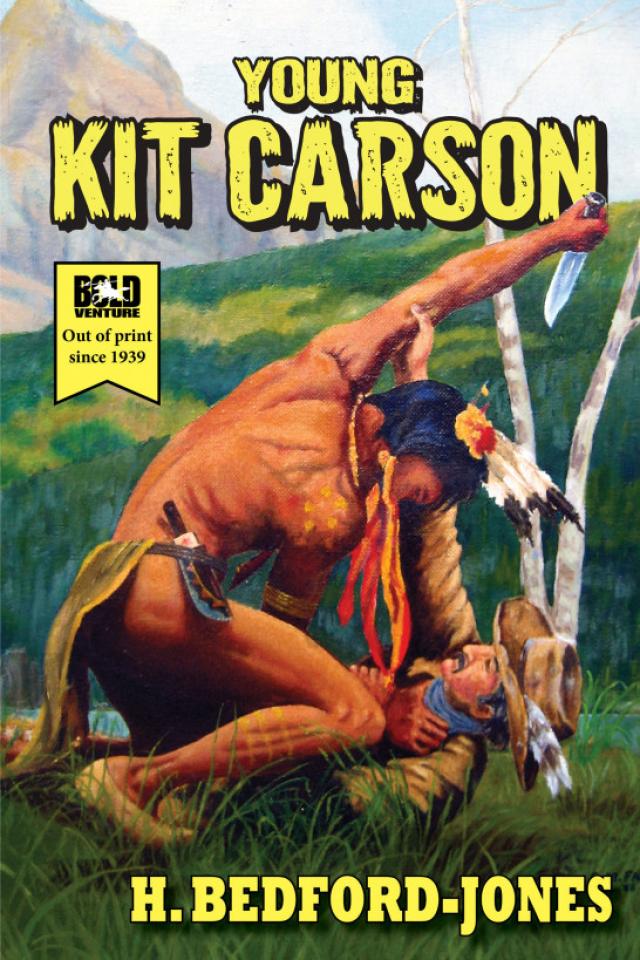


Young Kit Carson
H. Bedford-Jones
Bold Venture Press
Contents
Title Page
Copyright
Introduction
Chapter 1
Chapter 2
Chapter 3
Chapter 4
Chapter 5
Chapter 6
Chapter 7
Chapter 8
Chapter 9
Chapter 10
Chapter 11
Chapter 12
Chapter 13
Chapter 14
Chapter 15
Chapter 16
Chapter 17
Chapter 18
Chapter 19
Chapter 20
About the author
About the Publisher
Copyright Info
© 2019 Bold Venture Press ● 1st edition 2019
Edited and designed by Rich Harvey
PUBLISHING HISTORY
“Young Kit Carson” originally appeared in the July 26, 1941 issue of The Star Weekly newspaper.
Thanks to Camille “Caz” Cazedessus and Pulpdom magazine.
This is a work of fiction, though based on actual historical figures, places and events. The author has recreated events, locales and conversations based upon historical documents and his imagination.
ALL RIGHTS RESERVED
No part of this book may be reproduced or utilized in any form or by any means, electronic or mechanical, without permission in writing from the publisher.
This edition has been marked via subtle changes, so anyone who reprints from this collection is committing a violation of copyright.
Visit www.boldventurepress.com for more books like this.
Printed in the United States of America.
Introduction
A few years ago, I tracked down the great-great-grandson of Christopher “Kit” Carson and introduced myself. I lived in Taos, New Mexico where Kit lived back in the mid-1800s. His old house there is now a museum. I became fascinated by Kit’s life, and wanted to meet some of his family who were living in SW Colorado.
John Carson resembles Kit — about 5 feet 6 inches tall, rather soft spoken and with a college degree in American History. For a while he worked at Bent’s Fort, where Kit worked in the 1840s.
John and I sat around a campfire, chewing on a Buffalo steak, and laughed about Kit being chased up a tree by a Grizzly bear those many years ago. Kit escaped by repeatedly hitting the bear on his nose with a branch, and then waiting all night for it to finally wander away.
I found the HBJ story Young Kit Carson in a Canadian newspaper supplement from 1941. The Star Weekly published the novel in the July 26 supplement, on sixteen broadsheet-size pages.
Young Kit Carson is a sufficiently accurate story of his days, and you should enjoy it. Almost all of the characters were real people, and the events described are very close to real events in the Rocky Mountains of old. Kit passed in 1859, quietly in bed in Colorado.
— Camille “Caz” Cazedessus
pulpdom.com
Chapter I
THE narrow streets of outsprawled Santa Fe were dark. In the plaza, where the hard, bare ground defied spring with a rearguard skift of winter’s snow, dying embers glowed here and there. These marked the evening mess-fires of teamsters and wagoners of the Santa Fe Trail, and their companioning trappers in from the mountains. The hooded wagons stood spectral and silent, sentinelled by bordering axe-scarred cotton woods. Beyond. the governor’s palace and the flanking seats of power, military, civil and religious, held the gateway of Mexico’s northern frontier.
The night’s doings centered in the Fonda, the one-story tavern marking the end of the Santa Fe Trail. The doors of the main entrance stood hospitably ajar. Slipping past the walled corral where trail mules and oxen hunched and snorted. Kit Carson, with rifle poised in buckskin arm. entered out of the night.
“How, Kit!” went up a yell of recognition.
“Here’s Kit Carson down from Taos!”
Carson plunged at once into rude but hearty welcome, strident gaiety, hazy smoke and flickering lights.
The bar was busy. Carson swallowed his dram and took the stool offered him by big Rube Herring. Slight of build, fair-haired and blue-eyed, his rifle between his knees, its muzzle topping his hat-brim, he took in the show, watchful, wasting no words.
Nine years ago, he had come over the trail from Missouri. Out of Taos, 80 miles northeast of Santa Fe. He had trapped across to Mexican California, and also beyond the mountain divide into Oregon. As soon as the streams and passes opened with the spring, he was off again with his trapsack; but behind this simple prospect now lurked perplexities and problems to be set at rest.
“Doin’s in the big lodge, hey?” bellowed Rube Herring above the uproar. “Hurray for ol’ Kaintuck! One time it’s fat cow; next time it’s toasted moccasin. Where from?”
“Taos,” replied Carson laconically. “What’s the sign hereabouts?”
“A-plenty, Kit. My feet itch to dance Injun. Will you wet your whistle?”
“Had my liquor. If there’s a scrimmage, I don’t aim to lose my hair.”
“Never got so drunk I couldn’t line hindsight and foresight!” And Herring guffawed. “Last time I seen you was at rendezvous on the Green. You’d come in from the Snake, after trapping with a Hudson’s Bay party. After we reached Fort Hall trading post on the Snake, the Injuns run off what stock we had left. Had to buy animals from Tom McKay of the Hudson’s Bay, so as to get rendezvous. I haven’t paid for mine yet.”
“Where did you set traps this beaver season? For the Britishers again?”
“Dunno, Rube. I’m a free trapper. The H.B.C. hold a prime beaver country and pay well for pelts.”
Fiddle and guitar now burst into a wild strain. Back to the walls went chairs and tables. Rifles clattered into a discard, but every man knew where his own iron went. There was a rush for the women. The agile Mexicans were first.
Confusion, wild hilarity, black looks; the Mexicans far outnumbered the Americans present. The plank floor shuddered to the beat of heavy feet; the candle-flames swayed and tilted at their moorings. Trapper and teamster left womanless fell into bear hugs, prancing awkwardly over the floor. Dust eddied. Carson, caught in the grip of old Laforay the breed Iroquois, pivoted hither and thither, as the music swirled.
The circle tired, and finally broke with a united scalp halloo. The music fell away. Then something happened, all in a flashing instant, ere the music picked up and pulsed a newer, more seductive strain. Something that held the whole place gripped and motionless. An inner door had swung open. She stood there, then lithely advanced across the threshold, smiling as she confronted the staring eyes.
A golden girl, wearing tightly fitted doeskin which revealed rather than concealed. A slimly rounded woman, her small head crowned with twin-braided hair the rich color of the northern beaver. The parting, Carson noted, was deeply vermilioned. Dusky golden features, forehead low, brows nearly meeting and well arched above eyes soft and lustrous as those of the young cow bison. Straight proud nose, a perfect oval face curving to the passionate, strong chin and lips. And upon her feet moccasins with tiny bells. Thrust between girdle and soft thigh, a knife in beaded sheath.
As the girl stepped aside, another figure appeared in the doorway behind her. A warrior, erect, contemptuous, watchful; a Comanche, painted of visage, with dressed buffalo robe sweeping his figured moccasins. At sight of him Carson sensed a movement around, of hands fitting to knife-haft or seeking discarded rifle. Then, suddenly, the girl-woman was dancing.
She danced to the languorous sway and tinkle of her moccasin bells, while the music pulsed. Undulating, provocative, laughing, she quickened as the fiddles quickened. Carson started; it was the April moon Young Squaw Dance of the Arapaho people. Others recognized it also, as a murmur testified.
With gradual circuit of the room, she was coming. Carson felt her eyes touch on him. Now she had come; she was pausing before him, with uplift of eyes and arms extended. He felt the warmth of her. He saw her lips move; he heard the word: “Come!” Thus, in April, the Arapaho girls would bid the young men. It was to dance that she invited him.
Carson moved, but another was before him with a wild, sharp cry:
“Caspita! No, American dog! Yo. caballero Mejicano—”
A Mexican sprang for her, avidly seized her and caught her to him. Arm cutting into her waist, the Mexican faced around, snarling, whipping out a knife. But swifter even than Carson was the girl herself.
“You?” she cried in quick scorn. Her fingers darted; her blade came clear; her hand drove it in to the very haft. The Mexican gasped. His clutch relaxed. He slumped, and slid to the floor.
Fandangos usually ended this way; a blow, a knife, a charge and scramble. Now there was a rush. The Americans, heavily outnumbered, took the offensive. Bodies met bodies; knives clashed; stools and rifles were swung. The lights were being hastily snuffed. Women shrieked in wild affright.
Carson had snatched up his rifle, even as the girl’s knife drove home. Now, with agile rapidity, he swept her back, covered her from a rush of Mexicans with his flailing rifle barrel. Her laugh rang in his ears as she slipped back through the doorway and disappeared.
Darkness fell upon the place. Carson broke through the Mexicans. His own people were retreating to the entrance. Fighting cool-headed, he joined the retreat. Trappers and teamsters were pouring out into the street. The rear men faced about with final thrust and smash, then backed away. The heavy doors slammed shut, and the bolts were shot.
Carson found himself left with Herring and Laforay. The old breed said, “That young woman, I see her before now! What she do here, eh?”
“Huh!” said Rube Herring. “I seen her with a Hudson’s Bay party west of the mountains, near rendezvous time last summer. She’s a breed, half Injun, and half French.”
“Her mother’s a Blackfoot,” said Laforay. “I see her las’ year in Yellowstone country, in Plenty Eagle’s lodge. I hear the Crows talk about her. The Snakes, they talk too. Go Everywhere Woman—that’s her! I hire out again this spring to Hudson’s Bay. They have the open hand. Maybe I get rich, marry her.”
Herring said: “She made a dead set for Kit, here. Hey! What’s the sign, Kit?”
“Never saw her before.” Carson grimaced and rubbed his shoulder. Someone had hit it in the scrimmage, and the bone was still sore from a Blackfoot bullet. “Plenty Eagle, huh?” he added, with a low oath. “It was his ball that downed me, time I near froze, stretched out all night. Ain't forgot it, neither.”
CARSON was skirting the high wall of the Fonda corral when he heard the slight pad-pad of moccasins in his wake. He whirled, ready, peering into the obscurity. It was the tall Comanche of the framing doorway; robe reversed now, hair side out.
“Amigo!” The Comanche spoke in guttural Spanish. “Young woman say Little Chief come.”
No mistake. “Little Chief” — so the red folk knew him, a name eloquent in its laconic significance.
“That is good,” said Carson gravely. His heart was weak; he must see her again. He could not refuse. She knew his name, had asked for him.
The Indian turned, wordless, robe-enveloped and straight-footed. Carson followed. They rounded the farther corner of the Fonda and came to a single doorway, and passed in. Here was a small room, lamp-lighted. The Comanche ushered Carson in, then came in and closed the door and stood against it.
She was here, sitting on a couch. She had wrapped herself in a crimson shawl. She sprang up, her moccasin bells tinkling, and held out her hand, white-woman fashion.
“Kit Carson is welcome,” she said in English, spiced with accent. “Will he sit down?”
Carson let her fingers slip from his hand. He sat upon an ox-hide stool, held his rifle between his knees, and waited, his eyes devouring her.
“I have to thank you for what you did, in there, for me.”
“It was nothing,” said Carson, but not in words. With the Comanche’s intent eyes glowing upon him, the universal sign-language came more naturally. It steadied him to use his hands, thus. His cool poise returned. Blackfoot, eh?
“You would have danced with me?” she asked, smiling.
“I would, yes,” he replied.
“I know of you, Kit Carson. I have heard Captain McKay speak of you. You were with him, after beaver.”
Carson nodded. “Last spring, into the great basin south of the Snake.”
“Captain McKay helped you with horses when yours were stolen, eh?”
“He had them. We didn’t,” Carson was laconic, alert.
“Indians don't steal Hudson’s Bay horses.”
“Those devils of Blackfeet will steal anything that has four feet and a coat of hair.”
“Yes?” She showed no anger. “You think the Blackfeet all bad? But they get on very well with the Hudson’s Bay men. And supposing that I, Marie, am of the Blackfeet?” With the smiling question she leaned toward him, provocative. “Am I so bad, then? Maybe you will go with Captain McKay again, into rich beaver country this time. I will tell him. I am of the Hudson’s Bay people, you see. And I’ll meet you again, west of the mountains “
What was she after? Carson’s thoughts were on those horses for which he owed McKay She read his mind, and smiled anew.
“The horses do not matter; they shall be nothing, my friend.”
He sensed danger, a fascinating danger. Her eyes drew him, and he felt as he had once felt when matching eyes with a crouched panther. Abruptly, he stood up.
“I’ll be going,” he said, finality in his air. Her eyes widened, but she made no protest.
“Don't forget, then. Captain McKay will expect you.”
“Good-night.”
Chapter II
WILLIAM BENT reflectively stuffed his pipe It was a Cheyenne pipe with blackened bowl and long hollow-reed stem gaily painted and hung with a weasel-tail pendant. He and Kit Carson were sitting on the flat roof of his fort, out before the second-storey quarters, in the sunlight. His dark features were almost Indian, marked by the smallpox. He was a man of careful speech, of plodding thought.
Never in all his life had he, or any other white man, beheld such a sight as now greeted him.
Before the flat, graveled roofs of the trading post, the Stars and Stripes lazily flapped in the plains breeze from the cupola sentry-box atop the main gateway. This was the north bank of the Arkansas river, a scant 100 miles from the Rocky Mountains boundary. Bent’s Fort had advanced the flag 500 miles to this southwestern corner of the United States.
Bent lighted the tobacco with a lucifer. His words followed the gush of smoke from lips and nostrils.
“Ten thousand on ’em, and 10,000 more within a day’s ride. If those fellers only knew how easy they could wipe us out, Kit, they’d be dancing our scalps before another sundown.”
Carson pulled at the short clay pipe stuck in his tanned face. His eyes, narrowed on the outspread scene, belied the brief smile on his lips.
“They don't know, Bill. They do know they’d lose a heap of lives trying. And an Injun counts lives.”
The February day was mild. Here on the roof, the beams of the westering sun were warm with promise of approaching spring. The courtyard below, enclosed by the post walls and the abutting living-quarters, was a busy scene.
Northward, running clear over the plains horizon, a late afternoon sun gleamed level upon a far-scattered forest of lodges — Arapahoe, Cheyenne, and Utes from the mountains; the plain was whitened by those bleached buffalo hides. The crossed lodge-poles, cutting from the peaks of the cone-shaped tepees, broke the sky endlessly. Few men had ever seen so many redskins at one time.
“Fifty whites at best, and close on 20,000 Injuns; counting men and boys both, half of ’em fighters,” reflected Bent. “And plunder a-plenty if they had the grit to stand losses.”
“Shucks. Bill! You’re married into the Cheyennes: why worry?” said Carson. “Besides, you've got an open hand. You’re big trader to them; they and the Rapahoes know which way their stick floats. Before you came, they were poor. Now they’re rich. They turn in buff’ler robes to the post and get their pay in goods.”
Bent looked down at his Cheyenne leggings and moccasins, fringed and beaded like those of a chief. A slight, wiry, swart man, he was slow to voice what lay deep in his mind.
“Old Thunder, my wife’s father, gave me this medicine pipe. He’s my friend,” he said awkwardly. Beside him was the one man in whom he felt that he might confide.
“He’s had something on his mind lately. I can't get much out of him. It’s something about a medicine beaver. He’s Cheyenne, you know, and keeper of the Cheyenne medicine arrows. He knows a lot. But this medicine beaver is new to me. Ever hear of a white beaver?”
Carson considered. “Yes.… Legends, mostly. Ghost-dance stories. Nobody ever saw one. That is, not real white fur.”
“Where there’s smoke, Kit, you’re liable to find fire. Owl Woman, my wife, loosens her tongue a bit. Looks as if Comanches are stirring up trouble.”
“Reckon they might be,” Carson assented. “I hear tell the Comanches are jealous about this here post of yours, which leaves them poor while it makes the Cheyennes rich. Any Comanches trade here?”
“No. They won't come in for trade at all,” Bent said simply. “They want a trading post down in their country. But that’s not the word. Kit. Now look yonder. See that bunch of lodges there, keeping by themselves?”
Carson nodded, squinting at the groups of tepees.
“Comanches, sure. Keeping clear of the Utes, huh? And the Utes stay clear of the ’Rapahos.”