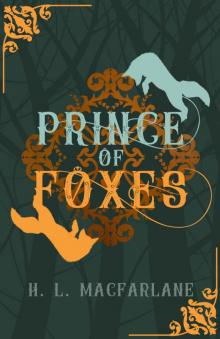
Prince of foxes, p.1
Prince of Foxes, page 1
part #1 of Bright Spear Trilogy Series


Contents
Copyright
Dedication
Author's Note
Prologue
Chapter One
Chapter Two
Chapter Three
Chapter Four
Chapter Five
Chapter Six
Chapter Seven
Chapter Eight
Chapter Nine
Chapter Ten
Chapter Eleven
Chapter Twelve
Chapter Thirteen
Chapter Fourteen
Chapter Fifteen
Chapter Sixteen
Chapter Seventeen
Chapter Eighteen
Chapter Nineteen
Chapter Twenty
Chapter Twenty-One
Chapter Twenty-Two
Chapter Twenty-Three
Chapter Twenty-Four
Chapter Twenty-Five
Chapter Twenty-Six
Chapter Twenty-Seven
Chapter Twenty-Eight
Chapter Twenty-Nine
Chapter Thirty
Chapter Thirty-One
Chapter Thirty-Two
Chapter Thirty-Three
Chapter Thirty-Four
Epilogue
The story continues in Lord of Horses...
Acknowledgements
Origin of Poems
About the Author
Copyright © 2019 Hayley Louise Macfarlane
All rights reserved.
Published by Macfarlane Lantern Publishing, 2019
Glasgow, Scotland
No parts of this publication may be reproduced, stored in a retrieval system, or transmitted in any form or by any means, electronic, mechanical, photocopying, recording, or otherwise, without the prior written permission of the copyright owner.
This book is sold subject to the condition that it shall not, by way of trade or otherwise, be lent, resold, hired out, or otherwise circulated without the publisher’s prior consent in any form of binding or cover other than that in which it is published and without a similar condition including this condition being imposed on the subsequent purchaser. Under no circumstances may any part of this book be photocopied for resale.
This is a work of fiction. Any similarity between the characters and situations within its pages and places or persons, living or dead, is unintentional and co-incidental.
Cover Art Copyright © 2019 Hayley Louise Macfarlane
For Scotland, and for faeries.
PLEASE NOTE: Prince of Foxes is written in British (UK) English.
When someone has wakened to what is really there
is that person free of the chain of consequences
and I answered yes and with that I turned into a fox
and I have been a fox for five hundred lives
Fox Sleep (W. S. Merwin; 1992)
Prologue
Names were important. They always had been, from the moment man first developed language to understand the world around him. They were important, but the intense popularity of a particular playwright’s work in the South of England suggested otherwise. When hoards of Londoners leeched into Scotland in search of good hunting grounds, golfing estates and other leisurely pursuits that they could not find at home Sorcha became unwillingly familiar with Shakespeare’s plays.
But Sorcha and her family knew better than to take his words to heart. A rose by any other name would not smell as sweet, for once it lost its name it was no longer a rose as one knew it. And names weren’t important simply for their superficial usage in eliminating the need to wordlessly point at things.
All her life Sorcha had the rules of names drilled into her. Do not call a person by their first name if you are not familiar with them. Take your husband’s surname when you marry and leave your own behind. Bear a son to pass on his father’s name. Give your children names full of luck, strength, wisdom and beauty, for they would need such traits when they grew up.
But these mantras all paled in comparison to the one rule the infuriating English tourists liked to laugh at most. They would not laugh so loudly if they knew the truth. Nobody who knew the truth laughed about it. This rule was the very reason Sorcha often went by Clara, an anglicised version of her first name that she despised but eagerly used nonetheless.
She had witnessed first-hand, as a child, what happened when you did not follow this one, most important rule. You disappeared – sometimes forever, sometimes for no time at all – but if you returned you were changed, and almost never in a good way. Sorcha had seen calm and even-tempered folk go mad, and the loudest, brashest of her father’s friends retreat into their own minds, never to speak another word.
Tourists often thought the locals were crazy when they came to visit the little town of Darach. It was nestled between large, sweeping forests and breathtakingly beautiful lochs, so it was a popular place to visit away from the hustle and bustle of Glasgow and Edinburgh. Locals warned them against conversing with anyone they might meet roaming beneath the trees, or wandering along the shores of the lochs, especially at twilight. The tourists, without fail, never heeded their advice.
So they disappeared, in one fashion or another, and they only had themselves to blame. They had been warned, after all, and they didn’t listen.
Never, ever give your real name to a faerie.
Chapter One
Lachlan
Today was the queen’s funeral and Lachlan, her only child and heir to the throne, was deliberately avoiding the ceremony.
His mother would understand, he was sure. He’d never been one for mournful occasions; most of the Seelie folk weren’t. Their lives were long enough to be considered immortal by the humans who largely lived, unknowing and unseeing, beside them. If Lachlan allowed himself to be truly sad he’d spend centuries feeling that way.
It was the last thing he wanted.
So Lachlan was currently whiling away his morning following a human girl who was collecting early autumn brambles on the outskirts of the forest. She lived in Darach, the closest human settlement to the central realm of the Scots fair folk. The people who lived there were, in general, respectful and wary of Lachlan and his kind. They saw what members of the Seelie Court could do fairly regularly, after all. The rest of the British Isles was another story entirely, though it hadn't always been that way.
Everybody in the forest knew things were changing.
The advancements made in human medicine, and human technology, and human ingenuity, meant that humans were beginning to forget what it felt like to fear 'otherness'. They believed themselves above tales of faeries, and magic in general, though Lachlan knew there were humans capable of magic, too.
Not here, though, he thought, creeping from one tall bow of an oak tree to another to trail silently after the girl. She was happily eating one bramble for every two she placed in her basket, seemingly without a care in the world. Not on this island. Not for centuries. Lachlan knew this was largely because his mother, Queen Evanna – as well as King Eirian of the Unseelie Court far down south, in England – spirited all such magically-inclined British children away to the faerie realm, to live for all intents and purposes as faeries themselves.
That's certainly better than being an ordinary human, especially now, when they've forgotten about us.
A stiff breeze tearing through the oak tree caused Lachlan's solitary earring to jingle like a bell. Adorned with delicate chains and tiny sapphires, and spanning the entire length of his long, pointed ear as a cuff of beaten silver, the beautiful piece of jewellery had been a gift from his mother from a time long since passed. Back then Lachlan had been enamoured with the blue-eyed faerie, Ailith, and had been convinced the two of them would marry. The earring was ultimately meant as a gift for Ailith, he'd decided. His mother would never be so direct as to give it to Lachlan's beloved herself. It wasn’t in her nature.
But then Queen Evanna had married the half-Unseelie faerie, Innis, who was the Unseelie king’s brother. He had himself a grown son, Fergus, who came with his father to live in the Seelie realm. The two were silver where Lachlan and his mother were gold, and Ailith had become betrothed to his new-found stepbrother instead of him.
So Lachlan lost his love and, now, he’d lost his mother. The earring was all he had left of both.
I should go to the funeral, he decided, turning from the girl as he did so. I am to be king, after all. I should –
Lachlan paused. He could hear something. More chime-like than his earring in the wind, and clearer than the sound of the nearby stream flowing over centuries-smooth stone.
The human girl was singing.
“The winds were laid, the air was still,
The stars they shot alang the sky;
The fox was howling on the hill,
And the distant echoing glens reply.”
Lachlan was enamoured with the sound of her voice. The words were Burns; the melody unfamiliar. He thought perhaps she’d invented the tune herself and, if so, she was a talented girl indeed. He peered through the yellowing leaves of the oak tree, intent on seeing what the human with the lovely voice truly looked like.
She was not so much a girl as a young woman – perhaps not quite twenty – though since Lachlan himself had lived for almost five times that long she was, for all intents and purposes, still simply a girl. Her skin was pale and lightly freckled, though her cheeks held onto some colour from the fast-fading summer. Her hair was a little darker than the oak trunk Lachlan was currently leaning against. It flashed like deep copper when it caught the
A cream dress fell to her ankles and sat low on her shoulders. Small leather boots, made for wandering through forests and across meadows, were laced across her feet. A cloak of pine-coloured fabric was slung over the handle of her almost-full wicker basket. Well-made clothes, he concluded, but nothing elaborate or expensive. Just an ordinary girl. She dithered over the correct words of the next verse of her Burns poem as Lachlan merrily watched on. Fair to look at, for a human. But it is her voice that is special. Special enough to ask her name.
He delighted over thinking how his stepfather and stepbrother would react when he brought back a human girl, enchanted to sing for him until the end of time. I wonder what Ailith would think. Would she be jealous? Would she mourn for the loss of my attention?
Lachlan was excited to find out.
He stretched his arms above his head, causing his earring to jingle once more. Below him the girl stilled. She stopped singing, dark brows knitted together in confusion.
“Is somebody there?” she asked, carefully placing her basket down by her feet as she spoke.
“You have a lovely voice,” Lachlan announced. He was satisfied to see the girl jump in fright, eyes swinging wildly around before she realised the voice she’d heard came from above. When she spied Lachlan standing high up on the boughs of the oak tree she gasped.
“You are – it is early to see one of your kind so far out of the forest,” she said. She struggled to maintain a blank face, to appear as if she wasn’t surprised in the slightest to see a faerie standing in a tree.
Lachlan laughed. “I suppose it is. Today is a special occasion; we are all very much wide awake.”
The girl seemed to hesitate before responding. Lachlan figured she was trying to decide if it was wise to continue such a conversation with him. “What occasion would be so special to have you all awake before noon?”
“The funeral of the queen. My mother.”
“Oh.”
That was all she said. Lachan had to wonder what kind of reaction he’d expected. Certainly not sympathy; he had no use for such a thing.
“You are not at the funeral?” the girl asked after a moment of silence. “If you are her son –”
“I shall get there eventually,” Lachlan replied. He sat down upon the branch he’d been standing on. “Tell me your name, lass. Your voice is too beautiful to not have a name attached to it.”
To his surprise, she smiled. “I do not think so, Prince of Faeries.”
Clever girl.
“You wound me,” he said, holding a hand over his heart in mock dismay. “An admirer asks only for a name and you will not oblige his lowly request? How cruel you are.”
“How about a name for a name, then?” she suggested. “That seems fair.”
Lachlan nodded in agreement. The girl could do nothing with his name. She was only human.
“Lachlan,” he replied, with a flourish of his hand in place of a bow. “And you?”
“Clara.”
“A pretty name for a pretty girl. Is there a family name to go with –”
“I am not so much a fool as to give you my family name,” Clara said, “and I think you know that.”
He found himself grinning. “Maybe so. Come closer, Clara. You stand so far away.”
He was somewhat surprised when she boldly took a step forwards, half expecting her to decide enough was enough and run away.
Even careful humans give in to the allure of faeries, he thought, altogether rather smug. It won’t be long until I have Clara’s full name.
When Clara took another step towards him Lachlan noticed that her eyes were green.
No, blue, he decided. No, they’re –
“Your eyes,” he said, deftly swinging backwards until he was hanging upside down from the branch. Lachlan’s face was now level with Clara’s, though the wrong way round. She took a shocked half-step backwards at their new-found proximity. “They are strange.”
“I do not think my eyes are as strange as yours, Lachlan of the forest,” she replied. “Yours are gold.”
“Not so uncommon a colour for a Seelie around these parts. Yours, on the other hand…we do not see mismatched eyes often.”
Clara shrugged. “One blue, one green. They are not so odd. Most folk hardly notice a difference unless they stand close to me.”
“Do many human boys get as close to you as I am now?” Lachlan asked, a smile playing across his lips at the blush that crossed Clara’s cheeks.
She looked away. “I cannot say they have.”
“Finish your song for me, Clara. I’ll give you something in return.”
“And what would that be?” she asked, glancing back at Lachlan. Her suspicion over the sudden change of subject was written plainly on her face.
He swung himself forwards just a little until their lips were almost touching. “A kiss, of course.”
“That’s…and what if I do not want that?”
“Then I guess I leave with a broken heart.”
Clara’s eyebrow quirked.
“You do not believe me,” he complained.
“With good reason.”
“You really are a cruel girl.”
The two stared at each other for a while, though Lachlan was beginning to grow dizzy from his upside down view. But just as he was about to right himself, Clara took a deep breath and began to sing once more.
There were four verses left of her Burns poem, about a ghost who appeared in front of the poet to lament over what happened to him in the final years of his life, and it was both haunting and splendid to hear. Lachlan mourned for the spirit as if it had been real, and wished there was more to the poem for Clara to sing.
But eventually she sang her last, keening note, leaving only the sound of the wind to break their silence. When Lachlan crept a hand behind her neck and urged her lips to his Clara fluttered her eyes closed. The kiss was soft and chaste – hardly a kiss at all – but just as it ended Lachlan bit her lip.
The promise of something more, if Clara wanted it.
The girl was breathless and rosy-cheeked when Lachlan pulled away. A rush ran through him at the sight of her.
“Tell me your last name,” he breathed, the order barely audible over the breeze ruffling Clara’s hair around her face.
She opened her eyes, parting her lips as if to speak and –
The sound of bells clamoured through the air.
Clara took a step away from Lachlan immediately, eyes bright and wide and entirely lucid once more.
“I have to go,” she said, stumbling backwards to pick up her forgotten basket and cloak before darting away from the forest.
No matter, Lachlan thought, as he dropped from the branch to the forest floor. I shall see her again. I will have her name next time.
But he was disappointed.
Now he had to go to his mother’s funeral alone, with no entertainment to distract him from his grief when evening came.
Chapter Two
Sorcha
“Have I lost my senses entirely?” Sorcha cried. “Singing for a faerie. Their prince! I must have gone mad!”
She passed Old Man MacPherson’s farm in a haze of scurried footsteps, dropping brambles from the basket clutched to her chest as she went. The man’s son was up on the roof; he waved to Sorcha when he noticed her, and she nodded in response. He was replacing a slate tile which had come loose and smashed upon the ground in the middle of the night. Soon the mild weather would turn and the farm would need to be as watertight as possible to avoid the coming rain, which arrived hand-in-hand with the darkest months of the year.
But Sorcha was happy with the promise of wet, cold days and wetter, colder nights. For though the creeping autumn weather and the inevitable winter that followed caused damage to roofs and fields and sometimes livestock, it also signalled a blessed end to the slew of tourists that had bombarded the tiny town of Darach since April.
Good riddance to them, Sorcha thought with vicious pleasure. Let them return to their cities and their pollution.
She paused by the loch-side to pick up a pair of empty glass bottles and a filthy handkerchief. Sorcha scowled; only a city-dweller would leave behind such a mess on the shore of the most beautiful loch in the country.