

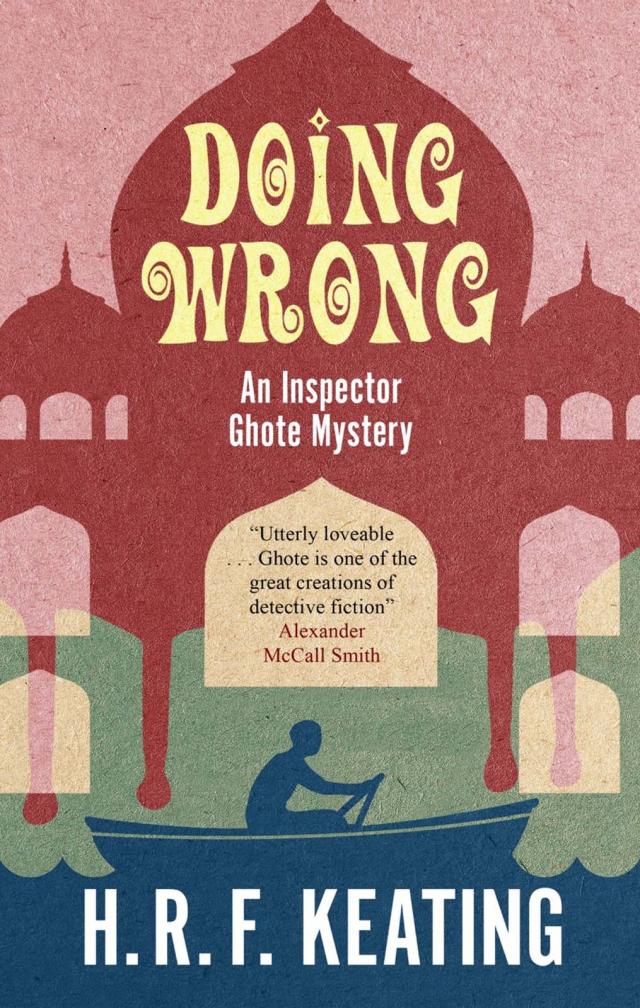
Doing wrong, p.1
Doing Wrong, page 1


Contents
Cover
Title Page
Copyright
Introduction
Chapter One
Chapter Two
Chapter Three
Chapter Four
Chapter Five
Chapter Six
Chapter Seven
Chapter Eight
Chapter Nine
Chapter Ten
Chapter Eleven
Chapter Twelve
Chapter Thirteen
Chapter Fourteen
Chapter Fifteen
Chapter Sixteen
Chapter Seventeen
Chapter Eighteen
Chapter Nineteen
Chapter Twenty
Chapter Twenty-One
Chapter Twenty-Two
DOING WRONG
H. R. F. Keating
This ebook is copyright material and must not be copied, reproduced, transferred, distributed, leased, licensed or publicly performed or used in any way except as specifically permitted in writing by the publishers, as allowed under the terms and conditions under which it was purchased or as strictly permitted by applicable copyright law. Any unauthorised distribution or use of this text may be a direct infringement of the author’s and publisher’s rights and those responsible may be liable in law accordingly.
First published in Great Britain in 1994 by Macmillan.
This eBook edition first published in 2020 by Severn House Digital,
an imprint of Severn House Publishers Limited.
Copyright © 1994 by H. R. F. Keating.
Introduction copyright © 2020 by Vaseem Khan.
The right of H. R. F. Keating to be identified as the author of this work and the right of Vaseem Khan to be identified as the author of the introduction has been asserted in accordance with the Copyright, Designs & Patents Act 1988.
British Library Cataloguing in Publication Data
A CIP catalogue record for this title is available from the British Library.
ISBN-13: 978-1-4483-0403-5 (e-book)
Except where actual historical events and characters are being described for the storyline of this novel, all situations in this publication are fictitious and any resemblance to living persons is purely coincidental.
This eBook produced by
Palimpsest Book Production Limited,
Falkirk, Stirlingshire, Scotland
INTRODUCTION
Sitting on my bookshelf in my east London study is a twenty-year-old and somewhat dog-eared copy of The Perfect Murder. Some of the pages are marked by my own all but illegible scribbles, others are crinkled by a combination of damp and rainwater; not just any rain, mind you, but honest-to-goodness monsoon rain. I bought the book from a roadside seller while living in Mumbai in my twenties, the sort of grinning, roadside sprite that is as much in evidence in H.R.F. Keating’s 1960s vision of India as he was in the India I found myself in. I’d gone there in 1997 to work as a management consultant, and ended up spending ten wonderful years ‘in-country’. My parents hailed from the subcontinent but I’d grown up in Thatcher’s Britain – all I knew of India came from hazy memories handed down to me by my father (he’d been unceremoniously shunted across the newly-created border to Pakistan as a child during Partition) and bits and pieces I’d gleaned from Bollywood movies.
The India that I discovered was a nation on the cusp of transformation, a country beginning the journey from a semi-industrialised agrarian economy – the post-colonial India that Keating introduced to us decades earlier and that had largely stagnated since – to the status, today, of superpower-in-waiting. A country of swamis and snake charmers – as it had always been – but now, increasingly, a country of call-centres and coffee shops, of shopping malls and software firms, of MTV and McDonald’s. A country that Inspector Ghote would find both recognisable and wholly beyond his imagining.
By the time I returned to the UK, a decade later, I had already decided that I would encapsulate those incredible memories of India into a novel. The result was The Unexpected Inheritance of Inspector Chopra, the first in my Baby Ganesh Agency series. These crime stories, featuring a policeman forced into early retirement from the Mumbai police service and subsequently compelled to ‘adopt’ a one-year-old baby elephant, are my attempt to chronicle the tumultuous landscape of the India that I observed first-hand. Five novels and two novellas in the series later, I can admit that these tales of the subcontinent owe a debt to H.R.F. Keating’s Inspector Ghote series.
Back when I was casting around for a suitable template upon which to base The Unexpected Inheritance of Inspector Chopra, my eye alighted on that old copy of The Perfect Murder. I had already had the idea of a policeman who inherits a baby elephant, but I was seeking inspiration that such a work – a crime novel set on the subcontinent – might find an audience. The modern publishing industry was not prone to experimentation, or so my investigations at the time informed me.
As I reread Keating’s novel and recalled the success that his series had enjoyed, I was emboldened. Two years later I completed my manuscript and whizzed it off to a small selection of agents. The rest, as they say, is history.
My protagonist, Inspector Ashwin Chopra, could not be more different to Inspector Ghote. Whereas Ghote is a timid, sometimes obsequious fellow, often forced to bend to the prevailing winds of authority, Chopra is a rigid, bristly-moustachioed man, unfailingly honest, and intractably unyielding. And yet in their DNA we find a common gene – an unwavering commitment to that dark flame that flickers so elusively on the subcontinent – justice. For India is a place where justice is often at the mercy of those with wealth and power. This did not sit well with Ghote, and neither does it sit well with Chopra.
Both Keating and I set out to bring to life these two policemen and the city that they inhabit – Bombay/Mumbai – India’s city of dreams. Yet the respective roads that we travelled to do so could not have been more different. I spent ten years living and working in India; Keating only visited India for the first time a decade after The Perfect Murder was published.
That being the case, one might rightly ask why he chose the subcontinent as his muse in the first place? The answer: he picked up an atlas, flicked through it, and randomly chanced upon a map of India. From such moments of serendipity are legends born.
The novel that Keating subsequently wrote was published in 1964 and entitled The Perfect Murder. It featured Inspector Ganesh Ghote (pronounced Goh-té) of what was then known as the Bombay crime branch, a detective of considerable resourcefulness and tenacity. Ghote is not your typical western policeman. There is little of the maverick about him, no melodrama, no bitter divorces in his past (he is dedicated to his wife Protima), no hard-charging, hard-drinking machismo. He is a minor cog within a vast engine of bureaucracy and at the same time accepts this and chafes against it. He is set above the common man – by virtue of his uniform – and yet condemned to forever belong to the lower echelons of that vast stratified populace that gives India such colour and depth. Time and again in these immensely readable novels we see Ghote at the mercy of bombastic senior officers, villainous landlords and wealthy industrialists. In the face of abuse, obstacles and evil machinations, Ghote remains undeterred, finding his way to resolution in every case through a combination of understated intellect and quiet bloody-mindedness. When asked about the genesis of his seminal character, Keating would later reply, ‘Inspector Ghote came to me in a single flash: I pictured him exactly as he was, transposed as it were by some magic arc from Bombay to London. It was a tremendous piece of luck really, because I don’t think Inspector Ghote will now ever die. At least he’ll live as long as I do.’
Prophetic words. The Perfect Murder has met with enduring success. Upon publication it won the Crime Writers’ Association’s Gold Dagger in the UK and claimed an Edgar Award from the Mystery Writers of America. Keating was on his way. And after twenty-five wonderful books and a short story collection, Inspector Ghote has joined the pantheon of great sleuths: Holmes, Poirot, Maigret. In his own way, Ghote has that shimmering of Golden Age stardust about him.
The first Ghote arrived more than half a century ago. The world has changed since then and literary sensibilities have moved with the times. Today, controversies abound under the banner of ‘cultural appropriation’, some justified, others perhaps trumpeted beyond the merits of the case by vested interests. Seasoned literary commentators and social media trolls alike are quick to pronounce judgment on writers they feel have not earned the right to depict a particular lived experience. No doubt they would make much of the fact that H.R.F. Keating, by his own admission, knew very little about India when he began researching these novels. His portrayals of India and Indians might offend some, an example of what they might term post-colonial hubris.
I think this is missing the point. That was a different era, with different dynamics at work. Yes, there will be some who find offence merely in the fact that a middle-aged white man who had never been to India should achieve literary acclaim for novels set in the country. Personally, I believe that writers must have the licence to write that which inspires them. Whilst diversity and cultural authenticity in publishing is something I fervently believe in – for obvious reasons – I will also stand by the right of authors to be authors, that is, to journey on those fantastical oceans of the imagination that make writing such an enjoyable endeavour. For me the key to all such quasi-moral quandaries is whether or not an author has treated his subject matter with respect and empathy. And in his treatment of the subconti nent and its people Keating did more than simply create a series of intriguing crime novels. He brought the India of that time – in all its grit and glory – to the attention of the wider world.
We only have to look at how appreciative Indian readers themselves were of his portrayal.
In a 1981 article for India Today (updated in 2014), Sunil Sethi tells the story of Keating’s third visit to Bombay. He is mildly astonished when a young woman, a fan of his books, approaches him to express her admiration. Keating, Sethi tells us, can’t quite believe the reception he received in India: ‘There you are quietly writing away at your desk, and you produce this little book. Your wife likes it, but she’s an interested party. Your agent approves, but he’s also an interested party. Then you come 5,000 miles from home, and people stop you on street-corners to tell you how much they love reading your books. Isn’t it wonderful?’
Of course, the country has changed dramatically since then. I wonder what Keating would make of this modern India? And what would modern Indians make of him and his work? More importantly, how would Ghote fare? I have a feeling that the inspector, a beacon of decency in a sometimes indecent world, would find himself quite at home as India continues its struggle to undo millennia of entrenched social attitudes: corruption, inequality, nepotism, and the debilitating effects of the caste system.
Ultimately, as a lifelong crime reader and now a relatively seasoned writer in the genre, I believe that there is nothing so likeable in the annals of crime fiction as an honourable detective. And in Ghote we find just such a man, a man for the times in which we live.
Vaseem Khan
London, 2020
ONE
What have I done wrong, Inspector Ghote thought, climbing the stone stairs on his way to report to the Assistant Commissioner. Nothing. Truly nothing. I am right. Inspector Wagh is wrong.
Once again he saw the body in his mind’s eye. Mrs. Shoba Popatkar, veteran freedom fighter, former Minister, upholder of a hundred good causes. Her plain blue-check cotton sari flung out in a wide arc on the bare stone floor of her little flat. Her spectacles lying upside down beside her. The time-sharpened old woman’s face with its unmissable faint grey moustache, and the bruises in the fleshless throat where the murderer’s thumbs had dug deep.
No, out there at Dadar, Wagh has got it wrong. Despite the way her purse was ripped open, that half-wit servant of hers had not arranged with some goonda to come and rob his employer. Why should he have? For years he had been her faithful employee. Oh, Wagh is saying it is always the servant one must first surmise on. True enough when nothing else is looking at all likely. But he should not have ignored and ignored every word of protest the fellow was babbling out when he arrested him. Just only because he is simple-minded.
And there are other things. Little things only. So little that Wagh made nothing of them. But there, nevertheless. The small green uncollected return half of a rail ticket to Banares I was finding in that big leather handbag. No money in that, true. Something in Wagh’s favour. But then what about the fellow I was just now questioning in the bazaar there? Fellow stating a man who asked him where Mrs. Popatkar stayed had a Banares accent?
Yet not so much to set against Wagh’s quick arrest. Will A.C.P. sahib think I am making a fool of myself only to want to go to Banares?
What have I done wrong, H. K. Verma asked almost aloud to the dawn Banares sky as he climbed out of the wide flooded Ganges, the water from his soul-cleansing bathe streaming off his broad back.
Yes, I killed her. But I had to do it. It was right to do it. Right. God Krishna himself is saying it. In holy Gita when he is telling Arjuna it is his duty to fight. To kill, if need be, each and every man in the army opposite.
Negotiating the last of the slippery, silted-over steps, nevertheless a huge groan escaped him.
But to have killed her … strangled her …
When I was always wanting to do right. Always from boyhood days. Never have I so much as once thought of taking the life of any man, woman or child. But … but if I had not done that … And I was asking her not to tell the world what she had read in that confession of lost faith K.K. was making. I was asking and asking. I was begging her. And she would not listen. No, no, truth must come out. It is what I have always fought for. The obstinate old woman. When that truth will make so much of difference. Not to me alone, but to all I would be able to help in India. When I am, after so many years, having in my grasp one cabinet seat. Minister for Social Upliftment. Yes, I will get that. It is all but arranged. I know it will come. I know.
No, no. I was right to do it. Right.
“Well, Inspector,” the Assistant Commissioner said, “I expect, of course, when on an important case a Crime Branch officer is sent to keep an eye on the local fellows, that he may find all is not up to the mark.”
Then a look of sharp doubt flicked onto his face.
“But I am well knowing Inspector Wagh out at Dadar. A cent per cent efficient officer.”
“Oh, yes, sir. Yes. But, sir, I am thinking this time he is going too much by the rules in arresting the servant there. Altogether correct procedure, sir, and quick work also. But, sir, that fellow, Tantya by name, is truly half-witted. I am believing Mrs. Popatkar was employing him out of kindness itself. She was having that reputation. So, sir, Inspector Wagh was not listening to all the jabber the fellow was uttering.”
“If it was half-witted nonsense only, Inspector Wagh was quite right not to waste time with it.”
“Yes, sir. But, sir, Tantya was saying and repeating that Mrs. Popatkar had suddenly decided to visit Banares and had given him some leave. He was to come back today only, before she herself thought she would be here in Bombay again. Sir, her killer must have come just only after she had arrived back earlier than she had thought. Her suitcase itself had not been unpacked even. Tantya is claiming, as far as I was able to make it out, that when he was coming back at the time she had told he was just only finding her dead. He was after all reporting crime, sir.”
“And you believe the fellow when Wagh does not?”
“Sir, it is not that only. Sir, I was finding in Mrs. Popatkar’s purse her rail ticket from Banares.”
“So the lady did visit Banares. Well, we are all meant to do that at some time or another. Stand in the Ganges, wash away the sins and so forth. That’s no reason for her to have been murdered here in Bombay.”
Slowly H. K. Verma picked up his dhoti from the pile of clothes he had left at his usual place on the ghat steps.
But what if I was seen and remembered there in Bombay, he asked himself, a quiver of fear running through the swell of his belly. What if I was seen in Dadar itself? Somewhere beside one of those decayed old houses and the shops selling everything cheap that could be wanted? Or in that bazaar with those women in greasy saris squatting there with their newspaper sheets of wilting vegetables, and with those shapeless creatures in the doorways, those cripples and lepers lying wheresoever they could? Among the bargainings, the shoutings, the quarrellings?
Investigation must have already begun down there also. Questions already must be being asked. It will be a top-notch investigation, too. Shoba Popatkar was a famed lady. Freedom fighter. Railways Minister in early Independence days. And resigning also when there was that 200-killed train disaster.
Who would do the same now?
But I will. If there is some altogether equal disaster in my department when I am a Minister in my turn, I will. … If I am ever made Minister now. If police inquiries are not leading to me myself.
But they cannot. No inquiries can show I was there. Not howeversomuch of a first-class officer they are putting onto the case.
“But, sir,” Ghote said, aware that for some urgent inner reason he was perhaps pleading more than a self-respecting officer should. “Sir, there is more itself. I was asking myself out there if it was truly likely that some small-time goonda would rob a lady known to all as doing so much of right thing. And, sir, I was also wondering whether in her hundred percent bare flat there would be very much of anything to rob.”
“And where did all this wondering get you, Inspector?”


