

When things dont go your.., p.1
When Things Don't Go Your Way, page 1


PENGUIN LIFE
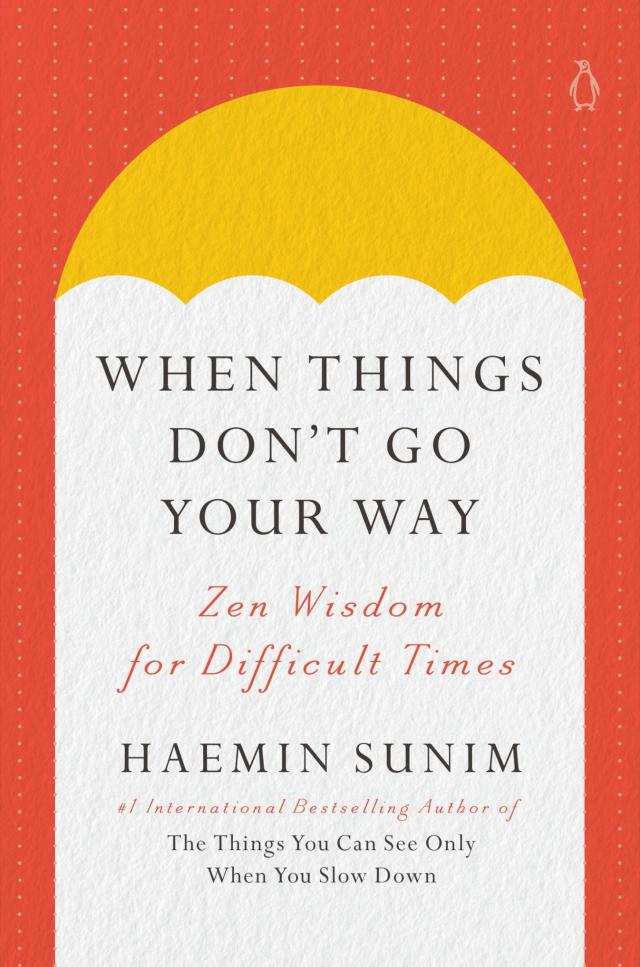
WHEN THINGS DON’T GO YOUR WAY
Haemin Sunim is a Korean Zen Buddhist teacher and author of two bestselling books, The Things You Can See Only When You Slow Down and Love for Imperfect Things. His books have sold over 6 million copies worldwide and have been translated into thirty-eight languages. Born in South Korea, he came to the United States to study film, only to find himself pulled into the spiritual life. Educated at UC Berkeley, Harvard, and Princeton, he received formal monastic training in Korea and taught at Hampshire College in Amherst, Massachusetts, for seven years. His books are popular as guides not only to meditation but also to overcoming the challenges of modern life. When not traveling to share his teachings, Sunim lives in Seoul, where he founded Dharma Illumination Zen Center, which offers meditation retreats and counseling programs.
PENGUIN BOOKS
An imprint of Penguin Random House LLC
penguinrandomhouse.com
Copyright © 2018, 2024 by Haemin Sunim
English translation copyright © 2024 by Charles La Shure
Penguin Random House supports copyright. Copyright fuels creativity, encourages diverse voices, promotes free speech, and creates a vibrant culture. Thank you for buying an authorized edition of this book and for complying with copyright laws by not reproducing, scanning, or distributing any part of it in any form without permission. You are supporting writers and allowing Penguin Random House to continue to publish books for every reader.
Portions of this book were originally published in Korean as 고요할수록 밝아지는 것들 (Goyohalsurok Balgajineun ggeokdeul) by 수오서재 (Suoseojae), Paju, South Korea.
A Penguin Life Book
library of congress cataloging-in-publication data
Names: Hyemin, author, translator. | La Shure, Charles, translator.
Title: When things don’t go your way : Zen wisdom for difficult times /
Haemin Sunim; translated by Charles La Shure and Haemin Sunim.
Description: New York City: Penguin, 2024. | The unverified Korean title is: Tangsin i purhaeng hal ttae kiŏk haeya hal mal. | Translated from Korean.
Identifiers: LCCN 2023025995 (print) | LCCN 2023025996 (ebook) | ISBN 9780143135890 (hardcover) | ISBN 9780525507475 (ebook)
Subjects: LCSH: Suffering—Religious aspects—Buddhism. | Resilience (Personality trait)—Religious aspects—Buddhism. | Zen Buddhism—Doctrines. | Spiritual life—Zen Buddhism.
Classification: LCC BQ4235 .H9413 2024 (print) | LCC BQ4235 (ebook) | DDC 294.3/4442—dc23/eng/20230921
LC record available at https://lccn.loc.gov/2023025995
LC ebook record available at https://lccn.loc.gov/2023025996
Cover design: Nayon Cho
Interior design adapted for ebook by Estelle Malmed
Quotes noted as * have been attributed to the speaker listed.
pid_prh_6.2_145914326_c0_r0
Contents
Introduction
Chapter 1: When Things Don’t Go Your Way
Don’t Be All Right
Why Are We Unhappy?
How Do You Feel About the Universe?
Chapter 2: When Your Heart Is Aching
Please Reject Me Gently!
Spring Days Are Gone
My Jealousy, My Suffering
Chapter 3: When Feeling Burned Out and Joyless
Small but Certain Happiness
Where Is Your Querencia?
Finding Peace in a Restless Mind
Chapter 4: When Loneliness Visits
Why Are We Lonely?
A New Era of “Alone Together”
Seeing Loneliness as It Is
Chapter 5: When Facing Uncertainty
The Courage to Say “I Can’t”
The Two Me’s Inside of Me
Listen First to the Pain Inside of You
Chapter 6: When Enlightenment Has Yet to Occur
Ways of Living Harmoniously
Discovering Your True Self
The Tale of Roundy’s Great Journey
_145914326_
Introduction
A lonely, middle-aged man lived by himself in a small village. One day, he heard a knock at his door and found an incredibly graceful lady standing there, dressed in heavenly clothes and adorned with stunning jewels. Enchanted by her beauty and delightful scent, the man kindly asked her who she was. She replied, “I am the Goddess of Pleasant Virtue. I have come to bestow upon you great prosperity, success, and love.” Overjoyed at her words, the man immediately invited her in and prepared a feast in her honor.
A short time later, the man heard another knock at his door. Upon answering, he saw a woman dressed in tattered clothing, with a terrible odor. The man asked her why she was at his door. She replied, “I am the Goddess of Unpleasant Darkness. I have come to bring poverty, failure, and loneliness into your life.” Fearful of her words, the man asked her to leave immediately. However, she then stated, “I follow wherever my twin sister goes. If you want my sister to stay, you must also invite me in.” When he asked the Goddess of Pleasant Virtue if this was true, she nodded her head and said, “We are a pair. You cannot accept one without the other.”
This tale from the Nirvana Sutra illustrates how good fortune often leads to unforeseen disappointments and hardships. Although we desire only positive experiences in life, it is inevitable that we will also encounter difficult times. These challenges, however, are not without purpose. They can serve as valuable opportunities for self-discovery that can lead to emotional maturity and spiritual growth. The extent of the maturity and growth often corresponds to the severity of the situation we face. We learn to be patient, courageous, compassionate, and truthful through the pain we go through.
* * *
—
This book draws on my personal journey through various struggles and challenges that led to a deep reflection and appreciation of my life, both as a Zen teacher and as a human being. Each of the six chapters features an emotionally challenging time, and consists of three personal essays filled with my stories and advice. Alongside these essays, you will find a collection of short, insightful stanzas that capture either my “a-ha” moments or “ouch” experiences. I hope these reflections provide comfort, hope, and encouragement to those facing difficulties in life. May your journey be blessed with love and kindness as well as many moments of small enlightenment!
Chapter 1
When Things Don’t Go Your Way
Don’t Be All Right
Can you sit still with difficult emotions? Rather than trying to quickly escape from them, are you able to allow them to stay with you and witness how they unfold in your mind?
I know that this goes against our instincts to avoid uncomfortable feelings by any means possible. But for a minute or two, I encourage you to go against your instincts, and let those difficult feelings flow in the space of your mind. For instance, be curious about what would happen if you were to allow a sense of disappointment, sadness, or hurt to linger. Instead of judging yourself for having such feelings, or trying to divert your attention by watching a TV show or surfing the Internet, what if you face them directly and observe unpleasant feelings without any prejudice or resistance?
For a long time, the most difficult emotion for me was the fear of abandonment. Whenever someone canceled a dinner appointment at the last minute, leaving me alone for the evening unexpectedly, or if I didn’t hear back within twenty-four hours after sending a text message to a friend, a fear of abandonment was triggered in me. I felt the pain of loneliness and anxiety, as if I had been left out in a field to fend for myself. I frequently thought about worst-case scenarios, including people leaving me without any warning. When triggered, I could also sense a dark existential void, as if it were going to engulf me. I would then seek a way to avoid these uncomfortable feelings while desperately looking for safety and connection.
I feel a little vulnerable sharing this because I am a middle-aged man who also happens to be a Zen teacher. But, like those of many spiritual teachers in the past, my journey also began because of very personal psychological sufferings. Even after sitting on a meditation cushion for many years, it was a mystery to me why I had this fear of abandonment when I had a stable upbringing by loving parents who actually like each other. After the success of my books gained me recognition in South Korea, my fear of abandonment, unfortunately, grew. I was afraid that people might turn their backs on me one day and abandon me for good because of what I said or did.
And then, to my surprise, it actually happened.
In the winter of 2020, I agreed to appear on a Korean TV program that documented the daily life of well-known people. As usual, I started my day with a morning meditation and prayer in the small home where I have been living with my elderly parents for the last five years. I had bought the house for my parents with the royalties from my books and then transferred the ownership to my Buddhist order. However, after the program aired, a small group of people criticized me for not practicing the monastic ideal of “non-possession,” without understanding the true reality of a monk’s life in Korea: we have no pension or guaranteed housing. Most of us have to fend for ourselves.
Some people started spreading rumors online that this house was opulent and claimed that I possessed a Ferrari. This was frustrating because
Life had given me many lemons before. But this time, I was given too many lemons to make into lemonade. I was shocked, overwhelmed and deeply hurt. My worst nightmare was coming true. I felt betrayed by my monastic brother and deserted by the people who had previously liked my work. Ironically, I, the founder of the School of Broken Hearts, found myself in urgent need of healing.
* * *
—
When I was new to spiritual practices, I had naively imagined the path as one of moral perfection where practitioners had to eliminate all negative emotions such as anger, hatred, fear, and attachment. As a result, I unconsciously repressed those feelings while pretending to have transcended them. However, as I progressed on my spiritual journey, I discovered a more mature path that involves accepting all aspects of myself, including what appear to be the dark and negative ones. I was wrong to assume that spiritual enlightenment could be attained while neglecting unresolved emotional issues or traumatic wounds. I learned that such issues and wounds hold crucial spiritual lessons that must be learned before reaching a profound awakening.
Many close friends and family members asked how I was doing during those darkest days. At first, I answered that I felt much better than expected. But that wasn’t true. I was numb inside and lost for the first time in my life. This moment was becoming a real test of my spiritual practice.
So instead of pressuring myself to feel better, I decided to give myself permission to not be all right. I asked myself to embrace these difficult feelings and see this moment exactly as it was. I allowed myself to feel what was actually there, rather than trying to change it or running away from it.
When I made space for unprocessed emotions, I was soon able to notice the energy of rage in my body. It was like an intense fire, particularly around my chest and throat. I screamed in my room, and further expressed this rage through writing in a journal, therapeutic dancing, mountain climbing, and talking to trusted friends. After honoring my anger for a month or two, I allowed myself to feel deep grief and sorrow, to respect the part of me that felt like it had just died. I let all of the emotions that had been bottled up inside of me pour out in a torrent of tears. Eventually, after going through periods of rage, solitude, and tears, I found myself confronting the root of my emotions: fear.
In my journal, I asked my fear what I was afraid of. At first, it answered, “I am afraid of not being able to provide for those who have been dependent on me, like my aging parents, my godson, my assistants, my staff members, and their families.” Then I asked again what I was really afraid of. After a moment of silence, I had a sudden flashback from my childhood while I was writing.
I was a little boy desperately looking for my mom in a big open market. I was overwhelmed with panic and scared to death. Several adults came up to me as I was in tears and asked, “Where is your mother? Did you lose her?” Then a strange old lady took my hand and told me that she would take me to my mom. I reluctantly went with her. When we arrived at her house, I saw only a scary man, not my mom. Sensing that something was terribly wrong, I escaped through an open door and ran back to the market as fast as I could. After frantically wandering through the market for a while, I finally saw my mom desperately looking for me.
At last, I understood why I had had the fear of abandonment all along. It originated from my suppressed trauma in early childhood. For a long time, I had been ignoring the frightened inner child who had been separated from a source of love, warmth, and security. The dark void I felt represented the scary world that little boy found himself in, without his mother. I could see why I had to go through my worst nightmare. It was all part of my journey to meet the little boy and to integrate the part that had been—up until that moment—too frightening to become conscious of. I took a deep breath and spoke to the little boy: “I see you now. I will always stay right here with you, and never ever abandon you. I accept you just as you are, and love you with my whole heart.”
* * *
—
Things don’t often happen in our lives like we have hoped. When we encounter unfavorable outcomes, we often experience difficult emotions. If this is happening to you right now, no matter how overwhelming and terrifying it is, I want you to know that you can weather the storm. You are stronger than you feel right now and wiser than you believe.
Once the storm quiets down, and it will surely pass, don’t feel the need to pick yourself up immediately and get right back to where you were before. Give yourself time to sit with your present feelings. Once you make time and space for your emotions, you will be able to process them easily and ask important questions such as “What am I feeling now?” “What are my emotions trying to tell me?” and “What did I learn from the experience?” When we pose these questions with curiosity, rather than with judgment, we will come to see deeper truths about ourselves.
This process will then help us to remain collected and respond wisely instead of reacting impulsively. We get to redefine who we truly are by the way we respond to a setback. Remember that the greatest stories are not the ones where everything goes smoothly, as expected; they are always the ones about overcoming hardship and bouncing back from failure.
We have not finished authoring the book of our lives yet. Let us write one of the most meaningful stories with no regret.
* * *
The greatest glory in living lies
not in never falling,
but in rising every time we fall.
—Nelson Mandela
* * *
Welcome your pain,
for it will make you see the truth.
Embrace your failure,
for it will serve as a catalyst for growth.
Love your inner chaos,
for it will lead to self-discovery.
* * *
Pain teaches life lessons,
pleasure doesn’t.
* * *
I know you feel so alone and lost now.
But even in your darkest moments,
there is love to guide you through.
I will never give up on you.
* * *
Like the way the darkness brings out the stars,
you will be able to see who your true friends are
in the darkest moment of your life.
* * *
When you fall in a dark theater
give your eyes a moment to adjust before getting up.
Similarly, if life knocks you down,
take your time to process your emotions and wait for
a clear path forward to become visible.
* * *
We make peace with it
when we can understand it.
* * *
Processing emotions means making sense of one’s feelings
by acknowledging their presence and understanding the cause.
As a result, one finds healthy ways to cope with them,
rather than being unconsciously controlled by them.


