

Delicious hunger, p.1
Delicious Hunger, page 1


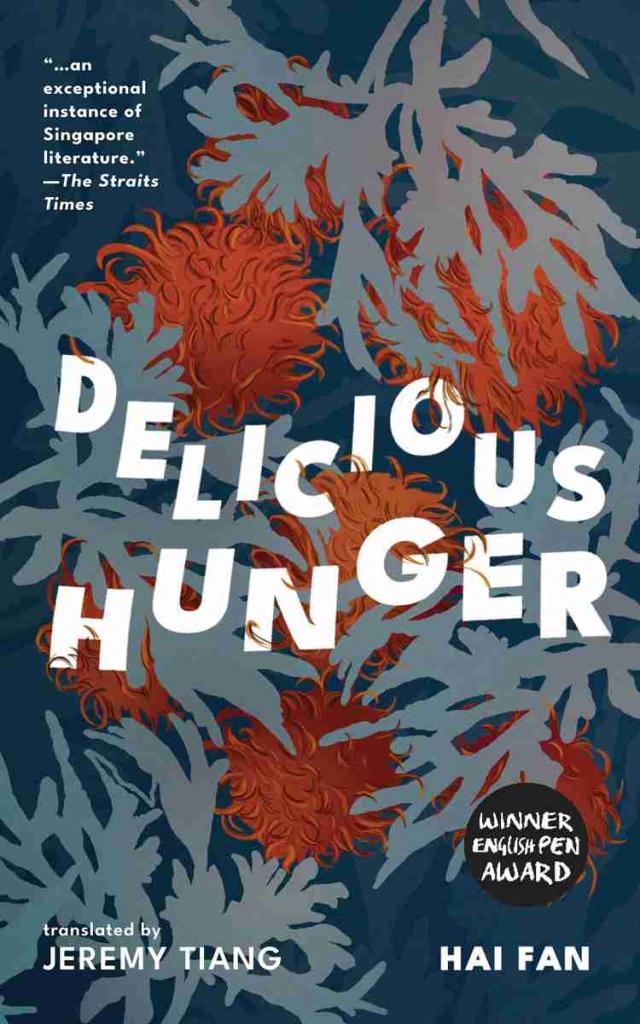
Rarely does a work of Singapore literature manage to render the dense tropical music of the jungle—or as Chinese-language writer Hai Fan puts it, “the rainforest talking in its sleep”.
The former Malayan Communist Party fighter’s short stories are intimate—though not naively sympathetic—sketches of the lives of the guerillas who fought in the rainforests in the last decades of the Cold War.
Booker Prize-longlisted Singaporean translator Jeremy Tiang allows Hai Fan’s gritty surrealism to shine through its dense foliage in his translation. The stories’ keen knowledge of the flora, fauna and geography of Malaya—and their relation to politics—makes this an exceptional instance of Singapore literature.
—The Straits Times
The revolutionaries’ daily lives come into sharp relief in Hai Fan’s stories, which take on added depth through their exploration of themes of friendship, love and purpose. Readers will find much to savour in these impassioned and unique tales.
—Publishers Weekly
No other Sinophone Singapore and Malaysian writer renders the quotidian experiences of revolution-making in the Peninsular Malaysian rainforests with such artistry and authenticity. Departing from established representations of jungles in the region’s literature, Hai Fan’s evocative tales bear the distinctive signs of his lived engagement with “the ways of the hills and rivers”. The vividly crafted stories foreground corporeal urges alongside a gamut of complex emotions as Hai Fan revisits his memory palace, the locus of his social idealism. Infused with nuance and empathy, Jeremy Tiang’s translation offers English-language readers unprecedented access to Hai Fan’s bracing narratives, inspiring a wider vicarious thought: How does commitment to political ideality enable personal beliefs to survive organisational failure? This is a luminous work of tremendous candour, courage and creativity.
—Chan Cheow Thia, author of Malaysian Crossings: Place and Language in the Worlding of Modern Chinese Literature
In this remarkable collection which I have the fortune to read in both the Chinese and English languages, Hai Fan masterfully weaves a tapestry of lives across Singapore and Malaysia’s cultural and linguistic mosaic. Hai Fan and our translator Jeremy deftly blend military terminology, guerrilla vernacular, and colloquialisms from multiple Chinese dialects, Malay, English, and Thai—creating an authentic linguistic landscape as rich and diverse as the region. Through eleven stories forged over thirteen years, readers can journey through verdant rainforests where characters move with purpose—some seen, some overlooked, some forgotten. While moments of gunfire and peril punctuate these brilliant tales, the collection’s core lies in the everyday rhythms of jungle life: planting crops, hunting, crossing rivers, setting mines, storing provisions and standing guard—military necessities that became the daily existence for which warriors like Hai Fan had risked everything.
—Dr Tan Chee Lay, scholar, poet, artist
At once poetic and visceral, haunting yet lyrical, Delicious Hunger immerses the reader in the sensory realities of jungle life: the sweetness of juice from woody vines, more refreshing than Coca-Cola; the tender gaze of a trapped mouse deer, so disarming it stays its captor’s hand; and the enchanting scent of wild mango stored in an earthenware jar, preserving not just fruit but fragile emotions.
Drawing from firsthand experience, Hai Fan’s short story collection vividly recreates one of Southeast Asia’s most complex anti-colonial struggles. Jeremy Tiang’s skillful translation captures the depth of the original text, from the precise naming of native flora to the subtle shifts in dialect that reveal the guerrillas’ diverse backgrounds, maintaining both the literary elegance and raw immediacy of Hai Fan’s prose.
With its compelling narratives and historical depth, Delicious Hunger is essential reading for those interested in revolutionary movements, post-colonial resistance and the global Cold War.
—Zhou Taomo, Associate Professor, the Department of Chinese Studies, Dean’s Chair, the Faculty of Arts and Social Sciences, National University of Singapore, author of Migration in the Time of Revolution: China, Indonesia and the Cold War
Stories of jungle dwelling that explore a geography of new communities, of daily survival, of broken bodies and lost dreams, turning the history we think we know inside out.
—Philip Holden, scholar of Singapore and Southeast Asian literature
… Delicious Hunger plucked me out of my urban climate-controlled environs and dropped me in the middle of the rainforest for a much more intimate, visceral experience. Nature is as much a character in these stories as any human being. Hai Fan’s descriptions, translated by fellow Singaporean Jeremy Tiang, are lush and evocative.
—Mekong Review
As a guerrilla fighter in the Malayan Communist Party’s 12th Regiment, Hai Fan has dedicated himself to weaving his thirteen years of military life into the fabric of grand history. Through his work, he not only brings vibrant colour to the grey areas of this historical period but also, with his documentary-style writing, significantly narrows the distance between readers and the past. Many writers have used the Malayan Communist Party and the rainforest as central themes in their works. In terms of literary achievement and historical depth, Hai Fan remains one of the most accomplished among them. His writing is meticulous and precise, capturing the daily lives of the Malayan Communist forces in the rainforest with remarkable detail while depicting their guerrilla warfare with gripping intensity. Over the years, his outstanding works have been published one after another, instantly overshadowing those who have relied on fictionalising the Malayan Communist experience.
—Hee Wai Siam, Associate Professor of Chinese, Nanyang Technological University
This haunting series of stories of ingenuity, solidarity, comradeship and futility is an impressive example of history as written by the defeated, but it’s more than that too—an almost hallucinatory dispatch from another world.’
—Owen Hatherley, a writer and the author of Landscapes of Communism and Trans-Europe Express
Delicious Hunger © Hai Fan, 2017
Originally published as 可口的饥饿 by 有人出版社, 2017
Translation copyright © Jeremy Tiang, 2024
“Into the Rainforest” © Jeremy Tiang, 2023,
as first published by The Margins, the digital magazine
of the Asian American Writers’ Workshop
“Dead Pigs, Buried Rations, Yesterday’s People” © Li Zi Shu, 2017
Translation copyright © Jeremy Tiang, 2024
ISBN 978-981-17539-7-8 (paperback)
ISBN 978-981-17539-8-5 (ebook)
English edition first published by Tilted Axis Press, 2024
This edition published under the imprint Ethos Books
by Pagesetters Services Pte Ltd
#06-131 Midview City
28 Sin Ming Lane
Singapore 573972
www.ethosbooks.com.sg
The publisher reserves all rights to this title.
Except for the quotation of short passages for the purpose of criticism and review,
no part of this publication may be reproduced, stored in a retrieval system,
or transmitted, in any form or by any means, electronic, mechanical, photocopying,
recording or otherwise, without the prior written permission of the publisher.
This is a work of fiction.
The names, characters and incidents portrayed in it are
the work of the author’s imagination.
In-house editing by Mok Zining
Cover design by Marie Toh
Layout and design by June Lin
Printed by Times Printers Private Limited
123456 2928272625
First published under this imprint in 2025
Typefaces: Calluna
Material: 70gsm Enso Lux
National Library Board, Singapore Cataloguing-in-Publication Data
Name(s): Hai, Fan. | Tiang, Jeremy, translator.
Title: Delicious hunger / Hai Fan ; translated by Jeremy Tiang.
Description: Singapore : Ethos Books, 2025.
Identifier(s): ISBN 978-981-17539-7-8 (paperback) | 978-981-17539-8-5
Subject(s): LCSH: Short stories, Singaporean (English)
Classification: DDC S823--dc23
CONTENTS
Publisher’s Note
Into the Rainforest: Translating Hai Fan
Mysterious Night
In the Line of Work
Hillside Rain
Magic Ears
Prey
Spell
Wild Mangoes
Swansong in that Faraway Place
Cherry-Red Ivory
Buried Rations
Delicious Hunger
Glossary
Author’s Note
Afterword
PUBLISHER’S NOTE
Translation is most obvious when it bridges languages and continents of meaning. But all acts of expression involve acts of translation, when our internal experiences exit our bodies to enter other bodies on the receiving end.
The original English translation of Hai Fan’s Delicious Hunger was a commission by Tilted Axis before Jeremy Tiang, the translator, introduced his work to Ethos Books for our consideration. I remember even now my first encounter with Hai Fan via Jeremy. There was the realness of the rainforest. The sensibleness of his characters’ actions. The presentness of things in every story. The words of a skilled translator have become a film so slender it is second skin to Hai Fan’s.
Ethos Books started a con versation with Tilted Axis. Acquiring this work for Southeast Asia publication enables Ethos to further the excellent work of Hai Fan, Jeremy and Tilted Axis. It also signals our aim to bring in translations, so as to develop a Southeast Asian ecology.
The Sunday after Ethos firmed up our agreement with Tilted Axis to acquire publishing rights to Delicious Hunger for Singapore and Southeast Asia (in English, Bahasa Indonesia, Thai and Vietnamese), I headed to Chestnut Nature Park for a walk. I believe the outing was initiated by Hai Fan. Jeremy invited me along, meaningfully. There were seven of us, including Hai Fan: Jeremy, Cheow Thia, Lysa, Lin Kang, Yu Wan and me.
Meeting Hai Fan in person was proof of a concept, flesh to the skin. The Malaysian author Li Zi Shu describes her first meeting with Hai Fan in the afterword of this book, centering brilliantly on his “resonant” voice—“he uttered each word with great force, very unlike the gentle cadences I was used to from soft-spoken literary folk”. This voice was the Chinese engine that powered Jeremy’s English vehicle.
Our walk was pleasurable. We were tasting the fruits of Hai Fan’s experiences, gained in the course of thirteen years as a young guerilla of the Malayan Communist Party.
That morning, I felt the joy of companionship discovered first in words and now in person. Reading in solitude and encountering another through translation, now walking alongside fellow walkers, I took the hand extended by Hai Fan and Jeremy.
For Ethos Books, the significance of Delicious Hunger is also the discovery of meanings with the potential to translate into other languages, enter other bodies and transform into real encounters and sensate presences in our shared lives.
To you, reader, I invite you to step into the world of Delicious Hunger. Join us in discovering the lush rainforests afforded by the stories and translations of Southeast Asia.
—Kah Gay
Publisher, Ethos Books
INTO THE RAINFOREST: TRANSLATING HAI FAN
In 1976, a young man from Singapore entered the rainforest to join the guerrilla forces of the Malayan Communist Party (MCP, or 马 共 / Magong). He knew that by doing so, he was cutting himself off from everything he had known, and that he might never be able to reemerge. He was 23 years old. He would have many names in his life. One of them, which would later become his pen name, was Hai Fan.
It may now seem quixotic to have joined the fight for Communism just as Singapore’s economy was on the upswing, but Hai Fan did not feel that he or anyone he knew would be a beneficiary of this prosperity. Having grown up in a rural area with a Chinese education, he could see that the lack of class mobility and increasing dominance of English would make it difficult for him to share in the country’s success. Besides, Communism did not look like a lost cause in 1976. The Cultural Revolution was still going strong in China, and just the year before, Cambodia, South Vietnam and Laos had come under Communist control. Dreaming of a better world, Hai Fan crossed the border into Thailand and made his way to a safe house in the town of Betong. From there he was led into the rainforest and inducted into the Party, in a group along with about sixty others.
On the inside, he joined hundreds of combatants, a self-sufficient society that had been going strong for decades. With the assistance of Orang Asli indigenous tribespeople, they planted crops such as cassava, hunted and practised blast fishing. Hai Fan’s second short story collection, Wild Pathways (野径, Got One Publisher, 2021), is a bestiary detailing the comrades’ various encounters with animals in the rainforest, many of whom end up getting eaten. In one of the stories, the comrades discuss “how elephants, a protected species, could have become a source of food? But what else could they do? In order to continue the battle. . . they would first need to conquer hunger. Without elephant flesh, cut off from the world in the belly of the rainforest, where else could they find rations?”
In 1989, the MCP signed a peace agreement with the Malaysian government in Hat Yai, Thailand, bringing to an end over forty years of revolutionary struggle and allowing around 1,200 guerrillas to reenter civilian life. The Thai government gave them a piece of land in Thailand on which to build settlements, which would later be known as ‘peace villages’. They had two months to leave the rainforest. In What the Rainforest Told You (雨林告诉你, Gerakbudaya, 2014), Hai Fan recalls how 150 comrades signed up to return to Malaysia as soon as it was possible, only for other comrades to urge them to stay in Thailand “and not be in the first batch to leave. Were they really so eager to depart from the Party?” This ambivalence is understandable. Aged 36, Hai Fan was one of the youngest comrades there. “The vast majority were over 40. Middle-aged, owning almost nothing, forced to return to a world they’d long been separated from, now unfamiliar and unpredictable, to begin a new life. Their fears and anxieties could not be easily soothed away.”
Hai Fan took three years to gain permission from the authorities, and in 1992, he finally returned to Singapore. He had written poems and stories while in the rainforest, but now he felt he had to focus on making a living, particularly after he married and had children. Eventually, though, he realised that he might end up deferring his dreams indefinitely if he waited too long, and so he left his full-time job to be an author.
I first encountered Hai Fan’s writing when I came across a copy of his story collection Delicious Hunger (可口的饥饿, Got One Publisher, 2017). By that time, he had already released several books as “Xin Yu”, but he was now using a different pen name in order to write directly about his experience in the MCP. I had read other examples of Magong literature, but immediately, this felt different—while the influence of socialist realism was present, this was richer, more gripping. I knew almost right away that I wanted to translate this book.
In the story “Buried Rations” from Delicious Hunger, Hai Fan describes how, after the signing of the Hat Yai peace agreement, the “Thai Army tactfully suggested the villagers leave off their uniforms, and gave them a small clothing allowance”, yet “they still wore uniform trousers as they built the village, but their top halves were a rainbow of colors. . . . It was initially jarring when red, orange, yellow and blue began showing up alongside the dark greens and mud browns. In bright daylight, these ordinary clothes made them feel they’d lost their invisibility, which made them anxious”. A perfect metaphor for the difficulty of the transition from life in the rainforest to the outside world.
I was born in Singapore in 1977, the year after Hai Fan entered the rainforest. All through my childhood, we visited Malaysia every six months, during the June and December school holidays. My parents both had a connection to the country: my mother is from Temoh, Perak, and my father has family in Selangor. We often stayed with my great-uncle and great-aunt in Jinjang, Selangor, just outside Kuala Lumpur.
Only much later would I learn that Jinjang had been a New Village (at the time, I don’t think I even knew what a ‘New Village’ was): In April 1950, the retired Indian Army officer Sir Harold Briggs arrived in Malaya and put into action what became known as the Briggs Plan, part of which involved herding half a million rural residents (many of whom did not own the land they lived on, and so could conveniently be branded ‘squatters’) into hundreds of ‘resettlement areas’ or ‘New Villages’ surrounded by barbed wire, in order to prevent this largely Chinese population from supplying the MCP with aid, which many had been doing as members of the Minyun (民 运 / people’s movement).
This tactic was not always successful; the novelist Graham Greene, in Malaya as a foreign correspondent, reported in 1951 that “a Communist military patrol on one occasion passed unchallenged through a wired-in village, both gates wide open, at 2 in the morning. The European officer, when this was reported to him, shrugged the affair off. What difference did it make? You couldn’t keep the Communists out with a bit of wire”. When the Emergency ended and the British left Malaya, some of the resettled villagers returned to where they had been moved from, while others simply removed the barbed wire and converted their New Villages into residential towns.


