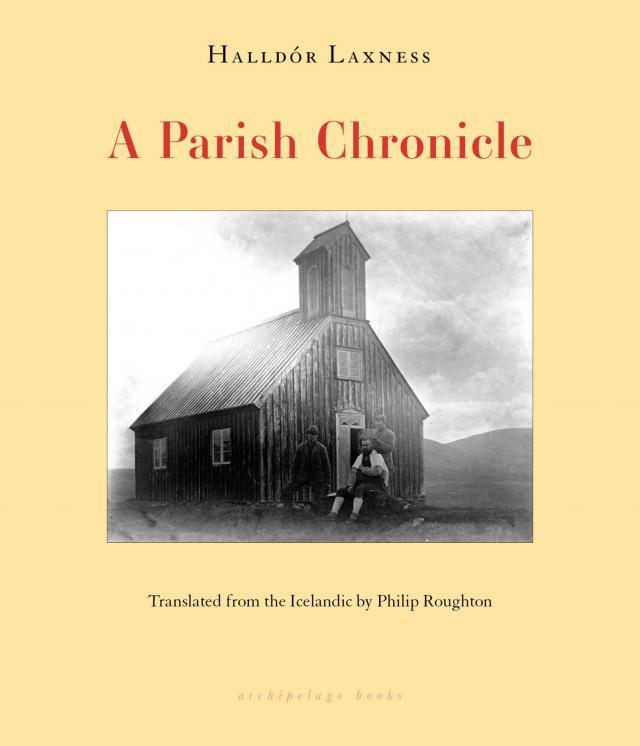
A parish chronicle, p.1
A Parish Chronicle, page 1


Copyright © The Estate of Halldór Laxness
Translation copyright © Philip Roughton, 2026
Published by agreement with Licht & Burr Literary Agency, Denmark on behalf of Forlagid, Iceland.
First published as Innansveitarkronika, 1970
Introduction copyright © Salvatore Scibona, 2026
First Archipelago Books Edition, 2026
All rights reserved. No part of this book may be reproduced or transmitted in any form without the prior written permission of the publisher.
Library of Congress Cataloging-in-Publication Data available upon request.
ISBN 9781962770514
Ebook ISBN 9781962770521
Archipelago Books, 232 3rd Street #A111, Brooklyn, NY 11215
www.archipelagobooks.org
Cover photograph: Walter H. Trevelyan
The authorized representative in the EU for product safety and compliance is eucomply OÜ, Pärnu mnt 139b-14, 11317 Tallinn, Estonia, hello@eucompliancepartner.com, +33 757690241
This work is made possible by the New York State Council on the Arts with the support of the Office of the Governor and the New York State Legislature.
Funding for the publication of this book was provided by a grant from the Carl Lesnor Family Foundation. This publication was made possible with support from the Hawthornden Foundation, the Nimick Forbesway Foundation, and the New York City Department of Cultural Affairs.
This book has been translated with financial support from
a_prh_7.4_155004445_c0_r0
Introduction
1 Egill Skallagrímsson’s Head
2 Ugly Land, Evolution Unknown
3 Not Even a Poor Little Angel; Traffic Begins
4 The Soul and the Sickbed
5 Difficulty Unknown
6 The Authorities Waken
7 The Start of the Church War
8 A Theological Excursion
9 News from the Front. Mustering of Troops
10 Appraisal of the Church. Petition
11 The Story of the Precious Bread
12 Mosfell Church Receives an Inheritance
13 Two Names
14 No Bell Found
15 A Trifle
16 The Episode of the Transport Man Begins
17 Raising Shark
18 Houseguest at Hrísbrú
19 The New Fróðá Marvels
20 On Mound Robbery
21 Of Gold and Hot Water
22 Mosfell Church Redescends
23 Epilogue
Endnotes
Introduction
Einginn fær mig ofan í jörð
áður en ég er dauður.
(No one puts me in the ground before I’m dead.)
—Þorsteinn Erlingsson
In October 1969, Halldór Laxness was in Rome doing what came naturally to him whenever he could get to his favorite city: shopping for women’s shoes. A clotheshorse even in his hard-up and ardently communist early days, he was at sixty-seven flush, and could now buy what he liked. But the state of European fashion depressed him. Nothing suited his taste. Certainly not the shoes, which he found “deliberately ugly.”[*1]
About the fate of his work he had lately been in outright despair. At twenty-nine he had promised in a letter, “I shall become a great writer in the eyes of the world or die!”[*2] But in a recent essay he claimed never to have had any real success in his home country, where he believed he was “now rightly forgotten by those few friends who once hoped that I would achieve such a thing.”[*3] More than once he had sworn off writing novels for good.
If he hadn’t had such grandiose ambition, would he have been so prone to grandiose disappointment? Or so immune to evidence that in the eyes of the world he had done fairly well? After all, he had won the Nobel Prize fourteen years before and was probably the most famous Icelander since Snorri Sturluson, the thirteenth-century historian and poet and one of the few medieval Icelandic writers whose names we know. By anyone else’s estimation, Laxness’s books had sold robustly in Iceland for years.
Nonetheless, it was true that the international readership Laxness had once craved hadn’t quite come to him. In the United States, for example, nearly all his dozens of books were out of print or had never been translated. The ego that had made it possible for him to write and publish his first novel at seventeen was the same undying tormentor that made it excruciating to accept anything from the world short of continuous acclaim.
By the time he arrived in Rome that October, fresh off a publicity junket in Denmark, he had lived about twenty years longer than his father had. He might reasonably have assumed he was nearing the end of his productive life. He didn’t know that he still had six more books to go, or that the many readers he had once hoped for would begin to find his work, especially in the English-speaking world, only after he would die twenty-eight years later in an Icelandic nursing home in 1998.
Since then, the new American edition of his masterpiece Independent People has gone into forty-four printings. Through reissues and new translations by Philip Roughton of major novels including Iceland’s Bell (2003), Wayward Heroes (2016), and Salka Valka (2022), the big, ambitious, often political or historical, but always wickedly funny novels of Laxness’s mid-career have become available to English-language readers. For us, it’s as though this man has been publishing new work for ninety years, since Salka Valka was first translated from its Danish version and published in London in 1936.
The shoes were for his wife and daughters back home in Iceland. (He often stocked their wardrobes when he traveled.) His shopping companion was Fru Dinesen, an intrepid spirit right out of the sagas, who had left the Danish farm where she was raised; gone to England to work as a housekeeper; moved to Italy; married an Italian who couldn’t support her; been widowed at forty-four; and by a bewildering mixture of nerve and luck (and despite the interference of two world wars) gone on to make herself a prominent Italian hotel proprietor, all while raising six children and publishing four memoirs.[*4] Five years earlier, the king of Denmark had knighted her. Laxness had been visiting her hotels in Rome since the thirties. She was ninety-seven years old.
One wonders if Laxness considered at least her a success, or any of the dozens of brilliantly drawn Icelanders in his novels who are born with nothing and die with less but in the meantime live with the self-possession and spiritual vision of saga heroes or saints.
In any case, the other thing that came naturally to Laxness in Rome was to write a novel, which he could do there in sundrenched rooms with the windows open. He evidently could not help but write there. His biographer, Halldór Guðmundsson, states that Rome always worked on him like a drug. The torture of his egoism about writing seems to have made the act of writing all the more necessary; it freed him from himself. When a novel got going, Laxness once wrote his second wife, it “lives in me like a separate world.”[*5]
The world that came alive in him that October was A Parish Chronicle, a short novel he had drafted six years before and set aside. It begins around the tenth century and sprints like a racehorse with light-footed gusto into what was the present day, all while maintaining the canny facade that it is nothing more than a vignette of sleepy parochial history, a sketch on the back of a brochure. Perhaps inspired by Dinesen’s age and resilience or by the ancient city around him, it’s imbued throughout with admiration for what is very old, spiked everywhere with skeptical humor that somehow doesn’t diminish that admiration.
* * *
—
Even in the nineteenth century, when Iceland was the poorest country in Europe, everyone there could read. The relationship between Icelanders and their literature and language can seem to foreigners a little insane. “This may seem strange,” one Icelander told an American television reporter in the 1980s, “but the Icelandic language is the very reason why we are staying here.”[*6] Contrary to Laxness’s doomy feelings about his impact on his countrymen, the week he died, an appreciation of his work in the country’s leading newspaper concluded, “The day Icelanders forget the writing genius of Halldór Kiljan Laxness, they will no longer fulfill their role as a nation.”[*7]
Icelanders speak one of the world’s oldest languages in continuous use and elect representatives to a parliament that has a claim to being the world’s oldest surviving legislative body. But geologically the country could hardly be younger, being entirely volcanic. Don’t bother looking for fossils; almost no sedimentary rock has had time to form. The sagas of Icelanders—plotty, laconic, often heart-rending—constitute one of the oldest literatures in any language still commonly spoken. Laxness was the heir not only to the language and setting of the sagas but to their humanity, their outrageous understatement and charm. Nonetheless, reading his novels even decades after his death, they land on the mind with the shock of the new. Readers who think they know the limits of Laxnessian style or what he seemed to believe will keep being surprised.
Throughout his career Laxness changed his mind about nearly everything that mattered to him. Politics, religion, love, prose style. He seemed to thrive on the meat of his own sacred cows. While he was working on A Parish Chronicle, he wrote to a Swedish scholar, “I have had a little novel in the works since the autumn, driven on by the same need for renewal that has always plagued me.”[*8]
A Parish Chronicle would be published in the original Icelandic in 1970. It is presented here in English for the first time. It represents yet another radical shift, in narrative perspective and ideals, for a man who never came close to writing the same book twice. It is his only novel in which he himself appears,[*9] all but invisibly, like a sprite.
Crammed with humor and pathos, it tells the story of a church bell as much as of a parish and a nation. Centuries ago in Mosfellsdalur Valley, near the farm called Laxnes (where the writer born Halldór Guðjónsson grew up and from which he later took his name), a little church is ordered demolished by the Danish crown in order to consolidate the parish with another nearby. More than a century passes before the authorities arrange to carry out the decree. But a few of the locals will have none of it.
Their cunning, and their persistence in holding onto what remains of their patrimony after the church is leveled, may go a little way toward explaining to foreigners how Icelanders have managed to survive in such a treeless, wind-scoured, famine-prone place for more than a millennium, or how they have maintained a language mostly unchanged since the time of the Viking raiders who first settled there.
The reader may wonder how much of this book is true, in the most secular and least inspired sense of the word. In fact many of the characters—even Big Gunna, one of the great larger-than-life paupers of Laxness’s oeuvre—did live in Mosfellsdalur and went by the names Laxness gives them in the book.[10*] Nevertheless, the first Icelandic edition included the prefatory note, “References to named individuals writings documents places times and events do not serve a historical purpose in this text.” He plainly didn’t let the historical record impede invention.
* * *
—
Laxness was a writer and a person of unembarrassed self-contradictions, a patriot given to blistering criticism of his countrymen; a doting father who in his twenties got a farm servant pregnant and seldom had anything to do with the daughter who came of it; a loyal friend who published a fawning defense of the Soviet state even after he had watched the secret police abduct one of his comrades from her Moscow apartment in the dead of night and take away her infant daughter during the Great Terror. We know this because he wrote about it, after he changed his mind about Stalin too.
If Laxness often wrote about what was wicked, ugly, even horrifying, he did so out of a habit of finding beauty in little else. As he said of one of his protagonists, his “cause was evil from almost every point of view except his heroism.”[*11] The challenge that some readers confront when starting his bigger books—on which A Parish Chronicle may work for future English-language readers as an urgent inducement to get moving—is sometimes whether they want to endure so much hardship and cruelty on nearly every page. But his heart never leaves these people, and the experience of reading him is of a singular, wry, unstinting sympathy especially for characters at their most blockheaded or deranged.
This contrast opens the territory for the kind of humor and pity he is so good at. “I don’t think a person needs to be eating all the time…It’s a bad habit,” says Gunna, who has just nearly died of exposure and has not eaten in three days.
A Parish Chronicle is a late vein of Laxnessism, as free of his previous ideological entanglements as he could make it. Around the time it was published, when a television interviewer asked if he had betrayed his youthful ideals, he answered, “I hope so.” Here, he’s as humane as ever, as interested in human folly, but now much less interested in correcting it. It is the work of a writer with nothing to prove, only to tell. It looks from the outside like a modest book. It turns out to be a major book in the grandness of its modesty.
Salvatore Scibona
New York City, 2025
Skip Notes
*1 Halldór Guðmundsson, The Islander: A Biography of Halldór Laxness, trans. Philip Roughton (London: MacLehose Press, 2008), 427.
*2 Ibid., 174.
*3 Ibid., 426.
*4 Gejl, Ib: Marie Dinesen i Dansk Kvindebiografisk Leksikon på lex.dk.
*5 Guðmundsson, The Islander, 373.
*6 NBC News, Today Show, aired 1986.
*7 “Sá sem lifir ekki í skáldskap lifir ekki af hér á jörðinni,” [“He who does not live in fiction will not survive here on Earth], Morgunblaðið, February 10, 1998, 33.
*8 Guðmundsson, The Islander, 441.
*9 Ibid., 443.
*10 Innansveitarkrónika “Sögupersónur,” https://innansveitarkronika.is/sogupersonur.
*11 “Sá sem lifir ekki í skáldskap,” 33.
1
Egill Skallagrímsson’s Head
After Iceland’s national hero and chief poet Egill Skallagrímsson had been resting comfortably in his grave mound for some time near what is now the main road through Mosfellsdalur Valley, in an area called Tjaldanes because travelers camp there, Christianity came to the country.[1] At that place, two rivers converge and run as one between high banks out of the valley. The poet’s bones were then exhumed and brought from the mound to a church, even though he had been a heathen.
A church had originally been built at the foot of Mosfell Peak at the place later called Hrísbrú, where it stood until a landslide fell onto the homefield there in the 12th century. After that, it was moved to a hill a bit farther to the east, now part of the Mosfell churchstead. Hrísbrú itself was a croft of Mosfell, on Mosfellstún west of the landslide.
When the church was moved, so written sources say, human bones were found under the altarplace of the old Hrísbrú Church; they were much larger than other people’s bones, and the residents of Mosfellsdalur moved them to Mosfell along with the church. Elderly folk believed them to be the bones of Egill Skallagrímsson.
An anecdote in the medieval Egill’s Saga testifies to the robustness of those bones: the priest who was in charge of their above-mentioned exhumation in the 12th century, Skafti Þórarinsson, picked up the skull and placed it on the churchyard wall; the skull was extraordinarily large. Yet what was even more surprising was its great weight; it was ridged all over like a scallop shell. Wanting to test the skull’s thickness, Skafti took a heavy hand-ax and struck the skull as hard as he could with its hammer end, trying to break it, but the skull only turned white where he hit it, and neither dented nor cracked, says the saga verbatim. Egill’s bones were buried at the edge of the churchyard at Mosfell, and no one has seen them since; foresighted people have said that they will only be found again on Iðavöllur.[2]
If you look at Mosfell now, you would think that the church had been there on the hill, its steeple silhouetted against the clouds, since ancient times. This, however, is not the case. Again and again this church disappeared from the hill. Over and over, it was thoroughly erased from the pages of history and omitted from the laws of God and man, failed to appear in written documents, was neglected in oral tradition. If any church has ever been able to cry out, justifiably, “My God, why have you forsaken me?” it is Mosfell Church.
When a church was rebuilt at Mosfell in these our own times, only around eighty years had passed since the last church disappeared from the hill; perhaps someone who had been baptized in the old church in 1888 was still living, although no one came forward to say so. The first time the church disappeared from the hill, two hundred and fifty years passed before the good word was heard there again. In the 13th century, the church still stood unchanged in its place, says Egill’s Saga, but more than a hundred years later, it is no longer mentioned in church inventories. In the Vilkin Inventory, from the latter part of the 14th century, this church no longer exists. Not very long afterward, Mosfell ceased to belong to the church, but the farm is listed in a register of the landed property of a rich lady in the west, Ólöf Björnsdóttir.