

Again dangerous visions, p.1
Again, Dangerous Visions, page 1


Subscribe to our newsletter for title recommendations, giveaways,
and discounts reserved only for subscribers.
Join here.
Praise for Again, Dangerous Visions
“In his stories of fantasy and horror, [Ellison] strikes closest to all those things that horrify and amuse us (sometimes both at the same time) in our present lives.”
—Stephen King
“He doesn’t write like anybody else. What emerges is a surprising, eclectic, almost protean series of visions, often disturbing, always strongly felt.”
—Michael Crichton
“Harlan was not just a great fantasist and/or science fiction writer; he was a great writer, period. When he was at the top of his form, from the late 60s through the 70s and well into the 80s, there was no finer short-story writer in all of English literature.”
—George R. R. Martin
“The words—there is an attention to the words. There is an attention to the sound of the words. You’re reading them in your head, and they sing.”
—Neil Gaiman
“Harlan Ellison—terrific prose, razor-sharp intellect, pulp gut punches and invention when needed, terse poetics…An original.”
—Guillermo del Toro
“Saul Bellow, Philip Roth, Norman Mailer, stand aside. Harlan Ellison is now a better short-story writer than you will ever be again during the rest of your lives.”
—Ray Bradbury
“Feisty, furious, yet extraordinarily kind and generous; Harlan Ellison was one of a kind.”
—Leonard Maltin
“You should buy this book immediately, because this is a book that knows perfectly that you are seething inside.”
—Algis Budrys, winner of the Pilgrim Award for Lifetime Achievement in Speculative Fiction
“Categories are too small—even the catch-all category of science fiction—to describe Harlan Ellison. Lyric poet, satirist, explorer of odd psychological corners, moralist, one-line comedian, purveyor of pure horror and of black comedy; he is all these and more.”
—Washington Post
“A furiously prolific and cantankerous writer [who] looked at storytelling as a ‘holy chore,’ which he pursued zealously for more than sixty years. His output includes more than 1,700 short stories and articles, at least 100 books, and dozens of screenplays and television scripts…ranked with eminent science fiction writers like Ray Bradbury and Isaac Asimov.”
—New York Times
“Ellison brought a literary sensibility to sci-fi at a time when the entire establishment was allergic to any notion of art. To say he was one-of-a-kind would be trite, and he would likely hate that. What he was, was a legend.”
—NPR
“There’s a real power to the way he uses the language and how he draws pictures in your mind.”
—Ron Moore
“You see Ellison’s unswerving social conscience throughout his fiction and critical essays…forcefully and eloquently—and at some length—lamenting the failure of the Equal Rights Amendment and railing against the scourge of misogynistic ‘knife-kill’ films.”
—RogerEbert.com
“The spellbinding quality of a great nonstop talker, with a cultural warehouse for a mind.”
—New York Review of Books
“An original and valuable writer…A twentieth-century Lewis Carroll.”
—Los Angeles Times
“The incredible Harlan Ellison writes as if an inner fuse is about to blow before he can get all the words on his pages.”
—Anne McCaffrey
The Dangerous Visions
Complete Collection
Dangerous Visions
Again, Dangerous Visions
The Last Dangerous Visions
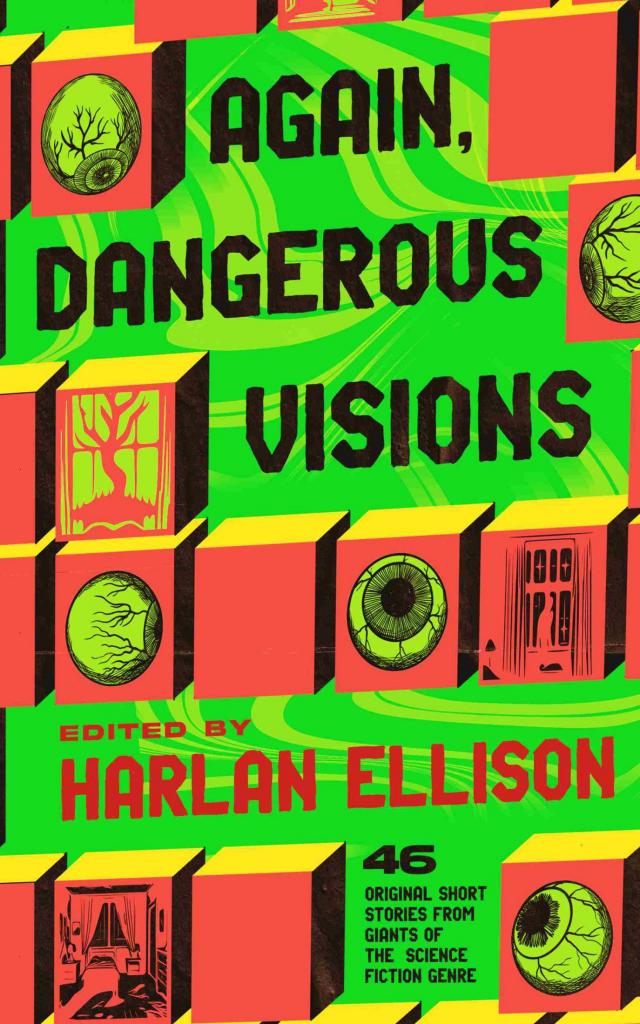
AGAIN, DANGEROUS VISIONS
EDITED BY
HARLAN ELLISON
Again, Dangerous Visions® edited by Harlan Ellison®
Published by arrangement with the Harlan and Susan Ellison Foundation.
Copyright © 1972 by Harlan Ellison. Copyright © renewed 2000 by the Kilimanjaro Corporation.
“Harlan Ellison, the WGA, and Me” © by David A. Goodman. All rights reserved.
E-book published in 2024 by Blackstone Publishing
Cover design by Sarah Riedlinger
All rights reserved. This book or any portion
thereof may not be reproduced or used in any manner
whatsoever without the express written permission
of the publisher except for the use of brief quotations
in a book review.
The characters and events in this book are fictitious.
Any similarity to real persons, living or dead, is coincidental
and not intended by the author.
The stories contained in this book are presented as they were originally written.
Trade ISBN 979-8-212-18373-4
Library ISBN 979-8-212-18372-7
Fiction / Anthologies (multiple authors)
Blackstone Publishing
31 Mistletoe Rd.
Ashland, OR 97520
www.BlackstonePublishing.com
For Brian & Lauraine Kirby
. . . and baby makes three.
“Harlan Ellison,
the WGA, and Me”
By David A. Goodman
I’m a writer, mostly a television writer, who served on the Writers Guild of America West’s Board of Directors for seventeen years, four of them as president, and I say with confidence everything I know about the WGA I first learned from Harlan Ellison.
I know that I’m not the only writer who had the experience of an unofficial Ellison mentorship in the business of television writing. Raised by a working single mother—a social worker—in a suburb of New York City, I grew up nowhere near show business. I was only aware “television writer” was a profession because of my exposure to the unique triumphs and frustrations that Ellison wrote about this line
of work.
I was a Star Trek fan—a rabid one—and I was obsessed and confused by the important dichotomy Ellison represented in relation to that series: (1) he wrote one of the most famous episodes of the original series, maybe the best one, “The City on the Edge of Forever,” and (2) he hated how the episode came out.
At twelve, I didn’t understand this at all. The idea that a writer wouldn’t be happy to have his name on an episode of my favorite television show was something I couldn’t fathom.
So I set out to try to understand it. I ordered a copy of the original script, in 1975 newly available in the science fiction anthology Six Science Fiction Plays, edited by Roger Elwood. This was not only the first teleplay I ever read, it was also the first screenplay. Though reading it didn’t help me understand Ellison’s difficulty with the final product (at twelve I couldn’t appreciate the subtlety of the original draft) I still learned a lot from this book.
First, in the anthology, Ellison wrote an introduction that set out the layman script terminology; it was here I first discovered what a scriptwriter meant by “POV,” “O.S.,” and “ESTABLISHING SHOT.”
He also mentioned that the original version of the script won an award from something called “The Writers Guild.” As someone who was beginning to dream of being a writer, belonging to an organization of writers sounded exciting.
But most importantly, Ellison wrote, as he did in many places, how disrespected the writer was in Hollywood, how many people take credit for the show, but without the writer if you turned on the television you’d have a test pattern or, at best, “recorded organ music.” This was the first time I was introduced not just to the craft of television writing, but its often unacknowledged primacy to the medium.
Over the years, there was always plenty to read about Ellison’s work in television, either through interviews or his own writings. I learned that some writers were so upset with how their work was changed, they employed a WGA–approved pseudonym. (I heard about this at fourteen and, with slightly more maturity, could better understand why he’d take his name off an episode of the television version of Logan’s Run.)
He also shared stories about the disrespect writers got from studio and network executives. My favorite anecdote, though I can’t remember the source: an ABC exec told Ellison to make a change in a script, and Ellison resisted. The exec said, “You’re only the writer, do it,” to which Ellison responded by throwing a chair through the twelfth-floor window. Ellison was quoted as saying, “A good punch in the mouth goes a long way in settling an argument.” For a while I thought all this was the norm, that if I became a writer, I was probably going to get into a lot of fist fights, which worried but didn’t deter me.
Aside from the apparent need for the occasional brawl, I came to understand through Ellison the monetary value of creativity. I was just out of college when I heard about his threatened lawsuit that got him paid and an acknowledgment in the credits of The Terminator. My takeaway was a simple truth that somehow I’d never realized: ideas are worth money. Shortly thereafter I began to work in Hollywood and saw how so many in this town willfully forget that ideas don’t just belong to everybody; they’re created by someone. But the companies would rather try to get them for free, and some writers don’t want to make trouble and fight for their due.
Ellison railed against this attitude, and when I became a member of the WGA in 1988, I immed iately became aware of his prominence in the union. He was a passionate defender of writers’ rights, always showing up for the battles the union fought. Long time union leader (and writer of Jaws) Carl Gottlieb told me that Ellison “never opted for tact when he felt an uncomfortable truth had to be confronted.” And he didn’t reserve his anger for the companies who expect writers to work for nothing; he also lamented writers who don’t demand what they’re owed.
At the beginning of 1988, a writers struggle was looming, but a group inside the WGA, calling themselves the “Union Blues,” took the position that the union should never strike. Ellison, recognizing that a strike (or the real threat of one), was a union’s greatest leverage, wouldn’t stand for this. At a general membership meeting at the Hollywood Palladium, Ellison confronted the leader of this splinter group, who, despite his larger size found himself being challenged to a fight. They came to blows and had to be separated. I heard this and started pricing boxing lessons.
His passion for labor issues came from his knowledge that the union was a collection of writers, and as such he felt duty bound to hold it to his own high standard. As recently as 2009, Ellison sued Paramount for merchandising royalties on his Star Trek episode and, at the same time, sued the WGA because he felt the union hadn’t done its job to fight for those royalties. Regarding the lawsuit, Ellison was quoted as saying: “It ain’t about the ‘principle,’ friend, it’s about the money! Pay me!” (Although, in the case of the WGA lawsuit, it was about the principle, as that suit was for one dollar.)
I look back on all this and see that I owe so much to this man I never met. I learned how important the Guild was, and the need to fight when necessary; though I never had to take the boxing lessons, I have taken on a lot of battles to get writers not just money, but respect.
And, as it turns out, I finally did come to understand his frustration with “The City on the Edge of Forever,” because I also have my name on an episode of Star Trek that was heavily rewritten and that I think is garbage.
1969 Introduction
By Harlan Ellison
In November 1967, the introductory lines I’d written for Dangerous Visions in the January of that year began to be read throughout the science fictional world. Sitting in Terry Carr’s apartment in Brooklyn Heights that January, backed against the wall with the final deadline for copy, I began my general introduction to the book it had taken me two years to construct:
“What you hold in your hands is more than a book. If we are lucky, it is a revolution.”
Now it is a year and a half later. As of 12 March 1969 Dangerous Visions has sold over sixty thousand copies in combined trade edition and book club release. It has won for its various authors a fistful of Nebula and Hugo Awards, and even a special citation from the 26th World Science Fiction Convention. (That citation, incidentally, reads as follows: “To Harlan Ellison, Editor of Dangerous Visions, the Most Significant and Controversial SF Book Published in 1967.”)
Now how about that, dreamers of the dream? Maybe there is a God after all. These thirty-five writers and artists and editors set out to put together the most significant and controversial book of the year, and by dingies, they seemed to have done it.
On the other hand, if Dangerous Visions was such a breakthrough, why are there so many people who denigrate it? Why did librarians throughout the country refuse to stock it on their shelves? Why did the ex-editor of the SF Book Club get thousands of returned copies, with incensed letters from mommies, scoutmasters, teachers, and clergy demanding to know why their kid’s precious bodily fluids had been polluted with this cesspool volume? Why has there sprung up a counterrevolutionary movement in the genre backed by something named John Jeremy Pierce, dedicated to pursuing a “holy war,” the goal of which is eradicating Dangerous Visions and books like it? Why, at symposiums from Berkeley to the Bronx, have critics railed and cursed this book? Why did one esteemed critic take it upon herself to name Dangerous Visions the bible of something she calls “The New Wave,” and then spend pages informing her readers how detestable it was?
And on the other hand, (this being the world of science fiction, we can have as many appendages as we choose) why did one newspaper reviewer say, “Dangerous Visions is one of the best anthologies in the genre to be published in the last decade. And I rather imagine that it will stand unchallenged for a good long while.”? Why does almost every author who appeared in the book speak with pride of his contribution to the project? Why did your humble editor receive over three thousand letters about the book, ranging from this one, from a Mrs. S. Blittmon of Philadelphia:
Dear Mr. Ellison,
When I picked up your book Dangerous Visions at the library & read the 2 introductions, I thought it was going to be great. I cannot tell you how sick I feel after reading (and she named two stories). You say you had a Jewish grandmother (so did I) but I think not; she must have been Viet Cong, otherwise how could you think of such atrocities. Shame, shame on you! Science fiction should be beautiful. With your mind (?) you should be cleaning latrines & that’s too nice. Sincerely . . .
to this one, from Monte Davis of New York City:
Dear Mr. Ellison:
Hoo-boy!!! And lots of similar exclamations which I will leave to your (doubtless fecund) imagination, all of which are intended to convey the idea that Dangerous Visions is one hell of a book. Leaving aside for the moment that ugly idea about the “new thing,” your green-jacketed beast is simply the most wildly entertaining thing I have encountered in many months. To one (like me) starved by the paucity of any sort of literary or intellectual freshness in the magazines, and the painfully small supply of readable new books, it came as a complete and total mind-fucker . . .
It went on and on like that, and now, a year and a half later, it still hasn’t stopped. Entire issues of fan magazines have been devoted to this book; professional editors have literally gotten into feuds with their contributors over stories too Dangerous Visions–like; entire careers of Big Name Writers have been altered by their work in the book; careers have been resuscitated and in one instance a career was throttled in its crib. But the changes in the science fiction field that seem to have stemmed from the publication of Dangerous Visions are even more striking.
The book opened the door with its popularity and controversy for a spate of “original” anthologies, intended to circumvent the narrow thinking of much magazine science fiction editing. While Damon Knight’s Orbit series began before Dangerous Visions was released, I do not think Damon will pillory me for stealing thunder when I opine that Dangerous Visions has made the market for his series larger, unlocked the thinking of many writers, and in many ways battered down the barricades for more unfettered writing, much of which he is now publishing in his anthologies. Harry Harrison’s new Nova collection of originals follows the pattern set by Dangerous Visions. Joe Elder’s The Farthest Reaches and Anne McCaffrey’s Alchemy and Academe are two more “original” collections that might well have foundered had it not been for Dangerous Visions.
The advance monies writers now get, as a result of the trailblazing chunk grabbed-off by Dangerous Visions in both hardcover and paperback editions, has doubled and tripled.
But most important, we have damned well gotten that revolution. If you doubt it, just say “new wave” to Sam Moskowitz. If you doubt it, just suggest to Fred Pohl that he publish an all–New Wave issue of Galaxy. And sit in on the panel discussions at a science fiction convention: there are still the worthwhile and interesting discussions of “the red shift as source material for astronomical sf stories,” but now—in addition—you hear learned treatises on Science Fiction as the Literature of Evolution, How To Write the Kinetic Mixed-Media SF Novel, Parallels of Symbolism in James Joyce and Philip José Farmer, Taboos in Magazine-published Science Fiction. Everyone is talking all at once, and the dialogue has made this the most exciting period in the history of science fiction. The critics and the academicians have found that this lowly “fiction of the people” has some legitimate aspirations to greatness, that the men who have devoted their lives to this kind of writing are in most ways equal to the turks lauded on the NY Times bestseller list.


